This site is supported by our readers. We may earn a commission, at no cost to you, if you purchase through links.

A ball python sitting still in the corner of its enclosure isn’t always resting—it might be telling you something’s wrong.
These snakes can’t generate their own body heat, so the temperature inside their tank isn’t just a comfort preference; it controls digestion, immune function, and metabolism.
Get it wrong, and you’ll see a snake that refuses food, struggles to shed, or develops respiratory infections before you realize the numbers were off.
Knowing how to check ball python tank temperature accurately—not just glancing at a cheap dial gauge—is the difference between a thriving animal and a sick one.
Table Of Contents
- Key Takeaways
- Step-by-Step Guide to Checking Tank Temperature
- Ideal Temperature Ranges for Ball Pythons
- Choosing The Right Thermometers
- Managing Temperature Gradients in The Enclosure
- Troubleshooting Inaccurate Temperature Readings
- Top 5 Products for Monitoring and Controlling Temperature
- Frequently Asked Questions (FAQs)
- Conclusion
Key Takeaways
- A ball python can’t regulate its own body heat, so getting the temperature gradient right—88–92°F on the warm side, 75–80°F on the cool side—directly controls digestion, immunity, and metabolism.
- Digital thermometers with probes placed at snake level give you readings within 1–2°F accuracy, while analog dials can drift up to 15°F off and silently put your snake at risk.
- Three placement zones matter: a warm hide probe above the substrate, a cool side probe at the opposite end, and a third tucked inside the hide—all at body height, never high on the glass.
- Monthly calibration checks, yearly battery replacements, and a backup thermometer aren’t optional extras—they’re what keeps a faulty reading from turning into a sick snake.
Step-by-Step Guide to Checking Tank Temperature
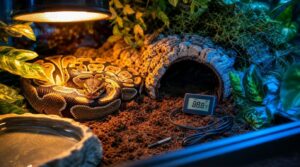
Checking ball python’s tank temperature doesn’t have to be complicated, but doing it right takes a little preparation.
A solid ball python temperature and humidity guide can save you from guesswork and keep your snake comfortable year-round.
Before you start reading temps, you need the right tools in the right spots. Here’s exactly how to set yourself up for accurate, consistent readings every time.
Preparing Your Tools
Getting your tools ready before you touch the enclosure saves time and prevents bad readings. Grab your digital thermometer, infrared temp gun, and thermostat probe — then run through this quick prep:
- Calibration Procedure – Set emissivity settings to 0.95 and verify against a known reference point.
- Battery Management – Install fresh alkaline AAA batteries for stable enclosure temperature accuracy.
- Probe Sterilization – Wipe probes with 3% hydrogen peroxide, then air-dry 60 seconds before mounting.
temperature gradients are essential for maintaining proper reptile health.
Locating Thermometer Placement Zones
Once your tools are prepped, placement is everything. Put your warm side probe at snake level above the substrate — not high on the glass. Drop a cool side probe on the opposite end to confirm your temperature gradient is real.
Tuck a third inside the hide interior. Keep every probe at body height to avoid a false reading that throws off your whole enclosure temperature picture.
For low enclosures, use ground probe placement on the floor beneath the heat source to guarantee an accurate gradient.
Ideal Temperature Ranges for Ball Pythons
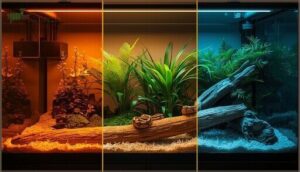
Getting the temperature right isn’t just about comfort — it’s what keeps your ball python healthy, active, and eating well.
Getting the temperature right keeps your ball python healthy, active, and eating well
Think of the tank as having three key zones, each with its own target range. Here’s what each one should look like.
Basking Spot Requirements
Your ball python’s basking spot needs to hit between 88–92°F at the surface. That narrow range isn’t arbitrary—it drives digestion and immune function.
- Use halogen bulbs positioned 8–10 inches above a flat flagstone.
- Place a thermostat probe at snake level, not on the heat source.
- Verify surface temps daily with an infrared temperature gun.
Never let it exceed 95°F.
Cool Side Temperature Guidelines
Once the cool side is dialed in, the cool side becomes your next priority. Keep it between 75–80°F — around 78°F is a reliable sweet spot for ball python care.
This gradient ratio gives your snake real control over its body temperature. Cool hide placement matters too: position it away from heat sources so enclosure management stays balanced and your temperature gradient actually works.
Nighttime Temperature Minimums
At night, your temperature gradient flattens — and that’s completely normal. Keep the cool side no lower than 70°F, with 75–78°F being ideal.
Just like with temperature, snake shedding humidity and environment tips can help you dial in the full nighttime setup so your ball python stays comfortable and stress-free.
Use ceramic heat emitters or a heat mat connected to a thermostat to hold those safety thresholds without adding light. Adjust thermostat setpoints based on your temperature log practices, and you’ll maintain solid temperature control through every overnight drop.
Choosing The Right Thermometers
The thermometer you choose makes a bigger difference than most people expect.
Not all options read temperatures the same way, and placing them wrong can throw off your whole setup. Here’s what you need to know to pick the right one and use it correctly.
Digital Vs. Analog Thermometers
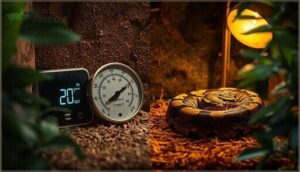
Choosing between a digital thermometer and an analog thermometer isn’t just a budget call — it directly affects your accuracy differences in ball python care. Digital units stay within 1–2°F, while analog models can drift 5–7°F off.
Digital thermometers also win on response time, calibration methods, and cost durability over time. For reliable temperature control, digital is the clear choice.
Placement for Accurate Readings
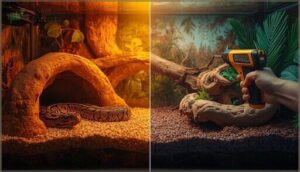
where you place your thermometer matters just as much as which one you use.
Set your warm hide probe at substrate level, where your snake actually rests. Position a cool side sensor in the shaded retreat zone.
Use an infrared basking surface meter on the exact basking spot. Secure every sensor so it doesn’t shift and skew your temperature gradient readings.
Avoiding Common Thermometer Mistakes

Even small thermometer mistakes quietly wreck your temperature gradient. Here’s what to watch for in your ball python care routine:
- Budget Thermometer Risks — Analog dials can read 10–15°F off, putting your basking zone dangerously out of range.
- Battery Care — Weak batteries cause 4–8°F under-readings; replace them yearly.
- Probe Integrity & Placement Interference — Frayed wires or a snake resting on the probe spikes false readings by up to 20°F. Secure probes away from direct contact. Run calibration techniques using an ice bath to confirm your thermostat and thermometer stay accurate.
Managing Temperature Gradients in The Enclosure
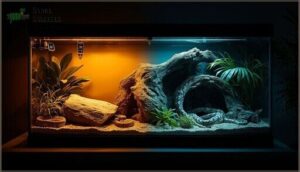
Getting the temperature gradient right inside your ball python’s enclosure isn’t as complicated as it sounds.
You just need to know where to place your heat sources, how to track each zone, and when to make small adjustments.
Here’s how to manage all three.
Creating a Warm and Cool Side
Think of your enclosure as two distinct neighborhoods. Your warm side needs basking surface materials like flagstone or slate under heat lamp positioning at 10–14 inches, hitting 88–92°F. Use a thermostat to lock that in.
Your cool side relies on ambient room cooling and substrate insulation to stay at 76–80°F — no extra heat sources needed there.
Monitoring Multiple Zones
One enclosure, three zones to watch — basking spot, mid-range, and cool side.
Use an infrared thermometer for quick infrared spot checks and digital probes for continuous hide temperature logging. Run a probe calibration routine weekly to keep readings trustworthy.
Thermostats with zone alerts flag sudden drops before they stress your snake, giving you real-time temperature control across the full temperature gradient.
Adjusting Heat Sources for Balance
Once your zones are mapped, balancing heat sources comes down to three levers: wattage selection, fixture distance, and thermostat settings.
Drop your ceramic emitter 1–2 inches closer to raise the basking spot 3–7°F, or pull it back to cool things down.
A dimming thermostat manages seasonal ambient room influence automatically, keeping your temperature gradient stable without swapping bulbs.
Heat-mat placement on one-third of the floor locks in the cool side.
Troubleshooting Inaccurate Temperature Readings

Even when setup looks right, the numbers on your thermometer don’t always tell the truth.
Faulty equipment, a misread thermostat, or an aging sensor can throw your readings off without any obvious warning signs.
Here’s how to spot the problem and fix it before your ball python pays the price.
Identifying Faulty Equipment
Faulty heating equipment is often the hidden culprit behind confusing temperature readings. Before blaming your thermostat, inspect each component carefully:
- Heat mat failure: uneven hot spots or dropping surface temps signal a worn-out mat
- Sticky gauge issues: adhesive strips read 20–25°F lower than actual substrate temps
- Infrared gun drift: cheap models drift 5–10°F in humid enclosures
- Lamp filament deterioration: dimming bulbs or blackened glass mean reduced heat output
- Thermometer accuracy: run an ice bath test — accurate probes read within 0.5°F of 32°F
Addressing Thermostat Issues
Once faulty equipment is ruled out, thermostats deserve a closer look.
Probe placement errors are the most common culprit — if your probe hangs in the air instead of touching the heated surface, your temperature control is working off bad data.
Mode selection problems matter too; pairing a dimming thermostat with a heat mat instead of a ceramic emitter causes erratic regulation.
Always verify your thermostat’s power rating matches your heater’s wattage.
When to Replace or Recalibrate Devices
Even after fixing thermostat placement, your thermometer itself may be the problem.
Probes in warm, humid environments degrade within 6–12 months, showing drift of 2–4°F.
If your infrared gun and probe disagree by more than 2°F consistently, replace the probe — don’t recalibrate your way around a dying sensor.
Monthly calibration checks and a backup device policy protect your temperature gradient year‑round.
Top 5 Products for Monitoring and Controlling Temperature
Getting the right gear makes all the difference regarding keeping your ball python’s environment stable and safe.
The products below cover everything from heat output to humidity tracking, so you’re not left guessing.
Here are five solid options worth having in your setup.
1. Arcadia 80W Deep Heat Emitter
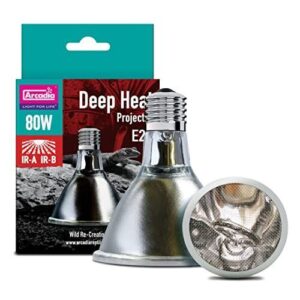
The Arcadia 80W Deep Heat Emitter is one of the smartest heating choices you can make for a ball python enclosure. It produces Infrared A and B wavelengths, which means the heat penetrates deep into muscle tissue rather than just warming the surface. It emits virtually no visible light, so your snake’s sleep cycle stays undisturbed.
At 80 watts, it’s also more energy-efficient than many 100W ceramic emitters. Just make sure you pair it with a dimming thermostat for safe, precise control.
| Best For | Reptile owners, especially those with nocturnal species like ball pythons, who want deep, penetrating heat without disrupting their animal’s natural sleep cycle. |
|---|---|
| Brand | Arcadia |
| Material | Aluminum |
| Weight | 7.4 ounces |
| Color | Silver |
| Reptile Compatible | Yes |
| Easy Maintenance | Timer compatible |
| Additional Features |
|
- Produces Infrared A and B wavelengths that heat deep into muscle tissue, not just the surface
- Emits no visible light, so nocturnal animals aren’t disturbed
- At 80W, it’s more energy-efficient than most comparable ceramic heaters
- May not reach high enough temperatures for species with more intense heat requirements
- Some users have reported durability concerns and a shorter-than-expected lifespan
- Voltage compatibility can be an issue — double-check you’re getting the right version for your region
2. Reptizoo Dimming Reptile Thermostat
 View On Amazon
The REPTI ZOO TC02 is a reliable dimming thermostat that pairs well with the Arcadia emitter mentioned above.
It uses smart PID heating mode, which gradually adjusts power output instead of switching the heater on and off abruptly.
That steady control keeps your basking zone stable without stressing your snake.
It supports up to 300W, works with heat lamps, mats, and cables, and displays real‑time temperatures on a clear LED screen.
You can also switch easily between Celsius and Fahrenheit.
| Best For | Reptile owners who want precise, stable heat control for their enclosures without constant manual adjustments. |
|---|---|
| Brand | REPTI ZOO |
| Material | ABS |
| Weight | 7.4 ounces |
| Color | Black |
| Reptile Compatible | Yes |
| Easy Maintenance | Calibration required |
| Additional Features |
|
- Smart PID mode keeps temperatures steady instead of cycling on and off, which is way easier on your animals
- Works with all the common heating options — lamps, mats, cables — so it fits most setups
- Simple LED display and easy toggle between Celsius and Fahrenheit make it genuinely user-friendly
- Temperature readings can be off by up to 5°, so you’ll want a separate thermometer to double-check
- Not compatible with sunlamps, which rules it out for some lighting setups
- A few users have had units fail, though the brand’s customer support seems to handle it well
3. Exo Terra Large Reptile Water Dish
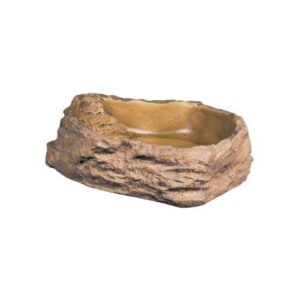
Temperature control isn’t just about heat — hydration matters too.
The Exo Terra Large Reptile Water Dish gives your ball python a clean, stable water source without disrupting your enclosure setup. It’s made from food-grade resin with a non-porous surface, so bacteria don’t get a foothold between cleanings.
The built-in safety steps help your snake climb out easily, and the rock-like exterior blends naturally into any terrarium.
At roughly 22 x 17.8 x 5.5 cm, it fits most enclosures without crowding the floor space.
| Best For | Reptile and amphibian owners who want a natural-looking, easy-to-clean water dish that keeps their enclosure both functional and good-looking. |
|---|---|
| Brand | Exo Terra |
| Material | Plastic |
| Weight | 1 Kilogram |
| Color | Multi |
| Reptile Compatible | Yes |
| Easy Maintenance | Non-porous surface |
| Additional Features |
|
- Non-porous, food-grade resin surface means bacteria has nowhere to hide — cleaning is quick and straightforward
- Built-in safety steps let your reptile climb out on their own, no drowning risk
- Rock-like design blends right into the terrarium without looking out of place
- Reported sizing inconsistencies mean the dish might not match the listed dimensions exactly
- Not a great fit for very small or very large reptiles — the size range is pretty middle-of-the-road
- At 1 kg, it’s decent but smaller species might find the proportions a bit off
4. TempPro TP50 Digital Hygrometer Thermometer
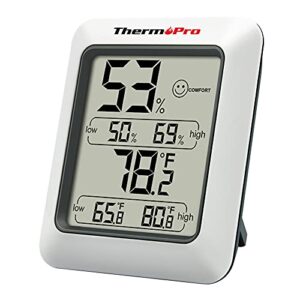
Knowing your exact temperature and humidity at a glance makes daily care much easier. The TempPro TP50 does both in one compact unit.
It measures temperature from -58°F to 158°F with ±1°F accuracy and humidity from 10% to 99% RH, updating every 10 seconds.
You get high and low record tracking, a built-in comfort indicator, and a magnetic back that sticks to metal surfaces.
One AAA battery keeps it running, and the clear LCD makes spot-checking your enclosure quick and straightforward.
| Best For | Anyone who needs a simple, reliable way to monitor indoor temperature and humidity — whether you’re caring for reptiles, aging cigars, brewing, or just keeping tabs on your home environment. |
|---|---|
| Brand | TempPro |
| Material | Plastic |
| Weight | 2.11 ounces |
| Color | White |
| Reptile Compatible | Yes |
| Easy Maintenance | 10-second refresh |
| Additional Features |
|
- Accurate and fast — readings update every 10 seconds with solid ±1°F and ±2–3% RH precision
- Versatile placement thanks to the magnetic back and built-in stand
- Easy to read at a glance with the comfort indicator showing DRY, COMFORT, or WET
- No Bluetooth, so you can’t log or track data remotely
- The display brightness isn’t adjustable, which can be an issue in darker rooms
- A small number of users noticed slight humidity discrepancies compared to other gauges
5. Zoo Med Forest Floor Substrate
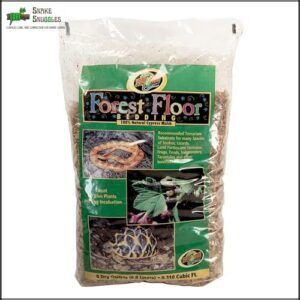
Substrate might seem unrelated to temperature, but it plays a direct role in humidity — and humidity affects how stable your thermal environment stays.
Zoo Med Forest Floor is 100% natural cypress mulch that absorbs and holds moisture, helping you maintain the 60–80% humidity ball pythons need.
Mist it occasionally to boost levels during shedding cycles. It also creates a natural forest floor look your snake can burrow into. Rinse it before use to reduce dust.
| Best For | Reptile and amphibian owners who need a natural substrate that helps maintain humidity levels in their enclosure. |
|---|---|
| Brand | Zoo Med |
| Material | Cypress Mulch |
| Weight | 0.3 Kilograms |
| Color | Green |
| Reptile Compatible | Yes |
| Easy Maintenance | Spray or mist |
| Additional Features |
|
- Holds moisture well, making it easy to keep humidity right where it needs to be
- Looks great — gives the enclosure a natural forest floor feel your animal can actually burrow into
- Easy to clean up and works with a wide range of species
- Can be dusty straight out of the bag, so you’ll want to rinse and dry it first
- Waste can be hard to spot visually — you’ll often have to rely on smell to know when it’s time to clean
- Pricier than some alternatives, especially if you’re filling a large enclosure
Frequently Asked Questions (FAQs)
How often should I check my pythons temperature?
Check your ball python’s tank temperature at least once a day. If your room temperature swings between day and night, bump that up to twice daily — morning and evening.
Can humidity levels affect temperature accuracy?
Yes, humidity does affect accuracy.
Condensation on sensors can cause readings to drop 2–5°F lower than actual air temperature, so always use a humidity-compensated digital probe.
What happens if my ball python gets too cold?
Think of your ball python like a car engine — it needs heat to run.
Below 70°F, digestion stalls, immunity drops, and lethargy sets in.
Prolonged cold below 65°F can be fatal.
Do ball pythons need temperature changes at night?
Ball pythons do benefit from a slight nighttime temperature drop, ideally staying between 70–78°F. It mimics their natural habitat and helps healthy circadian rhythms without risking respiratory issues.
How do seasonal changes impact enclosure temperature?
Seasonal shifts hit harder than most keepers expect.
Winter rooms drop to around 70°F, dragging enclosure temps down with them.
Summer pushes the opposite direction, risking dangerous spikes above 92°F without a dimming thermostat in place.
Conclusion
One misread thermometer can quietly undo months of careful care—your ball python doesn’t get a second chance at a failed shed or an infection that took hold while the temperatures looked "fine" on a faulty dial gauge.
Now that you know how to check ball python tank temperature the right way, you hold the real control. Accurate tools, consistent monitoring, and a proper gradient aren’t optional extras—they’re the foundation that everything else rests on.