This site is supported by our readers. We may earn a commission, at no cost to you, if you purchase through links.
classroom snake can look calm and healthy while sitting in the wrong temperature all day. That’s the tricky part. Snakes don’t make their own body heat, so the lamp above the enclosure does more than warm the tank—it shapes digestion, movement, and daily behavior.
That’s why choosing reptile heat lamps for classroom snake habitats takes more than picking the brightest bulb on the shelf. You need safe fixtures, steady temperatures, and a setup that creates both a warm basking spot and a cooler retreat. Get that balance right, and your enclosure starts working more like a patch of sun-warmed ground than a glass box.
Table Of Contents
- Key Takeaways
- What Are Reptile Heat Lamps for Classroom Snake Habitats
- Types of Heat Lamps Best Suited for Snakes
- Top 7 Reptile Heat Lamps for Classroom Snake Habitats
- Buying Guide: Key Purchase Considerations for Snake Enclosures
- Setting Up and Maintaining Heat Lamps in a Classroom
- Frequently Asked Questions (FAQs)
- Conclusion
Key Takeaways
- Snakes depend on external heat sources, so your classroom enclosure needs both a warm basking spot and a cooler retreat for healthy thermoregulation.
- Choosing the right heat lamp means considering fixture safety, wattage, thermostat features, and durability to keep both your snake and students safe.
- Ceramic heat emitters are best for overnight warmth without disrupting sleep, while dual-zone fixtures and UVB/UVA lamps support daytime activity and larger tanks.
- Regular maintenance, temperature monitoring, and clear placement guidelines prevent burns, overheating, and ensure consistent comfort for your classroom snake.
What Are Reptile Heat Lamps for Classroom Snake Habitats
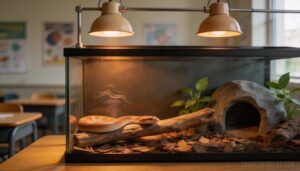
Snakes can’t regulate their own body temperature, so the heat source you choose matters more than most people realize. Whether you’re setting up your first classroom habitat or upgrading an existing one, understanding your options makes the whole process much easier.
For tips on choosing the best heating setup and keeping your snake comfortable, check out this guide to snake enclosure heating solutions.
Here’s a look at what reptile heat lamps actually are and why they’re essential for keeping classroom snakes healthy.
How Heat Lamps Replicate a Snake’s Natural Thermal Environment
In the wild, snakes warm themselves on sun-baked rocks through radiant heat transfer — and a well-chosen heat lamp replicates that same process inside your classroom enclosure. It creates a basking spot that hits 85–95°F, models surface temperature gradients across the tank, and enables diurnal cycle simulation so your snake can thermoregulate naturally, moving between warm and cool microhabitat zones just as it would outside.
A heat lamp recreates sun-warmed rocks, giving classroom snakes the warm-to-cool gradient they need to regulate themselves naturally
Infrared radiation provides essential temperature gradient creation for snakes.
Difference Between Heat Lamps, Ceramic Emitters, and Heat Mats
heat sources work the same way. Heat lamps create a bright basking spot but affect light emission impact on your snake’s day-night rhythm.
ceramic heat emitters deliver warmth without light — great for nighttime temperature regulation.
Heat mats handle substrate heat distribution along the terrarium floor. Each has different safety risk profiles, thermostat compatibility needs, and energy consumption differences, so matching the right option to your setup matters.
Why Classroom Snakes Need Consistent, Reliable Heat Sources
Snakes can’t regulate their own body temperature — so your snake terrarium’s heat consistency does that work for them. Ensuring reliable and consistent heat output promotes metabolic stability, immune support, and growth consistency over the school year.
Steady reptile heating also drives behavioral predictability, meaning calmer, more observable snakes. Without reliable temperature regulation, stress reduction becomes impossible, and sick or erratic snakes don’t make great classroom companions.
Role of Basking Zones and Cool Retreats in Snake Enclosures
Think of the enclosure as two neighborhoods that your snake moves between all day. That’s behavioral thermoregulation in action — and your setup either helps it or fights it.
- Basking zone sizing should cover 5–15% of the snake terrarium floor, reaching 90–100°F.
- Cold side temperature stays around 75–82°F for cool retreat accessibility.
- Heat lamp placement maintains 6–12 inches above basking spots.
- Thermal gradient spans 8–20 inches between zones.
- Substrate texture choice stays smooth in basking areas to prevent burns.
Types of Heat Lamps Best Suited for Snakes
Not all heat lamps work the same way, and snakes have specific needs that make certain types stand out. Picking the right one depends on your classroom setup, your snake’s habits, and how much control you want over temperature.
Here are the five types worth knowing before you choose.
Incandescent and Halogen Basking Spot Lamps
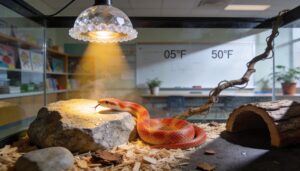
A well-placed halogen basking spot lamp does exactly what your snake needs — a defined hot zone that mimics midday sun. These lamps deliver intense, focused heat through beam focus technology, warming your snake’s muscles quickly. Quartz dome fixtures improve efficiency, while socket compatibility with standard E26 bases keeps setup simple.
| Feature | Details |
|---|---|
| Bulb Lifespan | 6–12 months typical |
| Color Rendering | Bright white, UVA-rich |
Ceramic Heat Emitters for Nighttime and 24-Hour Heating
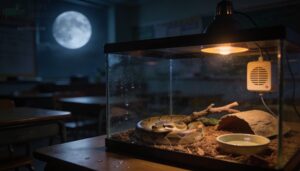
When the classroom lights go off, your snake still needs warmth. A ceramic heat emitter solves that quietly — no light, no disruption, just steady infrared penetration that warms your snake’s body directly.
These 24‑hour heat sources offer impressive nighttime temperature stability, moisture resistance, and energy efficiency. With a lifespan exceeding 10,000 hours, ceramic heat emitters are among the most reliable reptile heat lamps for snake habitats.
Infrared Heat Lamps and Deep-Tissue Warming Benefits
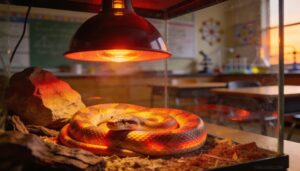
Unlike ceramic emitters, infrared lamps go a step further — delivering deep tissue penetration that warms muscle layers directly, not just surface skin. That’s real thermal therapy benefits at work inside your reptile habitat.
For more tips on creating an ideal environment, check out this complete guide to essential snake habitat heating and lighting.
Here’s what infrared heat does for your snake:
- Boosts blood circulation for faster nutrient delivery
- Facilitates muscle relaxation after activity
- Provides pain alleviation by reducing nerve irritability
- Penetrates tissue within minutes via short-wave infrared heat
- Works efficiently inside a deep dome fixture
UVB and UVA Combination Fixtures for Daytime Setups
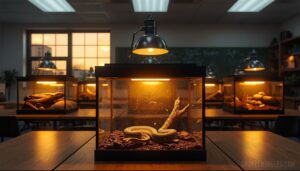
Some snakes benefit from UVB and UVA lighting for reptiles during daylight hours, supporting calcium metabolism and natural behavior cycles. Combination fixtures with Reflector Efficiency Design increase UVB/UVA output over the basking zone.
Adjustable Arm Mounts let you target coverage precisely.
Remember, UVB Lamp Lifespan generally runs 6–12 months, so track replacement dates.
Always follow Safety Eyewear Guidelines when handling snakes under active lamps.
Spectrum Ratio Tuning helps match light to your species’ needs.
Dual-Zone Fixtures for Larger Classroom Terrariums
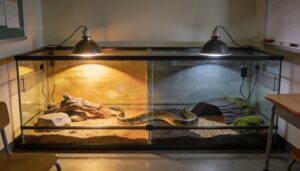
Bigger terrariums need more than one heat source — that’s where dual-zone heating really earns its place. A dual fixture lets you run separate Zone Bulb Types at each end, so your Dual Zone Calibration keeps one side at basking temps and the other cooler.
Heat Distribution Mapping, Safety Shielding Features, and Quick Connect Power make dual-zone heating practical, safe, and genuinely reliable for temperature stability all day.
Top 7 Reptile Heat Lamps for Classroom Snake Habitats
Finding the right heat lamp for a classroom snake habitat doesn’t have to be complicated. Each option below was chosen with safety, reliability, and classroom practicality in mind.
Here are seven worth considering.
1. BOEESPAT Deep Dome Reptile Lamp
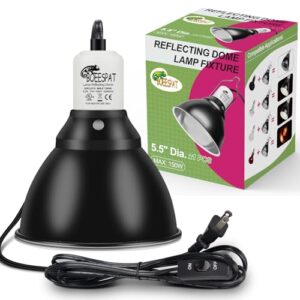
BOEESPAT Deep Dome Reptile Lamp is a solid choice for classroom setups. Its 5.5-inch aluminum dome pushes heat and light directly downward, giving your snake a well-defined basking zone.
The 67-inch cord keeps the fixture easy to position, and the built-in on/off switch means quick control during the school day.
It accommodates bulbs up to 150 W and works with ceramic emitters for overnight heating.
One thing to watch: switch can loosen over time, so check it during your weekly maintenance walk-through.
| Best For | Reptile owners and classroom setups who need a reliable, easy-to-use basking lamp with flexible bulb options and simple day-to-day control. |
|---|---|
| Bulb Type | E26 base compatible |
| Maximum Wattage | 250 W (recommended 150 W) |
| Heat Output | Directional heating |
| Installation | Easy screw-in setup |
| Warranty/Lifespan | 12-month warranty |
| Suitable For | Terrariums, vivariums, reptiles |
| Additional Features |
|
- The 5.5-inch deep dome directs heat and light right where your reptile needs it, creating a solid basking spot.
- Works with a wide range of E26 bulbs — UVA, UVB, ceramic heat emitters — so you’re not locked into one setup.
- The 67-inch cord and built-in on/off switch make positioning and daily use genuinely easy.
- The on/off switch can loosen or fail over time, which gets annoying fast with regular use.
- Some units have stopped working early, especially if bulbs run hot or exceed the recommended 150 W.
- The aluminum dome dents easily if dropped, so long-term durability is a bit of a question mark.
2. REPTI HOME Reptile Heat Lamp
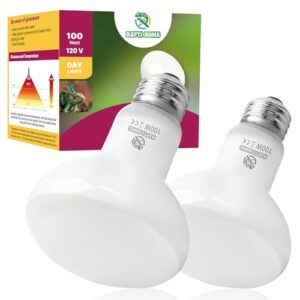
If you need a reliable heat source that won’t break the budget, the REPTI HOME Reptile Heat Lamp is worth a close look. Each 100 W bulb sits in a ceramic E26 socket built to handle repeated heat cycling — exactly what classroom use demands.
The 2-pack is smart planning; when one bulb burns out mid‑week, you’re not scrambling. Keep in mind it produces no UVB, so pair it with a separate UVB source for species that need it.
| Best For | Reptile and amphibian owners who want an affordable, easy-to-install basking bulb with a backup ready to go. |
|---|---|
| Bulb Type | E26 screw base |
| Maximum Wattage | 100 W |
| Heat Output | Focused basking heat |
| Installation | Screw-in installation |
| Warranty/Lifespan | 2-3 month lifespan |
| Suitable For | Reptile/amphibian terrariums |
| Additional Features |
|
- Comes in a 2-pack, so you always have a spare when one burns out
- Standard E26 base fits most fixtures — no special hardware needed
- At $11.99 for two bulbs, replacing them regularly won’t hurt your wallet
- Bulbs typically last only 2–3 months, so you’ll be replacing them pretty often
- No UVB output — species that need UVB will require a separate lamp
- Gets very hot, so you’ll need a proper ceramic fixture and good spacing to keep things safe
3. MIXJOY Dual Reptile Light Fixture
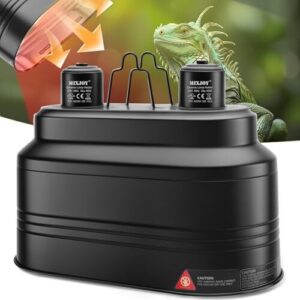
When you’re managing a larger terrarium, one fixture often isn’t enough. The MIXJOY Dual Reptile Light Fixture solves that with two independent sockets, each rated up to 160 W.
You can run a basking lamp on one side and a UVB bulb on the other — no splitters, no guesswork. The separate on/off switches let you cut heat or light individually, which is great during feeding or cleanups.
Heat-resistant ceramic sockets and built-in ventilation keep things running safely through long school days.
| Best For | Reptile owners who need both heat and UVB lighting in one setup — especially for larger tanks housing lizards, turtles, or tortoises. |
|---|---|
| Bulb Type | Heat, UVB, daylight bulbs |
| Maximum Wattage | 160 W per socket |
| Heat Output | Combined heat and UVB |
| Installation | Dual sockets, hanging hooks |
| Warranty/Lifespan | Socket failure after months |
| Suitable For | Lizards, turtles, snakes |
| Additional Features |
|
- Two independent sockets mean you can run a basking lamp and UVB bulb at the same time, no extra gear needed.
- Separate switches make it easy to cut one light without touching the other — handy during feedings or tank cleanouts.
- Ceramic construction and top ventilation hold up well during long daily use.
- Some users reported switch failures or flickering after a few months, particularly with high-wattage bulbs running 10 hours a day.
- Bulbs aren’t included, so factor that into your budget.
- The switches should be kept off the floor to avoid accidental bumps — a small but real safety thing to keep in mind.
4. REPTI ZOO Ceramic Heat Lamp
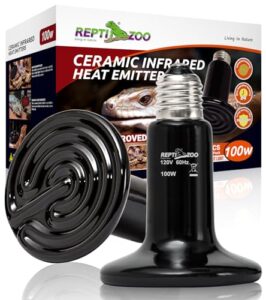
Sometimes you need heat without light — and that’s exactly what the REPTI ZOO Ceramic Heat Emitter delivers. Each pack includes two 100 W bulbs that screw into standard E26 sockets, so setup is straightforward.
Because they emit zero visible light, your snake’s day-night cycle stays undisturbed, even during overnight classroom hours. The high-purity ceramic construction manages humidity well and holds up through regular use. With a rated lifespan of 10,000 hours, you won’t be swapping bulbs every few months.
| Best For | Reptile and amphibian owners who need steady overnight heat without disturbing their animal’s natural sleep cycle. |
|---|---|
| Bulb Type | E26 ceramic heat emitter |
| Maximum Wattage | 100 W |
| Heat Output | Infrared heat only |
| Installation | Standard screw-in |
| Warranty/Lifespan | 10,000 hours rated |
| Suitable For | Reptiles, amphibians, snakes |
| Additional Features |
|
- Two bulbs per pack, each rated for around 10,000 hours — you won’t be replacing them constantly
- Zero visible light means nocturnal animals (and classroom setups) stay undisturbed
- High-purity ceramic holds up well in humid terrariums without cracking
- No UVB or visible light output, so species that need UV exposure will still require a separate basking lamp
- Real-world lifespan can fall short of the rated hours, with some users reporting burnout around 9–10 months
- No built-in temperature control — you’ll want an external thermostat to keep heat levels safe and consistent
5. DXOPHIEX Dual Reptile UVB Light Fixture
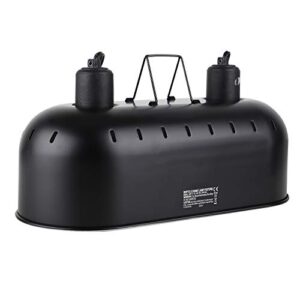
When your snake needs both heat and UVB light in one place, the DXOPHIEX Dual Reptile UVB Light Fixture performs that job well. Its two independent 150 W sockets let you run a ceramic emitter on one side and a UVB bulb on the other — no extra hardware needed.
The polished aluminum reflector spreads light evenly across the basking zone, and each head has its own switch. For a 30-gallon classroom terrarium, that kind of control is hard to beat.
| Best For | Reptile owners who need both heat and UVB coverage in one fixture for medium-to-large enclosures like 30-gallon terrariums. |
|---|---|
| Bulb Type | Ceramic, UVB, daylight bulbs |
| Maximum Wattage | 150 W per socket |
| Heat Output | Dual heat sources |
| Installation | Hanging hook, dual sockets |
| Warranty/Lifespan | User-reported issues |
| Suitable For | Bearded dragons, turtles, snakes |
| Additional Features |
|
- Two independent 150 W sockets let you run a heat lamp and UVB bulb at the same time, no extra fixtures needed
- Individual on/off switches give you easy control over heat and lighting separately
- The polished aluminum reflector spreads light evenly and cuts down on hot spots
- The 30-inch cord can sit against the enclosure hood, which is a fire hazard if you don’t route it carefully
- 150 W per socket is a lot of heat for small or juvenile setups — you’ll likely need a thermostat or dimmer
- Bulbs aren’t included, so factor in that extra cost before you buy
6. Juttilax Reptile Heat Lamp with Timer
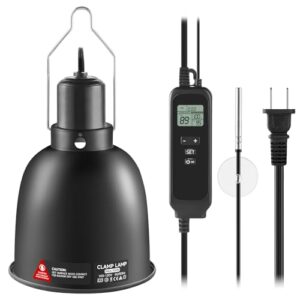
The Juttilax Reptile Heat Lamp with Timer gives your classroom terrarium something most basic fixtures don’t — built-in scheduling. Its PID thermostat holds temperatures between 68°F and 113°F without constant manual adjustments, and four programmable daily periods let you automate day-to-night heat cycles.
The dual-zone LCD clearly displays time, setpoint, and output power at a glance.
At $31.99, it’s solid value. Just note the 100 W bulb limit and confirm your timer settings hold after any power interruption.
| Best For | Teachers or hobbyist reptile keepers who want hands-off temperature scheduling without spending a lot. |
|---|---|
| Bulb Type | Ceramic, UVB, infrared bulbs |
| Maximum Wattage | 100 W bulb limit |
| Heat Output | Programmable heating |
| Installation | Hanging hook, probe |
| Warranty/Lifespan | Timer failure reports |
| Suitable For | Tanks, terrariums, cages |
| Additional Features |
|
- PID thermostat keeps temps steady without constant tweaking — good for animals that need stable heat
- Four programmable daily periods handle day/night cycles automatically
- Dual-zone LCD makes it easy to see exactly what’s happening at a glance
- Some users reported timer resets and at least one fire incident — worth monitoring closely
- 100 W bulb cap may not cut it for larger enclosures
- Programming the timer can be a bit confusing if you’re not used to that kind of setup
7. Fluker Basking Spotlight Bulb Reptile
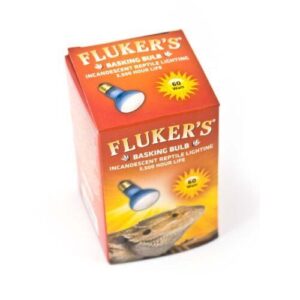
The Fluker Basking Spotlight Bulb (model 22601) is a no-frills, 60 W incandescent that does one thing well — it creates a focused basking spot your classroom snake can actually use. It fits any standard E26 fixture, so setup takes seconds.
Keep in mind it emits zero UVB, making it a poor solo choice for turtles or bearded dragons. For corn snakes or ball pythons, though, it’s a budget-friendly option.
Just keep a spare bulb handy — lifespan runs roughly two to four months.
| Best For | Budget-conscious reptile keepers who own heat-dependent species like corn snakes, ball pythons, or geckos that don’t need UVB lighting. |
|---|---|
| Bulb Type | Incandescent spotlight |
| Maximum Wattage | 60 W |
| Heat Output | Infrared basking heat |
| Installation | Screw-in spotlight |
| Warranty/Lifespan | 2-4 month lifespan |
| Suitable For | Snakes, lizards, geckos |
| Additional Features |
|
- Creates a focused, reliable basking spot that helps reptiles regulate their body temperature naturally
- Fits any standard E26 fixture — no special hardware needed, just screw it in and go
- Low cost makes it easy to stock up and always have a spare ready
- No UVB output, so it can’t be the only light source for species like bearded dragons or turtles
- Lifespan is only two to four months, and frequent on/off cycling can burn it out even faster
- 60 watts may not cut it for larger enclosures or species that need serious heat
Buying Guide: Key Purchase Considerations for Snake Enclosures
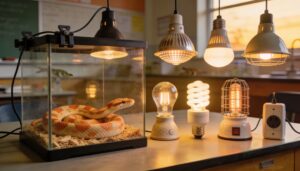
Picking the right heat lamp isn’t just about keeping your snake warm — it’s about keeping your students safe and your setup stress-free.
There are a few things worth thinking through before you buy, from wattage and thermostat features to safety ratings and energy use. Here’s what to look for.
Matching Wattage to Enclosure Size and Snake Species
Think of wattage as a dial you tune to match two things: enclosure size and species heat needs.
A 20-gallon tank with a cold-climate snake does fine at 25–40 watts. A 75-gallon desert species may need 60–100 watts.
Room temperature matters too—cooler classrooms demand more output.
A reliable wattage scaling formula: start at 1.5× the tank volume in watts, then adjust.
Thermostat and Temperature Control Features to Look For
A good thermostat does more than just switch heat on and off.
Look for Precision Setpoint Control accurate to 0.5°C, Proportional Heat Regulation to prevent temperature swings, and a PID inverter thermostat for smooth, consistent output.
Independent Zone Control lets you manage basking and cool areas separately.
Built-in temperature alarms and Energy Usage Reporting make classroom management genuinely easier.
Safety Features Including Over-Temperature Alerts and GFCI Protection
Safety isn’t optional when students are nearby.
Look for fixtures with Thermal Sensor Alarms and Auto Shutoff Mechanisms that cut power within milliseconds of detecting dangerous heat. GFCI Trip Indicators protect against electrical faults near moisture, which matters in any classroom.
Self Test Diagnostics and Certification Compliance Labels confirm the unit meets electrical safety standards.
These safety features to avoid overheating in terrariums aren’t extras — they’re essentials.
Fixture Durability and Heat-Resistant Socket Materials
A fixture that falls apart mid-semester isn’t just inconvenient — it’s a safety issue. When you’re shopping for classroom heat lamps, the socket material matters more than most people realize.
- Porcelain and heat-resistant ceramic sockets stay stable up to 500°F
- Zirconia Reinforced Bases resist cracking from daily thermal cycling
- PPS Plastic Insulation holds firm above 180°C without warping
- Thermal Shock Coatings and Metal Corrosion Protection extend heat source durability in humid rooms
- Durable metal reflectors with ceramicized surfaces are easier to clean and last longer
Ceramic Socket Longevity and heat lamp safety go hand in hand.
Energy Efficiency and Automated Heating Schedules
Durability keeps the fixture running — but efficiency keeps it smart. Look for fixtures with Smart Thermostat Integration and PID control so heating stays precise without wasting power.
Occupancy-Based Controls cut energy during lunch or after school, while Weather-Responsive Setpoints automatically adjust on cold days.
Energy Usage Analytics and Scheduled Maintenance Alerts make automated heating schedules and responsible snake husbandry surprisingly easy to manage together.
Setting Up and Maintaining Heat Lamps in a Classroom
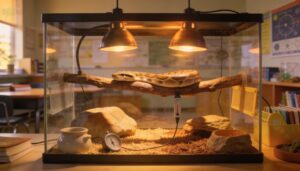
Setting up heat lamps in a classroom takes careful planning and regular upkeep. The right fixture placement and temperature control make all the difference for your snake’s health and safety.
Here’s what you need to know before choosing the best options for your enclosure.
Knowing which morphs you’re working with matters too — rare and unique boa morphs can have distinct care needs that should shape how you set up their habitat.
Creating a Safe Thermal Gradient Across The Enclosure
When you use the Gradient Mapping Technique, you’re shaping a heat gradient that snakes rely on for thermoregulation. For example, a Vertical Heat Differential of 5–10 cm helps them stretch or retreat as needed.
Pair insulated wiring layout with overheat alarm settings and a thermostat to maintain temperature stability, preventing overheating in reptile habitats. Student Observation Protocol promotes safe, hands‑on snake husbandry.
Positioning Fixtures to Prevent Burns and Overheating
After mapping your heat gradient, focus on Guarded Lamp Placement and Clearance Distance Standards—keep bulbs outside the snake’s reach or shielded with a protective cage. Reflector Angle Optimization directs warmth to the basking spot, not the whole tank.
Cable Routing Safety matters; cords stay out of reach.
Basking Surface Shielding and independent controls help maintain temperature stability, preventing overheating in reptile habitats.
Using Thermostats and Probes for Accurate Temperature Monitoring
Once your lamp is safely positioned, accurate temperature control comes next. Place your thermostat and temperature sensor at snake eye level for real readings.
Probe Calibration matters—check sensors with a reference thermometer monthly. Data Logging lets you track temperature fluctuation prevention.
Gradient Verification uses a second probe in the cool zone. Safety Wiring keeps cables secure and avoids accidental damage or burns.
Routine Inspection and Bulb Replacement Schedule
Even the best heat lamp maintenance routine can slip if you don’t keep records. For reliable performance, follow this checklist:
- Update your Inspection Logbook weekly.
- Track Bulb Lifespan and use a Replacement Calendar.
- Complete a Safety Checklist—cords, clamps, and temperature monitoring devices.
- Involve students in bulb replacement schedule tasks for accountability and hands‑on learning.
Teaching Students to Observe Snake Thermoregulation Safely
While you’re managing temperature in reptile enclosures, encourage students to track behavioral movement using color-coded gradient strips and infrared thermometer use.
For safe warmth, supervised handling procedures are essential—snakes stay restrained unless health checks require contact.
Daily data logging protocols help spot heat lamp safety for snakes, while temperature monitoring devices reveal how thermoregulation guides each snake’s choice of basking or retreat.
Frequently Asked Questions (FAQs)
Can heat lamps be used with glass tanks?
Yes, you can use heat lamps with glass tanks, but Glass Stress Management is important.
Follow Lamp Distance Guidelines—keep bulbs 6–8 inches from glass, use Safety Guard Installation, monitor temperature, and consider Alternative Heating Methods for safer reptile enclosure design.
How long do reptile heat bulbs typically last?
heat bulbs like cassette tapes—durability depends on cycling vs continuous use, humidity impact, and voltage stability.
Incandescent bulbs last 1–2 years; ceramic emitters stretch to 3–5 years.
Smart replacement scheduling keeps heat lamp safety for snakes on track.
What backup options exist during power outages?
You can rely on UPS Systems for instant backup, battery storage for hours of runtime, or solar backup paired with batteries.
Generator types—diesel, gas, or hybrid—require careful fuel management.
Thermal inertia from ceramic heat emitters helps nighttime heating.
How should heat lamps be stored when not in use?
You won’t win any awards for storing heat lamps on a classroom shelf.
Use a Dry Storage Area, Fire‑Resistant Cabinet, Impact‑Resistant Packaging, Heat‑Resistant Gloves, and Inventory Log Maintenance—protective warning indicator, guards, cord length, installation guidelines, safety features.
Conclusion
As you set up your classroom snake habitat, recall that a well-chosen heat lamp can make all the difference. Coincidentally, the right reptile heat lamps for classroom snake habitats both guarantee your snake’s comfort but also create a thriving environment.
By selecting a suitable heat lamp and following proper setup and maintenance guidelines, you’ll provide a safe and healthy space for your snake to flourish.
Your attention to detail will pay off in a happy, healthy pet.