This site is supported by our readers. We may earn a commission, at no cost to you, if you purchase through links.
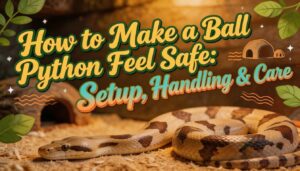
Most ball pythons don’t act “shy” because they’re unfriendly—they act that way because the world feels too open. A bare tank, one loose hide, or a few rushed handling sessions can turn a calm snake into a tight, worried coil.
The good news: safety is something you can build. When heat stays steady, hides fit snug, and your movements stay slow, your snake starts to settle in. That’s the heart of how to make a ball python feel safe.
Small changes in setup, handling, and routine often make the difference between a snake that braces and one that quietly explores.
Table Of Contents
- Key Takeaways
- Set Up an Enclosure That Makes Your Ball Python Feel Safe
- Keep Temperature and Humidity in The Right Range
- Read Your Ball Python’s Body Language Accurately
- Handle Your Ball Python The Right Way
- Build Long-Term Trust Through Routine and Consistency
- Frequently Asked Questions (FAQs)
- How do you keep a ball python healthy?
- How do you handle a ball python?
- Can a ball python be injured?
- What happens if a ball python is handled too much?
- How to tell if a snake is bored?
- How can I safely transport my ball python?
- What noises can stress out a ball python?
- How do I introduce a new snake to my home?
- Are ball pythons affected by household scents or chemicals?
- Conclusion
Key Takeaways
- Your ball python feels safest with snug hides, steady heat, and stable humidity—set up at least two hides per temperature side and keep warm and cool zones dialed in.
- Slow, gentle handling, and a regular routine help your snake relax—start with short sessions and always watch for stress signals before picking it up.
- Pay close attention to body language like tight coiling, hissing, or tongue-flicking—these signs tell you when your python needs space or might be stressed.
- Small changes in enclosure setup, handling, and daily habits build trust over time, turning a shy snake into a curious explorer.
Set Up an Enclosure That Makes Your Ball Python Feel Safe
Making your ball python feel safe starts with the right home. Every detail counts—from the size of the tank to what’s inside.
For practical tips on creating a stress-free environment, check out these ball python bite prevention techniques and habitat essentials.
Here’s what you’ll want to look for when setting up their space.
Choose The Right Tank Size and Secure Lid
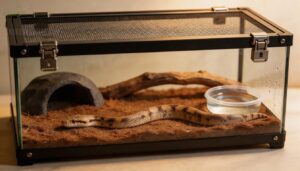
Even the calmest ball python will test its limits—so your enclosure setup must cover all the bases. Follow Tank Volume Guidelines: 20 gallons for juveniles, 40+ for adults.
Aim for a Length-to-Girth Ratio that lets your snake stretch. Use Lid Lock Mechanisms for escape prevention. Balance Ventilation Security with Material Durability Choices to make sure your ball python enclosure design keeps them safe.
Place at Least Two Hides on Each Temperature Side

Once your tank size and lid are sorted, focus on hide spacing—two hides per side, warm and cool. This gives your ball python micro climate zones and hiding spots for stress reduction.
Orient entrances inward for quick retreats. Pick tip-proof hides with solid roofs and material heat retention that won’t overheat.
That way, your enclosure setup provides habitat enrichment and true comfort.
Select a Substrate That Supports Comfort
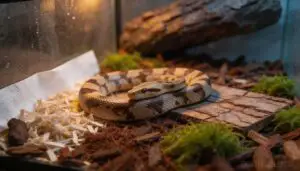
Substrate selection for ball pythons matters more than you’d guess—comfort starts under their belly.
Aspen bedding cushions scales, while coco coir moisture keeps humidity steady.
Paper towel hygiene makes cleanup quick and safe for sensitive skin.
Cork tile texture and moss humidity boost help mimic their wild floor.
Coconut fiber, cypress mulch, or coconut husk offer moisture and warmth without risk.
Add Cork Bark and Décor to Reduce Exposed Space

Comfort starts with your snake can touch and where it can hide. Cork bark gives textured grip for climbing and lets you build corner retreats—just like cracks in a wild burrow.
Layering décor creates vertical segmentation and visual barriers, so your python feels less exposed. That mix of hiding spots and microclimate creation turns a plain tank into a true bioactive vivarium.
Maintain a 12-Hour Light Cycle for Natural Rhythms

When you set up environmental lighting, use a timer for consistency—ball pythons thrive on stable day-night cycles. Place lights so they gently fill the room, not blast the enclosure.
For night, keep things dim—red light checks work if you must peek.
Stick with seasonal stability, twelve hours on, twelve off.
This routine promotes crepuscular and nocturnal activity patterns, matching their natural rhythm.
Keep Temperature and Humidity in The Right Range

Ball pythons need steady warmth and moisture to feel secure.
If you get the basics right, your snake will settle in and thrive.
Here’s what you’ll want to check for a safe, comfortable setup.
Warm Side 88–92 °F, Cool Side 76–80 °F
Ever notice your ball python hugging one hide over another? That’s the magic of a proper temperature gradient—warm side at 88–92 °F, cool side at 76–80 °F.
Place thermometer probes at substrate level for accurate heat zones.
Nighttime temperature stability matters—don’t let the warm side dip.
Hide temperature matching keeps your snake cozy, not stressed.
Use Under-Tank Heating Pads With Thermostats
Slide an under-tank pad beneath one side—never the whole tank—for steady heat distribution. Use an adhesive heating element(https://www.furrycritter.com/pages/articles/reptiles/under_tank_heaters.htm) to attach the pad to the tank’s exterior.
Pair it with a thermostat for thermal regulation; calibrate often to keep the gradient right.
Place probes at floor level for accurate readings. Check electrical safety—cords away from moisture and curious mouths.
Keep a backup power source handy. Pad placement and thermostat calibration keep your snake safe.
Keep Humidity at 50–60 % and Raise It During Shedding
humidity control as your ball python’s insurance policy against stuck shed—aim for a steady 50–60%. Use a larger water dish or misting for quick boosts, but don’t overdo it.
During pre‑shed, raise humidity to help the old skin loosen.
Humid Hide Placement matters—keep it warm and damp. Balance ventilation to avoid soggy corners or bone-dry air.
Monitor Both Zones Daily With Separate Thermometers
You wouldn’t trust a single thermometer for your whole kitchen—same goes for your ball python’s thermal zones. Daily Zone Temperature Comparison is key.
Place each probe at your snake’s resting height for Probe Position Consistency. Reading Accuracy Checks catch sensor drift before it becomes a problem.
Data Trend Analysis helps you spot subtle shifts—keeping temperature regulation and humidity control on point.
Read Your Ball Python’s Body Language Accurately
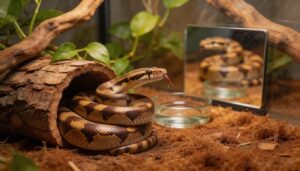
Ball pythons speak through their bodies—sometimes louder than words. If you know what to look for, you’ll spot signs of comfort or stress in a flash.
Here’s how to read their signals and know what your snake needs next.
Ball Formation — What It Means and When It Normalizes
Picture your ball python curled tight—a Defensive Coil is its go-to shield. Ball formation signals stress triggers like Environmental Changes, handling, or a new hide.
This defensive behavior fades as Relaxation Indicators show: muscles loosen, the head peeks out, and normal routines resume.
Constant balling or paired Health Correlates—like poor appetite—mean something’s off. Watch for defensive posture identification to guide your care.
Tongue-Flicking, Musking, and Other Stress Signals
When your ball python’s tongueflicking ramps up—paired with tense posture or Defensive Head Position—it’s reading the room for stress signals.
Musk Odor Release is its “back off” warning, usually triggered by Body Tension Indicators and lack of Hide Availability Impact.
Snake body language interpretation helps you spot these signals early, so you can use stress reduction techniques before things escalate.
Exploration and Active Behavior — What a Relaxed Ball Python Looks Like
If stress signals ease up, you’ll spot Calm Exploration—your snake moves slowly, head first, pausing to check its surroundings. Watch for:
- Relaxed Posture—gentle curves, not a tight curl
- Feeding Anticipation—active near the warm side, checking hides
- Water Soaking Behavior—soaks quietly, then resumes exploring
Quick Curiosity Recovery means your snake feels secure.
Hissing, Striking, and S-Curve Postures to Watch For
After calm exploration, you might see hissing, a quick S-curve tension, or a striking body position. These defensive behaviors—tight coiling, head retraction signal, and sudden body language shifts—mean your snake feels unsafe.
If you spot these stress signals, pause handling and let your python settle.
Here’s a quick cheat sheet:
| Signal | What It Looks Like | What To Do |
|---|---|---|
| Hissing | Loud exhale, tense | Pause, step back |
| S-Curve | Head pulled, coil | Avoid contact |
| Striking | Fast lunge, tight | Let snake hide |
| Head Retraction | Head tucked, still | Stay hands-off |
| Tight Coiling | Body pressed, tense | Give space |
Handle Your Ball Python The Right Way
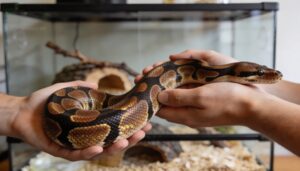
Handling your ball python isn’t just about picking it up—it’s about making every moment feel safe.
There are a few key steps that help build trust and keep stress low. Here’s how to handle your snake the right way, from day one.
Allow 7–14 Days of No-Contact Acclimation First
Ever wonder why your snake hides so much at first? That’s its way of settling in—so give it a full 7–14 day acclimation period.
Quiet Observation lets you watch for stress signals without interference. Keep Water Placement and Hide Consistency steady. Stick to your Feeding Schedule.
These habituation methods foster trust building in reptiles and set up Gradual Handling Techniques to Build Snake Trust.
Know When to Not Handle Your Ball Python
Even with the best intentions, there are clear moments when you should avoid handling your ball python. Pay attention to these cues—your snake’s comfort depends on it:
- During the Feeding Digestion Window or postfeeding rest period
- In the Shedding Sensitivity Phase
- When Cold Stress Indicators or Health Red Flags appear
- If you see Strike Risk Cues or other obvious stress signals
Approach From The Side and Support The Full Body
When you reach for your ball python, always use a Side Approach—think of it like greeting a friend face-to-face, not from behind.
Slide your hands in slowly, then use Full Body Support. One hand under the midsection, one near the front. This Hand Positioning keeps your snake steady and safe.
Gentle Lift, Calm Placement—these gentle handling methods build trust every time.
| Step | What To Do | Why It Matters |
|---|---|---|
| Side Approach | Approach from snake’s side | Reduces defensive startle |
| Full Body Support | Use both hands, support body | Prevents stress, sliding |
| Gentle Lift | Lift slowly, steady motion | Builds trust, handling safety |
Start With 3–5 Minute Sessions and Build Gradually
While you’re enthusiastic about bonding, Session Timing matters—start with just 3–5 minutes. This Gradual Extension lets you spot Stress Indicators using your Observation Checklist.
Short Handling sessions, especially after Pre-Feeding Rest, keep nerves low.
With patience and Gradual Handling Techniques to Build Snake Trust, you’ll see building Owner‑Snake bond through Gentle Interaction—stress reduction techniques are your best friend here.
Common Mistakes to Avoid When Handling a Ball Python
Want to keep your ball python calm?
Watch out for improper scent transfer—strong soaps or pet odors can trigger stress. Rough gripping or dangling the snake increases anxiety and risk.
Handling during shedding or right after feeding spells trouble—skip those sessions. Overhandling frequency wears them out. Feeding disruption breaks their routine.
Slow movements and gentle handling techniques are your best safety net.
Build Long-Term Trust Through Routine and Consistency
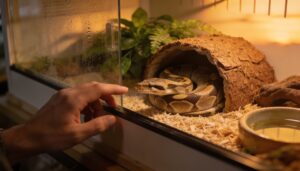
Trust takes time—for ball pythons, routine is everything. Your snake feels safest when life stays predictable and calm.
Ball pythons feel safest when their days run on a steady, predictable routine
Here’s how you can create that steady foundation day after day.
Stick to a Regular Feeding and Cleaning Schedule
Routine is your secret weapon—ball pythons thrive on predictability. Keep a stress‑free environment by sticking to a regular feeding schedule and cleaning routine. Here’s how:
- Feeding Consistency—same interval, same prey type
- Cleaning Rotation—predictable days
- Prey Size Control—match girth
- Spot‑Clean Timing—daily
- Logbook Tracking—record feed and clean
Learn What Your Snake Likes Through Observation
Ever notice your ball python pausing at a familiar scent or choosing one hide over another? That’s your cue—Scent Preference and Hide Orientation matter.
Watch how your snake interacts with Substrate Texture, Water Bowl Behavior, and Feeding Timing. By observing snake preferences, you’ll build trust, improve interaction, and master habituation training.
Learn to read your ball python’s body language—your snake’s comfort speaks volumes.
When Behavior Change Signals a Health Problem
Spotting signs of health issues in ball python behavior starts with noticing shifts—like sudden weight loss, mouth breathing, or odd respiratory noises.
Stiff body tension, persistent hiding, or abnormal shedding aren’t just stress signals; they hint at deeper trouble.
If your snake’s usual routines escalate into withdrawal or defensive weaving, it’s time to pay close attention and reassess its comfort.
Emergency Stop — Assess and Consider Calling a Vet
If your ball python shows open-mouth breathing, severe dehydration, or odd neurological signs—like wobbling or circling—it’s not just a bad day.
Visible injuries, sudden regurgitation emergencies, or a wet, foamy mouth mean it’s time for a vet. Watch for:
- Respiratory distress
- Severe dehydration
- Neurological signs
- Visible injuries
- Regurgitation emergencies
Frequently Asked Questions (FAQs)
How do you keep a ball python healthy?
Keep warm side 88–92°F, cool side 76–80°F, humidity 50–60%.
Prioritize Water Quality, Feeding and Nutrition Guidelines for Ball Pythons, Weight Monitoring, Parasite Prevention, stress reduction, and enclosure security and escape prevention for lasting health daily.
How do you handle a ball python?
Handle from the side with good Hand Placement—support mid-body and tail. Use slow movements, a Gentle Voice, and a Quiet Environment.
Start with 3–5 minutes.
Avoid post-feeding handling.
Positive Reinforcement strengthens your owner snake bond steadily.
Can a ball python be injured?
Like a knight in chain mail, yes—your ball python can suffer Trauma Sources, Burn Risks, Bite Injuries, and Scale Rot.
Watch Veterinary Signs, read body language, and follow handling safety protocols to prevent overhandling and stress.
What happens if a ball python is handled too much?
Too much handling ramps up stress—think musking, Aggressive Defensiveness, or a classic Feeding Refusal. Over time, stress escalation can trigger Immune Suppression or Weight Loss.
Preventing Overhandling and Stress in Ball Pythons means watching handling frequency and defensive behaviors closely.
How to tell if a snake is bored?
Funny thing—ball pythons aren’t bored like dogs or kids. If your snake hides, explores, or calmly tongue-flicks, that’s normal ball python body language.
Environmental enrichment—like scent stimulation and interactive objects—promotes exploration opportunities, not boredom relief.
How can I safely transport my ball python?
To transport your ball python, use a Secure Transport Container with proper Ventilation Management. Tape Heat Packs outside for warmth.
Place the container quietly in your vehicle.
After travel, focus on Post-Transport Recovery and follow handling and safety protocols.
What noises can stress out a ball python?
A ball python’s stress escalation ladder starts with Loud Music, Door Slams, Barking Dogs, Vacuum Noise, and Construction Noise.
These can trigger defensive behaviors—hissing, balling up, or hiding—especially when sudden or bass-heavy vibrations mimic stress signals.
How do I introduce a new snake to my home?
Set up a stress‑free environment—start with a Quarantine Period and Initial Health Screening. Practice Transport Safety, avoid loud noises, and use Scent Transfer.
Delay Feeding Introduction and handling session for snake acclimation. Trust builds with patience and observation.
Are ball pythons affected by household scents or chemicals?
Ever wonder if household scents or chemicals stress your snake? They do—ball pythons detect even faint fumes.
Chemical Irritation Risks, Wood Scent Toxicity, Essential Oil Hazards, Air Freshener Effects, and Pesticide Exposure Dangers trigger respiratory distress and disrupt scent-friendly environments.
Conclusion
Maybe you worry you’ll never get it “just right”—but ball pythons don’t grade your efforts. They care about warmth, snug spaces, and gentle hands.
If you’re patient, you’ll see the shy coil loosen and curiosity bloom. That’s how to make a ball python feel safe: not with ideal, but with steady, thoughtful care.
Each small step—every hide, every calm approach—shows your snake it belongs. Safety isn’t a finish line; it’s the daily path you share.