This site is supported by our readers. We may earn a commission, at no cost to you, if you purchase through links.
Most snake keepers obsess over temperature gradients and feeding schedules, yet UV lighting often gets dismissed as optional—a luxury for chameleons, not colubrids. That assumption has quietly cost snakes their bone density, immune function, and hormonal stability for decades.
UV light affects snake health at a biochemical level, driving vitamin D₃ synthesis, calcium absorption, and circadian regulation in ways no supplement fully replicates.
Get the spectrum wrong, skip the gradient, or ignore bulb degradation, and your snake pays the price long before symptoms surface. Understanding exactly what UVB does—and how to deliver it correctly—separates adequate husbandry from genuinely thriving animals.
Table Of Contents
- Key Takeaways
- How UV Light Supports Snake Health
- UVA Vs. UVB for Snakes
- Species-Specific UVB Needs
- Safe UVB Setup and Maintenance
- Choosing The Right Bulb Type and Strength
- Creating a UVB Gradient Across The Enclosure
- Correct Lamp Distance, Angle, and Fixture Placement
- Pairing UVB With Heat and a Thermal Gradient
- Using Timers for a Stable Photoperiod
- Bulb Replacement Schedules and Fixture Cleaning
- Glass and Plastic Barriers That Block UVB
- Signs of Too Much or Too Little UV
- Frequently Asked Questions (FAQs)
- Is UVB or UVA better for snakes?
- Is UV light bad for Ball Pythons?
- Can UV light affect a snakes shedding cycle?
- Does UV exposure influence snake breeding and reproduction?
- How does UV lighting interact with supplemental calcium dusting?
- Can snakes get enough UV through a window in sunlight?
- Does UV light impact lifespan in captive snakes?
- Conclusion
Key Takeaways
- UVB light isn’t optional for snakes—it drives vitamin D₃ synthesis at the skin level, and without the right intensity, your snake’s bones, immune system, and hormonal balance quietly deteriorate long before symptoms appear.
- Both UVA and UVB serve distinct, non-interchangeable roles: UVA anchors behavior, mood, and circadian rhythm, while UVB fuels the photobiological cascade that makes calcium absorption possible.
- Species, age, and morph all change UVB your snake actually needs—juveniles, albinos, and nocturnal species require carefully dialed-back exposure, while desert-dwelling diurnal species demand significantly higher UV index levels.
- correct setup means more than buying the right bulb—glass blocks UVB entirely, bulbs degrade invisibly over time, and without a UVB gradient and a calibrated meter, you’re guessing at your snake’s health rather than managing it.
How UV Light Supports Snake Health
UV light isn’t just about keeping snakes comfortable—it plays an essential role in their overall health and daily rhythms. Understanding how it works can help you create a habitat that maintains every aspect of your snake’s well-being.
From bone strength to immune support, UVB lighting benefits for pet snakes go deeper than most owners realize.
Here’s what you need to know about the ways UV light benefits your snake’s life.
Vitamin D3 Synthesis and Calcium Absorption
When you provide proper UVB lighting, you kickstart skin photochemistry—converting 7-dehydrocholesterol to vitamin D3.
Liver hydroxylation and kidney activation follow, producing the active hormone.
This triggers intestinal transport, boosting calcium absorption through vitamin D receptor signaling.
Without the right UVB intensity, vitamin D3 synthesis falters, risking metabolic bone disease and undermining your snake’s health from the inside out.
melanin absorbs UVB, reducing synthesis in darker‑skinned snakes.
Bone Mineralization and Metabolic Bone Disease Prevention
Once calcium absorption ramps up from vitamin D3 synthesis, your snake’s bones depend on a precise Calcium Phosphate Ratio and Collagen Scaffold Integrity.
If UVB lighting falters, metabolic bone disease follows—osteoid stays soft, pyrophosphate inhibition blocks mineralization, and parathyroid hormone balance tips. Watch for:
- Weak jaw tissue
- Spinal deformities
- Poor bone mineralization
- Lethargy
- Osteoblast resorption imbalance
Immune Support and Skin Health
Strong bones mean little if your snake’s skin barrier falters. UVB exposure, paired with Zinc Supplementation, boosts Antimicrobial Peptides and Langerhans Cell Activity, fortifying immune modulation right at the surface. Proper Skin Barrier Hydration and stress reduction keep defenses sharp, while immune function enhancement helps your snake recover quickly.
UVB overexposure—too much disrupts skin integrity and triggers Stress‑Induced Immunosuppression.
Circadian Rhythms, Hormones, and Activity Patterns
Just as skin health relies on steady UVB, so does your snake’s internal clock. Daily UVB lighting anchors circadian rhythm, aligning the Melatonin Cycle and Serotonin Rhythm for stable hormone synthesis.
Through Hormone Phase Coupling, Activity Timing matches Stress Hormone Peaks, ensuring behavioral stimulation and metabolic balance.
Without proper UVB intensity, these rhythms falter—leaving your snake restless and hormonally imbalanced.
Appetite, Digestion, and Stress Reduction
When you maintain consistent UVB lighting and environmental predictability, you’re not just supporting your snake’s enzyme activity and digestion—you’re actively reducing appetite suppression and stress. UVB exposure helps stabilize feeding cue consistency, while noise reduction and proper hydration levels lower stress hormones.
This combination fosters immune modulation, ensuring your snake digests meals efficiently and feeds with confidence, not anxiety.
Coloration, Basking, and Natural Behaviors
When you provide ideal UVB exposure, you activate natural color change thermoregulation and seasonal pigment variation—your snake’s skin shifts tone to balance heat and signaling. You’ll notice:
- Postural sun exposure boosts warmth and color.
- Basking behavior timing aligns with daylight.
- Microhabitat heat choice becomes precise.
- Using UVB to improve coloration and behavior in snakes delivers vibrant hues and active routines.
UVA Vs. UVB for Snakes
Regarding snake health, understanding the difference between UVA and UVB is essential. Each type of light plays a distinct role in your snake’s daily life and long-term well-being.
Let’s look at what sets them apart and why your setup should include the right balance.
What UVA Does for Behavior and Well-Being
Ever noticed how a snake’s world shifts with UVA photons?
You’re not just lighting the enclosure—you’re fueling Visual Enrichment, Daytime Orientation, and a stronger Exploratory Drive.
UVA stabilizes mood, reduces pacing, and anchors circadian rhythm, leading to stress reduction and improved immune function.
Here’s a quick comparison:
| Visual Enrichment | Reduced Pacing | Mood Stabilization |
|---|---|---|
| Daytime cues | Calm behavior | Consistent routine |
| Exploratory drive | Less stress | Better immunity |
What UVB Does for Vitamin D3 Production
Imagine a snake’s health hinging on a photobiological trigger—UVB lighting sparks a skin hormonal cascade, converting 7‑dehydrocholesterol to previtamin D3. That UVB energy dose directly drives vitamin D3 synthesis, boosting serum 25‑hydroxy D3 for calcium absorption and preventing metabolic bone disease.
Species-specific UVB keeps this conversion on track.
| UVB Energy Dose | Previtamin D3 Conversion |
|---|---|
| Triggers cascade | Starts synthesis |
| Dose matters | Allows absorption |
| Prevents disease | Maintains health |
| Species-specific | Critical for snakes |
Why Both Matter in Captivity
Think of your snake’s enclosure as a stage—without Synergistic UV Effects, you miss half the performance.
Comprehensive Light Balance means UVA drives Enhanced Behavioral Enrichment, while UVB lighting fuels vitamin D3 synthesis for Optimized Growth Rates and Pathogen Defense.
Both are critical: UVA vs UVB isn’t a contest, but a partnership for lasting health.
| UVA | UVB | Combined Effect |
|---|---|---|
| Activity | Vitamin D3 | Growth/Immunity |
| Exploration | Calcium Absorption | Bone Health |
| Stress Reduction | Metabolic Bone Disease Prevention | Welfare |
| Behavior | Synthesis | Enrichment |
Key Wavelengths for Effective UVB Exposure
You can’t cut corners regarding the UVB lighting spectrum—snakes need UVB photons in the Action Spectrum Range (290–320 nm), with the Narrowband Peak at 311 nm, delivering ideal vitamin D3.
Suberythemal Dose matters, so calibrate your UVB meter regularly for precise UVB intensity and dosage.
| Wavelength | Effectiveness |
|---|---|
| 293 nm | Ideal trigger |
| 311 nm | Narrowband peak |
| 315 nm | Lamp maximum |
| 320 nm | Upper limit |
| 290–320 nm | Action spectrum |
Why Visible Light Alone is Not Enough
While your enclosure may glow with visible light, that’s just surface-level brilliance—a Visible Light Deception.
Without the UVB Signal, your snake can’t synthesize vitamin D₃ or absorb calcium, leading to Physiological Deficiency.
Glass and plastic barriers cause Enclosure Transmission Loss, so don’t mistake active behavior for true health.
| Issue | Outcome |
|---|---|
| UVB Signal Absence | Weak bones, poor skin |
| Behavioral Misinterpretation | Hidden deficiency |
Species-Specific UVB Needs
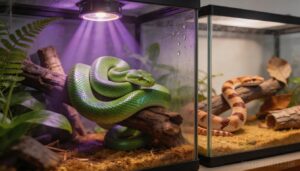
Every snake species has its own needs regarding UVB exposure. Getting these details right is the key to keeping your snake healthy and stress-free.
Let’s look at how different setups match those unique requirements.
Ferguson Zones and Natural UV Exposure
While you’re mapping out UVB exposure, Ferguson Zones give you a practical guide for UVI gradient mapping that mirrors natural sunlight. Microhabitat UV variation, seasonal UV shifts, cloud cover effects, and sun angle influence all shape real-world UVB intensity.
That’s why:
- Ferguson Zones anchor safe basking ranges
- UVI gradients prevent metabolic bone disease
- Seasonal shifts demand ongoing adjustment
Diurnal Vs. Nocturnal Snake Requirements
Matching UVB lighting to your snake’s activity peak hours is non-negotiable.
Diurnal species thrive when Light Phase Matching aligns with natural circadian rhythm, basking spot choice, and thermal zone selection.
Nocturnal snakes, in contrast, need dimmer setups and minimal UVB—overexposure triggers stress behavior signals. UVB intensity decreases with distance, so placement and timing shape species-specific UVB effectiveness.
Corn Snakes, Ball Pythons, and Other Common Species
You’ll notice how corn snakes, ball pythons, and their kin respond differently to UVB, thanks to morph pigmentation response and unique enclosure layout optimization. UVB intensity tracking with a Solarmeter, seasonal lighting adjustments, and habitat humidity considerations all shape their well-being.
The importance of UVB lighting for snake health is clear—metabolic bone disease lurks if UVB bulb replacement is neglected.
- Witness vibrant coloration shifts
- Prevent silent bone weakness
- See confident basking routines
- Reduce stress in sensitive morphs
- Track UVB intensity for peace of mind
Adjusting UVB for Juveniles Vs. Adults
Because juveniles absorb UVB more intensely, you must tailor dose scaling—raising fixture height or using spectral filtering to prevent overexposure.
Shorter exposure duration, frequent growth stage monitoring, and weekly Solarmeter checks guarantee safe Vitamin D3 synthesis without risking metabolic bone disease.
Species-specific UVB requirements mean adults tolerate higher UVB intensity, while young snakes thrive with gentler, well-measured gradients.
Lower UVB Needs for Albino Morphs
When caring for albino morphs, their species-specific UVB requirements demand extra caution—melanin loss necessitates prioritizing Shade Structures, UVB Diffusion Mesh, and Gradient Shade Zones to implement Eye Comfort Strategies.
Behavioral Escape Routes are essential, enabling snakes to self-regulate UVB dosage. Remember, UVB intensity decreases with distance, so balance lighting to avoid UVB under-exposure while upholding UVB lighting importance for snake health.
Matching UVB Levels to Habitat Type
When you’re setting up UVB for snakes, it’s critical to mirror their wild microhabitat—think Habitat UV Index, Microhabitat Sun Patches, and Ferguson Zones.
For desert environments, ramp up UVB, factoring in Altitude UV Adjustment and Reflective Surface Effects.
Tropical rainforests demand lower UVB, with Seasonal UV Variation considered.
Remember, UVB intensity decreases with distance, so tailor exposure precisely.
Safe UVB Setup and Maintenance
Setting up UVB for your snake isn’t just about picking a bulb—it’s about creating a safe, balanced environment.
There are a few key steps you’ll need to follow to get it right. Let’s walk through what matters most for your setup and ongoing care.
Choosing The Right Bulb Type and Strength
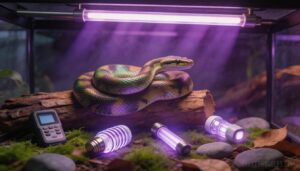
Choosing the right UVB bulb is more than matching wattage—it’s about UVB intensity, socket compatibility, and bulb coverage geometry. Don’t fall for LED UV misconceptions; LED UVB lights rarely deliver what snakes need.
Fixture shielding design matters, as does UVB bulb replacement. Use a Solarmeter to verify output, and always tailor choices to species-specific UVB requirements.
Creating a UVB Gradient Across The Enclosure
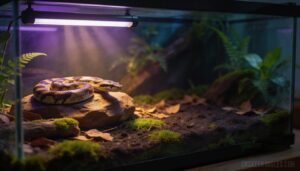
Think of your enclosure as a sunlit forest floor—snakes thrive when you create a UVB gradient that mimics nature. You’ll need:
- Basking Spot Placement for peak UVB and heat.
- Intensity Falloff Design using fixture shielding techniques, ensuring UVB intensity decay from warm to cool zones.
- Multi-Point Basking and UVB Meter Mapping, verifying Ferguson Zones with a Solarmeter.
Correct Lamp Distance, Angle, and Fixture Placement
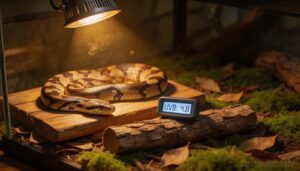
Ever notice how a snake’s basking spot can turn into a sunbeam or a shadow, depending on Fixture Height and Angle Tilt? Spot Centering and Distance Calibration are essential—use a Solarmeter or UVB meter for Hotspot Mapping.
Follow UVB placement guidelines, ensuring lamp height matches your snake’s basking posture. UVB intensity decay demands monthly checks to keep exposure precise.
Pairing UVB With Heat and a Thermal Gradient
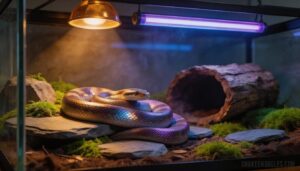
Once your UVB lighting is set, you need UVB Heat Integration—snakes only synthesize vitamin D₃ when skin warmth and light overlap. That’s why Heat Source Placement and Basking Spot Distance matter.
Create a thermal gradient where:
- Thermal Zone Overlap enables natural movement
- Temperature-UVB Balance prevents burns
- UVB meter guides adjustments
- Heat lamp safety is routine
- Metabolic bone disease risk drops
Using Timers for a Stable Photoperiod
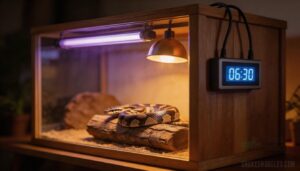
After you’ve balanced heat and UVB, reliable lighting schedules anchor circadian rhythms in snakes. A timer—preferably with Smart Timer Integration and Power Failure Backup—keeps the photoperiod steady, supporting circadian entrainment.
Gradual Light Shifts, not abrupt changes, protect natural behaviors. Separate UV timing lets you tailor exposure, while regular Timer Calibration ensures your diurnal reptiles get precise, health-promoting UVB lighting every day.
Bulb Replacement Schedules and Fixture Cleaning
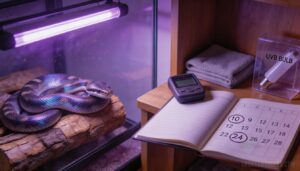
You won’t spot UVB degradation by eye—logging bulb lifespan and scheduling replacements on your calendar keeps exposure consistent, preventing gaps.
For fixture dust management, follow a power‑off cleaning protocol: wipe with a soft cloth, skip harsh chemicals, and dry thoroughly.
Every month, verify UV output with a meter. Here’s your routine:
- Log install dates
- Schedule bulb swaps
- Clean fixtures
Glass and Plastic Barriers That Block UVB
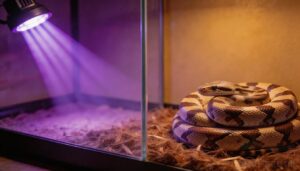
After cleaning and UVB Meter Calibration, check the beam path. Glass UVB Transmission is effectively zero, and Plastic UVB Blocking is usually the same.
That’s the Visibility vs UVB problem: bright light can still be useless.
Barrier Material Choice, UVB transmission through glass, and UVB safety guidelines define the importance of UVB lighting for snake health in every enclosure setup.
Signs of Too Much or Too Little UV
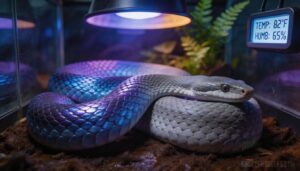
UV trouble rarely starts with a crisis, and that’s why the small warning signs matter. If you know what to look for, you can catch a lighting problem before it turns into a health problem.
The next points will show you the clearest signs that your snake is getting too much UV, too little, or the wrong setup altogether.
Symptoms of UVB Deficiency in Snakes
Think of deficiency as a slow drain on bone health: vitamin D3 deficiency, or hypovitaminosis D, quietly lowers serum calcium levels and sets the stage for metabolic bone disease.
- Lethargy and less exploring.
- Weight Loss, poorer feeding.
- Incomplete Shedding, dull skin.
- Muscle Twitching, weak grip.
- Jaw Weakness, softer bite.
These signs worsen gradually, so early correction matters greatly to recovery.
Risks of Overexposure, Burns, and Eye Irritation
Although snakes may seem fine at first, Delayed symptom onset makes UVB overexposure especially dangerous: Corneal flash burns, Photokeratitis symptoms, UV eye stress, and Thermal eye damage can appear hours later as redness, tearing, blurred vision, and light avoidance.
Watch for burns after UVB exposure, follow UVB bulb replacement schedule, and learn risks and signs of UVB overexposure and underexposure.
Hypervitaminosis D and Organ Calcification
Because UVB role in vitamin D3 synthesis and calcium metabolism cuts both ways, excess exposure can drive Vitamin D Toxicity and dangerous hypercalcemia effects.
- Renal Calcification damages kidneys.
- Cardiovascular Mineralization stiffens vessels.
- Soft Tissue Deposits disrupt organs.
- Proper UVB, calcium metabolism, hydroxyapatite formation, and preventing metabolic bone disease through proper UVB exposure demand balance in your enclosure daily.
Behavior Changes That Signal Lighting Problems
Your snake’s behavior is its most honest report card. Reduced basking, feeding refusal, increased hiding, and locomotion issues all signal that something’s off with your lighting setup.
A diurnal species suddenly going nocturnal points directly to disrupted circadian rhythms, while altered rhythm patterns after a bulb swap suggest the new spectrum is driving real snake stress.
Watch carefully — your snake tells you everything.
Your snake’s behavior is its most honest report card — it tells you everything
Daily Monitoring and Record Keeping
A daily log isn’t paperwork — it’s your early warning system. Consistent records reveal patterns invisible to casual observation, turning guesswork into informed care.
- Log Timing — Record when your UV lamp turns on and off, plus any outages.
- Bulb Condition — Note discoloration, clouding, or housing dust affecting output.
- Temperature Correlation — Use digital thermometers for temperature logging before and after bulb changes.
- Feeding Behavior — Track feeding results alongside UV schedule entries daily.
- Weight Tracking — Weigh your snake weekly; monitor UVB output measurement with a calibrated Solarmeter, scheduling UVB meter calibration monthly.
Frequently Asked Questions (FAQs)
Is UVB or UVA better for snakes?
Neither is simply better: UVA drives Behavioral Preference and activity, while UVB role in vitamin D3 synthesis and calcium metabolism makes it essential for Long-Term Health, especially with UVB considerations for diurnal vs nocturnal snakes.
Is UV light bad for Ball Pythons?
Like Icarus, ball pythons aren’t harmed by UVB exposure; trouble starts with excessive intensity or close bulbs, which can injure eyes and skin, while modest light in captivity promotes calcium metabolism and Skin Shedding Quality.
Can UV light affect a snakes shedding cycle?
Yes—UV light can affect Shedding Timing by shaping circadian rhythm regulation via UVB and UVA exposure, supporting the skin barrier, and, through the UVB role in vitamin D3 synthesis and calcium metabolism, improves Molting Success Rate.
Does UV exposure influence snake breeding and reproduction?
breeder’s metronome, driving endocrine regulation, circadian-rhythm regulation via UVB-UVA exposure, vitamin-D3 synthesis, calcium metabolism, immune-function and stress-reduction, mating-display cues, seasonal-breeding cycles, eggshell thickness, clutch size, and egg viability in many captive snakes.
How does UV lighting interact with supplemental calcium dusting?
UVB drives vitamin D3 synthesis, letting dietary calcium supplementation support calcium metabolism and bone health; if UVB dosage is weak, dusting schedule needs D3 synergy, or absorption timing triggers metabolic bone disease or hypercalcemia risk.
Can snakes get enough UV through a window in sunlight?
It looks promising, but sunlight through glass won’t deliver enough UVB; Glass Attenuation Effects slash UV Index Inside, leaving only Glass Behavioral Cues and Overheating Risk.
Use UVB lighting spectrum and placement guidelines, not windows.
Does UV light impact lifespan in captive snakes?
Longevity research on captive reptiles makes one thing clear: proper UVB exposure genuinely extends life expectancy by preventing metabolic bone disease, supporting immune function, and keeping calcium metabolism stable throughout a snake’s aging years.
Conclusion
Exploring the nuances of UV light for snakes is akin to charting a course through uncharted waters—a delicate balance of benefits and risks. By understanding how UV light affects snake health, you can utilize its power to boost vitamin D₃ synthesis, immune function, and overall well-being.
A well-crafted UVB setup, customized to your snake’s specific needs, is the key to unlocking a thriving, healthy pet. Make informed choices to guarantee a radiant future for your scaly companion.