This site is supported by our readers. We may earn a commission, at no cost to you, if you purchase through links.

Most ball pythons travel better than their owners expect—until the hide situation goes wrong. A snake without a proper hide in transit doesn’t rest; it spends the whole trip in threat mode, burning energy and building stress that can suppress feeding for weeks after you arrive.
The right ball python hides for travel setups solve this before it starts. Size, material, and placement all matter more than people realize, especially across multi-day trips or hotel stopovers. The five picks below cut through the noise with exactly what works, and why.
Table Of Contents
Key Takeaways
- A hide that’s too big is just as stressful as no hide at all — snug sizing (1.5–2x your snake’s coil diameter) is the single most important factor for keeping your ball python calm in transit.
- Non-porous materials like ABS plastic and food-grade resin are the only practical choice for travel hides because they survive repeated disinfecting without warping, cracking, or trapping bacteria.
- An offset single entrance isn’t just a design preference — it slows your snake’s exit during checks and creates the enclosed, directional security that keeps them in rest mode instead of threat mode.
- A damp moss pack inside the hide builds a localized humid microclimate without soaking the whole tub, but you need to check and replace it every 24–48 hours to prevent mold on longer trips.
Top 5 Ball Python Travel Hides
Not every hide that works at home will hold up on the road.
These five options are built for travel — easy to clean, stable in a tub, and sized right for a ball python that just wants to feel secure. Here’s what made the cut.
If you’re just getting started, this ball python hide guide for first-time owners breaks down exactly what to look for before you buy.
1. Leoterra Reptile Hide for Snakes
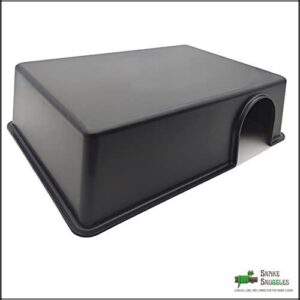
The Leoterra is a solid first pick for travel. Its large interior — roughly 16.5" × 10.6" × 4.3" — gives adult ball pythons real room to coil without feeling exposed.
Rounded corners won’t snag scales, and the smooth, non-porous plastic wipes clean fast between stops. High side walls reduce escape risk inside shallow travel tubs. One entry point keeps your snake feeling secure.
It’s simple, functional, and built for the road.
| Best For | Reptile owners with small-to-medium snakes, geckos, or other compact critters who want an affordable, easy-to-clean hide that holds humidity well. |
|---|---|
| Material | Molded plastic |
| Size | Medium |
| Weight | Lightweight |
| Easy to Clean | Rinse with water |
| Species Suitability | Snakes, lizards, spiders |
| Price | $12.99 |
| Additional Features |
|
- The enlarged entrance (2.75" × 2.36") makes it easy for snakes to get in and out, even after a big meal
- Top-seal design helps trap moisture inside, which is great for species that need a humid hide
- Super easy to clean — just rinse it off and drop it back in the enclosure
- Snakes over 200g may find the opening too tight, so you’d need to size up to the L or XL
- It’s light enough that an active snake can push it around, which might mean you need to weigh it down
- At $12.99, some folks feel it’s a bit pricey for what’s essentially a basic plastic hide
2. Crochet Snake Hideout Donut Bed
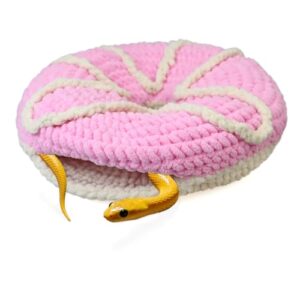
Not every travel hide needs to be rigid. The vomvomp Crochet Snake Hideout Donut Bed takes a softer approach — hand‑crocheted polyester yarn shaped into a snug tunnel that your snake can curl inside during car rides or vet visits.
The opening runs about 3–3.5 inches wide, sized right for hatchlings and small ball pythons. It’s breathable, machine‑washable, and doubles as a lightweight carrier. Just skip it for larger adults — the fit won’t hold up.
| Best For | Owners of hatchlings, small ball pythons, corn snakes, or other small reptiles who want a soft, lightweight hide that doubles as a travel pouch. |
|---|---|
| Material | Polyester yarn |
| Size | Small/Medium |
| Weight | Lightweight |
| Easy to Clean | Machine washable |
| Species Suitability | Snakes, small reptiles |
| Price | $19.99 |
| Additional Features |
|
- Breathable crochet design lets your snake’s scent pass through, which helps keep them calm and comfortable
- Machine-washable and easy to maintain — no fussing with complicated cleaning routines
- Lightweight and compact, so it’s easy to toss in a bag for vet visits or short trips
- Only works for small or juvenile snakes — larger adults will outgrow it fast
- Polyester can trap heat, so ventilation might be a concern in warmer environments
- The delicate crochet construction can wear down over time, especially with rough handling or frequent washing
3. Pangea Mini Reptile Hide Box
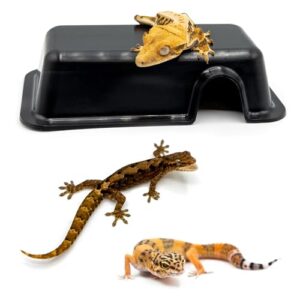
If soft hides aren’t your style, the Pangea Mini Reptile Hide Box is the no-nonsense alternative. It’s built from 1/8-inch thick ABS plastic — rigid, non-porous, and easy to wipe down between stops. The offset door keeps your snake feeling tucked in without trapping heat.
At 5.5 × 3 × 1.5 inches, it fits neatly inside rack tubs and 28–32 quart travel totes.
One downside: very small hatchlings under 500 grams may find the interior a touch roomy.
| Best For | Reptile keepers running rack systems or breeding setups who need a durable, easy-to-clean hide for hatchlings and small snakes like ball pythons or baby leopard geckos. |
|---|---|
| Material | ABS plastic |
| Size | Mini |
| Weight | 0.02 lb |
| Easy to Clean | Quick disinfection |
| Species Suitability | Snakes, geckos, lizards |
| Price | Not listed |
| Additional Features |
|
- Rigid ABS plastic holds up under heat lamps without warping or cracking
- Non-porous surface wipes clean fast — great if you’re sanitizing a bunch at once
- Offset door design gives small reptiles that snug, tucked-in feeling they need
- Interior might feel too spacious for snakes under 500 grams
- Plain black plastic looks pretty basic if you care about how your enclosure looks
- Fixed dimensions mean you need to double-check the fit before buying
4. Exo Terra Small Snake Cave
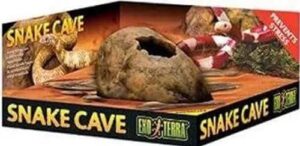
Want something with a bit more structure? The Exo Terra Small Snake Cave steps up with a removable top, so you can check on your snake mid‑trip without pulling the whole hide out.
It’s a small upgrade that makes a real difference, especially if you’re still figuring out which snake hide works best for your setup.
It’s made from non‑porous resin, measures roughly 16 × 11.5 × 7.3 cm, and comes with a moss pack you can dampen for a quick humid retreat.
Just don’t place it directly over a heat source — that narrow entrance traps warmth fast.
| Best For | Small reptile owners — especially those keeping baby snakes, geckos, or lizards — who want a tidy, stable hide that doubles as a humid retreat. |
|---|---|
| Material | Rigid plastic |
| Size | Small |
| Weight | 1.5 lb |
| Easy to Clean | Smooth surface |
| Species Suitability | Snakes, lizards, geckos |
| Price | $27.99 |
| Additional Features |
|
- Removable top makes it easy to peek in or clean without stressing your animal
- Included moss pack lets you boost humidity right inside the hide, great for shedding season
- Heavy, stable build means it stays put even with an active reptile inside
- The ~1 inch entrance is pretty tight, so your reptile can outgrow this one fast
- Sitting it over a heat source is a bad idea — warmth builds up quickly inside and can burn your pet
- The moss can smell off at first and leave behind particles, so give it a good rinse before use
5. Zoo Med Habba Hut Large
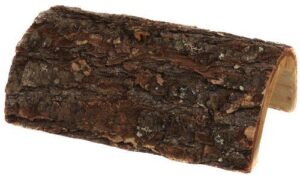
Wood hides aren’t always the first pick for travel, but the Zoo Med Habba Hut Large earns its spot. At 8 × 4 × 2 inches, it fits most juvenile and small adult ball pythons without crowding a travel tub.
The natural fir construction is untreated, so there’s no off-gassing risk in a sealed setup.
Pack damp sphagnum moss inside to build a quick humid retreat.
Just inspect it before each trip — wood warps, and a cracked hide isn’t worth the risk.
| Best For | Reptile and small mammal owners who want a sturdy, natural hide that doubles as a basking platform and can handle a bit of humidity. |
|---|---|
| Material | Natural wood |
| Size | Extra-Large |
| Weight | 1.7 lb |
| Easy to Clean | Wipe clean |
| Species Suitability | Reptiles, small mammals |
| Price | Not listed |
| Additional Features |
|
- Solid wood construction feels substantial and won’t tip over when your animal bumps into it
- Works as both a hide and a basking platform, so it pulls double duty in the enclosure
- Easy to pack with damp moss for a quick humid microclimate
- It’s on the large side, so smaller tanks may feel cramped once it’s in there
- Heavy enough that repositioning it is a bit of a hassle every time you clean
- Ships damaged occasionally, so give it a good look before you put any animal near it
Travel Hide Buying Criteria
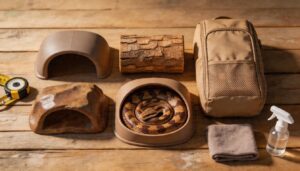
Not every hide that works at home will hold up on the road. Before you grab whatever’s closest, there are six things worth checking first.
Here’s what actually matters when you’re picking a travel hide for your ball python.
Snug Sizing for Secure Coiling
Size it wrong and your snake won’t settle. The interior should be 1.5 to 2 times your hatchling’s coil diameter ratio — snug, not squeezing.
Watch for snug fit indicators: head tucked, body centered, no wall pressure.
Proper clearance buffer and entry alignment let your ball python coil fully, without pressure point reduction becoming a concern.
Single Offset Entrance for Security
centered opening invites trouble — your snake can bolt straight out during travel checks. offset entrance creates a natural choke point design, slowing exit and limiting escape vectors.
Think of it like tailgating prevention: one body, one direction.
Directional sensing hides, confirms forward-only movement, while access control integration and regular sensor alignment checks keep the mechanism reliable every trip.
Non-porous Materials for Easy Sanitizing
Travel hides take a beating—disinfectants, moisture, repeated scrubbing. That’s why material matters.
ABS plastic and food-grade resin offer Durability Under Disinfection, resisting breakdown from bleach solutions. Integrated Fabrication eliminates micro‑creasevice traps where bacteria hide.
Look for smooth Surface Finish Types with solid Chemical Resistance and Thermal Stability, so hot sanitizers won’t warp the hide between trips.
Stable Bases That Resist Tipping
A tipped hide mid-transit is a stressed snake. Look for a Weighted Base Plate paired with an Anti‑Slip Bottom — that combination keeps the hide planted even on bumpy roads. A Low Center Gravity profile and Broad Footprint Design spread load evenly, while Chamfered Edge Reinforcement prevents corner snagging inside tubs.
A stable hide starts at the base — weighted, grippy, and low to the ground so bumpy roads never win
A stable hide means:
- No tipping when your snake pushes forward
- Grip that holds on glass, plastic, or wood
- Weight distributed low, not top‑heavy
- Corners that won’t catch on tub liners
- Consistent contact across the entire base
Smooth Interiors Without Sharp Edges
A rough interior is a hidden hazard. Run your finger along the inside — any burr, raised seam, or sharp cast line is a scrape waiting to happen.
Look for Rounded Edge Profiles, Bullnose Wall Finish, and Smooth Interior Joints that leave no gap for scales to catch.
Chamfered Interior Corners and Burr-Free Surfaces keep your snake moving safely without skin irritation.
Humid-hide Compatibility for Travel Tubs
Beyond sharp edges, humidity matters just as much in a travel tub. Your hide needs solid Hide Seal Integrity to trap moisture without turning the inside into a swamp.
Pack damp sphagnum moss — it’s the best for Moss Moisture Balance.
Keep Ventilation Rate moderate, position the hide along the Temperature Gradient‘s warm-middle zone, and plan your Filler Replacement Frequency every two to three weeks.
You can benefit from fast shipping when orders placed before 12 pm are dispatched the same day.
Matching Hides to Travel Setups
Not every hide works the same way in a travel tub — size, placement, and humidity needs all shift depending on your snake’s age and the length of your trip.
Getting the match right keeps your ball python calm and secure, whether you’re an hour from home or three days out.
Here’s how to pair the right hide to your specific setup.
Best Hide Sizes for Hatchlings and Juveniles
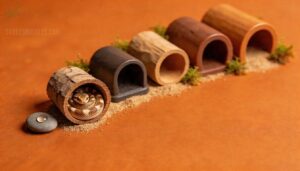
Hatchlings need hides in the 2–3 inch height and 3–4 inch width range, with an entrance diameter of 1.25–1.75 inches — that’s your entrance diameter guideline in practice.
Coil girth ratio matters here: too much interior space, and your snake won’t settle. Think growth stage scaling as your signal to resize.
Stable weight distribution design prevents tipping in travel tubs.
When Adults Need Larger Travel Hides
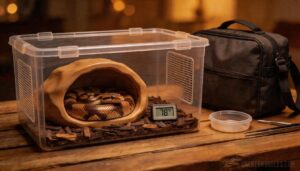
Adult ball pythons need hides measuring at least 7–9 inches tall with a 2–3 inch entrance opening. That extra height allows full coiling without forced posture.
Prioritize Material Durability and solid Ventilation Design for multi‑day trips.
Temperature Zoning stays manageable when Portability Features keep the hide stable, and Weight Capacity Limits prevent flex or collapse during transit.
Fitting Hides Inside Temporary Tubs
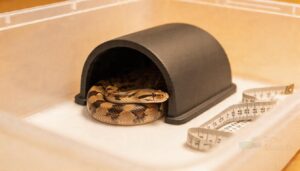
Once your adult has a properly sized hide, the next step is making sure it actually fits the tub. Measure the tub interior first — Tub Wall Clearance determines everything.
A hide with smart Modular Hide Design and Weight Distribution Balance sits flat without shifting.
Entrance Angle Optimization keeps reentry stress-free, and Quick-Release Latches make cleanouts fast between stops.
Warm-side Versus Cool-side Hide Placement
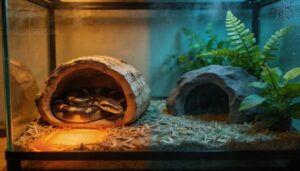
Place one hide directly over or near the Heat Source Proximity zone — upper 80s to low 90s°F keeps digestion moving. The second goes at the cool end, around 76–80°F, using Cool Zone Positioning for retreat after meals.
That Temperature Gradient Spacing between hides helps natural thermoregulation. Together, Dual Hide Balance gives your snake Coiling Security Zones across both thermal ends without crossing open ground.
Using One Hide or Two on Short Trips
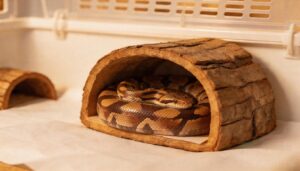
For short trips, one hide usually does the job. It maximizes Space Efficiency in tight travel tubs and simplifies Ventilation Control by reducing air pocket competition. Stress Reduction stays high when your snake knows exactly where its safe spot is.
Consider two hides when:
- Noise Buffering matters in loud environments
- You need a Backup Shelter if one shifts
- Travel exceeds a few hours
Adding a Humid Retreat During Transit Stays
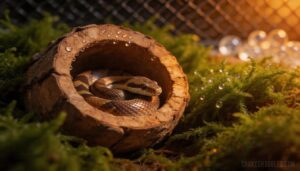
Transit stays change the game. A humid retreat creates a localized microclimate inside your travel tub without soaking the whole setup.
Focus on Microclimate Placement toward the warm side, keep Ventilation Balance intact, and check your Humidity Monitoring Tools every two hours.
| Factor | Recommendation |
|---|---|
| Moisture Source Options | Damp sphagnum moss or gel beads |
| Mold Prevention Strategies | Replace materials every 24–48 hours |
Safe Use and Cleaning Tips
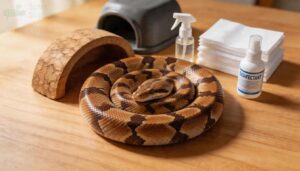
Getting your hide clean and travel-ready isn’t complicated, but it does take a little intention. A few simple habits before and after each trip can protect your ball python from unnecessary stress and hidden bacteria.
Here’s what you need to know to keep things safe and simple on the road.
Pre-trip Hide Inspection Checklist
Before every trip, run a quick once-over on each hide. Check ventilation holes for blockages and do a seal integrity test on all seams and lids — any separation can harbor bacteria.
Do a mold detection inspection inside, especially in moss hides. Fit within tub with room to spare, and complete a material toxicity confirmation by checking for chipped coatings or burrs.
Sanitizing Hides Before and After Travel
Sanitizing isn’t optional — it’s the line between a safe hide and a bacterial trap. Keep it simple with three non-negotiable steps:
- Apply a reptile-safe disinfectant and respect the Disinfectant Contact Time — usually 5–10 minutes.
- Run a quick Mold Detection Routine inside seams before packing.
- Follow Tool Sanitization Steps and use Disposable Hide Liners to cut cross-contamination.
A Moisture Barrier Spray before travel adds extra protection.
Managing Damp Moss Without Excess Humidity
Damp moss in a travel tub can turn into a humidity problem fast. Wring the moss until barely damp, then rely on Moss Airflow Management — keep a small gap between moss and tub walls.
Use Silica Gel Placement near the hide entrance and build Microdrainage Channels under the tray.
Follow a Moisture Monitoring Schedule every two hours, with smart Hygrometer Positioning at moss level.
Preventing Stress in Temporary Enclosures
Once humidity is dialed in, your next job is keeping stress low.
Ball pythons read their environment fast — noise, light, and movement all register.
Keep these habits in place:
- Quiet Car Ride: limit music and conversation
- Minimal Vibration: use padded tub placement
- Gradual Lighting: dim the travel area slowly
- Soft Substrate: cushions sudden jolts
- Calm Transport: slow, steady handling only
Replacing Cracked, Warped, or Outgrown Hides
A cracked or warped hide isn’t just an eyesore — it’s a real hazard. Sharp edges from cracks can snag scales, and warped shapes trap moisture unevenly.
When Material Durability Testing reveals deformation, swap it out immediately.
Rigid plastic and resin options hold up best, especially Temperature Resilient Designs that won’t buckle near warm-side temps.
Edge Polishing Techniques matter too — run your finger around any replacement’s entrance before it goes in.
Packing Hides for Car Rides and Hotel Stops
Once your hides pass inspection, pack them smart. Use a Hide Labeling System — a simple piece of tape marking warm vs. cool — so setup at the hotel takes seconds.
Portable Hide Carriers like soft-sided cases cut noise and prevent rattling.
Rotate hides using a Travel Hide Rotation order, and apply Space Optimization Tips by nesting smaller hides inside the tub itself.
Noise Reduction Strategies matter: wrap hides in a thin cloth.
Frequently Asked Questions (FAQs)
Can ball pythons share one hide during travel?
Yes, but only on short trips with calm snakes.
Watch for Co-hiding Behavior Signs and use aggression detection methods such as hissing or circling.
Apply Space Requirement Calculations: size up by at least 20% for two.
How often should travel hides be replaced?
Replace travel hides immediately when cracks, odors, or warping appear. Follow Wear Indicator Checks before every trip.
Apply Growth-Based Timing as your snake grows. Use Seasonal Hide Rotation, Odor Accumulation Triggers, and Replacement Interval Guidelines annually.
Do hides affect temperature regulation in transit?
A hide won’t heat your snake, but it does create microclimate stability by trapping still air.
That small temperature gradient buffer slows heat loss — especially when snug walls limit ventilation, restriction, and reduce the evaporation cooling effect.
Which hide materials handle cold weather best?
Resin and ABS plastic win for cold weather. Both offer strong moisture barriers and solid heat retention.
High thermal mass materials like ceramic help too, but only with insulated liners for cold shock resistance.
Should hides be removed during actual transport?
Leave the hide in place. It’s your snake’s anchor — a familiar scent, a visual shield, and a coiling surface all in one. Removing it mid-transit spikes stress and invites thrashing.
Conclusion
Ironically, the secret to a stress-free ball python travel setup lies in a simple hide. You’ve invested in your pet’s health and safety; now, invest in their comfort.
A well-chosen hide can make all the difference. When selecting ball python hides for travel setups, prioritize snug sizing, secure entrances, and easy cleaning.
By doing so, you’ll guarantee a smooth journey for both you and your pet. A happy snake is just a hide away; make the right choice today.
- https://azeah.com/reptiles-amphibians-lizards-snakes-tortoises-turtles/heating-and-temperature-control-reptiles
- https://showmereptileshow.com/resources/transporting-reptiles-in-cold-weather-essential-tips-for-safe-travels
- https://med.libretexts.org/Bookshelves/Anatomy_and_Physiology/Anatomy_and_Physiology_(Boundless)/5:_Integumentary_System/5.4:_Functions_of_the_Integumentary_System/5.4B:_Thermoregulation