This site is supported by our readers. We may earn a commission, at no cost to you, if you purchase through links.

boa constrictor into an apartment isn’t the problem most people expect. The real challenge is fitting the rack.
A full-grown common boa can reach six feet, and the enclosure needs to match that length—which means you’re suddenly planning around a piece of furniture that rivals your sofa in square footage.
Most apartment keepers don’t realize this until they’re measuring door frames with a tape measure and a sinking feeling.
The good news is that boa constrictor racks for small apartment setups have come a long way, with purpose-built designs that work with tight footprints, low ceilings, and landlords who don’t need to know the details.
Table Of Contents
Key Takeaways
- Full-grown boas need at least a 6×3-foot enclosure, so plan your room layout around the rack before you buy the snake.
- Vertical stackable systems are your best friend in a tight apartment — they trade floor space for wall space without cramping your boa.
- PVC outperforms glass and acrylic for compact setups because it holds heat and humidity without adding excessive weight to your shelving.
- Security isn’t optional — cam locks on every door and sealed vents under ¼‑inch are what stands between you and a very bad call to your landlord.
Best Boa Rack Styles
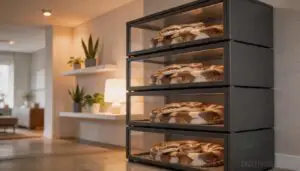
Not every rack style works in a small apartment — space constraints make some setups genuinely smarter than others. The good news is there are more options than most people expect, from low-profile units that slide against a wall to modular systems that grow alongside your room.
Here are the styles worth knowing about.
Low-profile Racks for Studio Apartments
When square footage is precious, low-profile racks pull real weight. A slim profile door and shallow cabinet depth let you tuck space-saving snake enclosures for apartments flat against any wall—no dead zones wasted.
Explore apartment-friendly snake enclosure options that prove smart design really can keep your snake happy without sacrificing your living space.
vertical organization solutions can further optimize the area.
Four features worth prioritizing:
- Under-shelf placement compatibility
- Hidden power strips for clean cable management
- Noise-dampening feet for renter-friendly setups
- Compact terrarium depth that doesn’t eat walking space
Vertical Stackable Systems for Tight Footprints
Vertical Footprint Optimization is where stackable cages really shine in a cramped apartment. Instead of spreading outward, modular and stackable boa habitats climb upward, reclaiming floor space you’d otherwise lose.
Adjustable Tray Spacing lets each level fit your snake’s current size. Anti-Roll Safety Locks and Sensor-Driven Collision Prevention keep things secure, while Integrated Cable Management keeps your vertical terrarium setup clean and rental-friendly.
Front-opening Enclosures Vs Tub-based Racks
Once you’ve gone vertical, the next call is what goes on each level. Front opening doors make Feeding Convenience and Cleaning Speed genuinely easier — you reach in at body level, no awkward overhead grabs.
V180 Tub Boa Breeding Rack systems win on Portability Factor and lower Animal Stress, since boas settle well in darker, enclosed spaces. Aesthetic Appeal tips toward front-opening, but apartment restrictions often favor space‑saving snake enclosures for apartments.
Modular Racks That Expand as Boas Grow
Modular reptile enclosures for boa constrictors solve the problem tub-based racks create — what happens when your juvenile outgrows its space? With expandable cages, you add levels using Frame Connectors without dismantling everything.
Growth-stage enclosure adaptability means Tub Compatibility stays consistent across the same family.
Plan your Power Distribution and Hide Integration from day one, and these space-saving snake enclosures for apartments scale quietly alongside your boa.
Complete Kits Vs Frame-only Rack Packages
Complete kits bundle PVC frames, tubs, and a 52-foot heat cable into ready-to-run customizable snake habitats with heat gradients — genuinely useful if you’re starting fresh.
Frame-only packages cut Cost Comparison by 30–50%, offering Customization Flexibility to mix tub sizes for baby and adult boas alike.
Long-Term Value favors kits for beginners, while frame-only wins on Shipping Handling, since rack-only ships free.
Choosing Apartment-Friendly Rack Dimensions
Getting the dimensions right is honestly half the battle when you’re working with limited square footage. The wrong rack size doesn’t just crowd your boa — it can throw off your whole room layout before you even add a water bowl.
Here’s what to keep in mind as you size up your options.
Sizing Racks for Baby, Juvenile, and Adult Boas
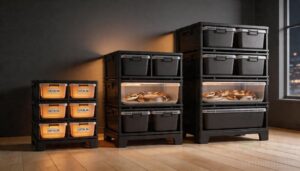
Getting the sizing right from day one saves you a lot of unnecessary upgrades.
The same logic applies to temperature control—choosing the right reptile thermostat for your corn snake setup means fewer headaches once your enclosure is dialed in.
Baby boas thrive in 15–28 quart tubs, while juveniles around three feet move into 28-quart grow-outs.
Adults need at minimum, a 6×3-foot enclosure.
Good upgrade path design and tub capacity guidelines let these modular, space-saving snake enclosures for apartments grow with your boa without sacrificing load capacity or vertical clearance limits.
Matching Enclosure Length to Snake Body Length
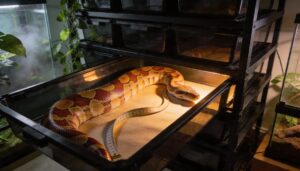
Here’s the rule that matters most: enclosure size should match your boa’s actual body length, not its length today. Accurate body length measurement — traced along the dorsal curve with flexible tape — gives you a true baseline for the stretch space rule.
Apply a length-to-width ratio of roughly 2:1, then build in a future size buffer through growth projection planning. Modular and stackable cages make that easy.
Floor-space Planning for Corners, Walls, and Closets
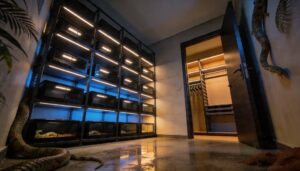
Apartment space is a puzzle, and your rack placement is the first piece. A Wall Run Layout along one wall keeps the center open for handling.
Corner Clearance matters more than people expect — leave room for door swing and Access Pathway.
Closet Fit works well if you measure usable depth, not the rough opening.
Smart Load Management starts with placement, not product.
Height Clearance for Stacked Enclosures
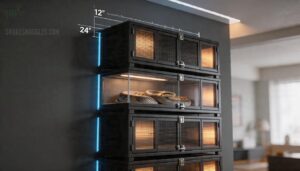
Stacking up sounds smart — until you’re on your toes trying to reach a boa in the back corner. Height clearance is everything with space‑saving snake enclosures for apartments. Keep these in mind:
- Leave a ceiling buffer of at least 18 inches above your top shelf
- Modular and stackable boa habitats should stay at or below your shoulder height for daily access
- Rack height limits cap around seven feet — stepstool reach accommodates anything above five feet high
Expandable stacking enclosure systems and vertical design work beautifully, but overhead light clearance matters too. Plan your stack before you build it.
Weight Limits for Upper-floor Apartment Setups
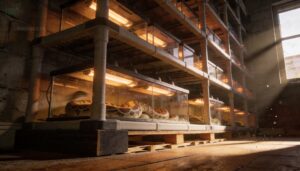
Upper floors in most residential buildings cap out at 40 lbs per square foot — and a fully loaded 8-shelf boa rack can hit 800 lbs fast. That’s where Floor Load Calculations and Joist Spacing Guidelines become your best friends.
| Setup Type | Total Weight | PSF (8 sq ft footprint) |
|---|---|---|
| Empty PVC rack | 180 lbs | 22.5 |
| Rack + substrate + bowls | 500 lbs | 62.5 |
| Full 8-shelf with boas | 800 lbs | 100 |
Footprint Weight Distribution is your fix — spread racks perpendicular to joists and use plywood underneath. Caster Load Mitigation helps too. Landlord Code Compliance isn’t optional either, so check before you stack.
Access Space for Feeding, Cleaning, and Handling
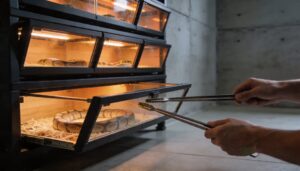
Weight gets all the attention, but access space is just as easy to overlook. Front-opening doors on modular and stackable cages give you real Prey Transfer Space and Handling Path Clearance without awkward overhead lifting.
Leave at least 24 inches in front of your space-saving snake enclosures for apartments — enough for your Sanitation Reach, Tool Accessibility Zone, and smooth feeding sessions using tongs safely.
Materials for Small-Space Boa Racks
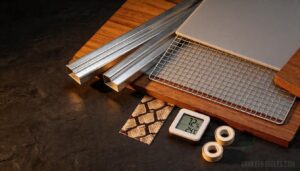
The material your rack is built from affects everything — heat retention, humidity, weight, and even how stressed your boa feels day-to-day. In a small apartment, those details matter more than you’d think.
Here’s how the most common options stack up.
PVC Heat and Humidity Retention Benefits
PVC enclosures quietly outperform most materials when space and stability both matter. Their natural insulation efficiency keeps stable temperature gradients locked in without constant thermostat fiddling.
PVC acts as a reliable moisture barrier too — slowing evaporation and supporting humidity control without soaking damage. That means energy savings, reduced condensation, and less intervention from you.
For space-saving snake enclosures for apartments, it’s a genuinely practical choice.
Glass Visibility Vs Weight and Heat Loss
Glass looks stunning, but it comes with real tradeoffs. Higher VLT means excellent visibility, yet glass struggles with U-value efficiency — heat bleeds out fast, making your thermal gradient harder to hold.
Low-e coatings help limit that loss through spectral selectivity, but they add cost and weight.
In tight apartments, extra load on shelving matters more than most keepers expect.
Acrylic Durability and Scratch Concerns
Acrylic lands somewhere between glass and PVC in practice. It’s lighter and impact-resistant, but scratches more easily — regular cleaning with anything abrasive leaves haze over time.
For acrylic enclosures, always use microfiber cloth use, and mild soap; skip ammonia-based cleaners entirely. Hard-coat options resist daily wear better, and UV stabilization benefits keep panels from yellowing.
Minor scratches? Scratch repair techniques like plastic polish actually work.
Sealed Wood or Melamine for Quieter Setups
Wood-melamine panels bring surprising acoustic damping to apartment setups — dense, sealed surfaces flex less and rattle far less than bare boards. Proper edge sealing blocks moisture from creeping into the core, supporting real humidity stability over time.
smooth surface finish wipes clean easily, and paired with noise-reducing gaskets on doors, these quiet boa constrictor enclosures keep everyday sounds low in shared living spaces.
Load-capacity Ratings for Stacked Enclosures
Stacking adds weight fast, so understanding Static Load Rating and Variable Load Rating before you build up is essential. The bottom unit carries everything above it — frame stiffness and solid load distribution keep doors aligned and panels from warping.
Modular cage design and expandable stacking enclosure systems with caster capacity ratings help you scale safely, especially in upper-floor apartments where every pound counts.
Non-reflective Finishes for Reduced Stress
Choosing a matte or low-glare coating isn’t just about looks — nonreflective surfaces to reduce reptile stress actually matter. Boas can startle at their own reflection, raising cortisol levels over time.
Matte Surface Benefits include keeping your modular cage design visually calm, while Scratch-Resistant Matte and Easy-Clean Non-Gloss finishes simplify upkeep. For space-saving snake enclosures for apartments, Stress-Reducing Color and Low-Glare Coatings make modular and stackable boa habitats feel quieter overall.
Heating and Humidity for Compact Racks
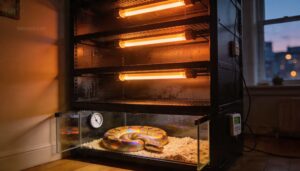
Getting the heat and humidity right inside a compact rack is honestly where most apartment keepers either win or lose. Dry indoor air, thin walls, and limited space all work against you — but the right setup makes it manageable.
Here’s what actually works for keeping your boa comfortable in a smaller footprint.
Radiant Panels Vs Ceramic Heat Emitters
Both options keep light out at night — but that’s where the similarities end. Radiant panels win on Heat Distribution Uniformity, spreading even warmth across space‑saving snake enclosures for apartments without drying out humidity. Ceramic emitters run hotter and faster, demanding more attention.
- Maintenance Frequency — radiant panels need almost no maintenance once installed
- Safety Shielding — no exposed element means fewer contact burn risks
- Power Consumption — smart heating via panels is genuinely energy‑efficient heating
Safe Thermostat Setup for Stable Heat Gradients
Think of your thermostat as the brain of your entire heat gradient system.
For modular and stackable cages, pulse proportional thermostats handle probe placement best — secure probes directly on heat tape under each tub, targeting 90°F warm-side, 75°F cool-side. Multi-probe control controls stacked levels independently.
Wattage matching and fail-safe integration prevent overloads. Annual thermostat calibration keeps temperature regulation dialed in.
LED and External UVB Lighting Options
Boas don’t strictly need UVB — but smart lighting still matters for their well‑being in space‑saving snake enclosures for apartments.
- LED Energy Efficiency: LED lighting runs cool, keeping modular and stackable cages from overheating.
- Combined UVA/UVB Units: Single fixtures covering both spectra simplify cramped setups.
- UVB Fixture Placement: Mount externally, never aimed at eye level.
- UVB Spectrum Matching: Target 290–320 nm for safe D3 support.
Maintaining Basking Zones and Ambient Temperatures
Getting your thermal gradient management right comes down to where your probes sit. Place the thermostat probe at basking platform level — not near the ceiling.
Your basking spot should hit 86–90°F, with ambient cool-end air staying around 75–80°F. At night, that nighttime gradient can drop slightly.
As your boa grows, its enclosure needs to grow too, so check this recommended terrarium size for a red-tailed boa to keep those temperature zones working properly.
Run heating and lighting solutions for compact reptile enclosures through a calibrated thermostat — airflow balance takes care of the rest.
Humidity Control in Dry Apartment Air
Apartments run dry — especially in winter. Your boa needs 60–80% RH, so a hygrometer is non‑negotiable.
Pair humidity sensors with a misting system or humid hide box for steady moisture retention. Water bowl evaporation helps more than you’d think in space‑saving snake enclosures for apartments.
Seal gaps around doors and vents, and position a humidifier nearby for reliable humidity control.
Ventilation That Prevents Condensation Without Over-drying
Good humidity control and ventilation actually work together — one without the other creates problems. Balanced airflow moves fresh air in and stale air out without pressure swings that drag moisture into cold corners.
Heat recovery systems temper incoming air, so Cold Surface Control becomes much easier.
Pair that with Humidity Sensors for demand-based adjustments, and your space-saving snake enclosures for apartments stay at the right RH without drying out.
Security and Maintenance in Apartments
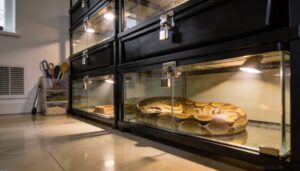
Keeping a boa in an apartment means security and cleanliness aren’t optional — they’re the whole game. A loose snake or a smelly enclosure can end your tenancy faster than a missed rent payment.
In an apartment, a loose boa or a smelly enclosure can end your tenancy faster than a missed rent payment
Here’s what to get right.
Cam Locks and Escape-proof Door Designs
A boa that escapes in an apartment isn’t just a problem — it’s a nightmare. That’s why front-opening doors with a solid cam lock body are non‑negotiable in space‑saving snake enclosures for apartments.
Anti-rotation plates keep the housing from loosening over time, and keyed‑alike systems let you manage multiple enclosures with one key.
- Cam locks provide reliable escape prevention without bulky hardware
- Keyed-alime pet safety locks simplify daily access across stacked racks
- Front-opening doors eliminate awkward top access in tight spaces
Sealing Gaps Around Vents and Access Points
Even a small gap around a vent can become an escape route for a determined boa. Seal duct seams with foil tape bonding on clean, dry surfaces, then apply mastic sealant application over any flexible joints. Use corrosion-proof wire mesh for vent mesh maintenance, keeping openings under ¼ inch.
| Gap Size Classification | Recommended Fix |
|---|---|
| Hairline cracks | Foil tape or caulk |
| 1/16–1/8 inch | Mastic sealant |
| 1–3 inches | Backer rod + foam |
| Duct penetrations | Firestop penetration details |
| Mesh vent openings | ¼-inch corrosion-proof screen |
Substrate Choices for Odor and Moisture Control
Substrate selection quietly shapes how your whole rack smells and breathes. Coconut Husk Absorption keeps moisture locked in without a soggy floor, while Cypress Mulch odor control is hard to beat for natural setups. For targeted Sphagnum Moss humidity boosts, tuck it inside hides.
Consider these core options:
- Bioactive substrates like Soil Blend Moisture mixes support humidity management long-term
- ReptiChip or Eco Earth handle odor reduction reliably
- Paper Bedding Maintenance suits temporary or quarantine tubs
Cleaning Routines for Small Indoor Spaces
A solid Daily Reset keeps your rack from becoming a biohazard. Spend ten minutes pulling waste, wiping surfaces with reptile-safe cleaning products, and doing a quick Floor Care Routine around the stand.
Weekly, go full Top-Down Dusting — vents first, then shelves, then floors.
Your cleaning and disinfecting schedule should include a 3% hydrogen peroxide wipe-down on all interior surfaces monthly.
Décor, Hides, and Water Bowls That Fit Compact Racks
Less is more inside a compact rack.
Wall Vines and Artificial Plant Walls add cover without eating floor space, while Compact Hide Pods and Floor Hides keep your boa secure without bulk.
A Zen Corner Cave or Cork Branch Small tucks neatly into corners.
Corner Water Bowls free up the center lane.
Fresh Sheet Moss, a Zen Mat, and heavy water bowls round things out cleanly.
Rental-friendly Features, Appearance, and Noise Reduction
Your rack doesn’t have to scream "reptile room."
Neutral color scheme frames, and straight-edged modular and stackable boa habitats read more like furniture than pet equipment.
Add felt pad hardware under stand legs to kill floor scraping.
Dimmable low-glare LED strips keep nights calm.
Thick area rugs soften vibration, and peel-and-stick wallpaper behind enclosures tie the whole setup into your home’s aesthetic effortlessly.
Frequently Asked Questions (FAQs)
Can boas share rack space with other reptiles?
Keeping boas together is like mixing oil and water — it rarely ends well. For species compatibility, stick to one boa per enclosure.
Shared spaces invite stress indicators, disease transmission, and feeding protocol chaos.
How do I handle noise complaints from neighbors?
Start with a polite conversation — your neighbor may not realize the issue. Document noise events, know local ordinances, and escalate to your landlord if needed. Simple soundproofing measures help too.
What permits do apartments require for keeping boas?
Before you set up a single rack, sort out the paperwork.
Landlord Consent comes first — then check State Dangerous‑Animal Permits, Species‑Protection Notification rules, and whether a Section 11 Welfare Permit applies.
Do boa racks affect renters insurance coverage?
The rack itself won’t affect your policy — but the boa will. Many insurers classify snakes under exotic pet exclusions, so liability disclosure matters.
Verify coverage before a claim dispute costs you.
How often should boas be moved between rack tubs?
Move boas only when they’ve outgrown their tub, need cleaning, or require quarantine. Chasing a fixed schedule adds unnecessary stress — let growth milestones and hygiene guide every transfer decision instead.
Conclusion
Like a puzzle piece, the right boa constrictor racks for small apartment setups fit seamlessly into your space. Consider your boa’s needs, and choose a rack that matches.
With options like low-profile and vertical designs, you can create a thriving environment. Invest in quality boa constrictor racks to guarantee a happy, healthy pet.