This site is supported by our readers. We may earn a commission, at no cost to you, if you purchase through links.

Managing six boas in separate glass tanks means six thermostats, six humidity gauges, and a room that looks like a herpetology lab mid-renovation.
Most keepers hit a wall around snake number three. Space runs out. Monitoring becomes guesswork. Feeding schedules turn chaotic.
Boa constrictor racks for multi-snake households solve this by consolidating your setup without cutting corners on the conditions each animal needs.
right rack keeps every snake at the right temperature, secure, and visible at a glance—whether you’re housing hatchlings in 7-quart tubs or adults approaching eight feet.
Table Of Contents
Key Takeaways
- Racks beat individual tanks once you hit three or more boas — they save space, simplify heat control, and let you check every snake at a glance.
- Match the tub size to your snake’s current length, not last year’s — hatchlings need 2×1.5×1 ft, while adults at 6–8 ft need at least a 6×3×3 ft enclosure.
- Heat tape on one end only, run through a thermostat, creates the 75–90°F gradient your boa needs to regulate its own temperature.
- Vision rack models scale with your collection — the V-15 holds up to 108 hatchling tubs, while the V-70 handles boas up to 5.5 ft, so you’re not starting over as snakes grow.
Best Rack Features for Boas
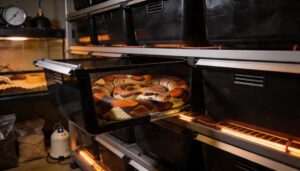
Not every rack works well for boas — the wrong setup causes stress, escapes, and wasted money.
Knowing what to look for before you buy makes all the difference, and this guide to boa constrictor racks for first-time owners breaks down exactly what separates a smart choice from a costly mistake.
A few key features separate a solid rack from one you’ll regret in six months.
Here’s what to look for before you buy.
Separate Housing for Each Boa
Every boa needs own space. No exceptions. Shared enclosures invite stress, aggression, and feeding competition — none of which you want.
Modular snake breeding rack systems solve this cleanly. Each snake gets its own tub with secure lid mechanisms, individual water management, and a hide distribution strategy that works for that snake alone.
Make sure each enclosure includes at least two hides to create humid microclimates. Better health monitoring, Fewer problems, Simpler control.
Floor-space Limits for Larger Snakes
Racks work great for hatchlings and juveniles. But floor-space limits hit quickly as boas grow.
A 6-foot boa needs a 6×3×3 enclosure minimum — that’s your snake length ratio baseline. Enclosure footprint calculations matter here.
Tubs don’t cut it for adults. Large snake racks and space-saving design help with multi-boa spatial planning, but adult boas eventually need real enclosures.
Modular Levels for Growing Collections
Modular rack design matters from day one, as collections inevitably grow over time.
Add-on shelf modules enable seamless scaling without requiring a full unit replacement. Side panel compatibility and an interlocking frame design ensure new levels integrate cleanly with existing structures, maintaining a unified setup.
Future level planning keeps your system expandable-stackable as you add modules, accommodating long-term growth. This forward-thinking approach prioritizes adaptability, allowing configurations to evolve alongside your needs.
Customizable snake rack configurations—including the V180 tub boa breeding rack—deliver practical flexibility. These designs offer expandable rack height, adjustable layouts, and adaptable builds tailored to specialized applications like reptile breeding.
Locking Wheels and Narrow-footprint Designs
Modular levels let you scale up. But none of that matters if your rack is stuck in a corner. Locking wheels change the game. Foot-operated locks engage without bending down. The swivel lock mechanism stops side drift too. Load-bearing casters hold the full weight — tubs, water, substrate, snakes.
Narrow base stability keeps your space-efficient snake housing tight against the wall. Caster spacing optimization prevents tipping. Lightweight and compact. Built to move when you need it — locked when you don’t.
Tub Compatibility, Hides, and Water Bowls
Tub Size Matching matters more than most keepers admit. Your boa needs room to coil, turn, and stretch — but not so much empty space that it feels exposed.
Vision tubs slide right into their snake rack system with no fuss. Add snug hide design on both warm and cool sides.
Water Bowl Hygiene keeps bacteria down — change it daily. Humidity Boosting Bowls do double duty during sheds.
Tool-free Assembly and Reconfiguration
No tools needed. Snap Lock System connectors click into place in seconds. That’s it. No screws. No manual.
The Click Click Assembly gets your rack standing in under 10 minutes.
Need more space? Level Stack Flexibility lets you add levels without rebuilding anything. These customizable expandable boa enclosures grow with your collection.
Caster Wheel Mobility and Adapter Hygiene Design keep daily care simple and fast.
Rack Sizes for Hatchlings to Adults
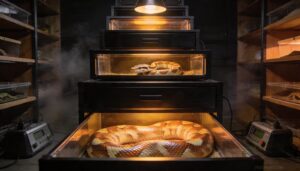
Boas don’t stay small for long. The right rack size today might be too tight in six months. Here’s what works at every stage of growth.
Hatchling Tub Needs Under 2 Feet
Baby boas under 2 feet don’t need much space — but they need the right space.
Your hatchling tub setup should check five boxes:
- Minimal Tub Dimensions: 2′ × 1.5′ × 1′
- Secure Lid Seal to prevent escapes
- Small Water Container to avoid drowning risk
- Easy Feeding Access and Quick Humidity Monitoring
- Temperature regulation via under‑tub heat
Multilevel hatchling rack systems offer a space‑saving design that’s Adjustable and Flexible — perfect for growing collections with hatchling tub accessories included.
Juvenile Rack Options From 2–5 Feet
Juveniles from 2–5 feet are the awkward middle child of boa housing — too big for hatchling tubs, not ready for adult enclosures.
That gap is where a snake breeding rack earns its keep.
| Rack | Tub Size | Best For |
|---|---|---|
| V-35S | 15-qt | Juveniles 2–3 ft |
| V-18 | 7-qt | Smaller juveniles |
| FB10-5 | Compact | Tighter spaces |
| BlackBox XR20 | V35/FB35 mix | Adjustable and flexible setups |
| Multi-level hatchling rack systems | Various | SpaceSaving Snake Breeding Infrastructure |
PVC Steel Choice construction with Vertical Stacking Efficiency keeps your Compact Footprint Design tight. Airflow Management and Adjustable Tub Height let each snake grow at its own pace.
When Subadults Outgrow Breeding Racks
At around 2.5–3 feet, Growth Rate Indicators tell you it’s time. Tub Size Thresholds hit fast — most Expandable breeding rack designs max out at 35 quarts.
Watch for these Behavioral Stress Signs in your Space-efficient snake housing:
- tight coiling with no room to stretch
- Refusing food or acting defensive during checks
- Body pressing every tub wall simultaneously
- Females outgrowing males by a full year
Upgrade Timing Strategies and Change Enclosure Planning keep your Space-saving snake breeding infrastructure ahead of your snake’s growth.
Why Adult Boas Need Larger Enclosures
Adult boas hit 6–8 feet.
changes everything.
Thermoregulation Freedom becomes non‑negotiable — your snake needs to move between 75°F and 90°F on its own terms.
Exercise Benefits disappear in a cramped tub.
Natural behavior, like climbing and exploring, requires real space.
Large enclosures reduce stress, support digestion, and enable Climbing Opportunities, no vivarium rack system or adjustable snake enclosure design can skip.
Planning Upgrades in Multi-snake Homes
Plan ahead — don’t just house the snakes you have today. Future-proof tub sizing means buying expandable breeding rack designs that grow with your collection. Incremental level expansion keeps costs manageable. Budget forecasting helps avoid scrambling when juveniles outgrow tubs fast.
Adjustable snake enclosure designs and stackable modular terrarium systems let you reconfigure without starting over. integrated monitoring systems early. Space-efficient snake housing pays off long-term.
Matching Rack Depth to Snake Size
Depth matters more than people think. Your boa needs enough straight-line stretch to rest without curling against the walls.
Follow basic snake length guidelines — tub length should match or exceed body length. Tub depth calculations matter too, since boas use vertical space utilization at night.
shallow tub forces compression. Match your reptile enclosure tub sizes to the snake you have now — not last year’s size.
Vision Rack Models Worth Comparing
Vision makes several rack models — each built for a different stage of your boa’s life. Knowing which one fits your setup saves you money and headaches down the road.
Here’s a quick look at the models worth your attention.
V-15 Hatchling Rack Capacity and Use
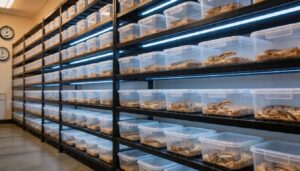
The V-15 Hatchling Rack is built for volume. Each shelf holds six V-15 tubs — that’s your level-to-tub ratio locked in.
Go 16 levels, and you’ve got 96 spots. Step up to 18, and you hit 108.
Footprint consistency means the same 34.5″ × 21″ floor space either way. For hatchling housing solutions, this snake breeding rack simply delivers.
V-18 Hatchling Rack for Larger Tubs
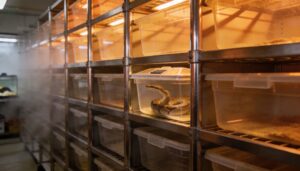
The V-18 steps up where the V-15 leaves off. Each shelf holds four 7-quart tubs — more floor space per snake. The 18-level build fits 72 tubs total. Steel pole reinforcement and ABS panel strength keep everything solid. No bowing.
For multi-snake households running a V-18 tub hatchling rack, tub volume flexibility and adjustable shelf height make this snake breeding rack worth every dollar.
V-35S Breeding Rack for Juveniles
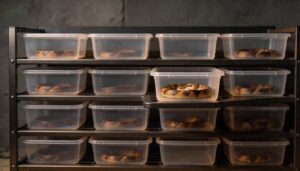
Your juveniles need room to grow — not an oversized pen. The V-35S Breeding Rack holds 32 tubs of space-efficient snake housing, each built from polypropylene strength that’s 25% thicker than standard bins. Low profile design keeps young boas secure.
The flat-top seal locks tight, while rodent breeding integration makes it flexible.
Durable breeding rack materials and adjustable and adaptable shelving make Vision snake breeding racks worth it.
V-70 Breeding Rack for Bigger Boas
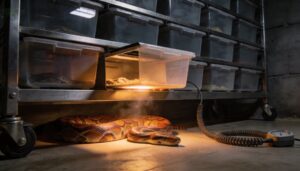
Bigger boas need bigger tubs. The V70 Tub Breeding Rack meets this need with 50-quart tubs, offering a real Tub Volume Advantage for snakes up to 5.5 feet. Key features include:
- 34" long tub provides ample stretching room
- Smooth bottom enhances Cleaning Accessibility
- Under-tub heat supports heat gradient creation and zone control in reptile habitats
- Space-efficient design accommodates Large Enclosures in compact footprints
- Low Power Consumption via thermostat-controlled Flexwatt heat
Durable Breeding Rack Materials ensure Weight Support without flex. Choose between Casters or Feet to suit your room layout.
Maximum Level Configurations and Expansion
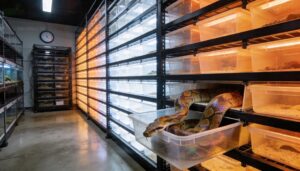
Want to grow your collection without starting over? Vision racks scale with you.
The 16 Level Breeding Rack holds 32 tubs — bump to the 18 Level Breeding Rack, and you get 36.
Adaptive level modules let you add rows as needed.
Rack height budgeting matters here: 18 levels hit nearly 91 inches.
These flexible breeding rack designs are expandable stackable systems built for future tub scaling and load‑bearing considerations at every stage.
Price-per-tub Value Across Models
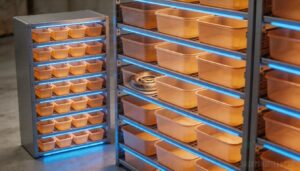
Same rack price. Different tub count. That’s where the math gets interesting.
The V15 Tub Hatchling Rack wins on Tub Cost Ratio — 108 tubs at $1,429.09 beats any Model Value Comparison. The V18 Tub Hatchling Rack offers better Volume Price Efficiency per quart.
Qty 10 or Qty 20 tubs? Per-Tub Savings grow as levels rise. Reptile hatchling rack pricing rewards scale — Economies of Scale are real here.
Heat, Humidity, and Safe Setup
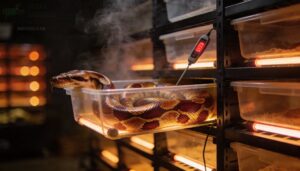
Getting the heat and humidity right isn’t optional — it’s the difference between a thriving boa and a sick one. Every tub in your rack needs its own gradient, moisture balance, and proper airflow working together.
Here’s what you need to set it up correctly.
Creating a 75–90 °F Gradient
Your boas need a 75–90°F spread — one side warm, one side cool. Heat Source Positioning drives everything here.
- Place heat cable on one side only for true Gradient Monitoring
- Use Thermostat Calibration to lock basking zones at 86–90°F
- Support Airflow Management with integrated rack ventilation
- Try Seasonal Temperature Adjustment, dropping nights to 68°F safely
Basking Zone Placement in Each Tub
Heat tape does one job — but only if you place it right.
Tub End Selection matters. one end per tub and stay consistent across every level. That’s your warm side.
Heat Tape Alignment means running a 22×11-inch flex watt strip under that end only — roughly one-third of the floor.
| Zone | Target Temp |
|---|---|
| Basking Spot | 86–90°F |
| Warm Side | 80–85°F |
| Cool End | 75–80°F |
| Night Low | 68°F |
Basking Spot Size cannot exceed 50% of the tub floor — that kills Temperature Gradient Control fast. Secure strips with aluminum foil tape for Heat Tape Protection. No tape shifting. No hot plate effect. clean, reliable heat gradient and zone creation your boa can actually use.
Thermostats and Probe Placement
Your thermostat runs the show — but only where the probe sits.
Nail these four things:
- Thermostat Wiring Practices: wall → thermostat → heat tape. Never reversed.
- Probe Securement Techniques: cable-tie the probe flat under the heat tape — snakes move loose probes.
- Heat Source Matching: one thermostat per tub level for Multi-Thermostat Coordination.
- Calibration Verification Steps: use a digital thermometer to confirm your gradient reads true.
Heat Cable on Every Level
Cable Routing Strategies start at the bottom shelf and work upward.
Use One-sided Placement — RL Heat Tape for VE Racks runs under one tub edge only. That creates your heat gradient and zone creation in reptile habitats automatically.
Zigzag Pattern covers bigger tubs better.
Cable Safety Measures: no sharp bends, no crushing.
Power Distribution stays controlled — always run through a thermostat.
Ventilation Effects on Humidity Retention
Ventilation built-in to Vision racks does real work — but your vent hole density and inlet exhaust placement decide how well humidity holds.
- Use 2–3 mm holes spaced 10 cm apart
- Offset inlets low, exhausts high
- Increase airflow path length across each tub
- Watch for humidity gradient stability between levels
Good mold prevention starts with consistent airflow — not guesswork.
Substrate Choices for Stable Moisture
Airflow sets the stage — substrate seals the deal. Coconut coir holds moisture longer than most options and won’t spike humidity fast. Cypress mulch slows evaporation at the floor level. Sphagnum moss works best in a damp hide corner.
Moisture layering offers a strategic approach: start with a wet coir base, then top with drier mulch. This method balances humidity effectively.
For breeding racks, a soil blend provides essential stability, aiding consistent humidity regulation without drastic fluctuations.
Preventing Shedding Problems in Rack Systems
Bad sheds don’t start at shed time — they start weeks before.
Maintain humidity between 55% and 75% daily, and bump it up to 80% when eyes go blue. Humid hide placement matters: position it on the cool end to keep moss damp longer.
Ensure the water bowl is large enough for soaking. Regulate heat tape through a thermostat.
Stick to your rack-cleaning routine and never skip the mite-inspection protocol.
How to Choose Your Final Rack
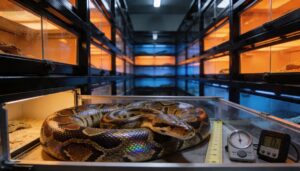
You’ve covered heat, humidity, and sizing — now it’s time to put it all together. The right rack depends on what you have now and where your collection is headed.
Here’s what to look at before you buy.
Best Racks for Hatchling-heavy Households
Running a hatchling-heavy household means you need expandable shelf systems fast. The V-15 is your best bet — starting at 8 levels and scaling to an 18 level hatchling rack with 108 tubs.
- Tub accessibility stays easy at every height
- Weight distribution stays balanced with modular shelves
- Noise reduction comes from locking wheels
- Lighting integration works shelf by shelf
- Space-efficient snake housing from a compact 34.5″ footprint
Best Options for Mixed-size Boa Collections
Mixed collections need a tub size hierarchy — hatchlings, juveniles, and adults each require different space. Snake breeder racks like Vision’s V-15, V-35S, and V-70 offer expandable breeding rack designs that handle all three stages.
Adjustable and flexible levels make cost-effective scaling simple.
Temperature zoning and humidity control methods stay consistent across tub sizes. Space-saving design keeps your whole collection organized without chaos.
Capacity Planning by Current and Future Snakes
Count your snakes today — then count them two years from now. Your Growth Rate Forecast should drive every rack decision you make.
One breeding pair yields 20–30 hatchlings yearly. That’s 30 tub slots gone fast.
Tub Slot Allocation and Expansion Budget Planning keep your Population Density Modeling realistic.
EXPANDABLE STACKABLE Vision racks support Long-term Capacity Scaling without chaos.
Flexible breeding rack designs and 10 Level Breeding Rack options make breeding colony management straightforward.
Mobility, Room Layout, and Floor Space
Your room layout shapes everything. Plan it wrong and you’re tripping over tubs.
- Aisle Width Planning starts at 36 inches between racks for safe access
- Footprint Consistency across V-35 units (34.5 × 21 inches) simplifies Modular Row Expansion
- Corner Placement Strategies and Vertical Rack Stacking optimize space-efficient snake housing
- EXPANDABLE STACKABLE Modular Reptile Housing Solutions fit 10-by-12 rooms cleanly
- Locking wheels move 800-pound loaded racks without wrestling
Durability, Warranty, and Long-term Value
Vision racks are built from highest quality materials and have been trusted for over 20 years. That’s not luck — that’s material longevity you can count on.
Enclosures carry a 5‑year warranty. Repairability options exist too — replacement tubs swap out without touching the frame.
Your cost per year drops the longer you run them. This is a lifetime investment.
Professional snake breeder tools don’t come cheap, but they do last.
When a Rack Beats Individual Enclosures
A rack wins when you keep more than two or three boas. Space efficiency alone makes the case — stacked tubs beat a wall of separate cages every time.
Cleaning convenience speeds up your weekly routine. Temperature uniformity stays consistent across every level with one thermostat. Flexible expansion means adding snakes without rearranging your whole room. Less disruption. Reduced stress — for you and your animals.
One thermostat, one rack, zero chaos — less cleaning, less stress, more snakes
Frequently Asked Questions (FAQs)
Can snakes live in a snake rack?
Yes — snakes can live in a rack. It provides health monitoring, stress indicators tracking, and low-maintenance reptile care.
Space-efficient snake housing works best for hatchlings needing simple, secure, temperature and humidity management in reptile racks.
How big should a boa cage be?
Size depends on the snake. Hatchlings under 2 ft need a 2′ × 5′ × 1′ tub. Juveniles need 4′ × 2′ × 2′. Adults 6–8 ft need at least 6′ × 3′ × 3′.
Can boas safely share a rack room together?
Yes — but not in the same tub. Each boa needs its own space.
Shared rooms work if Quarantine Protocols, Individual Thermostats, and strict Cleaning Schedules are in place.
Separate setups prevent stress and pathogen spread.
How often should rack tubs be deep-cleaned?
Think of it like laundry — let it pile up and you’ve got a real problem.
Deep-clean tubs monthly. Spot clean daily.
That’s your Cleaning Frequency Guidelines baseline for low-maintenance reptile care.
What feeding schedule works best in rack systems?
Feed by age, not habit. Hatchlings eat every 10–14 days. Juveniles eat weekly. Adults eat every 2–4 weeks.
Always check body condition first. Post-feeding rest — 48 hours minimum. One consistent feeding day keeps everything on track.
Do rack-housed boas show more stress behaviors?
Rack-housed boas can show stress — but only when setup is wrong. Poor heat gradient and zone creation, humidity stability issues, and tight space all raise barrier contact frequency.
Get those right, and stress drops fast.
How do you quarantine new boas in rack setups?
Keep new arrivals separate. Use a quarantine isolation tub design with paper towel substrate. Maintain quarantine heat consistency via thermostat.
Practice biosecurity tool management — dedicated tongs, no sharing. Monitor for 60–90 days before introducing to your Vision Snake Rack.
Conclusion
Back in the day, keepers managed six boas with duct tape plans and crossed fingers.
That era’s done.
right boa constrictor racks for multi-snake households give you real control — clean rows, stable heat, and every animal visible in seconds.
No more guesswork.
No more wall-to-wall glass tanks eating your floor space.
Pick the rack that fits your collection now and the one it’ll grow into.
Build smart once.
Don’t rebuild twice.