This site is supported by our readers. We may earn a commission, at no cost to you, if you purchase through links.
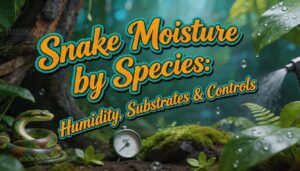
A rosy boa kept at 75% humidity won’t just be uncomfortable—it’ll develop scale rot within weeks. That single number separating survival from slow systemic failure reveals why species-specific snake moisture isn’t a preference setting; it’s a biological mandate. Wild pythons regulate moisture by retreating into humid burrows; captive snakes don’t get that option, so you control what they can’t.
Enclosure type, substrate choice, and measurement accuracy all determine whether your humidity targets translate into actual conditions at snake level. Get any one of those variables wrong, and your hygrometer reading becomes fiction. The differences across species are stark, specific, and non‑negotiable.
Table Of Contents
- Key Takeaways
- Snake Humidity by Species
- Best Enclosures for Moisture Control
- Substrates for Species-Specific Moisture
- Measuring Humidity The Right Way
- Fixing Low and High Humidity
- Misting Methods for Safe Humidity Increases
- Humid Hides for Shedding Support
- Water Bowl Placement and Evaporation Effects
- Ultrasonic Humidifiers and Automatic Controllers
- Signs of Low Humidity, Including Stuck Shed
- Signs of Excess Moisture, Scale Rot, and Mold
- Preventing Respiratory Issues From Poor Ventilation
- Seasonal Humidity Adjustments for Indoor Snake Rooms
- Frequently Asked Questions (FAQs)
- What is the ideal humidity level for a snake tank?
- Do snakes need high humidity?
- Is too much humidity harmful to snakes?
- Do snakes need a humidifier?
- Does seasonal breeding affect snake humidity requirements?
- How does snake age change moisture needs over time?
- Are there humidity differences between male and female snakes?
- Conclusion
Key Takeaways
- Humidity isn’t a preference—each species has a hard biological range, and missing it by even 10–15% triggers real consequences like scale rot, stuck sheds, or respiratory infection.
- Your enclosure material does more humidity work than any misting schedule: PVC holds moisture in, screen-top glass tanks bleed it out, and no amount of misting fully compensates for the wrong build.
- Substrate depth and species match determine whether humidity stays stable between checks—coconut fiber and sphagnum for tropicals, dry sand-soil mixes for arid snakes, and wet aspen is a fast track to mold.
- A digital hygrometer placed at snake level, calibrated with a salt test, and supplemented by a second probe in larger enclosures is the only setup that tells you what your snake is actually breathing.
Snake Humidity by Species

Not every snake on your shelf needs the same air around it. Humidity requirements shift dramatically depending on where a species evolved — a West African rainforest demands something completely different from a Sonoran desert wash.
Getting those ranges right for each species really matters — this breakdown of python species humidity differences shows just how wide that gap can be.
Here’s what each major group actually needs.
Ball Python Humidity Range: 60%–80%
Ball pythons thrive at 60%–80% relative humidity year‑round, but push that toward 70%–80% during a shedding cycle to prevent retained eye caps and patchy tail skin.
Temperature interaction matters here — the warm side accelerates evaporation, so gradient design should concentrate damp substrate toward the cooler end.
Use a digital hygrometer at ground level, maintain fresh hydration water, and adjust for seasonal shifts in ambient indoor air.
Watch for impending shed signs like dull coloration and opaque blue eyes.
Green Tree Python and Emerald Tree Boa: 70%–90%
Tropical canopy snakes like Green Tree Pythons and Emerald Tree Boas operate in a different league than the ball python discussed above. Their species-specific humidity requirements sit at 70%–90%, reflecting the branch moisture gradients and canopy microclimate of Amazonian and New Guinean rainforests.
Key management points:
- Juvenile hydration is critical — hatchlings dehydrate faster than adults and need stable, consistent moisture
- Rainfall simulation via timed misting drives humidity spikes that dry back toward 70% baseline, mimicking natural wet-dry cycles
- Color shift humidity cues matter — juvenile color transitions in both species correlate with stable environmental conditions
Substrate selection for ideal moisture retention and reliable humidity control methods for snake habitats aren’t optional here. They’re the baseline.
Boa Constrictor Humidity Range: 55%–75%
Boa constrictors sit comfortably in the 55%–75% range — noticeably lower than the canopy species above. Species-specific humidity requirements for snakes like Boa constrictor aren’t static, though. Breeding moisture and seasonal humidity shifts trigger measurable behavioral cues and metabolic effects.
A humid hide, combined with smart substrate selection for ideal moisture retention, keeps conditions stable without tipping into the soggy territory that invites scale rot.
Corn Snake and Temperate Species: 40%–60%
Corn snakes (Pantherophis guttatus) drop comfortably into the 40%–60% band — reflecting their temperate, southeastern U.S. origins where regional climate matching means patchy moisture, not constant saturation.
Humidity control here is forgiving, but shedding humidity boost matters: substrate selection for ideal moisture retention, like cypress mulch, helps brumation moisture needs and the ventilation versus moisture retention balance that prevents respiratory complications.
Rosy Boa, Hognose, and Arid Species: 30%–50%
Rosy boas and western hognose snakes — built for Rock Crevice Shelters and sandy desert floors — cap out at 50% humidity, and pushing past that invites scale rot fast.
Use a Desert Soil Mix substrate with minimal moisture retention, prioritize Ventilation Strategies over moisture trapping, and reserve Shedding Hydration to a single humid hide.
Your Temp Humidity Gradient does the rest.
Matching Enclosure Moisture to Native Habitat
Every species carries its native climate in its physiology — Habitat Climate Replication isn’t optional, it’s foundational.
Every species carries its native climate in its physiology — replicating that habitat isn’t optional, it’s foundational
Rainforest Moisture Modeling for green tree pythons looks nothing like Regional Moisture Profiles for hognose snakes.
Match your Microclimate Design to origin data: Natural Substrate Mimicry, correct enclosure type, and species-specific humidity guidelines applied together determine shed quality, immune function, and long-term survival.
Humidity control tools and best practices, mean nothing without that ecological baseline first.
Best Enclosures for Moisture Control
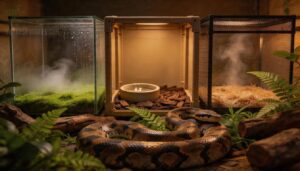
The enclosure you choose does more humidity control than almost any other variable in your setup. Construction material, ventilation design, and sealing all determine whether you’re constantly fighting moisture loss or barely thinking about it.
Getting the enclosure right from the start is the best defense—see how these factors tie directly into ideal moisture levels for snake shedding before mold or soggy substrate becomes your problem.
Here’s how the most common options stack up.
Why Screen-top Glass Tanks Lose Humidity Fast
A screen-top glass tank is intrinsically a humidity crash waiting to happen. Ventilation pressure from constant airflow through those ventilation holes strips moisture from substrate, decor, and water bowl evaporation before it builds up. Heat loss through the glass cools rising air, reducing its moisture-carrying capacity.
Surface area leakage compounds this: your room climate dictates the microclimate inside, not you.
How PVC Enclosures Retain Moisture Better
PVC enclosures solve what glass tanks can’t: they hold humidity where you need it. Low-porosity panels resist moisture absorption, so evaporation stays in the air, not the walls. Sealed seam design locks that humidity in, while an insulating wall structure prevents the temperature swings that accelerate drying.
Adjustable venting lets you fine-tune airflow without sacrificing your target microclimate. Wet zone control and substrate moisture retention handle the rest.
Covering 50%–75% of Screen Tops Safely
If you’re stuck with a screentop glass tank, covering 50%–75% of the mesh is your most practical fix. Cut plexiglass to size — its heat resistance supports overhead lamps — or use aluminum foil with proper foil edge sealing to trap moisture in your microclimate. Smart condensation monitoring tells you if the seal is working.
- Secure foil edges with HVAC aluminum tape for residue-free tape residue management
- Leave 25%–50% uncovered near ventilation holes and adjustable vents to prevent CO₂ buildup
- Use ¼-inch plexiglass over the cool side for reliable humidity measurement stability
- Follow a cover replacement schedule every one to two days for foil to prevent dust-compromised seals
Balancing Airflow With Humidity Retention
Airflow and humidity aren’t enemies — they just need smart positioning. Cross-height vent placement drives the passive chimney effect: intake low, exhaust high, letting warm moist air exit without mechanical help.
Adjustable vent placement lets you tune exchange as seasons shift.
Avoid directing drafts across hides; instead, use humidity gradient design paired with substrate depth and moisture retention to build a stable microclimate through airflow moisture modeling.
Zoning Snake Rooms for Different Species Needs
Running a mixed-species room without microclimate zoning is a setup for failure.
A ball python at 70% and a hognose at 35% can’t share the same ambient air, so designing snake rooms with zone-specific humidity using isolation barriers, ventilation zones, and lighting segmentation lets each enclosure hit its species-specific humidity guidelines independently.
substrate selection for humidity control, then fine-tunes each microclimate from there.
Substrates for Species-Specific Moisture
Substrate does more than line the bottom of a cage — it actively shapes the humidity your snake breathes every hour. Your choice of bedding, and how deep you pack it, determines whether moisture stays stable or swings wildly between checks.
Here’s how the most common options stack up for different species.
Coconut Fiber, Cypress Mulch, and Sphagnum Moss
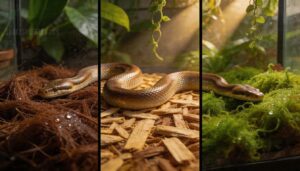
Three substrates do most of the heavy lifting in humidity control:
- Coconut fiber — highest Water Retention Capacity of the three, ideal for 70%–90% setups
- Cypress mulch — absorbs and releases moisture steadily, offering solid Burrowing Comfort without staying waterlogged
- Sphagnum moss — its Acidic Properties suppress bacteria, and it holds roughly 20× its weight in water
Smart substrate selection means knowing your Mixing Ratios. Blend coconut fiber with cypress mulch to zone moisture across the enclosure without triggering Mold Resistance failures.
How Substrate Depth Affects Humidity Stability
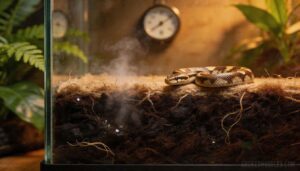
Depth is where moisture buffering actually happens. A 2–3 inch bed of coconut fiber holds enough water to slow evaporation and control failures between mistings, keeping humidity steadier than a half-inch layer ever could.
The lower zone stays damp while the surface stays dry — surface dryness balance that protects your snake’s scales.
That stratification creates natural burrow moisture zones and a real humidity gradient, cutting mold risk mitigation problems tied to soggy, compacted bedding.
Aspen for Moderate to Low Humidity Setups
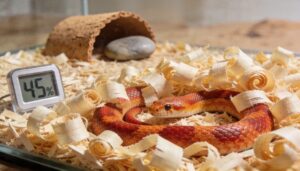
Switch from the stratified moisture buffering of coconut fiber; aspen shavings reveal their niche: substrate selection for ideal moisture retention isn’t always about holding more — sometimes it’s about holding less.
Aspen suits corn snakes, king snakes, and hognose snakes — species with humidity requirements landing between 30%–60%. Its practical advantages include:
- Burrowing Ease — loose shavings let snakes tunnel without resistance
- Light Contrast — pale color makes spot cleaning easy; waste is immediately visible
- Dust Control — sift before use to protect respiratory health
- Change Frequency — dry setups stay usable three to four weeks between full changes
Wet aspen molds fast. Keep it dry, and humidity regulation takes care of itself.
Sand and Dry Soil for Arid Snakes
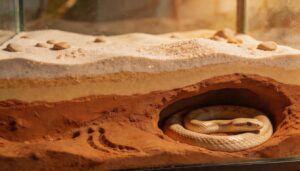
Desert snakes like sand boas aren’t just tolerating sand — they’re built for it. Dust-free sand mixed at burrowing ratios of 60–70% soil to 30–40% sand gives fossorial species room to tunnel and anchor stable subsurface chambers.
A clay additive improves structural integrity without trapping moisture, ensuring the substrate remains functional for burrowing.
Sand heat transfer stays efficient when kept dry, supporting substrate selection for ideal moisture retention within the 30–50% target. This eliminates high humidity risks entirely for arid species.
Why Paper Substrates Fail at Moisture Control
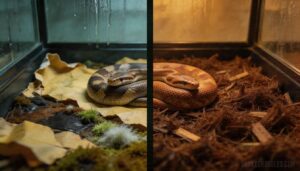
Paper looks convenient, but hygroscopic paper fiber chases ambient air rather than holding steady moisture — and that is exactly why it fails at humidity control.
Capillary absorption pulls water unevenly through the sheet, causing:
- Rapid moisture loss when enclosure temperatures rise
- Uneven moisture spread that kills microclimate management
- Mold growth risk as wet fibers collapse
Reserve paper for quarantine only. Substrate selection for ideal moisture retention demands better.
Measuring Humidity The Right Way
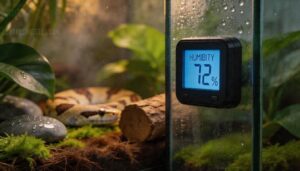
Getting humidity range right is only half the job — knowing whether your readings are actually accurate is the other half. A bad hygrometer will lie to you straight-faced, and your snake pays the price.
Here’s what you need to know to measure humidity the right way.
Digital Vs Analog Hygrometer Accuracy
Your choice between digital and analog dial hygrometers isn’t minor — it determines whether you’re actually hitting your species’ target range.
Digital hygrometers carry an error margin of ±1%–3% RH, while analog units routinely drift ±5%–10%. That sensor drift compounds without consistent calibration frequency.
Resolution precision matters too: digital displays show exact values; analog dials force estimation.
For serious keepers, digital wins every time — battery dependence is a small trade-off.
Best Probe Placement Inside Snake Enclosures
Where you place your digital hygrometer’s probe changes everything. A warm side probe belongs on the actual surface your snake uses — on top of hide substrate, not glass. Your cool side probe captures the thermal gradient.
For arboreal species, match the probe height to the snake’s perch level. A hide level probe reflects what the animal actually experiences.
Secure mounting prevents drift.
How to Calibrate With a Salt Test
Your hygrometer is only as reliable as its last calibration. The salt test method is the standard fix.
Mix table salt with just enough water to create a wet slurry—no pooling liquid. Seal it with your probe in an airtight bag. After six hours, the chamber stabilizes at 75% RH.
Calculate your calibration offset from this stabilized reading.
Recalibrate annually.
Using Two Hygrometers in Larger Habitats
One hygrometer tells you a single story; two tell you the truth. In larger enclosures, humidity gradient mapping reveals exactly where dry pockets form — usually on the warm side near heat sources.
Sensor redundancy benefits you immediately: when readings diverge sharply, you catch a failing sensor before your snake pays the price.
Place probes at substrate level on both ends for reliable localized dry spot detection.
Tracking Daily Humidity Highs and Lows
Min/Max logging extends what two probes started — now you’re seeing when, not just where.
A data logger set to short intervals captures humidity fluctuation that a midday glance will miss entirely.
Download the records, run trend charting, and temperature correlation becomes obvious: humidity dips as heat rises.
Set alert thresholds at your species’ boundaries, and your humidity monitoring stops being reactive.
Fixing Low and High Humidity
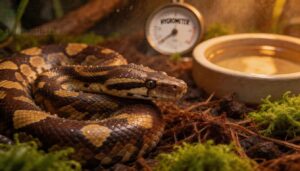
Getting humidity right isn’t a one-time fix — it’s an ongoing adjustment based on what your snake is telling you. Whether you’re dealing with stuck sheds or soggy substrate, the fix is almost always simpler than it looks.
Here’s what actually works.
Misting Methods for Safe Humidity Increases
When humidity dips below target, a manual misting routine beats scrambling for fixes.
Use fine mist nozzles and direct your targeted wall spray at enclosure walls and foliage — not the animal.
Short misting burst timing with dechlorinated water, scheduled morning and evening misting sessions, and a consistent misting schedule prevent oversaturation.
Automated misting systems paired with humidity calibration eliminate guesswork, keeping mistings and substrate moisture strategies on target.
Humid Hides for Shedding Support
Automated misting manages the enclosure’s ambient range, but a humid hide targets the shed cycle directly.
To create a DIY hide construction, cut a single entry point into an opaque plastic tub and pack it loosely with damp sphagnum moss; this setup establishes a localized microclimate.
Species-specific placement matters—warm-side placement dries faster. Check moss moisture daily; a musty odor means immediate replacement.
Water Bowl Placement and Evaporation Effects
Where you place the water bowl matters as much as the bowl itself. Warm-side placement raises evaporation, which can be useful for ball pythons but counterproductive for corn snakes.
A smooth, non-porous bowl like this rock-finish terrarium water bowl for ball pythons makes cool-side placement easier to manage without sacrificing a natural look.
Bowl surface area, depth evaporation rate, shade positioning, and ventilation proximity all shape how the water bowl contributes to ambient humidity control:
- Warm-side placement raises evaporation rate and humidity levels noticeably
- Shade positioning slows moisture loss during peak light hours
- Wider bowls increase bowl surface area, boosting but depleting faster
- Deep bowls sustain evaporation longer than shallow dishes
- Bowls near vents lose moisture quickly, disrupting humidity control
Ultrasonic Humidifiers and Automatic Controllers
Ultrasonic humidifiers use a piezo transducer frequency around 113 kHz to atomize water mechanically — no heat, no steam, just cool mist distributed through mist distribution ducting directly into the enclosure. Pair yours with programmable humidity controllers that use controller hysteresis settings to prevent rapid cycling.
Automatic top-up reservoirs keep output consistent, and smart monitoring systems log fluctuations that digital vs analog hygrometers accuracy comparisons consistently favor digital for.
Signs of Low Humidity, Including Stuck Shed
Low humidity announces itself through a clear pattern of Dry Skin Indicators: wrinkled, dull scales, chalky Urates Consistency, and Activity Reduction as dehydration sets in.
Stuck Shed Patterns — retained sheds clinging to the tail tip, or Eye Cap Issues where eye caps lift unevenly — confirm the problem.
Humidity troubleshooting checklists should prioritize shedding success, since effects of low humidity on snake stress compound fast.
Signs of Excess Moisture, Scale Rot, and Mold
Too much moisture leaves a trail of evidence you can’t miss.
Scale Rot Discoloration — red, yellow, or greenish-black patches on ventral scales — is your first hard signal.
Wet Substrate Clues, like mushy, clumping bedding, and Condensation Build-up on glass confirm the enclosure isn’t drying properly.
Mold Growth Patches and Foul Odor mean bacteria are already active.
Fix humidity control and substrate selection for ideal moisture retention immediately.
Preventing Respiratory Issues From Poor Ventilation
Poor ventilation doesn’t just trap moisture — it concentrates airborne pathogens directly in your snake’s breathing zone. Stagnant air lets respiratory infections take hold fast, particularly in sealed PVC setups where CO2 Monitoring reveals dangerously low Air Exchange Rates.
Counter this through:
- Cross Ventilation Design using upper vents plus low-speed fans
- HEPA filtration to improve Filtration Efficiency without humidity loss
- Strategic Fan Placement Strategies to push exhaust upward
Seasonal Humidity Adjustments for Indoor Snake Rooms
Your indoor climate shifts more than you think — Winter Heater Impact strips moisture from the air aggressively at night, while Summer AC Effects can dry enclosures just as thoroughly.
Seasonal humidity swings and snake health are directly linked, so maintain Seasonal Humidity Logs, perform Seasonal Sensor Calibration regularly, and use Humidity Gradient Mapping to catch drift before your animals show it.
Frequently Asked Questions (FAQs)
What is the ideal humidity level for a snake tank?
There’s no single "ideal" humidity level for a snake tank — it depends entirely on the species.
Humidity safety thresholds range from 30% for arid snakes to 90% for tropical species, making species-specific humidity requirements non-negotiable.
Do snakes need high humidity?
Not all snakes need high humidity — it’s entirely species-dependent.
Habitat adaptation drives water balance needs, and species-specific humidity requirements for snakes range from 30% for arid dwellers to 90% for tropical canopy species.
Is too much humidity harmful to snakes?
Yes — too much humidity is just as dangerous as too little.
Excess moisture drives Bacterial Proliferation, triggers scale rot, and fuels respiratory infections, all while pushing Enclosure Microbial Load into ranges that compromise your snake’s Immune System.
Do snakes need a humidifier?
Not every snake needs a humidifier — it depends entirely on species-specific humidity requirements and your room’s dryness baseline.
A tropical species in a dry winter home benefits far more than a rosy boa ever would.
Does seasonal breeding affect snake humidity requirements?
Seasonal breeding does shift humidity demands, but not the species target range.
Hormone-driven moisture needs peak during shed cycles and egg development hydration phases, making temporary shedding support peaks and breeding humidity shifts the practical focus of seasonal humidity adjustments for captive snakes.
How does snake age change moisture needs over time?
Age rewrites the rules.
Hatchling Water Loss peaks before the first shed, young snakes demand tighter Juvenile Shed Frequency checks, adults reach Adult Humidity Stability, and seniors face real Senior Shedding Challenges requiring Age Specific Checks.
Are there humidity differences between male and female snakes?
Sex-based humidity differences in snakes are basically a myth.
Species-specific humidity guidelines govern both sexes equally — except gravid females, who may benefit from a brief shedding humidity boost during reproductive cycles.
Conclusion
You may think precision is excessive, but species-specific snake moisture isn’t negotiable. Achieving ideal humidity requires careful control of enclosures, substrates, and measurement.
By understanding species-specific needs, you can create a thriving environment, ensuring your snakes’ health and well-being through precise control of species-specific snake moisture, substrate choice, and accurate hygrometer readings.