This site is supported by our readers. We may earn a commission, at no cost to you, if you purchase through links.
A failed shed isn’t just an eyesore—it’s a diagnostic. When skin comes off in patches instead of one clean inversion, the enclosure is telling you something.
Substrate moisture retention sits at the center of that problem, quietly determining whether your snake thrives or struggles through every biological cycle. Get it wrong in either direction—too wet, too dry—and you’re trading scale rot for respiratory irritation.
The substrate beneath your snake isn’t passive bedding; it’s an active humidity management system. Choosing the right material, depth, and moisture balance for your species makes the difference between reactive problem-solving and genuinely stable husbandry.
Table Of Contents
- Key Takeaways
- Why Substrate Moisture Retention Matters
- Best Moisture-Retaining Snake Substrates
- Match Bedding to Snake Species
- Enclosure Design for Humidity Control
- Measure and Adjust Substrate Moisture
- Top 10 Snake Bedding Products
- 1. Zoo Med Aspen Snake Bedding
- 2. Galápagos Aspen Digs Natural Bedding
- 3. Halatool Organic Coconut Fiber Substrate
- 4. Bio Dude Terra Sahara Bioactive Substrate
- 5. RediChip Medium Coconut Reptile Substrate
- 6. Legigo Coconut Chip Substrate for Reptiles
- 7. Real Live Moss For Reptile Terrariums
- 8. Riare Sphagnum Moss for Terrarium
- 9. Riare Organic Coco Coir Soil Bricks
- 10. Legigo Coconut Fiber Terrarium Bedding
- Frequently Asked Questions (FAQs)
- Conclusion
Key Takeaways
- Substrate moisture isn’t passive—it actively controls shedding success, respiratory health, and scale condition, so getting it wrong in either direction triggers real medical problems.
- Match your substrate material to your species’ exact humidity range: coconut fiber and sphagnum moss for 60–90% RH tropical builds, aspen or sand-soil blends for arid species needing 30–50% RH.
- Enclosure design—PVC vs. screen-top, water bowl placement, and screen coverage—shapes ambient humidity as much as substrate choice does, and ignoring it forces constant compensatory misting.
- Measure what you think you know: digital hygrometers calibrated via salt test and placed at substrate level catch moisture swings before they escalate into retained sheds or scale rot.
Why Substrate Moisture Retention Matters
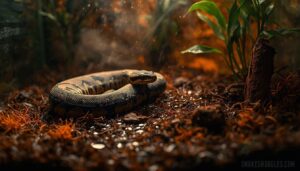
Substrate moisture does more than keep bedding damp — it directly controls shedding success, respiratory health, and skin condition. Get it wrong and you’re dealing with retained shed, scale rot, or a snake gasping from fungal buildup.
Choosing the right bedding from the start makes all the difference, and this beginner’s guide to snake substrates breaks down which options actually hold moisture without creating the soggy conditions that breed bacteria.
Here’s what you need to know before picking a substrate.
How Substrate Moisture Affects Shedding
Substrate moisture buffering directly shapes shedding cycle timing and outcome. When humidity management falls short, old skin loses flexibility — tears, stuck patches, and stress follow.
Maintaining adequate ambient humidity is essential for a healthy fluid layer during pre‑shed.
- Consistent moisture retention keeps the fluid layer between old and new skin intact
- Skin flexibility optimization depends on maintaining 50–80% RH through the pre-shed hydration window
- Moisture gradient effects across the enclosure prevent uneven shedding and humidity molting stress
Preventing Scale Rot With Proper Dampness
Scale rot follows saturated substrate like clockwork. When ventral scales sit against persistently wet bedding, bacterial colonization accelerates—and veterinary intervention becomes unavoidable.
Effective scale rot prevention hinges on substrate drainage design: coconut fiber drains well between misting cycles, preventing free surface moisture. Microclimate monitoring at substrate level catches localized humidity zones before damage starts.
Keep bedding damp, never soaked.
Avoiding Respiratory Issues From Wet or Dry Bedding
too wet breeds mold — spores accumulate quickly and stress respiratory tissue.
Too dry, and dust becomes the problem.
Both failures share the same fix: airflow balance paired with a solid spot cleaning routine.
Microclimate monitoring catches moisture swings before they escalate.
Low dust bedding cuts particulate load at the source.
Control the moisture zone; control the air your snake breathes.
Matching Moisture to Species Humidity Needs
Every species runs on its own humidity dial. Tropical snakes need 60–80% RH; desert species stay healthy at 30–50%.
That range isn’t arbitrary — it’s the foundation of species-specific moisture profiles and microclimate zone design.
Match your substrate’s moisture retention properties to those thresholds, and you’ve already solved half the equation before shedding humidity boosts or seasonal humidity adjustments even come into play.
Best Moisture-Retaining Snake Substrates

Not all substrates pull their weight equally with respect to holding moisture.
The right pick depends on your snake’s specific humidity range — and choosing wrong can mean stuck sheds, scale rot, or worse.
Here’s what actually works, broken down by how each option manages moisture retention.
Coconut Fiber and Coco Coir for High Humidity
Coconut fiber — coco coir — is the workhorse of high humidity setups. It holds 4–8 times its weight in water, releases moisture gradually, and its near‑neutral pH maintains pH stability and a thriving microbial habitat that breaks down waste naturally.
Weight Efficiency and Rehydration Speed make it practical:
- Buffers moisture swings through capillary action
- Resists sudden dry pockets in humid enclosures
- Maintains 70–90% RH without waterlogging
- Rehydrates within minutes from compressed bricks
- Cushions ventral scales during shedding
Cypress Mulch for Steady Moisture Release
Unlike cypress mulch’s sponge-like saturation, cypress mulch absorbs moisture steadily and releases it slowly, making it ideal for maintaining humidity gradients within snake enclosures without waterlogging.
Mulch thickness effects matter: a 2–3 inch layer creates a damp microclimate that buffers daily temperature swings and slows surface evaporation after misting. That’s where misting integration techniques pay off — light, targeted sprays rehydrate dry surface spots without saturating deeper layers.
Decomposition rate impact is minimal short-term. Cypress breaks down slower than pine or hardwood, lasting months before replacement. As it ages, darker chips signal extended residence time — useful insight for your substrate change schedule.
Odor management strategies are built into the material itself. Cypress resists mold and compaction better than many organics, keeping that musty-enclosure smell in check when you spot-clean regularly.
Temperature buffering benefits your snake directly — the insulating layer moderates substrate temperature swings between heat cycles, reducing stress on thermoregulation-sensitive species.
For moisture retention properties of common substrates, here’s how cypress stacks up:
| Property | Cypress Mulch | Coco Coir | Aspen Shavings |
|---|---|---|---|
| Moisture Retention | Moderate–High | Very High | Low–Moderate |
| Mold Resistance | High | Moderate | Low |
| Decomposition Rate | Slow | Moderate | Moderate |
| Humidity Range Supported | 55–80% RH | 70–90% RH | 30–60% RH |
| Substrate Depth Recommended | 2–3 in | 2–4 in | 1–2 in |
Galápagos Cypress Mulch is a reliable substrate choice — your substrate choice here isn’t guesswork; it’s a calculated match to your snake’s moisture needs.
Sphagnum Moss for Humid Hides
Sphagnum moss does something no other substrate can replicate: it holds up to 20 times its own weight in water, releasing moisture steadily for 24–48 hours inside a humid hide.
Sphagnum moss holds up to 20 times its weight in water, releasing moisture steadily for 24–48 hours inside a humid hide
Three reasons it earns a permanent spot in your humidity management toolkit:
- Moss Antimicrobial Benefits suppress surface mold naturally
- Moss Expansion Dynamics increase moisture-exchange surface area when wet
- Moss Compatibility Coir boosts overall retention in mixed setups
Follow a consistent Moss Rehydration Schedule — rewet with room-temperature water every 1–2 days. For Moss Longevity Replacement, swap it out every 6–12 months. Your substrate choice here directly controls shedding outcomes.
Aspen Bedding for Lower-moisture Setups
Aspen shavings sit at the opposite end of the moisture spectrum — and that’s exactly what low-humidity species need. Corn snakes and hognose snakes thrive here.
| Property | Aspen Performance | Benefit |
|---|---|---|
| Moisture Retention | 30–60% RH support | Prevents over-saturation |
| Rapid Drying | Faster than coco fiber | Reduces mold risk |
| Dust Reduction | Low particulate output | Protects respiratory health |
| Burrowing Comfort | Loose, stable structure | Natural exploration support |
| Odor Control | Absorbs urine efficiently | Extends change intervals |
Zoo Med Aspen Snake Bedding delivers consistent Ventilation Enhancement through natural air channels — keeping snake health intact without complex humidity management.
Sand-soil Blends for Arid Species
Arid species like rosy boas and western hognose snakes need substrate that drains fast and stays dry — desert soil mix is the foundation of that control.
- Start with 60% coarse sand or calcium sand, 30% soil
- Pumice Ratio: add 5–10% pumice for aeration
- pH Balance: target 6.5–7.0 for stability
- Drainage Testing: squeeze test yields zero runoff
- Mixing Protocol: layer dry top over marginally moist core
Particle size and substrate depth determine humidity retention.
Match Bedding to Snake Species
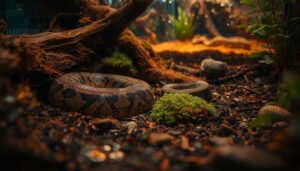
Not every snake plays by the same humidity rules — what works for a ball python will stress out a rosy boa.
Getting the substrate right starts with knowing exactly what your species needs.
Here’s how the most common pet snakes stack up.
Ball Python Humidity and Bedding Choices
Ball pythons demand a humidity range of 55–65% daily, climbing to 70–80% during shedding.
Coconut fiber leads in substrate moisture capacity — it holds water steadily without pooling.
Bedding depth optimization matters too: 2–4 inches let your snake burrow into a stable microclimate.
Heat gradient impact is real — warmer zones dry substrate faster, so mold prevention strategies and ventilation balance both depend on smart placement.
| Factor | Recommendation |
|---|---|
| Daytime humidity | 55–65% RH |
| Shed cycle humidity | 70–80% RH |
| Best substrate | Coconut fiber |
| Bedding depth | 2–4 inches |
| Seasonal humidity shifts | Raise gradually in winter |
Boa Constrictor Substrate Moisture Needs
Boas run a tighter margin than ball pythons — target 60–70% RH daily, nudging higher during breeding periods. Moisture gradient matters here: keep the warm side slightly drier to prevent saturation.
- Use coconut fiber or coconut chips for strong humidity retention
- Maintain 3–4 inch burrow depth for stable microclimates
- Monitor substrate temperature — heat accelerates moisture loss
- Run humidity checks twice daily during seasonal humidity shifts
Corn Snake Bedding for Moderate Humidity
Corn snakes sit in a comfortable middle ground — 40–60% RH daily, bumping to 65–75% during shedding. Coconut fiber maintains humidity retention well here, staying pliable without waterlogging.
Keep burrowing depth at 3–4 inches for stable microclimates. Spot-clean every 1–2 days for odor management, and monitor temperature-humidity balance closely — warm-side heat drives evaporation faster than you’d expect.
Arid Species and Low-retention Substrates
Rosy boas and western hognose snakes need 30–50% RH — far drier than anything a corn snake requires. A Desert Sand Mix with Perlite Aeration keeps low moisture bedding draining fast while Heat Source Dryness does most of the work naturally.
Burrow Depth of 1–2 inches allows for Microclimate Zoning without trapping moisture. For desert snake substrate, dry substrate wins — target substrate moisture retention only inside a single humid hide.
Humidity Boosts During Shedding Periods
Even arid species need a temporary humidity ramp-up when they enter pre-shed.
A targeted misting schedule — once or twice daily directly into the humid hide — raises local RH without saturating the main substrate.
Temperature-humidity synergy matters here: warmer zones accelerate evaporation, creating moisture gradient zones that the snake can self‑regulate.
Coconut fiber moisture inside the hide helps reduce shedding stress and clean, single‑piece molts.
Enclosure Design for Humidity Control
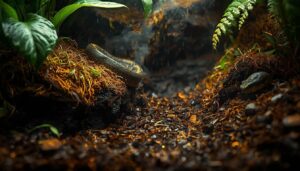
Your enclosure setup does more humidity work than most keepers realize. The materials, ventilation, and layout all push that RH number up or down before you ever touch a mister.
Here’s what actually makes the difference.
Screen-top Tanks Versus PVC Enclosures
Your enclosure choice dictates everything about humidity control. Screen-top glass tanks bleed moisture constantly — stabilizing humidity gradients within snake enclosures becomes a daily battle. PVC holds moisture far better through sealed seams and low-porosity panels.
Compare both on what matters:
- Heat retention — PVC wins decisively
- Maintenance ease — PVC resists mold, warps, staining
- Durability — screen-top hardware degrades faster
- Customization flexibility — PVC integrates misting, heating, ventilation design cleanly
Partial Screen Covering for Moisture Retention
Covering 50–75% of your screen-top glass tank’s mesh cuts humidity loss without killing airflow — that balance is the whole game. Use corrosion-resistant materials rated for high-RH environments, and set cover height adjustment 1–3 cm above substrate.
Smaller screen mesh size slows vapor escape, supporting stable humidity gradients within snake enclosures. The result: a consistent microclimate design without constant misting.
Warm-side Water Bowl Placement
Position your water bowl on the warm side — this single adjustment raises enclosure humidity by 8–12% through passive evaporation, functioning as a low-maintenance humidity reservoir.
Keep it near the heat source but off the direct basking spot; scalding water disrupts water temp management and accelerates bacterial growth.
Monitor thermal gradient shifts with a hygrometer, and change water every 24–48 hours for mold prevention.
Fine Misting Without Soaking Substrate
Fine misting is precision work — blast too much and you’ve soaked your substrate into scale rot territory. Use a nozzle emitting 50–100 micron droplets for Droplet Size Optimization, held 15–20 cm above the bedding.
Misting Timing Protocol matters: after application, apply an Airflow Pause Strategy of 10–20 minutes. Watch for Surface Bead Observation — beads persisting 5–15 minutes confirm ideal moisture retention.
Using Humid Hides for Targeted Moisture
Humid hides solve a real problem: raising enclosure-wide humidity risks mold and respiratory infections, but your snake still needs 75–95% RH during shedding. A humid hide delivers targeted moisture without compromising ambient conditions.
Pack damp sphagnum moss inside, place it warm-side for Temperature-Humidity Sync, and smooth the Hide Entrance Design to prevent snout abrasions. Check weekly — Mold Prevention Strategies start with airflow and dry surroundings outside the hide.
Measure and Adjust Substrate Moisture
Getting humidity right starts with knowing what’s actually happening inside the enclosure—not just guessing. A reliable measuring setup, properly placed and calibrated, gives you the data to fix problems before they become health issues.
Here’s what you need to monitor and adjust substrate moisture with confidence.
Why Digital Hygrometers Are More Accurate

Analog hygrometers drift ±5–10% RH — a margin that can mean the difference between a healthy shed and retained skin. Digital units close that gap to ±1–3% using low hysteresis capacitive sensors, temperature compensation algorithms, and multi-sensor cross-check validation.
High-frequency sampling catches rapid fluctuations.
Auto-calibration routines correct humidity sensor drift automatically, keeping your readings honest without constant manual intervention.
Probe Placement at Substrate Level
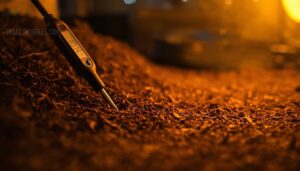
Accurate readings start with where you put the probe. Place it at substrate level on the warm side — central positioning, away from water bowls, keeps localized dampness from skewing your data.
Angle it slightly toward the substrate, not upward. Maintain depth consistency across checks: 1–2 cm in.
Standardized sampling times eliminate diurnal variables, giving you reliable microclimate data worth acting on.
Salt-test Calibration for Humidity Sensors

Probe placement gets you consistent data — now make sure your digital hygrometer is actually telling the truth. A salt test is the standard for humidity calibration: sodium chloride at solution saturation holds a stable 75% RH, giving you a fixed reference point.
- Seal your sensor above the solution — no contact with liquid
- Allow 6–8 hours for stabilization before recording
- Apply temperature control; readings shift outside 20–25°C
- Recalibrate annually to counter sensor drift of 1–3% RH
Fixing Dry Pockets and Wet Spots
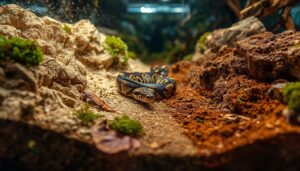
Even a calibrated sensor can’t fix a substrate that’s uneven. Dry pockets form when airflow outpaces moisture replenishment — wet spots when drainage fails. Both compromise your snake’s microclimate.
| Problem | Fix |
|---|---|
| Dry pocket | Substrate leveling + targeted misting schedule |
| Wet spot | Remove saturated material, increase airflow management |
| Uneven moisture gradient | Redistribute substrate, adjust misting frequency |
| Humidity spikes | Improve ventilation, reduce misting volume |
| Pocket monitoring gaps | Add second probe, log daily readings |
Top 10 Snake Bedding Products
Finding the right bedding isn’t guesswork — it comes down to matching moisture retention to your snake’s actual needs. These ten products cover everything from bone-dry arid setups to high-humidity tropical builds.
Here’s what each one brings to the enclosure.
1. Zoo Med Aspen Snake Bedding
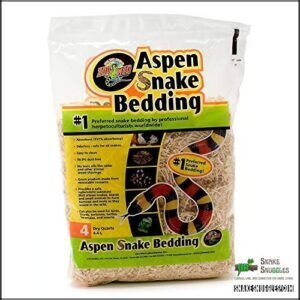
Zoo Med Aspen Snake Bedding earns its place in dry-to-moderate setups — not because it’s flashy, but because it’s reliable. With a 191% absorbency rating and 99.9% dust-free composition, it keeps enclosures clean without irritating airways.
It’s free of cedar oils, holds shape for burrowing, and spot-cleans easily.
That said, aspen tops out around 40–60% RH, making it a poor fit for high-humidity species.
Corn snakes, hognose, and rosy boas? It’s a strong match.
| Best For | Reptile owners keeping corn snakes, hognose snakes, rosy boas, or other dry-to-moderate humidity species who want a low-maintenance, non-toxic substrate. |
|---|---|
| Material Type | Aspen fiber |
| Organic Composition | Yes |
| Moisture Retention | Low |
| Burrowing Support | Yes |
| Odor Control | Yes |
| Package Size | 4 qt |
| Additional Features |
|
- Absorbs well (191% absorbency) and stays nearly dust-free, so your snake’s enclosure stays cleaner and their airways stay clear
- No cedar oils or toxic additives — safe for long-term use with sensitive species
- Holds its shape nicely, letting snakes burrow and hide the way they naturally would
- Tops out around 40–60% RH, so it’s a bad fit for tropical or high-humidity species like ball pythons
- The 4 qt bag is pretty small — if you’ve got a large enclosure or multiple setups, you’ll be reordering often
- Mostly sold online, which means you can’t just grab it from a local store in a pinch
2. Galápagos Aspen Digs Natural Bedding
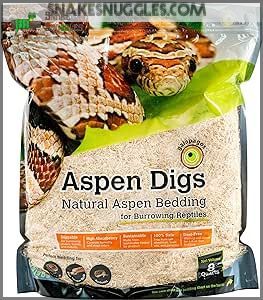
Galápagos Aspen Digs runs in the same lane as Zoo Med — dry-to-moderate humidity, 40–60% RH, suited for temperate colubrids that don’t need saturated substrate. What sets it apart is sourcing: 100% pure aspen timber by-products, free of resins, oils, and chemical additives.
The low-dust processing matters for sensitive respiratory systems.
At $8.99 for 8 quarts, it’s budget-friendly for small enclosures.
Don’t expect it to hold moisture long — corn snakes and hognose will thank you; tropical species won’t.
| Best For | Corn snakes, hognose, and small mammals like hamsters or guinea pigs that need a dry, diggable substrate without chemical additives. |
|---|---|
| Material Type | Aspen wood shavings |
| Organic Composition | Yes |
| Moisture Retention | Low |
| Burrowing Support | Yes |
| Odor Control | Yes |
| Package Size | 8 qt |
| Additional Features |
|
- 100% pure aspen with no resins or oils — clean and safe for sensitive animals
- Low-dust processing helps protect delicate respiratory systems
- At $8.99 for 8 quarts, it’s an affordable pick for smaller enclosures
- Dries out fast — not a good fit for tropical species that need higher humidity
- Some buyers report residual dust and recommend sifting before use
- 8 quarts may run out quickly depending on enclosure size
3. Halatool Organic Coconut Fiber Substrate
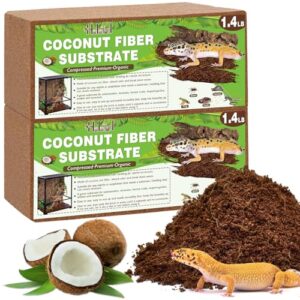
Halatool’s compressed coconut fiber bricks expand to roughly three times their original size once hydrated — giving you more usable substrate per dollar than most loose-fill options. Each 1.4 lb brick targets 60–80% RH, the exact range for pythons and tropical colubrids needs year‑round.
fibrous matrix aerates well enough to prevent stagnant wet zones, which is where scale rot starts.
Monitor moisture closely though — over‑wetting invites mold fast.
Digestible if ingested, low‑dust, and biodegradable. A practical, species-appropriate choice for humidity‑dependent setups.
| Best For | Reptile and invertebrate keepers who need reliable humidity control for tropical or moisture-loving species like crested geckos, pythons, tarantulas, and hermit crabs. |
|---|---|
| Material Type | Coconut husk fiber |
| Organic Composition | Yes |
| Moisture Retention | High (60–80% RH) |
| Burrowing Support | Yes |
| Odor Control | Yes |
| Package Size | 2 bricks (2.7 lb) |
| Additional Features |
|
- Expands to roughly 3× its size when hydrated, so one brick stretches surprisingly far across multiple tanks
- Naturally regulates humidity in the 60–80% RH range and cuts down on misting and cleaning frequency
- Soft, low-dust, and fully digestible — safe even if your pet decides to take a bite
- Needs a proper soak before use; skip that step and you’ll end up with hard chunks that won’t break apart easily
- Over-watering is a real risk — too much moisture and mold can show up fast
- The brick format takes more prep time than grabbing a pre-loosened bag, and bits can scatter when you’re opening the package
4. Bio Dude Terra Sahara Bioactive Substrate
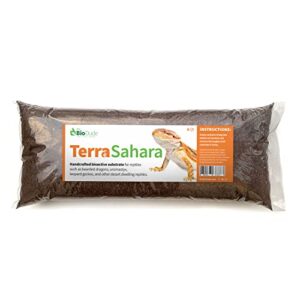
Bio Dude’s Terra Sahara isn’t just a substrate — it’s a fully engineered desert biome in a 6-quart bag. Formulated for arid species like sand boas, Uromastyx, and leopard geckos, it holds moisture between 25–40% without pushing ambient RH into dangerous territory.
The bioactive blend sustains isopods, springtails, and live desert plants simultaneously.
Larger chunks can pose impaction risk for juveniles, so feed small animals separately.
At $24.95, it’s a ready-to-use system that eliminates guesswork.
| Best For | Desert reptile keepers — bearded dragons, sand boas, Uromastyx, and leopard geckos — who want a bioactive setup without mixing their own substrate from scratch. |
|---|---|
| Material Type | Desert plant mix |
| Organic Composition | Yes |
| Moisture Retention | Low (desert-optimized) |
| Burrowing Support | Yes |
| Odor Control | Yes |
| Package Size | 6 qt |
| Additional Features |
|
- Ready-to-use right out of the bag — no mixing, no guesswork
- Supports live plants, isopods, and beneficial microbes all at once
- Great low-allergen swap if aspen bedding gives you trouble
- Larger chunks can be a choking or impaction hazard for juveniles
- You’ll need to feed small reptiles in a separate dish to play it safe
- At 8 lbs, it’s a bit heavy to deal with if returns are ever needed — and you’re covering that shipping cost
5. RediChip Medium Coconut Reptile Substrate
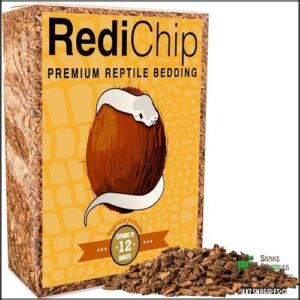
RediChip’s medium coconut husk chips pull double duty — dry for arid setups, lightly misted for tropical builds. The medium chip size strikes a practical balance: enough surface area to hold moisture steady without waterlogging the enclosure floor.
Each 12-qt bag weighs 2.27 lb and covers smaller to mid-sized enclosures adequately, though you’ll need supplemental media for anything 55 gallons or larger.
Dust is minimal out of the bag.
It’s a flexible, eco-friendly foundation that fits ball pythons, boas, and most mid-humidity species comfortably.
| Best For | Reptile keepers setting up small to mid-sized enclosures for ball pythons, boas, geckos, or tortoises who want a flexible substrate that works in both arid and tropical builds. |
|---|---|
| Material Type | Coconut husk chips |
| Organic Composition | Yes |
| Moisture Retention | Moderate |
| Burrowing Support | Yes |
| Odor Control | Yes |
| Package Size | 12 qt |
| Additional Features |
|
- Works dry or misted, so it adapts easily to a wide range of reptile and amphibian setups
- Eco-friendly and pre-cleaned, with a loose texture that lets animals burrow naturally
- Pulls double duty as a plant propagation mix for orchids, Hoyas, and similar species
- The 12-qt bag won’t cut it for large enclosures like 55-gallon tanks without adding extra media
- Dust can be noticeable when you first open and handle the bag
- Pricier per volume than bulk options, and stock through some retailers has been hit or miss
6. Legigo Coconut Chip Substrate for Reptiles
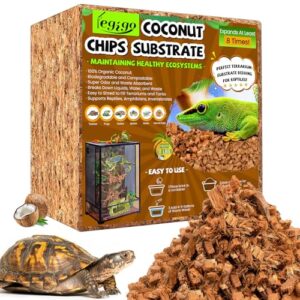
Legigo’s coconut chip brick ships compressed — add water and it expands to fill your enclosure floor without the bulk of pre-expanded bags. At 10 lb per brick, it’s a solid value for mid-to-large setups housing ball pythons or tropical boas needing 60%–80% RH.
The chips release moisture gradually, stabilizing ambient humidity without waterlogging the substrate.
Inspect each batch carefully — some users have flagged dust, dried grass, or occasional plastic fragments.
Not suitable for arid species requiring 30%–50% RH environments.
| Best For | Reptile keepers housing tropical or humidity-loving species like ball pythons, boas, or dart frogs who want a natural, low-maintenance substrate that holds moisture well. |
|---|---|
| Material Type | Coconut husk chips |
| Organic Composition | Yes |
| Moisture Retention | High |
| Burrowing Support | Yes |
| Odor Control | Yes |
| Package Size | 10 lb brick |
| Additional Features |
|
- Ships as a compact brick and expands with water, so it’s easy to store and takes up way less space than pre-expanded bags
- Holds humidity consistently, which is a big deal for tropical species that need that 60–80% RH sweet spot
- The soft, chunky texture lets reptiles dig and burrow naturally, and it doubles as garden mulch or a soil amendment
- Some batches have come with dust, dried grass, or even plastic fragments mixed in — always worth a close look before using
- Needs regular rehydration to stay effective, especially if you live somewhere dry
- Not a good fit for desert species that need dry conditions — this substrate is built to hold moisture, not avoid it
7. Real Live Moss For Reptile Terrariums
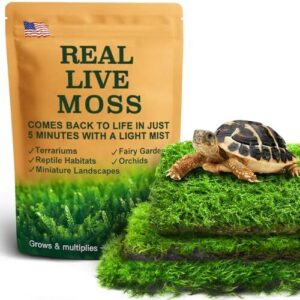
LUCKYRUNES’ live moss pack ships three 3.5″ × 7″ sheets — each a different species — that rehydrate within 5–10 minutes of misting.
Position them around humid hides or over coconut fiber substrate to push localized RH toward the 70%–80% range that ball pythons and tropical species need during shedding.
The moss roots gradually, expanding coverage over months.
One caveat: some sheets arrive with brown patches or tears.
Inspect immediately and mist consistently — let it dry out, and it’s done.
| Best For | Reptile and amphibian keepers who need a natural, humidity-boosting ground cover for tropical setups like gecko, frog, or turtle enclosures. |
|---|---|
| Material Type | Live moss sheets |
| Organic Composition | Yes |
| Moisture Retention | High |
| Burrowing Support | No |
| Odor Control | No |
| Package Size | 3 sheets |
| Additional Features |
|
- Three different moss species in one pack, so you get variety and can see what works best in your setup.
- Rehydrates fast — usually within 5–10 minutes of misting — and can keep growing and spreading for months.
- Works great for more than just reptile tanks; looks beautiful in fairy gardens, bonsai displays, or any bio-active build.
- Sheets can show up dry, brittle, or with brown patches and tears, so quality isn’t always consistent.
- Needs regular misting to stay alive — skip it too often and the moss won’t recover.
- Not a good fit for dry-climate species like certain spiders, since the moisture levels will clash with their needs.
8. Riare Sphagnum Moss for Terrarium
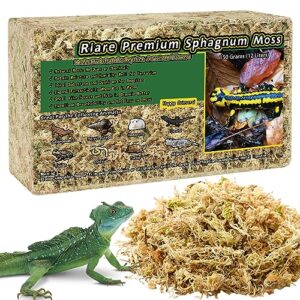
Unlike live sheets that need rooting time, Riare Sphagnum Moss works immediately — soak it, wring it slightly, and pack it into a humid hide within minutes. The 5.3 oz brick expands enough to fill a 6-qt chamber, holding moisture for slow, steady release that keeps localized RH in the 70%–80% range without soaking surrounding substrate.
It’s soft enough to protect ventral scales during pre-shed positioning. Rinse before use to clear residual fiber debris.
| Best For | Reptile and amphibian keepers who need a reliable, fast-hydrating substrate for humid hides, egg incubation, or moisture-loving plants like orchids. |
|---|---|
| Material Type | Sphagnum moss |
| Organic Composition | Yes |
| Moisture Retention | High |
| Burrowing Support | Yes |
| Odor Control | Yes |
| Package Size | 5.3 oz |
| Additional Features |
|
- Expands dramatically from a compact brick — a single 5.3 oz pack can fill a 6-qt terrarium after soaking, so you get a lot of mileage from a small package.
- Holds moisture really well while staying breathable, which helps you maintain that sweet spot of humidity without waterlogging your setup.
- Works for way more than just reptiles — great for orchids, carnivorous plants, beetle enclosures, and egg incubation too.
- Hot water can mess with the texture and lead to clumping or mildew, so you have to be a little careful during rehydration.
- Needs a rinse before use to clear out stray fibers and debris, which adds a small but annoying extra step.
- Not ideal for species like bearded dragons that might try to eat it — ingesting too much can cause digestive problems, so you’ll need to keep an eye on them.
9. Riare Organic Coco Coir Soil Bricks
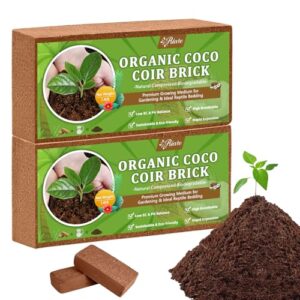
sphagnum manages targeted hide moisture, coco coir takes on the whole enclosure floor. Riare brick weighs 1.4 lb dry but expands to roughly 8× its volume once hydrated — one brick blankets about 6 ft² at a 2‑inch depth.
The 100% coconut pith holds moisture steadily without waterlogging, supporting 70%–90% RH environments that green tree pythons and ball pythons demand.
Its neutral pH and low EC discourage bacterial buildup, and the coarse texture lets burrowing species tunnel naturally.
| Best For | Reptile keepers and plant growers who want an affordable, eco-friendly substrate that holds humidity well across a large area. |
|---|---|
| Material Type | Coco coir bricks |
| Organic Composition | Yes |
| Moisture Retention | High |
| Burrowing Support | Yes |
| Odor Control | No |
| Package Size | 2 bricks (2.8 lb) |
| Additional Features |
|
- Expands up to 8× its dry volume, so two bricks go a long way — great bang for $9.99
- Holds moisture evenly without waterlogging, making it ideal for high-humidity enclosures and seedling trays
- 100% organic and sustainable, with a neutral pH that won’t mess with your plants or reptiles
- Completely inert — no nutrients at all, so you’ll need to fertilize separately for any plant use
- Expansion can be uneven; some bricks need multiple soaks before they fully break apart
- Breaking it down gets messy — loose fibers go everywhere and excess water leaves a clumpy slurry if you’re not careful
10. Legigo Coconut Fiber Terrarium Bedding
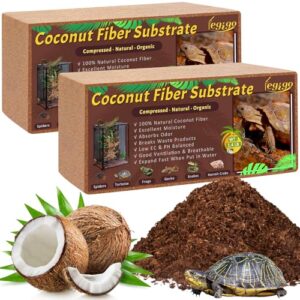
Where Riare ships one brick per pack, Legigo doubles it — two compressed coconut fiber bricks per package, each measuring roughly 7.87 × 3.94 × 1.97 inches dry.
Both hydrate into a fluffy, loose coir layer that holds 60%–80% RH consistently.
The 100% organic material is chemical-free, odorless, and non-abrasive against ventral scales.
Spot cleaning is straightforward since wet waste clumps slightly.
When the full substrate change comes — every 4–6 weeks — you can compost the spent coir directly.
| Best For | Reptile, amphibian, and invertebrate owners who want a natural, chemical-free substrate that supports digging behavior and keeps humidity stable. |
|---|---|
| Material Type | Coconut fiber bricks |
| Organic Composition | Yes |
| Moisture Retention | High |
| Burrowing Support | Yes |
| Odor Control | Yes |
| Package Size | 2 bricks (2.79 lb) |
| Additional Features |
|
- Two bricks per pack gives you more value and a longer time between restocking runs
- Holds humidity well in the 60–80% RH range, which is exactly what most tropical species need
- Spent coir goes straight to the compost bin or garden — nothing wasted
- No printed instructions in the box, so first-timers will need to look up hydration ratios on their own
- Occasional foreign particles mean you’ll want to sift it before putting it in a sensitive animal’s enclosure
- Has to be soaked before use, which adds a step if you’re doing an emergency substrate swap
Frequently Asked Questions (FAQs)
How to keep snake substrate moist?
Want stable humidity without the guesswork?
Keep the top layer surface-damp, not pooling. Use coconut fiber or cypress mulch, seal most of the screen lid, and check moisture levels daily — especially on the warm side.
What substrate holds humidity in snakes?
Coconut fiber and sphagnum moss top the list — coconut fiber holds moisture without waterlogging, while sphagnum retains up to 20 times its weight in water, making both ideal for high-humidity enclosures.
How often should snake substrate be fully replaced?
Full substrate replacement every 4–6 weeks sounds excessive—until mold appears overnight. Spot-clean daily, replace fully on schedule, and adjust sooner if odor, saturation, or visible waste demands it.
Can mixed substrates be layered for better humidity control?
Yes — layering substrates works well. A coarse drainage base, moisture-retaining mid layer, and mossy top creates a humidity gradient that stabilizes RH without waterlogging the enclosure.
How does enclosure size affect substrate moisture retention?
Like a sponge stretched too thin, larger enclosures dilute moisture faster — more air volume, more surface area, more evaporation.
Scale your substrate depth and misting frequency accordingly, or dry pockets form.
Conclusion
A keeper once described substrate as "the foundation no one sees until something breaks." That image holds.
Substrate moisture retention for snakes isn’t a minor detail you revisit after a bad shed—it’s the structural layer every other husbandry decision rests on.
Match the material to your species, dial in depth and dampness, and measure what you think you know.
The enclosure stops sending distress signals when the substrate finally stops guessing.