This site is supported by our readers. We may earn a commission, at no cost to you, if you purchase through links.
Most boas won’t stop growing until they’ve claimed every inch of your available space—some reaching 10 feet or more, transforming a manageable hobby into a logistical challenge. However, a handful of slow-growing boa species break this pattern entirely, capping at lengths between 3 and 6 feet. Their restricted growth stems from factors like island isolation, reduced prey availability, and decades of genetic drift.
The Hog Island Boa, for instance, rarely exceeds 2 meters at full maturity, while the Corn Island Boa often stays under 1.2 meters—compact enough for a standard enclosure without sacrificing the complexity that makes boas rewarding to keep. These smaller species thrive in setups that accommodate their modest size while meeting their specific needs.
Understanding which species stay small, why they do, and what they require is critical to creating a thriving environment versus a frustrating one. This knowledge ensures both the keeper’s convenience and the snake’s well-being.
Table Of Contents
Key Takeaways
- Island-isolated dwarf boas like the Hog Island and Corn Island species stay under 4 feet due to genetics and limited prey, not enclosure size or poor health.
- Feeding frequency, prey size, and sex are the three biggest variables that determine how fast and how large your slow-growing boa will get.
- Before buying any dwarf boa, verify locality documentation, clutch records, and growth logs — mislabeled stock is common and directly affects your long-term care plan.
- Compact boas live 20–30 years, so consistent temperature gradients, humidity matched to the snake’s native region, and annual vet visits aren’t optional extras — they’re the baseline.
Best Slow-Growing Boa Species
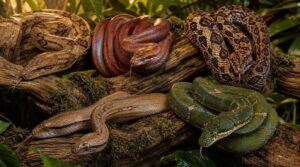
Not all boas are built for big spaces, and that’s exactly what makes these five species worth knowing.
Each one fits a different lifestyle, so it helps to read up on boa constrictor care and space requirements before committing to a species.
Each one grows slower and stays smaller than most, which change how you plan your setup, feeding schedule, and long-term commitment.
Here are the best slow-growing boa species to explore.
Hog Island Boa
The Hog Island boa stands out among dwarf boas for its remarkably slow growth rate and manageable adult size of 1.5–2.0 meters. Size genetics play a real role here — island isolation drives insular dwarfism, keeping these snakes compact.
Monitor growth rate regularly, plan enclosure size accordingly, and note their pale, habitat-matched coloration.
Captive breeding programs have stabilized conservation status greatly. Its status is monitored under the IUCN Red List assessment.
Corn Island Boa
Another island specialist worth knowing is the Corn Island boa, native to Nicaragua’s Islas del Maíz. This dwarf boa rarely exceeds 3–4 feet, making enclosure size straightforward to manage. Its island habitat shaped both its compact build and subtle color morphs — light browns with blushed saddles.
Growth rate monitoring matters here since development is genuinely slow, often spanning several years to full maturity.
Crawl Cay Boa
The Crawl Cay boa thrives within a mangrove ecosystem on a small Belizean island, mirroring the habitat of the Corn Island boa. Prey Specialization and limited food sources reinforce its slow continuous growth and compact size genetics, with adults rarely exceeding 1.5 meters.
Their striking speckled camouflage—dense black on gray—and unique ecological role make them standout candidates for Island Conservation-focused Captive Breeding programs, which manage dwarf boas responsibly.
Tarahumara Mountain Boa
Shifting from coastal mangroves to highland canyons, the Tarahumara Mountain Boa offers something genuinely different. Native to Mexico’s Sierra Tarahumara, it uses rocky thermoregulation across pine-oak terrain, staying compact at 1.0–1.3 meters.
Its mosaic crossbands and highland camouflage blend perfectly into forest floors. Among dwarf species, size reduction follows predictable growth curves tied directly to seasonal activity and reproductive timing.
Thus, your feeding schedule matters, as these patterns directly influence the snake’s development and health in its specialized environment.
Central American Dwarf Boa
The Central American Dwarf Boa is one of the most locality-dependent dwarf boas, with adults reaching 4–5 feet in length. Females are consistently larger than males.
Color Pattern Variation is directly tied to habitat requirements, as brown-to-gray saddle markings shift distinctly by region.
The Reproductive Cycle matures at 2–4 years, with timing dependent on sex.
Careful attention is required for Size genetics, Thermal Behavior, and Conservation Status before committing to care for this species.
Why Some Boas Grow Slowly
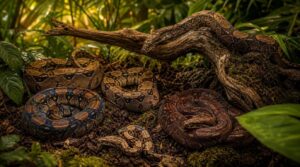
Slow growth in boas isn’t random — it’s the result of specific biological and environmental forces working together.
Understanding these drivers helps you predict how your snake will develop over time.
Here are the five key reasons some boas stay compact throughout their lives.
Island Dwarfism
Island isolation does something striking to a boa’s genetics over generations. When a small founder population gets cut off by open water — a population bottleneck — certain size-related traits lock in and repeat. That’s the dwarfism gene at work, not stunting.
Locality dwarf boas like Hog Island and Crawl Cay carry vestigial pelvis structures and adaptive coloration, confirming their deep evolutionary roots in restricted habitat requirements.
Limited Prey Availability
When prey density drops—even by 25 percent—a juvenile boa’s energy budget constraints activate rapidly, slowing measurable growth from centimeters to millimeters monthly. Foraging habitat restrictions and seasonal prey fluctuations further tighten feeding frequency, exacerbating nutrient deficiency over time.
Meeting a dwarf boa’s dietary and nutritional requirements is non-negotiable; limited prey availability directly caps its growth potential.
Genetics and Locality
Your boa’s growth ceiling is partly written in its DNA before it hatches. Locality dwarf boas from isolated islands carry reduced haplotype diversity and unique mitochondrial lineages shaped by founder effects during colonization.
Gene flow barriers between islands lock in allele frequency shifts over generations, producing regionally distinct size potential. These barriers isolate populations, reinforcing genetic divergence and limiting the exchange of traits.
Whether traits express as dominant, recessive, or codominant depends on each animal’s geographic origins and genetic inheritance. This inheritance pattern reflects both ancestral lineage and adaptive responses to insular environments.
Sex-Based Size Differences
Sex isn’t just about biology here — it actively shapes how fast your boa grows and where it stops. Female boas consistently outgrow males, driven by female fecundity demands and resource allocation toward reproductive tissue. Male growth plateaus earlier, often at sexual maturity around 3–5 years.
For sex-specific milestones, this baby boa growth speed guide helps set realistic feeding and size expectations.
For a clearer comparison, see this boa constrictor size by locality guide, which accounts for these sex-based differences.
Dimorphism drivers like thermal influence and prey intake further widen size variability, making sex a reliable predictor of adult size potential.
Feeding Frequency Effects
How often you feed directly controls your boa’s growth rate — it’s that simple. Meal frequency influences enzyme activity, digestive efficiency, and even stress hormones like cortisol. A consistent feeding schedule keeps reptile metabolism steady, supporting healthy juvenile growth without overloading the gut.
- Smaller, frequent meals improve digestive efficiency
- Irregular intervals increase stress hormones and slow metabolic rate
- Match prey size to dietary requirements at each stage
- Track weekly weight to fine-tune your feeding schedule
Adult Size Comparison Guide
Adult size is where most people’s expectations fall apart. A "dwarf" boa can still reach 4–6 feet depending on species, sex, and locality, so knowing the numbers before you commit matters.
Here’s exactly what you’re working with across the most popular slow-growing options.
Smallest Boa Options
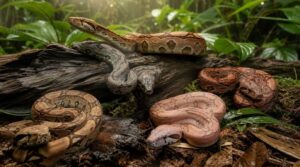
Few reptiles fit a compact lifestyle better than dwarf boas. The Central American Dwarf Boa tops out around 2.5–3 feet, while the Hog Island and Corn Island boas stay under 4 feet. Miniature boas like the Mexican Dwarf Boa and Sonoran Dwarf Boa rarely exceed 3 feet. Small snake care becomes manageable when you know what to expect.
| Species | Adult Length | Pet Trade Availability |
|---|---|---|
| Central American Dwarf Boa | 2.5–3 ft | Moderate |
| Hog Island Boa | 3–4 ft | Good |
| Corn Island Boa | Under 4 ft | Limited |
| Mexican Dwarf Boa | Under 3 ft | Sporadic |
| Sonoran Dwarf Boa | 2.5–3 ft | Rare |
Color morph variations, breeding program success, and legal import regulations all influence availability in the pet trade.
Male Versus Female Size
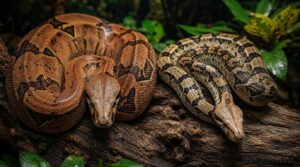
Sexual dimorphism in size manifests differently based on sex. Females exhibit noticeable girth expansion at sexual maturity due to substantial reproductive investment, while males remain leaner with longer tails utilized in courtship displays. This divergence underscores distinct evolutionary strategies tied to reproductive roles.
Habitat-driven dimorphism and seasonal mass fluctuation further modulate these patterns across regions, introducing variability in how size and girth differences express locally.
| Trait | Male vs. Female |
|---|---|
| Adult size | Males smaller overall |
| Girth | Females broader |
Expected Growth Timeline
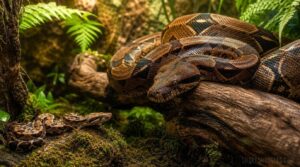
Growth doesn’t happen in a straight line. A boa’s juvenile growth phase involves adding roughly 2–4 cm yearly, with First-Year Growth reaching 15–20% of its final adult length. During this stage, the snake’s development is rapid but nonlinear.
By Year Three, the Juvenile Growth Rate slows noticeably as Growth Plate Decline reduces metabolic activity. This marks a transition toward slower, more gradual development. Maturity Age Milestones typically occur between years five and eight, signaling the shift to adulthood.
| Growth Stage | Yearly Length Gains | Temperature Gradient Effect |
|---|---|---|
| Year 1–2 | 15–20% adult length | High-impact |
| Year 3–5 | 2–4% annually | Moderate-impact |
| Year 6–8 | Minimal | Low-impact |
Mature Weight Ranges
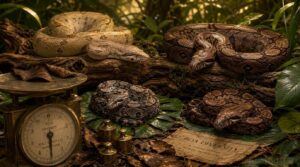
Once your boa reaches adulthood, weight matters more than length. Use Weight Benchmarking and Condition Scoring to track real health.
Locality Weight Profiles vary noticeably across species, as shown below:
| Species | Mature Weight Range |
|---|---|
| Hog Island Boa | 1.5–2.5 kg |
| Corn Island Boa | 0.8–1.8 kg |
| Crawl Cay Boa | 1.0–2.0 kg |
| Central American Dwarf | 0.5–1.5 kg |
For accurate tracking, weigh fasted at the same time weekly as part of your scale calibration routine.
Compact Boa Misconceptions
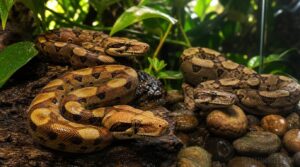
Most myths about compact boas collapse under basic observation. A few deserve direct correction.
| Myth | Reality |
|---|---|
| Size Ceiling Myth: tanks limit growth | Genetics and prey drive size, not enclosure |
| Health Equals Growth: slow means sick | Slow growers stay healthy; maturity just takes longer |
Don’t let the Morph Size Assumption steer your expectations either — dwarf boas reach their manageable size based on polygenic size traits, not appearance.
Care Needs for Compact Boas
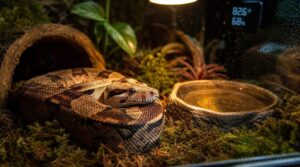
Compact boas don’t need a mansion, but they do need the right setup. Getting the basics right — enclosure size, temperature, humidity, feeding, and handling — makes a real difference in how well your snake thrives.
Here’s what each of those care areas actually looks like in practice.
Enclosure Size Planning
Your enclosure design sets the foundation for everything else. A 5–10 gallon glass terrarium works well for most compact boas, but incorporate a 20–30 percent future expansion margin from the start.
Ensure proper component clearance standards around heat sources—at least 2 inches on all sides. This maintains safety and functionality.
Good thermal dissipation planning and a wide access panel width simplify maintenance while minimizing stress for your animal.
Temperature Gradient Basics
Temperature gradient management is what separates thriving compact boas from stressed ones. A proper thermal gradient—ranging from an 80–85 °F warm side to a 70–75 °F cool side—emphasizes that both gradient magnitude and direction are critical.
Conduction gradients from heat mats and convection effects from ceramic emitters function differently; thus, combining both strategically is essential.
Key measurement techniques to apply:
- Place thermometers at floor level on both ends
- Use a digital infrared gun for spot-checking gradient direction accuracy
- Log readings morning and night to catch temperature drift
Humidity by Locality
Locality shapes everything. Coastal humidity and tropical rainforest moisture environments demand 60–70% indoor humidity for dwarf boas from those regions.
Tarahumara mountain boas tolerate lower levels, closer to 50–60%, mirroring desert night dew and mountain nocturnal humidity conditions.
River valley moisture zones sit somewhere in between.
Use a humidity misting system to hit these ranges consistently without guesswork.
Feeding Small Prey Safely
Prey size is where most feeding problems start. Keep feeder rodents at 10–15% of your boa’s body weight, and don’t exceed the width of its midsection. Prekilled options — fully thawed frozen prey — protect against bites and support a consistent feeding schedule. Use feeding tongs every time.
- Match prey size ratio carefully at every feeding
- Always thaw prekilled rodents in warm water first
- Use feeding tongs to keep hands clear
- Follow hygiene protocols: sanitize tools between meals
- Allow 24–48 hours post-meal rest before any disturbance
Stress-Free Handling Tips
Handling a compact boa demands calm, deliberate control. Begin with thorough handwashing preparation to eliminate food scents that may trigger feeding responses.
Choose a quiet handling environment, free from sudden noises or flashes. Apply slow motion techniques: lift the snake with gentle support under the midsection, avoiding any grip on the head.
Monitor for stress signals, such as tail flicking or lip licking. Prioritize short, consistent handling sessions to gradually foster docile behavior over time.
Choosing a Slow-Growing Boa
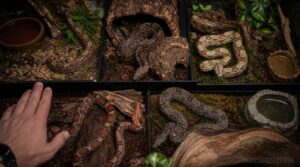
Picking the right slow-growing boa isn’t just about size — it’s about knowing exactly what you’re getting before you commit. A few key factors will separate a good match from a frustrating mistake.
Here’s what to check before you buy.
Locality Verification
Before you commit to any dwarf locality boa—Hog Island, Tarahumara, or otherwise—verify its origin documentation thoroughly. Breeder traceability requires confirmed clutch numbers, permit compliance records, and legitimate import certificates.
Geospatial mapping tools cross-reference claimed coordinates with known habitats, while island provenance for Hog Island specimens demands collection-site records.
Species identification and genotype testing eliminate mislabeled stock entirely.
Morph Versus Locality
Once you’ve confirmed locality, carefully weigh morphs against it. A morph’s metabolic rate can shift growth tempo, but locality’s prey density sets the ceiling. Three things to watch:
- Climate morph interaction affects temperature regulation and seasonal growth
- Hybrid growth synergy may blur dwarf locality size predictions
- Regional morph selection shapes manageable size across generations
Don’t let flashy color morphs override proven dwarf boas’ lineage data.
Health and Growth Records
Beyond morph selection, growth charting becomes your clearest window into a boa’s real developmental history. Request medical history records showing measurement protocols—weight, length, and body condition score logged at each checkup.
Accurate data privacy protections guarantee those records stay intact across keepers.
| Record Type | What to Check | Why It Matters |
|---|---|---|
| Growth Chart | Monthly length/weight entries | Confirms slow, steady gain |
| Health Checkups | Vet visit dates and notes | Flags illness or growth spikes |
| Feeding Log | Prey size and frequency | Links diet to growth rate |
Long-Term Ownership Commitment
Records tell you where a boa has been — your responsibility plan tells you where it’s going. Long-term reptile ownership requires annual vet checks, financial budgeting for habitat upgrades every 5–7 years, and a clear rescue rehoming strategy if life circumstances change.
Boas live 20–30 years, so preventative veterinary care and regular health checkups are non-negotiable. These practices form the baseline for ethical long-term commitment, ensuring the animal’s well-being throughout its lifespan.
Boas live 20–30 years, making preventative veterinary care and long-term commitment non-negotiable for ethical ownership
Frequently Asked Questions (FAQs)
What are the three types of boas?
Think of boas like a family with three distinct siblings. Boa constrictor tops out near 13 feet, Boa imperator averages 6–9 feet, and the Western boa usually reaches 7–10 feet.
Do dwarf boas coexist peacefully with other reptiles?
Dwarf boas aren’t natural roommates. Their docile nature doesn’t guarantee species compatibility — feeding segregation and behavioral monitoring are essential, and enclosure design with habitat partitioning reduces conflict greatly.
Can dwarf boas thrive in bioactive enclosure setups?
Dwarf boas can absolutely thrive in bioactive setups.
Substrate microfauna like isopods and springtails handle waste efficiently, maintaining a clean and balanced environment.
Live plant selection, moisture control, and vertical enrichment ensure optimal humidity and habitat complexity, keeping conditions perfectly regulated.
Are slow-growing boas suitable pets for beginners?
Slow-growing boas, especially dwarf boas, suit beginners well. Their docile temperament, low maintenance needs, affordable setup, and minimal vet care make the beginner learning curve manageable.
Just commit to mastering proper handling techniques and suitable habitat basics.
Conclusion
Choosing the right snake is half the battle—the other half is following through with consistent care.
Slow-growing boa species like the Hog Island or Corn Island Boa reward patience with manageable size, predictable behavior, and decades of interaction.
Verify locality documentation, track growth records, and match enclosure conditions to the specific subspecies you keep. Every detail you get right compounds over time, turning a well-researched decision into a thriving, long-term relationship with one of reptile keeping’s most rewarding animals.