This site is supported by our readers. We may earn a commission, at no cost to you, if you purchase through links.
A reptile that won’t eat, refuses to move, or hides constantly isn’t always sick—it’s often cold. Temperature drives nearly every biological process in reptiles, from digestion to immune function, and even a few degrees off can quietly derail their health for weeks. A ball python sitting on a cool side hovering at 75°F isn’t relaxing; it’s struggling to break down its last meal.
Proper heat in a reptile habitat isn’t a luxury setting you dial in once—it’s an active system that needs the right sources, accurate controls, and consistent monitoring to keep your animal genuinely thriving.
Table Of Contents
Key Takeaways
- Temperature controls nearly every biological process in reptiles, so even a few degrees off can silently derail digestion, immunity, and behavior for weeks.
- Every heater needs its own thermostat—no exceptions—because an uncontrolled heat source is both a fire risk and a death sentence for your animal.
- A proper thermal gradient only works when probes are placed correctly: one on the basking surface, one inside the cool-end hide, both secured and calibrated regularly.
- Heat and humidity are linked—get one wrong and the other suffers, disrupting shedding, digestion, and long-term health.
Set Species-Specific Temperature Targets
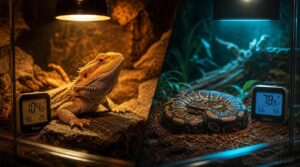
Not every reptile runs on the same thermostat. A bearded dragon and a ball python have completely different needs, and getting those numbers wrong can cost you.
Pairing the right mat to the right controller matters more than most people realize, especially if you’re exploring reptile heating mats safe for kids and families where stable, predictable temps are non-negotiable.
Here’s what to dial in for each key temperature zone.
Warm-side Temperature Range
Your warm side isn’t just a comfort zone — it’s where digestion, immunity, and activity begin. Tropical species like ball pythons require 28–30°C, while bearded dragons need a basking spot closer to 38–42°C.
Exceeding 34°C without managing humidity triggers warm-side stress signs rapidly. Consistent temperature monitoring ensures a stable thermal gradient and prevents metabolic disruptions from sudden temperature shifts.
For reference, a warm temperature is defined as the 70–85 °F warm range, which corresponds to 21.1–29.4 °C.
Cool-side Temperature Range
The cool side is where your reptile escapes heat stress — get it wrong and the whole thermal gradient collapses. Maintain cooler zones between 24–28°C (75–82°F) and ensure temperatures never fall below 22°C.
- Use heat sink materials like tile to absorb excess warmth
- Apply passive cooling strategies by shading the cool end
- Prioritize airflow management to prevent temperature fluctuations
- Check substrate conductivity to support habitat temperature stability
Nighttime Temperature Drop
Once the cool side is dialed in, nighttime temperature becomes your next focus. Radiative heat loss accelerates after sunset, causing enclosure surfaces to drop several degrees within hours.
Most reptiles require a 10–20°F nighttime drop, but avoid letting temperatures free fall uncontrollably. Prioritize managing ventilation cooling impacts and preparing for cold-front contingencies.
Leverage data-logging trends to monitor humidity’s nocturnal influence and detect unexpected temperature fluctuations. This proactive approach prevents stress on your animal by addressing imbalances before they escalate.
Juvenile Versus Adult Needs
Age changes everything. Juveniles have a faster metabolic rate, requiring temperatures 2–5°F higher than adults. This extra warmth supports calcium needs, immune development, feeding frequency, and natural behavioral exploration.
As reptiles mature, reduce the thermal gradient to align with adults’ lower thermal requirements. This adjustment helps avoid developmental reproductive problems linked to chronic overheating, ensuring long-term health.
Snake-specific Heat Preferences
Not every snake follows the same heat curve. Corn snakes thrive with a basking spot near 29–32°C and a cool retreat around 24–26°C. Ball pythons prefer a warm side of 30–32°C.
To refine temperature gradients, use heat preference testing — observe where your snake settles. This adaptive behavior helps tailor zones to your species’ needs.
Monitor adaptive basking behavior, species heat curves, and pit organ cues to ensure your heat source placement is correctly set up.
Create a Safe Thermal Gradient
A good thermal gradient isn’t complicated, but it does require some intentional setup. Your reptile needs the freedom to move between warm and cool zones on its own terms.
Here’s how to build that balance into the enclosure.
Heat One Enclosure End

Think of your enclosure as having a hot side and a cold side — a setup that only works with deliberate heat source placement. Mount your heat lamp 5–15 cm above the substrate at one end only. Proper end insulation techniques keep warmth from bleeding out.
- Angle the lamp to shape the basking spot without spreading heat across the entire floor
- Control airflow direction so warm air rises and drifts naturally toward the cool end
- Use guard shield design to block direct reptile contact with hot components
This creates defined temperature gradient zones, which your reptile can actually use.
Add Warm and Cool Hides

Hides anchor your thermal gradient — without them, your reptile can’t use the temperature zones you’ve built. Material choices matter: ceramic and rock hides retain heat efficiently on the warm side. Acrylic is ideal for visibility. Adding a lined interior boosts insulation, improving heat retention by up to 15%.
On the cooler side, ventilation design prevents trapped heat from undermining your thermal microhabitat.
Leave Space for Retreat
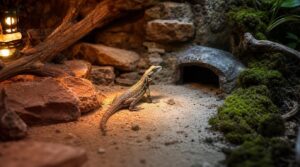
Your reptile needs a clear, unobstructed path to the cooler area—no climbing over heat sources to get there. Prioritize retreat accessibility by keeping the hide clearance open and airflow pathways unblocked.
A good corn snake tank setup guide will show you exactly how to position both hides so your snake can move freely between warm and cool zones without any obstacles in the way.
Substrate selection matters too; avoid heat-retaining materials on the cool side.
Maintain an equipment buffer zone between heaters and the retreat. That separation is what keeps your thermal gradient—and your animal—stable.
Check Vertical Temperature Zones

Tall enclosures don’t heat evenly from floor to ceiling—that’s just physics. Upper layer gradient, mid-zone, and bottom zone stability each require separate verification through Height Heat Mapping.
Place three probes at:
- Basking surface (28–32°C)
- Mid-Height Probe position (24–28°C)
- Floor-level cool zone (22–26°C)
This Vertical Gradient Ratio confirms species-centric thermal zones are functioning correctly throughout the thermal gradient within the enclosure.
Adjust for Seasonal Changes
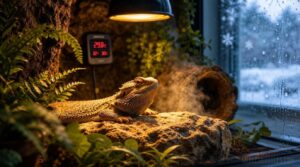
Your enclosure doesn’t know it’s winter—but your reptile does. As ambient temperature drops seasonally, room temperature compensation becomes essential.
Adjust thermostat setpoint upward and try adjusting heater height or wattage to restore lost warmth.
Schedule gradient shift scheduling checks each season. Even a 3–5°C room drop demands immediate thermostat settings review to preserve thermal gradient maintenance year-round.
Choose The Right Heat Source
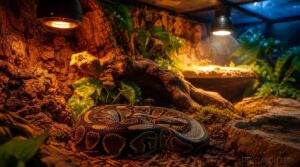
Not all heat sources work the same way, and picking the wrong one can throw off your whole setup.
Your reptile’s needs, enclosure size, and day-night schedule all play a role in the decision.
Here are the main options worth knowing.
Heat Lamps for Basking
A focused heat lamp is your best tool for building a reliable basking spot. The built-in Reflector Efficiency concentrates the Heat Beam Angle directly onto your target surface, so you control basking temperature without guessing.
Watch for these key factors:
- Match wattage (25–100W) to enclosure size
- Confirm UVB supplementation separately unless using mercury vapor
- Track energy consumption for long-term cost
- Prioritize heat lamp safety — always pair with a thermostat
- Replace bulbs per lamp lifespan ratings to support consistent basking behavior
Ceramic Emitters for Nighttime
Ceramic heat emitters solve that perfectly. They work entirely within the infrared spectrum, delivering heat regulation without disrupting sleep cycles.
Choose wattage selection between 60–150W based on enclosure size. Pair every unit with a proportional thermostat to counter thermal inertia.
Always use safety guarding to block direct contact. Heat source efficiency stays high; energy efficiency stays reliable all night.
Under-tank Heat Mats
Under-tank heaters take a different approach — they warm from below, mimicking ground heat.
Material durability matters here; inspect edge seals regularly for peeling or wear. Use adhesive mounting to secure the mat outside the enclosure floor.
Run a wattage calculation based on mat size (4–24W range). Always pair with a heat mat thermostat, placing your temperature sensor at the heated zone.
Plug into a GFCI outlet for heat mat safety.
Radiant Heat Panels
Radiant heat panels work differently from mats — they emit infrared heating directly onto surfaces, not air. High-emissivity materials make them remarkably energy efficient.
Mount at the correct height following clearance requirements, then pair with a proportional thermostat for precise temperature control.
They’re quiet, low-maintenance, and ideal for sustaining a stable thermal gradient.
Keep your maintenance routine simple: dust them regularly, inspect for warping.
Match Heater to Enclosure Size
Sizing your heater wrong is one of the most common mistakes keepers make. Your heat output calculation starts with total surface area — all six sides, not just the footprint.
- Calculate Surface Area Wattage from length, width, and height
- Add Temperature Rise above your coldest expected room temperature
- Apply Draft Compensation if your space gets airflow
- Account for Insulation Effects — uninsulated enclosures need more wattage
Heater Oversizing is fine; pair it with a thermostat to control output precisely.
Install Thermostats and Safety Controls
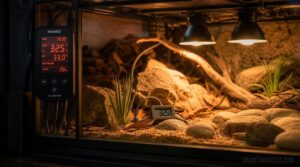
A heater without a thermostat is a fire waiting to happen — and a dead reptile waiting to happen too.
A heater without a thermostat is a fire waiting to happen and a reptile waiting to die
Every setup needs proper controls to keep temperatures locked in and your animal safe. Here’s what you need to put in place.
Use Every Heater With Thermostats
Every heater needs its own thermostat — no exceptions. A loose heat mat or lamp running unchecked is a fire and burn risk waiting to happen. Use heater-specific channels on your thermostat controller so each heat source gets independent control and calibration per heater.
A digital temperature controller with redundant thermostat backup protects against single-point failures. Always confirm power rating alignment before connecting.
| Heater Type | Thermostat Requirement |
|---|---|
| Heat lamp | On/off or dimmer thermostat |
| Ceramic emitter | Pulse-proportional controller |
| Under-tank mat | Low-wattage dedicated channel |
Choose Proportional Thermostats
Unlike basic on/off switches, a proportional thermostat uses duty cycle and pulse modulation to deliver heat in steady, controlled increments. This keeps temperatures within a tight band — no wild swings.
Bandwidth tuning allows users to match their heater compatibility, whether using mats or ceramic emitters.
Wi-Fi thermostat controllers with remote alerts enable early detection of temperature excursions, preventing emergencies.
Thermostat calibration ensures long-term accuracy for proportional control systems.
Set High-temperature Limits
Your thermostat’s high limit is your reptile’s last line of defense against overheating. Set it a few degrees below the species’ maximum safe basking temperature — that safety margin accounts for thermostat lag compensation and hotspot probe placement errors.
For a deeper look at why that buffer matters, how thermostats prevent reptile overheating walks through the feedback mechanisms that keep basking zones safely within range.
Recheck your high limit calibration after room temp adjustments, since cooler or warmer rooms shift hotspot readings. Verify it holds across multiple heat cycles, not just one.
Add Temperature Alarms
Even the best thermostat controls can fail silently. A dedicated temperature alarm adds a critical second layer. Configure high/low temperature alarms with alarm threshold settings that match your species’ limits, and enable rate-of-change alerts for rapid spikes.
Multi-channel alerts via app, SMS, or email cover you remotely.
Use remote sensor zones, battery backup power, and remote temperature monitoring to keep every temperature sensor active around the clock.
Plug Into GFCI Outlets
All your heating equipment—lamps, mats, and thermostats—must be plugged into GFCI outlets. These outlets trip within milliseconds when detecting a current imbalance as small as 5 milliamps, preventing electrical shock before it can harm you or your animals.
To ensure safety, follow these critical guidelines:
- GFCI Testing: Press the test button monthly to confirm automatic shutoff functionality.
- Outlet Placement: Install weather-resistant models near moisture sources.
- Reset Procedures: After a trip, resolve the underlying fault before resetting.
- Load Management: Avoid connecting multiple heat sources to a single circuit.
Place Probes and Thermometers Correctly
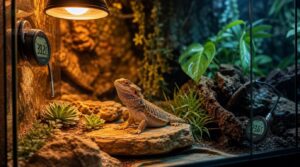
Getting the temperature right means nothing if your probes are in the wrong spot. A misplaced thermometer can give you false readings and put your reptile at real risk.
Here’s exactly where each probe needs to go.
Probe on Basking Surface
Getting this right starts with one rule: press the probe flat against the basking spot substrate—tile, stone, or rock—so that the flush probe placement gives you actual surface conductivity, not a floating air reading. Position 2–3 inches below the heat source.
Substrate conductivity varies by material, so heat-resistant mounting keeps the sensor locked in place.
Watch for drift beyond 2°C—that is your burn risk alert.
Second Probe at Cool End
Your basking probe tells half the story. Place the second probe at the cool end—mid-substrate, inside the retreat hide—to complete your thermal gradient picture. Keep it clear of water bowls; Signal Interference Prevention matters here, since moisture causes Environmental Noise Effects on readings.
Aim for Probe Placement Height matching your reptile’s typical body level. Temperature Differential Monitoring between both ends confirms your temperature control is working.
Secure Probes Firmly
A drifting probe quickly wrecks your readings. Secure each sensor with Threaded Grip Screws and Locking Collar Locks to prevent vibration-induced shifts in temperature sensor placement over time. Add Silicone Vibration Dampers against enclosure walls and apply Ferrite EMI Shielding on cable runs to reduce interference.
Finish with Redundant Cable Ties:
- Zip-tie thermostat probe cables to fixed anchor points
- Route wires away from heat sources
- Re-check probe placement after any tank rearrangement
- Log position details for consistent temperature calibration
Avoid Measuring The Snake
Your probes do the work — never the snake. Picking up your reptile to "check" its warmth disrupts the thermal gradient and spikes stress.
Stick to a Fixed Probe Routine and use Infrared Surface Scans for Non-Contact Verification across basking tiles and hides.
This Handling Avoidance Protocol keeps temperature logging consistent, probe placement accurate, and your snake undisturbed.
Calibrate Thermometers Regularly
Even accurate-looking thermometers drift. Check every digital thermometer against a reference standard every 12–24 months — sooner if you drop a probe or change your setup.
Use an ice-point bath for your calibration setup, wait for readings to stabilize, then record any offset.
Consistent offset tracking and stability assessment keep your temperature logging reliable, so your temperature sensors never quietly mislead you.
Monitor Heat Daily and Seasonally
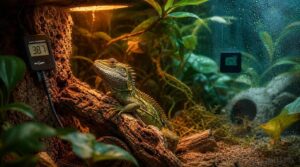
Checking temperatures once and calling it done won’t cut it — your reptile’s needs shift with the time of day, the season, and even what you last changed in the enclosure.
Good heat management means staying consistent and catching problems before your animal feels them. What to track and when is key to maintaining their health.
Record Temperatures Twice Daily
Check your enclosure twice daily — morning and evening — using a digital thermometer at both ends. Min‑max logging catches brief heater overshoots a single reading misses. Record ambient drift tracking alongside enclosure data to separate room temperature shifts from actual heater problems.
Log consistency audits across days reveal trends before they become emergencies. Temperature sensors and environmental data logging turn guesswork into reliable trend charting.
Watch Nighttime Readings
Nighttime is when your setup gets real. Daytime logs look great — but temperature fluctuations after lights-out reveal thermostat lag, cold spot detection gaps, and heat retention rate issues you’d otherwise miss. Watch these five overnight metrics closely:
- Cool-end floor temp after lights off
- Warm-side stability for nocturnal species
- Room temperature influence on enclosure readings
- Day/night temperature cycle consistency
- Night data logging trends across multiple days
Recheck After Enclosure Changes
Every enclosure change resets your thermal baseline. Swapping substrates, adding decor, or sealing gaps all shift temperature fluctuations in ways your thermostat controls won’t automatically catch.
Run probe relocation validation, thermal mass reassessment, ventilation impact review, insulation effect audit, and substrate moisture impact checks after every modification.
Your temperature probe readings and data logs may look completely different — even if you changed nothing about your heater settings.
Use Data-logging Sensors
Data-logging sensors take your environmental monitoring to the next level. Set Logging Interval Settings to every 5–10 minutes for accurate trend tracking. Your temperature probe and humidity sensor feed continuous data into exportable logs.
Remote Data Access lets you review readings from your phone anytime. Enable Alert Integration for out-of-range warnings.
Don’t ignore Battery Management — a dead logger means blind spots in your data logs.
Respond to Room-temperature Shifts
Room temperature shifts are silent saboteurs. Seasonal HVAC changes can throw off your thermostat controls overnight without warning. Build Insulation Strategies into your setup—insulate enclosure walls and floors to improve Thermal Inertia Management.
Practice Draft Prevention near windows and vents.
Size heaters for adequate Backup Heater Capacity so Heat Recovery Timing stays fast when ambient temperatures drop unexpectedly.
Balance Heat With Humidity

Heat and humidity do not work in isolation — if one is incorrect, the other is affected. Your reptile’s ability to shed, digest, and stay healthy depends on maintaining both within the appropriate range.
Striking this balance is critical. Get one wrong, and the other suffers, disrupting essential biological processes. Understanding this interplay ensures your reptile thrives in a properly managed environment.
Match Humidity to Species
Humidity isn’t one-size-fits-all — it’s tied directly to species-centric thermal zones and species-specific temperature needs. Tropical species require relative humidity (RH) between 60–90 percent, while desert species thrive in 20–40 percent humidity.
To manage these needs, map microclimates using separate probes and implement gradual humidity acclimation for newly acquired animals. This ensures a smooth transition to their new environment.
Regular humidity sensor calibration is critical to maintaining reliable humidity control and ensuring accurate readings. This practice prevents discrepancies and supports consistent care.
Protect Shedding Conditions
Shedding puts your reptile in a vulnerable state — and you’re temperature and humidity work together more than ever here. Humidity stability is the backbone of a clean shed.
Follow these steps:
- Maintain your thermal gradient without changes during active shedding.
- Practice gentle handling — or none at all.
- Keep hide temperature within the warm zone.
- Time any equipment adjustments around shedding timing, not during it.
- Overheating prevention is crucial: excess heat dries skin before it separates.
Prevent Damp Cold Hides
A damp cold hide quietly undoes all your thermal gradient work. Position warm-side hides directly in the basking zone for proper heat distribution.
Choose non-porous materials — hide material choices matter for condensation prevention. Keep substrate dryness under hides a priority.
Run surface temperature checks to confirm warmth. Good airflow management and consistent temperature control keep hides dry and safe.
Mist Without Overheating
Misting keeps your enclosure balanced, but poor timing creates temperature fluctuations that undo your heat management. Use automated misting in short bursts — airflow optimization helps fine mist evaporate within 60 seconds, preventing humidity spikes above 80%.
Choose a droplet size around 20–50 micrometers and always use distilled water for water purity. These practices ensure effective evaporation and minimize residue buildup.
Smart misting timing preserves humidity control without compromising your thermal gradient, maintaining a stable environment for your enclosure.
Track Humidity With Hygrometers
Your hygrometer’s effectiveness depends entirely on proper usage: selecting the right type, placing it correctly, and regularly monitoring its performance.
- Sensor Type Comparison: Capacitive models surpass resistive ones in accuracy.
- Placement Strategies: Mount at mid-enclosure height, away from misters.
- Calibration Procedures: Verify against a salt solution reference (±3% RH).
- Data Logging Alerts: Wi-Fi models push notifications when humidity levels deviate from targets.
- Maintenance Tips: Clean probes monthly using distilled water.
Frequently Asked Questions (FAQs)
How does heating affect reptile immune system health?
Temperature directly controls immune enzyme kinetics in reptiles.
Thermal stress response activates when temperatures drop below 65°F, suppressing immune function and elevating temperature-driven pathogen risk — leaving reptiles vulnerable to infections they would otherwise fight off easily.
What burns can improper surface temperatures cause?
Overheating surfaces become silent hazards. Contact burns start fast — skin above 140°F breaks down in seconds. Blister formation, tissue necrosis, barrier disruption, and pain escalation follow prolonged substrate contact.
How does heat influence reptile reproductive success?
Incubation temperature shapes embryo development, sex ratio, and hatchling mass.
Too much heat cuts reproductive cycles short and kills embryos.
Even a small thermal shift can determine whether eggs hatch healthy — or not at all.
Can power outages harm reptiles during temperature drops?
Without power, enclosures drop toward room temperature fast. Cold stress symptoms—like lethargy and digestive failure—set in quickly.
Low thermal mass setups lose heat fastest, putting your reptile at serious risk.
How often should heating equipment be inspected for safety?
Monthly safety checks catch most problems early. Inspect cords, probes, and outlets every 30 days. Run a quarterly heater review and an annual wiring audit before each heating season starts.
Conclusion
Get this wrong, and your reptile pays the price—silently, slowly, and sometimes irreversibly. Learning how to maintain proper heat in a reptile habitat isn’t a one-time setup; it’s a daily discipline. Every probe placement, every thermostat setting, every seasonal adjustment builds a habitat your animal can genuinely thrive in.
Temperature isn’t just comfort—it’s the engine running everything beneath the scales. Keep it dialed in, and your reptile will show you the difference.
- https://toadranchcages.com/blogs/news/best-ways-to-heat-your-reptile-enclosure?srsltid=AfmBOopbZkGpm4IaJYiuyAaThifnDt9VNxls-e0qDw6Ua5mtSERGxgzo
- https://toxirium.com/how-to-achieve-perfect-reptile-temperature-gradients-the-2026-guide/?srsltid=AfmBOopIzLxEMLaKxIqBOK2b4cxsj-GIdjgb-1yEXIeklxSJvqik6LfY
- https://www.thebiodude.com/blogs/reptile-and-amphibian-lighting-faqs-and-help/here-s-why-you-shouldn-t-be-using-a-heat-mat-for-your-reptile?srsltid=AfmBOopfysBNnky59l3w4IGNzO0Fzeklkt4O2gZ3wKteOHaW_YHTuzRr