This site is supported by our readers. We may earn a commission, at no cost to you, if you purchase through links.

A boa constrictor raised on identical feeding schedules can end up half the size of its sibling—not because of poor care, but because genetics set the ceiling before husbandry even enters the picture. That’s the part most keepers miss. They obsess over prey size and enclosure temps while the snake’s IGF-1 pathways and polygenic size traits quietly run the show beneath the surface.
Understanding the factors affecting boa growth means tracking multiple variables at once: lineage, diet, thermal gradients, stress hormones, and enclosure design all push and pull against each other.
Getting one wrong means the others can’t fully compensate.
Table Of Contents
Key Takeaways
- Genetics sets your boa’s size ceiling before husbandry even enters the picture — two siblings on identical care can end up feet apart in adult length because IGF-1 pathways and polygenic traits are already running the show.
- Prey weight should sit around 10% of your boa’s body mass, fed weekly for juveniles, since that schedule alone drives roughly 31% faster growth compared to bi-weekly feeding.
- Temperature gradients (86–90°F warm side, 76–80°F cool side) aren’t just comfort features — they directly control enzyme activity, nutrient absorption, and metabolic rate, meaning a cold enclosure quietly starves your snake’s growth.
- Chronic stress is a silent growth killer: elevated cortisol suppresses IGF-1 signaling and can stunt size by up to 25%, so enclosure space, secure lids, and a stable environment aren’t optional extras.
Genetic Factors Shaping Boa Size

Before you can shape your boa’s growth, you need to understand what’s already written in its DNA. Genetics set the ceiling — how long your snake can realistically get, how fast it will reach that size, and even how its body uses energy.
Things like subspecies lineage, IGF1 pathways, and polygenic inheritance all play a role, as this boa constrictor size timeline and genetic growth guide breaks down in useful detail.
Here are the key genetic factors that determine your boa’s size potential.
Inherited Adult Size Ceiling
Before your boa ever takes its first meal, its growth ceiling is already written in its DNA. This is the Heritable Length Setpoint — a Polygenic Growth Limit shaped by dozens of growth-regulating genes working together. Think of it as an inherited blueprint from its Ancestral Lineage Ceiling.
Species like sand boas and rosy boas carry especially conservative setpoints, making them ideal choices if you’re drawn to boa species that stay small and grow slowly throughout their lives.
5 Genetic truths every keeper should know:
- Parental Size Influence predicts roughly how large your boa will grow.
- Genetic variation across lineages sets distinct adult size ranges.
- Early Developmental Epigenetics can quietly shift how genes are expressed during juvenile stages.
- No single gene controls size — it’s always a team effort.
- Heritable adaptation means island boas and mainland boas carry fundamentally different ceilings.
Sexual Dimorphism Differences
Female boas run 1–2 ft longer than males, driven by hormonal influences tied to reproductive output. This size difference reflects energy allocation at work: more body equals more offspring. Such size dimorphism isn’t random—it stems from genetic and biological factors functioning as intended. The pattern echoes broader sexual dimorphism across taxa observed in many species.
| Trait | Female Boas | Male Boas |
|---|---|---|
| Adult Length | 8–10 ft | 6–8 ft |
| Mating Behavior | Receptive, selective | Active, competitive |
| Diet Quality Needs | Higher | Moderate |
Island Dwarfism Genetics
Geography rewrites genetics over time. Island dwarf boas shrink through founder effect and allele fixation — when a small founding population carries size-reducing variants, genetic variability collapses fast.
Gene flow barriers keep mainland genetics out, letting metabolic trade-offs and regulatory divergence lock in smaller body plans across generations.
Population genetics and the island effect don’t just influence size — they hard-wire it.
Subspecies Size Potential
Each subspecies carries its own size ceiling — baked into their lineage through Genetic Variation Mapping and centuries of Evolutionary Adaptation Rates.
- South American rainforest boas: 10–12 ft maximum recorded lengths
- Pearl Island boas: capped at 6 ft through island dwarfism
- Climatic Stability Effects reinforce consistent growth limits
- Prey Availability Impact and Geographic Habitat Influence determine whether boas actually reach their potential
Metabolism and Skeletal Genes
Behind every inch of growth, your boa’s body runs a tightly coordinated molecular engine. Genes like MYLIP and ARSB regulate energy metabolism and skeletal development, while IGF1 signaling — insulin-like growth factor — drives bone and muscle expansion.
| Gene System | Function | Growth Impact |
|---|---|---|
| RANKL/OPG balance | Bone remodeling | Structural integrity |
| Wnt β-catenin | Osteoblast activation | Length gains |
| mTOR regulation | Nutrient-to-growth conversion | Rate control |
Sirtuin coupling links cellular energy to skeletal output. Disrupt that, and growth stalls.
Diet Choices Driving Healthy Growth
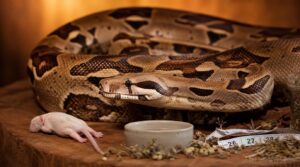
What you feed your boa — and how often — shapes its growth more than most keepers expect. Getting the diet right means understanding prey size, feeding schedules, and the risks of going too far in either direction.
Here’s what actually moves the needle.
Proper Prey Size
Getting prey size right is the single biggest lever for your boa’s growth. Aim for a Prey Weight Ratio of roughly 10% of your snake’s body weight—weigh your boa monthly and adjust accordingly.
A well-fed boa is also a calmer, more handleable one—so pairing good feeding habits with understanding how boa temperament and handling connect makes the whole experience better for both of you.
Prey Diameter Matching is equally critical: the prey should mirror the widest part of your boa’s body. Failure to do so risks Undersized Meal Risks like sluggish growth, poor protein intake, and weak muscle development. Conversely, Oversized Prey Consequences include regurgitation or impaction.
Always use Gradual Size Increase as your boa grows, avoiding sudden jumps in prey size.
Feeding Frequency Effects
Feeding frequency matters more than most keepers realize. Nail your Meal Timing Consistency and you’ll see real Growth Plateau Prevention in action. Weekly feeding schedules work best for juveniles — studies show a 31% faster growth rate versus bi-weekly.
Here’s what to watch:
- Match Caloric Balance to life stage
- Respect Stomach Capacity — never rush the next meal
- Monitor Stress Hormone Response during schedule changes
- Track nutrient absorption through stool quality
Protein-rich Rodent Diets
Rodents aren’t just convenient—they’re nutritionally close to perfect for boas. A high-protein diet built on Protein Source Diversity (rotating rats, mice, and the occasional quail) ensures solid Amino Acid Balance, supporting muscle and bone development simultaneously.
Maintain the Calcium-Phosphorus Ratio to safeguard skeletal health, while monitoring Digestibility Metrics through stool quality. Avoid excess protein to prevent Kidney Load Management concerns. Ultimately, diet quality drives real growth.
Seasonal Fasting Impacts
Seasonal fasting cycles are real growth rate determinants — and not always in a bad way. In the wild, food availability drops seasonally, and your boa’s metabolism adapts through fat mobilization and improved insulin sensitivity.
Prolonged fasting causes metabolic stress, cutting caloric reduction by up to 20% annually.
Smart energy allocation means keeping fasting windows short to protect growth momentum and seasonal sleep quality.
Overfeeding Growth Risks
More isn’t always better — overfeeding your boa to chase faster growth creates serious problems.
A calorie surplus shifts development toward fat storage, causing uneven body shape and metabolic stress your snake can’t easily recover from.
Digestive overload follows frequent large meals, overwhelming your boa’s system.
Meanwhile, liver strain and immune suppression leave your boa vulnerable to disease.
Obesity shortens lifespan, compounding these risks over time.
A balanced diet with smart feeding frequency beats overfeeding every time.
Temperature and Humidity Effects
Getting the temperature and humidity right in your boa’s enclosure isn’t optional — it’s what drives healthy digestion, clean sheds, and steady growth.
A boa that’s too cold or living in dry air will slow down in ways you might not notice until the damage is done.
Here are the key environmental factors you need to dial in.
Ideal Heat Gradient
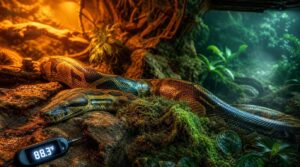
Think of your boa’s enclosure as a thermal highway — one end hot, the other cool, with everything in between doing the work. Heat Gradient Consistency is what keeps your snake healthy and growing.
- Heat Source Placement: Warm side targets 86–90°F; cool side stays 76–80°F.
- Cooling Zone Design: Never let the cool end dip below 76°F.
- Probe Distribution: Place digital probes at three points — hot spot, mid-tank, cool end.
- Thermostat Calibration: Calibrate sensors to stay within ±2°F of your target.
- Temperature Gradient Optimization: A 10–12°F spread facilitates natural thermal regulation behavior.
Digestion and Metabolism
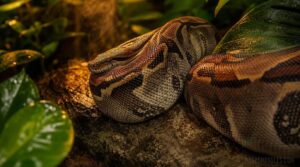
Temperature is critical for boa constrictors’ digestion, as it drives every digestive process. Enzyme activity ramps up at 86–90°F, boosting nutrient absorption and energy use. Dropping below 70°F stalls metabolism significantly.
| Factor | Ideal Range | Impact |
|---|---|---|
| Enzyme Activity | 86–90°F warm side | Peak protein breakdown |
| Gut Microbiota | 60–80% humidity | Aids nutrient absorption |
| Hormonal Control | Stable gradient | Regulates feeding response |
| Metabolic Rate | 80–90°F ambient | Efficient energy conversion |
| Nutritional Needs | 5–10% body mass meals | Prevents digestive stress |
Beyond temperature, gut microbiota (requiring 60–80% humidity), hormonal control (maintained through stable gradients), and metabolic rate (optimized at 80–90°F ambient temperatures) are critical. Adhering to nutritional needs—specifically meals sized at 5–10% of the boa’s body mass—prevents digestive stress.
Nighttime Temperature Drops

Your boa’s warm side does the heavy lifting during the day, but nighttime tells a different story. Radiative cooling — where surfaces shed heat into the air — naturally drives a temperature inversion after dark.
Aim for a nightly dip to around 68°F. This mimics wild conditions and facilitates healthy thermoregulation in snakes:
- Prevents metabolic overload from constant high ambient temperature
- Supports natural growth cycles through temperature gradients
- Reduces urban heat trapping effects inside enclosed setups
- Minimizes frost formation and dew condensation risks on cool surfaces
Humidity and Shedding
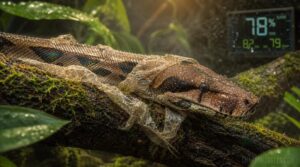
Humidity regulation in enclosures directly drives shedding success. Keep humidity levels between 60–70% — drop below 40% and you’ll start seeing shedding failure signs like stuck eye caps or retained tail tips.
| Factor | Target Range |
|---|---|
| Ambient Humidity | 60–70% |
| Humid Hide Design | 80%+ locally |
Microclimate monitoring matters more than overall readings. Use seasonal humidity adjustments to prevent mold prevention issues while supporting clean sheds.
Respiratory Health Support
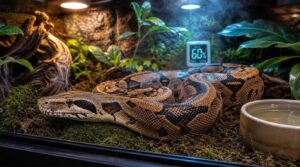
Respiratory health is directly tied to humidity regulation and temperature gradients established in enclosures. Maintaining these environmental factors is crucial for overall well-being.
Poor airflow design, irritant control failures, and stress breathing caused by temperature swings can quickly compound issues. Addressing these challenges requires proactive management of the habitat’s conditions.
To safeguard respiratory health, implement these essential practices:
- Maintain hydration support with clean, fresh water daily
- Apply quarantine protocols for any new arrivals
- Eliminate scented sprays — humidity control won’t compensate for airborne irritants
- Reduce stress factors like loud noise and sudden lighting shifts
Enclosure Space and Stress Control

The size of your boa’s home matters more than most keepers realize — it directly affects stress levels, muscle development, and long-term growth. A cramped enclosure isn’t just uncomfortable; it can stunt a boa’s growth by up to 25% compared to properly sized setups.
Here are the key enclosure factors you need to get right.
Juvenile Enclosure Needs
A cramped juvenile is a stressed one — and stress kills growth. Enclosure dimensions matter more than most keepers realize. Aim for at least four times your snake’s total length in floor space, with vertical branch height reaching 1.5 times its body length.
Maintain temperature gradients, humidity control between 50–70%, and proper substrate depth of 2–4 cm under hides. Ensure hide diversity across both ends of the enclosure and a dedicated feeding zone isolation area.
Spacious enclosures genuinely support juvenile growth.
Adult Enclosure Sizing
Once your boa hits adulthood, enclosure dimensions become non‑negotiable.
Width should follow a girth width ratio of at least four times the snake’s body width, while total length plus one extra meter gives adequate room for hotspots and retreat zones.
Vertical clearance of 0.8 meters above the tallest perch prevents cramped quarters.
Add substrate zoning for comfort, and don’t skip escape‑proof locks — spacious enclosures only work when they’re secure.
Climbing and Enrichment
Think of your boa’s enclosure as a living gym. Vertical rope systems and branches spaced 8–12 inches apart deliver muscle-strengthening climbs that build real tone.
Puzzle feeder design boosts cognitive engagement, while habitat complexity zones and sensory enrichment tools reduce stress hormones that stunt growth.
Smart enclosure design for reptiles — combining space for movement with varied textures — creates a genuinely stress-free reptile habitat.
Secure Lid Importance
A missing or flimsy lid isn’t just an escape risk — it’s a hidden stressor that spikes your boa’s cortisol and quietly kills growth.
- Locking mechanisms prevent accidental disengagement during handling
- Tamper evident seals confirm the enclosure design for reptiles stays uncompromised
- Material durability resists warping, maintaining habitat suitability long-term
- Contamination prevention blocks dust and pathogens
- Audit trail integration helps track access for consistent care routines
Stress-related Growth Delays
Chronic stress is a silent growth killer. Elevated cortisol suppresses IGF-1 signaling — the very pathway driving your boa’s skeletal development. Sleep disruption, appetite reduction, and immune compromise stack on top of each other fast.
Chronic stress silently kills boa growth by suppressing the very hormones that build bone
| Stress Effect | Growth Impact |
|---|---|
| Cortisol suppression of IGF-1 | Slowed bone formation |
| Behavioral inhibition | Reduced muscle stimulation |
| Immune compromise | Energy diverted from growth |
| Sleep disruption | Lower growth hormone output |
A stress-free reptile habitat isn’t optional — it’s foundational.
Growth Milestones and Health Monitoring
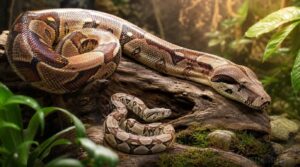
Knowing what to expect as your boa grows takes a lot of guesswork off the table.
From hatchling to full adult size, each stage comes with its own benchmarks worth paying attention to.
Here are the key growth milestones — and how to keep an eye on your snake’s health along the way.
Hatchling Size Range
Boa hatchlings are born alive — not from eggs, which means maternal nutrition and the clutch egg mass (the collective resources invested during gestation) directly shape their starting size. Geographic variation in hatchling size is evident, with species SVL baselines ranging from 14 to 22 inches depending on locality and gestation duration in the womb.
Tracking these numbers early establishes a critical foundation for growth monitoring in captive snakes, ensuring accurate baseline data for developmental assessments.
First-year Growth Expectations
Once you’ve got your hatchling’s baseline documented, the rapid juvenile growth phase truly begins. During this first year, expect a length doubling rate of approximately 2.5 to 3.5 feet under optimal care. Key factors driving this growth include your boa’s feeding schedule, temperature and humidity conditions, and early skeletal development.
Track these growth monitoring metrics consistently:
- Measure total length monthly
- Log weight gain percentage bi-weekly
- Note shed frequency as a seasonal growth peak indicator
- Adjust prey size to match increasing girth
Two-year Development Markers
By year two, your boa should reach approximately 60–90 cm, marking the end of the rapid juvenile growth phase. Skeletal maturity begins to set in, and metabolic shifts slow the early sprint of development.
Length benchmarks and body mass index both become critical at this stage. As growth velocity drops noticeably, maintaining a consistent feeding schedule and juvenile nutrition is essential to support this transitional period.
Adult Size Timeline
After that two-year slowdown, most captive boas reach their adult size range between ages three and five. Here’s how the Growth Curve Phases typically progress:
- Year one: Rapid doubles in length.
- Year two: Growth reaches 50–70% of adult length.
- Years three to four: Yearly length gains gradually taper.
- Year five: Marks the Timeline Completion Age for most specimens.
Maturation Speed Variability is influenced by factors like genetic variability and feeding schedules, which shape how quickly boas achieve these milestones.
Veterinary Growth Checks
Regular veterinary checkups do more than confirm your boa is alive and eating. At each visit, the vet tracks Weight Charting, Body Condition Scoring, and Appetite Assessment to monitor health comprehensively. These procedures help catch problems before weight drops or other issues emerge.
If growth rate stalls, Hormonal Evaluation or Diagnostic Imaging may follow, as snake metabolism issues rarely announce themselves loudly. Early intervention through these advanced diagnostics ensures timely care.
Top 3 Boa Growth Items
Getting the genetics and husbandry right is only half the equation — right gear makes the other half possible.
Whether you’re setting up for a hatchling or upgrading for a growing adult, the tools you choose matter.
Here are three items worth keeping on your radar.
1. THARAHT Pink Turkey Feather Boa

The THARAHT Pink Turkey Feather Boa isn’t your typical gear—it’s a fun prop for presentations, educational demos, or themed events where you want to make an impression.
Made from natural turkey feathers, it stretches two full yards and weighs just 40 grams, ensuring it won’t slow you down.
While reusable and lightweight, feather shedding is a real concern. A quick shake after each use helps maintain its full, performance-ready appearance.
| Best For | Anyone who needs a fun, eye-catching accessory for dance performances, themed parties, Mardi Gras, Halloween, or costume events where bold style matters more than durability. |
|---|---|
| Material | Natural turkey feathers |
| Weight | 40g |
| Length | 2 yards |
| Primary Use | Costume accessory |
| Reusability | Reusable with care |
| Skill Level | No skill required |
| Additional Features |
|
- Made from real turkey feathers, so it looks and feels genuinely fluffy and full.
- Super lightweight at just 40g — you’ll barely know you’re wearing it.
- Two full yards of coverage makes it a standout piece for photos, stage looks, and costumes.
- Sheds feathers pretty easily, which can get messy fast.
- The stitching or glue can give out with regular use, so it may fall apart sooner than expected.
- The feather texture can irritate sensitive skin, so it’s worth being careful around kids.
2. Tharahht Rainbow Turkey Feather Boa
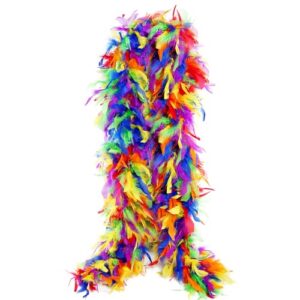
Step up your presentation game with the Tharahht Rainbow Turkey Feather Boa. At two yards long and just 38 grams, it drapes easily around your shoulders without weighing you down during demos or events.
The rainbow sequence — red through purple — catches light well and remains clearly visible across a room.
Similar to the pink version, feather shedding occurs, so give it a shake before use. Store it flat or hanging to maintain its fullness and photo-ready appearance.
| Best For | Anyone who needs a fun, eye-catching accessory for costumes, photo shoots, or one-time event looks without spending much. |
|---|---|
| Material | Natural turkey feathers |
| Weight | 38g |
| Length | 2 yards |
| Primary Use | Costume accessory |
| Reusability | Reusable with care |
| Skill Level | No skill required |
| Additional Features |
|
- Two yards long, so it drapes generously and works great for layering or dramatic styling
- Lightweight rainbow color blend that reads well across a room or in photos
- Reusable and skin-friendly — hang it up before your event and the feathers fluff right back up
- Feather density runs thin, and shedding can get messy during active wear
- Colors may look lighter in person than they do in product photos
- Not built for all-night or high-movement use — expect some wear on the look as the night goes on
3. Python Crash Course Third Edition
If you’re serious about tracking boa growth data, logging feeding schedules, or building your own husbandry spreadsheets, Python Crash Course Third Edition gives you the foundation to do it yourself. No prior coding experience required — it walks beginners through Python 3.x essentials like variables, loops, and classes, then applies those skills to real projects using Matplotlib for data visualization and Django for web apps.
At $27.53 and 552 pages, this book equips you to create custom tools tailored to your needs. Think of it as husbandry recordkeeping, but you build the tool yourself.
| Best For | Boa keepers who want to build their own tracking tools and have zero coding experience but are ready to put in the work. |
|---|---|
| Material | Paper/print |
| Weight | 2.19 lb |
| Length | 552 pages |
| Primary Use | Learning resource |
| Reusability | Permanent reference |
| Skill Level | Beginner-friendly |
| Additional Features |
|
- You learn by actually building things — a game, data visualizations, and a web app — so the skills stick.
- Covers Matplotlib and Django, which means you could genuinely create custom feeding logs or growth trackers for your collection.
- At $27.53 for 552 pages, it’s a solid deal for what you get.
- The deployment section references Platform.sh, which rebranded to Upsun — so some instructions are already outdated.
- You’ll need to install several libraries and set up VS Code before you even start, which can be a friction point for total beginners.
- If you’ve never touched a command line before, the pace might feel aggressive early on.
Frequently Asked Questions (FAQs)
Can parasites stunt a boas overall growth?
Yes, parasites can absolutely stunt your boa’s growth.
Heavy parasite loads divert nutrients away from muscle and length gain, slowing progress by reducing protein absorption and triggering immune responses that eat into your snake’s energy reserves.
How does genetics affect captive versus wild growth?
Wild boas carry broader genetic diversity, which often unlocks larger adult size potential. Captive lines, especially inbred ones, can quietly lose those growth-promoting alleles — capping final size well below wild relatives.
Do stress hormones permanently limit a boas size?
Stress hormones act like a slow leak in a tire — chronic exposure can stunt your boa’s growth, but it’s rarely permanent.
Restore stable conditions, and most juveniles recover their normal growth trajectory.
Can lighting cycles influence a boas growth rate?
Lighting cycles do matter. A stable 12/12 light-dark schedule maintains your boa’s feeding response and hormonal rhythms.
Disrupt it, and you risk stress-related slowdowns in appetite and digestion — both tied to growth.
How does water intake affect boa development?
Water is easy to overlook, but it’s quietly doing a lot of heavy lifting.
Without consistent access to clean water, your boa’s digestion slows, nutrient absorption drops, and growth stalls noticeably.
Conclusion
Two boas from the same clutch, same keeper, same prey schedule—one hits six feet, the other barely reaches four. Genetics simply drew different finish lines. That’s the honest truth behind the factors affecting boa growth: your husbandry can improve what’s there, but it can’t rewrite what the lineage already decided.
Nail your temperatures, feed appropriately, minimize stress, and track milestones. These practices optimize outcomes within genetic boundaries. You’re not fighting biology—you’re working with it.