This site is supported by our readers. We may earn a commission, at no cost to you, if you purchase through links.

Step outside at dusk and you’ll notice the shift immediately: birdsong fades, and something else takes over. A tongue flicks through darkness, tasting the air for prey it can’t yet see. That’s the moment ectothermic hunters like snakes come alive, trading daytime basking for the cover of night.
Nocturnal snake behavior patterns aren’t random wandering. They’re finely tuned responses to temperature, predator avoidance, and prey availability, shaped by millions of years of evolution.
Understanding when and why snakes move after dark helps you read the landscape around you, whether you’re hiking a desert trail or checking on a pet coiled in its enclosure.
Table Of Contents
Key Takeaways
- Snakes shift activity to nighttime primarily to regulate body temperature, avoid predators that hunt by sight, and follow prey like rodents and amphibians that are also more active after dark.
- Nocturnal snakes rely on tongue-flicking for scent tracking, heat-sensing pits (in pit vipers), low-light vision, and ground vibration detection to hunt effectively without relying on sight alone.
- Environmental factors like seasonal temperature shifts, humidity, moonlight, artificial light, and available shelter all influence how much and when snakes move at night.
- Reducing snake encounters at home and staying safe on nighttime walks requires sealing entry points, using proper flashlight techniques, and knowing how to respond if a bite occurs.
What is Nocturnal Snake Behavior?
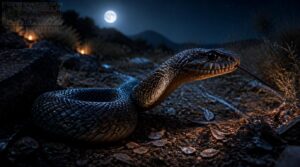
When the sun goes down, a snake’s whole world shifts into gear. You’ll notice patterns in when they move, when they rest, and how their schedules can bend with the seasons. Here’s what actually defines nocturnal behavior, from nightly routines to how it plays out even in a pet snake’s enclosure.
Getting the light-dark balance right matters too, since how long you run UV light for your snake directly shapes how well that nocturnal rhythm settles in.
Nighttime Activity Patterns
Once the sun dips, a snake’s world truly wakes up. Midnight movement cycles kick in as temperatures cool, letting nocturnal species hunt without overheating.
- Peak activity often falls between 20-28°C
- Twilight foraging windows extend into pre-dawn hours
- Lunar influence effects can slow movement on bright nights
This shift may represent opportunistic nocturnal behavior in response to warming environments.
Temperature-driven activity and reptile circadian rhythms shape nighttime hunting patterns, guiding nocturnal snake behavior toward stealth, safety, and steady prey pursuit.
Resting During Daylight
Once dawn breaks, your snake retreats to a burrow, crevice, or dense brush for microhabitat selection that stays cool. This daylight rest helps thermoregulation and energy conservation, syncing with its circadian rhythm so activity resumes predictably by dusk.
Resting site security matters too, keeping it hidden from diurnal predators while it recovers strength for another night’s hunt.
Nocturnal Versus Crepuscular
Not every snake that avoids daylight is truly nocturnal. Crepuscular species, like copperheads, restrict activity to dawn and dusk twilight periods, exploiting cooler temperatures and dimmer light without committing to full darkness.
- Nocturnal: active sunset to sunrise
- Crepuscular: peaks at dawn/dusk only
- Both show circadian rhythm flexibility
- Light intensity sensitivity shapes each pattern
This temporal niche partitioning reduces competition, letting different animal behavior strategies coexist across the same habitat.
Species That Shift Schedules
Heat rewires the clock. Many species that behave as diurnal or crepuscular hunters in spring will flip to full nocturnal activity once summer temperatures spike, avoiding lethal daytime heat.
| Trigger | Typical Shift | Example Pressure |
|---|---|---|
| Summer heat | Diurnal → Nocturnal | Dehydration risk |
| Urbanization | Any → Nocturnal | Human-wildlife gaps |
| Habitat fragmentation | Crepuscular → Nocturnal | Reduced cover |
Pet Snake Night Routines
Rarely does captivity erase instinct: pet snakes still follow animal circadian rhythms shaped by wild ancestry. As night falls, ball pythons and corn snakes seek warm microzones, relying on thermal gradient stability and rising humidity to trigger foraging behavior.
Their heat-sensing pits paired with sharp low-light movement detection explain how ball pythons perceive their surroundings after dark.
Appetite often dips once temperatures cool, signaling rest. Stable hides and darkness support natural sleep cycles, preventing sleep cycle disruption common in poorly managed enclosures.
Why Snakes Become Active at Night
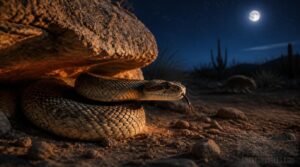
As the sun sets, a snake’s body and behavior shift for good reason. Being ectothermic, its choices about when to move aren’t random—they’re driven by temperature, safety, and opportunity. Here’s what’s actually pulling these animals into the dark.
Cooler Evening Temperatures
Sundown flips a switch for snakes: as temperatures drop 2 to 6 degrees within two hours, ectothermic bodies shift toward comfortable thermoregulation zones.
- Radiative cooling chills bare soil fastest
- Urban pavement retains heat longer
- Clear skies deepen temperature drops
- Dew point shifts humidity levels
- Microclimates vary by surface type
This cooling window suits crepuscular and nocturnal hunters seeking relief from daytime heat stress.
Safer Movement After Dark
Darkness works like a cloak, letting snakes glide past diurnal birds of prey that hunt by sight alone. Fewer eyes means fewer threats.
This shift also reduces daytime competition for basking spots and territory.
For your own wildlife safety, carry a flashlight, wear reflective gear, and stick to planned routes when walking near known snake habitat after sunset.
Rodent and Amphibian Prey
Follow the food, and you’ll find the schedule. Voles and mice, usually 15 to 60 grams, offer high rodent energy density worth hunting after dark. Amphibians like tadpoles and juvenile salamanders add distinct nutrient profiles near water’s edge.
Seasonal prey cycles shift both size and abundance, driving nocturnal hunting patterns and habitat encounter rates that shape each species’ nighttime strategy.
Higher Nighttime Humidity
Ever notice how the air feels thicker after sunset? That’s moisture-driven foraging at work. As temperatures drop, relative humidity climbs, easing skin hydration and creating thermal stability that lowers metabolic stress.
Damp ground also boosts scent trail persistence, helping snakes track prey through microclimate humidity pockets near burrows and streams—refining nocturnal hunting patterns tied directly to these environmental conditions shaping reptile activity cycles and habitat selection.
Reduced Daytime Competition
Why fight for turf when the night shift is nearly empty? Nocturnal snakes slip into niche partitioning by hunting hours when diurnal rivals sleep, easing territorial dispute reduction and letting burrow sharing patterns work in their favor.
- Fewer rivals means less energy wasted on standoffs
- Quiet burrows feel safer for resting young
- Seasonal prey pulses arrive with less rush
- Microhabitat refuge use keeps shelters uncontested
How Snakes Hunt After Dark
Once darkness falls, a snake’s body becomes a finely tuned toolkit for finding its next meal. Sight isn’t the star player here—smell, heat, and touch take over instead. Here’s how each sense pulls its weight in the hunt.
Tongue Flicking and Scent
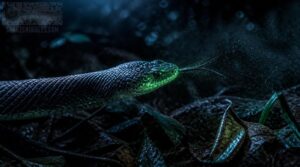
Watch a snake move through leaf litter, and you’ll notice that flicking tongue almost constantly testing the air. That’s airborne molecule collection in action, gathering scent particles for stereo scent mapping.
Each fork feeds a separate vomeronasal organ, giving directional smell. This enhanced olfaction drives chemical trail tracking, letting nocturnal species navigate confidently toward prey without relying on sight at all.
Heat-sensing Pit Organs
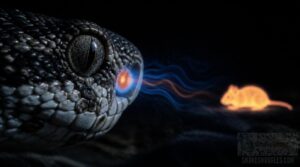
Between the eyes and nostrils, pit vipers carry a thin infrared membrane that works like a built-in thermal camera. TRPA1 proteins convert warmth into neural signals the moment prey passes within range.
A pit viper’s infrared membrane acts like a built-in thermal camera, using TRPA1 proteins to turn warmth into neural signals
Sensitivity reaches roughly 0.003°C, letting the brain build a coarse thermal image through neural heat coding—an astonishing sensory perception that guides strikes accurately even in total darkness.
Low-light Vision Advantages
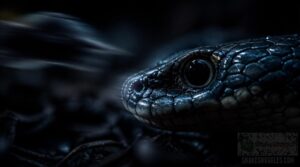
Infrared heat sensing gets the spotlight, but a snake’s eyes pull real weight too. Rod-dominant retinas and quick pupil dilation boost light capture, while mesopic vision blends dim shapes with subtle motion.
- Rod sensitivity spots movement, not color
- Peripheral motion flags approaching prey or threats
- Contrast enhancement sharpens edges in near-total darkness
- Combined sensory adaptations sustain nocturnal activity efficiently
Ground Vibration Detection
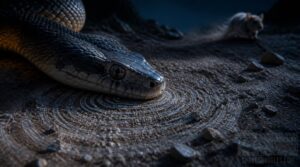
Vision controls motion, but a snake’s jawbone acts like a built-in geophone, picking up ground vibrations transmitted through soil. Bone conduction to the inner ear detects low-frequency signals, similar to seismic monitoring principles:
| Vibration Source | Frequency Range | Detection Distance |
|---|---|---|
| Footsteps | Low-frequency | Several meters |
| Rodent movement | Low-frequency | Close range |
| Larger animals | Mixed | Farther, attenuated |
This sensitivity helps with predator avoidance and hunting alike.
Ambush Versus Active Hunting
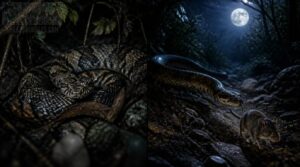
Rarely do snakes hunt just one way—hunting mode flexibility shapes survival strategies after dark.
- Ambush relies on camouflage effectiveness and stillness
- Active hunters need real pursuit speed to chase mobile prey
- Energy expenditure tradeoffs favor ambush for conserving reserves
- Prey encounter rates drive which mode pays off
- Habitat structure often dictates the predator-prey relationship at play
Predation risk and dense cover often tip the balance toward ambush.
Factors That Change Night Activity
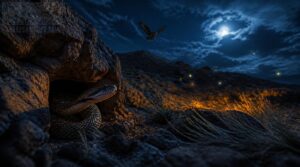
A snake’s nightly schedule isn’t fixed; it shifts in response to conditions around it. Temperature, weather, light, shelter, and even biology all play a part in when and how much a snake moves after dark. Here’s what actually drives those changes.
Seasonal Temperature Shifts
Seasons rewrite the clock for ectothermic snakes, since temperature regulation depends entirely on environmental conditions. Spring nights narrow to 5-8°F drops, while autumn brings sharper 8-14°F cooling, shifting activity windows earlier or later.
Mountainous terrain can swing 20°F after dusk, whereas urban heat islands blunt that drop by 2-5°F—altering nocturnal timing regionally as climate change gradually reshapes these seasonal cues, affecting both wildlife activity and agricultural frost risks.
Warm, Humid Weather
Sticky nights change everything for a hunting snake. Once relative humidity climbs past 60%, evaporative cooling limits kick in, so you’ll notice snakes hunting longer after dark when the heat index stays dangerously high.
Damp conditions also mean prey abundance shifts—amphibians thrive, drawing nocturnal predators into extended foraging. That same moisture affects humidity-driven shedding, giving snakes healthier skin turnover during muggy spells.
Moonlight and Artificial Light
A full moon can turn a dark clearing into a hunting ground. Moonlight prey visibility improves as rodents cast shadows across open soil, aiding ambush predators.
Urban glow disrupts this. Urban skyglow effects and artificial spectral interference mask natural gradients, pushing nocturnal snakes toward shaded edges. Light pollution alters foraging shifts near roads, while urbanization impacts local habitats for species relying on lunar shadow navigation to move safely.
Habitat and Hiding Places
Where a snake spends the day shapes how it moves at night. Burrow depth patterns matter here—tunnels 20 to 60 centimeters down stay cooler in summer, warmer in winter.
Rock microhabitats hold humidity above 70%, aiding shedding. Leaf litter insulation buffers temperature swings, while tree crevice utility offers predator avoidance. Even artificial shelter design—hollow logs, cave structures—helps habitat management, sustaining nature’s balance across varied environmental factors.
Feeding and Shedding Cycles
A snake’s appetite quietly rewrites its nighttime clock. Digestion raises metabolic rate, often pulling active hours toward warmer, food-rich periods after dark.
Juvenile growth rates demand frequent meals, speeding shedding cycles compared to adults. Protein intake from rodent prey fuels skin renewal, while the humidity shedding link proves critical—dry enclosures invite dysecdysis. Consistent moisture and steady feeding keep circadian rhythms, hunting drive, and predator-prey timing working in balance.
Night Safety Around Snakes
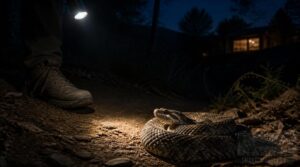
Knowing why snakes move at night is one thing; knowing how to share that space safely is another. Whether you keep snakes at home or simply walk near their habitat after dark, a few practical habits go a long way.
Here’s what you need to know to stay safe, starting with your enclosure.
Safe Evening Enclosure Checks
Dusk is when captive snakes wake up, so a quick enclosure sweep before lights-out matters most. Check gate latch security and confirm double-locking mechanisms engage fully.
Run your hands along seams for barrier integrity, watch for gaps near the substrate, and test motion-activated lighting. Note humidity readings for environmental monitoring. Keep an emergency response plan and snake bite contact list within reach, always.
Outdoor Flashlight Precautions
Once your enclosure checks are done, outdoor walks demand their own gear. Choose weatherproof, crush-resistant lights. Aim the beam downward, never at eyes—glare causes disorientation. Use red light mode to preserve night vision while checking for nocturnal activity. Carry spare batteries in waterproof cases.
Know strobe/SOS signals for snake bite emergencies, and practice species identification before assuming any encounter is safe.
Preventing House Encounters
Your home offers the same appeal as a rock pile: warmth, shelter, easy prey. Seal cracks with silicone, add door sweeps, and fit mesh over vents. Clear debris within a meter of the foundation, since active nocturnal species investigate cover-rich zones.
| Fix | Purpose |
|---|---|
| Door sweeps | Blocks threshold gaps |
| Mesh vents | Stops crawlspace entry |
| Motion lights | Deters approach |
| Cleared perimeter | Removes hiding spots |
| Sealed cracks | Closes small openings |
When Bites Need Help
Even with every precaution, bites happen. Suspected venomous snakes demand immediate emergency care—never suck out venom or apply tourniquets. Watch for redness spreading, profuse bleeding, or systemic illness signs like fever.
Any unknown reptile bite carries tetanus risks and warrants infection monitoring for 24 hours. When in doubt, treat wildlife safety precautions seriously and call for help.
Frequently Asked Questions (FAQs)
How to tell if a snake is in your house at night?
Like a shadow that leaves no footprint, a house snake reveals itself only in whispers: rustling behind walls, faint musky odors, discarded shed skin, and rodents suddenly gone quiet near their usual nighttime haunts.
Why do some snakes hunt in urban areas at night?
Cities offer urban prey concentration near waste and streetlight feeding hotspots, while asphalt’s thermal benefits extend hunting time.
City microhabitat refuges and reduced daytime disturbance make nighttime hunting strategies more efficient despite light pollution’s natural balance disruption.
Are copperheads considered nocturnal or crepuscular hunters?
Not strictly nocturnal—copperheads are primarily crepuscular, favoring dawn and dusk transitions for twilight foraging, though summer heat can push activity into fuller nighttime hunting strategies as part of their seasonal rhythm shifts and thermal regulation needs.
How does rainfall impact nighttime snake movement levels?
Light rain triggers a rainfall prey flush, boosting movement, while heavy downpours send snakes sheltering.
Rising humidity correlates with sustained activity, and post-rain foraging bursts rely on moisture-driven scent tracking, showing how active nocturnal serpents truly are after storms.
Can urbanization change what snakes eat at night?
Built-up blocks reshape reptile diets: urban prey diversity shrinks, meals shrink too, and snakes lean on synanthropic rodent exploitation unevenly, foraging across fragmented habitat patches shaped by urban microclimates and disrupted predator-prey relationships.
Conclusion
Darkness delivers a different kind of wisdom for snakes moving under cover of night. Nocturnal snake behavior patterns reveal a world tuned to temperature, safety, and hunger, not chaos. Once you recognize these rhythms, a rustle in the grass stops feeling random and starts feeling readable.
Respect the enclosure, respect the trail, and carry a flashlight when curiosity pulls you outdoors. Understanding replaces fear with awareness, and awareness keeps both you and the snake safe.
- https://www.pixfra.com/snakes-after-dark-hunting-patterns-and-behaviors-revealed
- https://www.nhm.ac.uk/discover/news/2016/september/study-sheds-light-on-snake-vision.html
- https://the-gist.org/2020/10/rhythm-of-the-night-how-circadian-clocks-influence-nocturnal-creatures
- https://www.redalyc.org/journal/425/42575514073/html
- https://www.tandfonline.com/doi/pdf/10.1080/09291017509359493