This site is supported by our readers. We may earn a commission, at no cost to you, if you purchase through links.
That tight S-coil isn’t a resting posture — it’s loaded mechanical spring, ready to strike the second you misjudge distance. Snakes don’t bluff every time, and a feeding-response strike moves faster than your hand can react. Reptile handlers learn this the hard way, usually with a puncture wound as the lesson.
So when should you use a snake hook? The answer isn’t "always" or "never" — it’s about reading the animal in front of you: coil tension, breathing rate, hiss pitch, even how it holds its head.
Get that read right, and the hook becomes an extension of your judgment, not a crutch. Get it wrong, and no tool saves you.
Table Of Contents
- Key Takeaways
- Use Hooks During Risky Handling
- Use One When Distance Helps
- Avoid Handling High-Stress Snakes
- Match Hook to Snake Size
- Use Hooks Gently and Safely
- Frequently Asked Questions (FAQs)
- What are the risks of using snake hooks?
- Are snake hooks better than sticks?
- What materials are best for durable snake hooks?
- How do you identify a venomous snake by appearance?
- What gear should you wear before handling snakes?
- How do you safely tube a venomous snake?
- Whats the safe distance when approaching a wild snake?
- Conclusion
Key Takeaways
- Use a snake hook whenever a snake shows defensive posture, tight S-coiling, hissing, or rapid breathing—these are clear signs it’s loaded and ready to strike.
- Always match the hook’s size and shape to your snake’s body, using mini-hooks for hatchlings, short hooks for colubrids, and wide, reinforced hooks for heavy constrictors.
- Support one-third of the snake’s body with the hook, lift slowly, and prevent dangling to reduce stress and protect spinal health during handling.
- Sanitize hooks between every snake and prepare secure containers for transfers to prevent cross-contamination and ensure safe relocation.
Use Hooks During Risky Handling

Some moments call for distance, plain and simple. Your snake’s body language and the situation at hand will tell you when a hook belongs in your hand instead of your fingers doing the work. Here are five scenarios where reaching for one isn’t optional—it’s the smart move.
If you’re unsure whether a species tolerates handling at all, this guide to handling snakes safely by species can help you decide when a hook is the safer bet.
Defensive S-coils
Ever watched a snake pull into a tight S before it strikes? That’s your cue to grab the hook, not your hands.
A defensive S-coil means mechanical spring force is loaded and ready — ignore it and you’re risking a strike.
Snake handling hooks give you strike prevention and distance, letting you read snake behavior safely before making contact.
Hissing or Striking
That hiss isn’t just noise — it’s a defensive venting sound, air forced through a tightened glottis as a last warning before things escalate.
Watch for a gaping mouth and lunging bluff strikes; the snake isn’t committing yet. That’s stress-induced agitation talking. Keep your hook between you and the threat zone. Distance beats bravado every time.
Cage Cleaning
Bluff strikes fade once you’re out of range — but the danger doesn’t disappear during cage cleaning. Keep the snake on the hook while you scrub, since debris and detergent residue can irritate skin. Use approved cleaners, rinse thoroughly, and dry cages completely to prevent mold. It is essential to use veterinary-approved disinfectants to make sure your reptile stays safe.
- Sanitize hooks between enclosures
- Verify cleanliness with ATP testing
- Log drying times before reloading
- Follow component cleaning schedules
- Rinse away all detergent residue
Feeding-response Moments
Feeding time flips a snake’s brain into prey-response mode — strikes come fast, and they’re not bluffing anymore. Keep the hook ready before food even hits the enclosure.
Recognize hunger cues like tongue-flicking and head-tracking, then use the hook to guide feeding safely, away from your hands. Once satiated, movement slows — that’s your cue handling can resume, calmly and without added stress.
New Snake Assessment
What do you actually know about a snake that’s brand new to your care? Nothing — and that’s exactly why the hook comes out first.
Use it for risk factor identification while you run through a physical condition checklist and behavioral baseline tracking, watching for species temperament cues and identification markers before your hands ever get close. First contact stays hook-only until you’ve scored the welfare basics.
Use One When Distance Helps

Sometimes the smartest move isn’t getting closer—it’s staying back. A hook buys you space when a situation calls for caution instead of confidence. Here’s when that extra distance actually works in your favor.
Nervous Pet Snakes
Rapid tongue flicking, an elevated head, sudden retreats — that’s your snake telling you it’s on edge. A hook gives you distance without confrontation, letting stress settle instead of escalate.
Before reaching for a hook, though, it helps to know whether your snake’s temperament even matches your experience level, which is why comparing best large pet snake breeds and their care needs is worth doing early on.
Watch for gaping or hissing, too. Pair hook use with habituation training: gentle, predictable sessions build trust over weeks, easing environmental anxiety and stress-induced appetite loss along the way.
Unknown Temperament
What happens when you’ve never met this snake before? You don’t know its baseline reactivity patterns yet — so treat every new animal as a risk assessment in progress.
- Watch for stressor tolerance levels before contact
- Note stimuli response variation to handling
- Let environmental influence factors guide your first sessions
A hook keeps you safe while unknown temperament reveals itself through actual behavior, not guesswork.
Large Snake Transfers
Moving a large constrictor isn’t a one-person job. A two-person carry distributes weight and stops rolling, while a hook maintains distance during the lift itself.
Before transport, confirm the transfer cage security, check transport vehicle climate control, and complete documentation protocol requirements — origin, destination, date, behavior notes. Afterward, post-transfer health monitoring catches complications early.
Head Direction Control
Where a snake’s head points tells you everything — a hook keeps that head aimed away from you, not toward you. Its heading depends on internal cues (thalamic HD cells, vestibular input) much like ours, but you control the outcome through:
- Angling the hook away from your body
- Redirecting during defensive posture
- Guiding turns before strikes form
- Maintaining safe handling distance throughout
Safer Enclosure Access
Opening an enclosure isn’t just about grabbing your snake — it’s about controlling every inch of that access point. Keyed locking mechanisms and tamper switch alerts flag unauthorized openings before trouble starts.
Weather sealing keeps gaskets tight against moisture and temperature swings, while status indicators give you instant health checks. Stick to maintenance schedules for hinges and latches, and always lead with your hook, never your hand.
Avoid Handling High-Stress Snakes

Not every snake is a candidate for hands-on work, hook or no hook. Some bodies send clear signals that today isn’t the day, and ignoring them puts you both at risk. Here’s what tells you to back off and wait.
Heavy Breathing
Ever counted a snake’s breaths and wondered if something’s wrong? Rapid, labored breathing signals real distress — not just excitement.
Watch for:
- Rate climbing well above resting baseline
- Shallow, rapid breaths with poor depth
- Abdominal heaving instead of smooth rhythm
- Breathing paired with lethargy or stillness
- No exertion trigger explaining the effort
When you see this, skip the hook entirely. Let the animal settle first.
Gaping Mouth
Gaping mouth doesn’t always mean trouble — but context matters. A basking snake gapes for thermoregulation; a handled one gaping wide is signaling defensive posturing.
| Context | Meaning |
|---|---|
| Under heat lamp | Cooling |
| During handling | Warning |
| Near prey | Feeding cue |
| Prolonged, still | Distress |
Sudden gaping with no heat or food nearby? Reach for your hook, keep distance, and back off the strike zone.
Extreme Lethargy
Sluggish is normal after a big meal. Unresponsive isn’t. A snake that won’t track movement or lift its head signals respiratory distress or metabolic failure — often tied to thermoregulation breakdown or dehydration.
- Barely reacts to touch
- Head stays flat, eyes half-closed
- Won’t right itself when flipped
- No feeding response at all
This calls for a reptile-capable vet, not your hook.
Visible Swelling
Lethargy tells you the inside’s failing. Swelling shows you the outside’s compromised.
Lethargy signals failure within, while swelling reveals damage on the surface
Look for shiny, stretched skin or tightness where scales should move freely — signs of tissue fluid buildup affecting mobility. Localized enlargement near a bite site? Don’t touch it. Treat it as venomous snakebite protocol until proven otherwise, and get emergency medical care fast — venom potency varies, but risk assessment always favors caution over your hook.
Match Hook to Snake Size
Not every snake hook fits every snake—size mismatches cause fumbles, and fumbles cause bites. Your hook needs to match the animal in front of you, from length to grip width to head shape. Here’s how to size it right, species by species.
Mini-hooks for Hatchlings
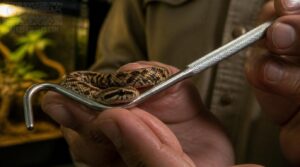
A hatchling’s whole body might weigh less than a slice of bread — under 1 ounce — so you need precision control tools, not full-sized gear.
- 24-inch aluminum shaft
- Under 1 oz weight
- Narrow, tapered head
- Textured, non-slip grip
- Smooth edges to prevent scale abrasion
Aluminum hook benefits include reduced handling fatigue and steady control for delicate, wriggling hatchlings during specialized hatchling management.
Short Hooks for Colubrids
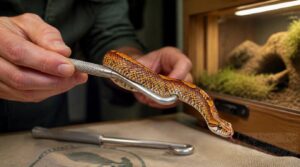
Somewhere between 12 and 18 inches is your sweet spot for corn snakes, king snakes, and rat snakes — the everyday colubrids you’ll handle most.
Aluminum hook benefits shine here: lightweight, corrosion-resistant, easy on your wrist during repeated use. Stainless steel durability suits wrigglier specimens needing extra strength. Either way, rounded heads and smooth scale contact protect your snake while narrow tips give you precise scooping techniques for confident, safe handling practices.
Longer Hooks for Adults

Six feet of muscle changes everything about your approach. Once a snake crosses that threshold, you need 25 to 40 centimeter hooks — the extra shaft length gives you mechanical distance and reach advantages that shorter tools can’t match.
Thicker grips mean better control and stability under real weight. For large constrictors, that length isn’t a luxury. It’s the difference between control and a shoulder full of snake.
Wide Hooks for Heavy Bodies

Not all hooks are built the same, and shank width matters more once you’re working with real bulk. Heavy-bodied constrictors need a wide hook gape for proper force distribution and secure heavy body support.
Look for:
- Thick gauge carbon steel
- Reinforced eyelets
- Forged construction
- Corrosion-resistant finish
These material durability standards keep your snake handling hooks from bending under pressure — critical for safe handling practices with large constrictors.
Smooth Rounded Hook Heads

That rounded head does more than look tidy — it’s built for reducing material snagging against scales and cage furniture alike. The hemispherical contour spreads pressure evenly, minimizing subject trauma during lifts.
Polished alloy construction and corrosion-resistant coatings keep the smooth metal shaft gliding cleanly. Choose a scale-friendly hook tip whenever safe handling practices matter most with your snake hook.
Use Hooks Gently and Safely

Owning the right hook is only half the job — technique is what keeps you and the snake safe. Every lift, transfer, and cleanup between animals demands a specific method, not guesswork. Here’s what proper hook technique actually looks like in practice.
Support One-third Back
Position your snake hook so it carries roughly one-third of the body, measured from the tail. This creates a stable contact point, keeps the center of gravity balanced, and cuts spinal pressure.
You’ll see the whole body posture too—early threat detection matters in safe handling practices and solid reptile husbandry alike.
Lift Slowly and Steadily
Once contact’s set, raise it at 2–4 inches per second—no jerks, no surprises.
Managing Momentum matters more than speed. Move in stages:
- Lift an inch, pause
- Watch the head
- Continue if calm
- Stop if tension builds
This incremental elevation keeps continuous body support intact, reduces stress, and turns your snake hook into a tool for genuine stress reduction, not just restraint.
Prevent Dangling
A dangling snake is a stressed snake — and a fall risk. Keep at least one-third of body weight on the hook at all times, with a supportive grip preventing sudden shifts. Maintain a steady midbody anchor point so no section hangs free.
Move slowly, stay close to the ground, and use two-person transfers for larger bodies to protect welfare and control.
Sanitize Between Snakes
Every hook that touches one snake carries scent, bacteria, and shed skin cells to the next. Sanitize between snakes with 70% isopropyl alcohol or quaternary ammonium cleaners — no shortcuts.
- Wipe hook shaft and head fully
- Let contact time sit 15 minutes
- Rinse and dry before reuse
This prevents cross-contamination and helps maintain quarantine protocols across your entire reptile collection.
Prepare Secure Containers
Once your hook does its job, the snake needs somewhere safe to land. Choose a holding container with rigid resin construction, 8–12 vents, secure latches, and clear labeling — species, size, date, handling notes.
| Feature | Standard | Ideal |
|---|---|---|
| Latches | Snap-lid | Tamper-evident |
| Interior | Dark | Light, smooth |
| Vents | 4–6 | 8–12 |
Good containment protects both handler and animal welfare during reptile relocation.
Frequently Asked Questions (FAQs)
What are the risks of using snake hooks?
Sharp or angled contact can trigger a strike, cause physical injury, or trigger cortisol spikes. Dirty tools spread pathogens between snakes.
Poor lifting technique risks handler musculoskeletal strain, and mishandling venomous snakes without proper risk assessment invites real legal liability.
Are snake hooks better than sticks?
Not universally — hooks give you precision head control and better maneuverability in tight spots, while rubber-tipped sticks reduce abrasion on delicate skin. Your choice depends on the snake’s size, temperament, and the specific handling task ahead.
What materials are best for durable snake hooks?
Stainless steel resists corrosion and rust under repeated cleaning, while aluminum alloy cuts fatigue on long jobs. Fiberglass composites add strength without weight, and copper’s antimicrobial edge fights cross-contamination.
Ergonomic grips and telescoping models round out a durable, comfortable setup.
How do you identify a venomous snake by appearance?
You spot a venomous snake by triangular head profile, vertical pupils, and heat-sensing pits near the nose. Beware, bold color patterns and defensive displays can be mimicry—never trust appearance alone for species identification or safety.
In New Mexico, the black-tailed rattlesnake favors rocky canyons and desert scrub, so a guide to the types of snakes in New Mexico helps you tell local species apart.
Even experienced hikers misidentify species at a glance, so a guide to the snakes of New Mexico is worth studying before you explore rattlesnake country.
Young snakes add another wrinkle, since juveniles often show different colors and patterns than adults, and this guide on identifying baby copperhead snake markings breaks down those early-life traits so you don’t mistake them for a harmless species.
For a closer look at that telltale hourglass banding in young snakes, this guide to identifying baby copperheads breaks down the coloring patterns to watch for.
If you’re unsure which local species fit this profile, this guide to identifying venomous snakes in Tennessee breaks down the region’s specific look-alikes and warning signs.
What gear should you wear before handling snakes?
Before handling snakes, wear puncture-resistant gloves, eye protection with wraparound polycarbonate lenses, snake gaiters or durable pants, and reinforced boots. Sanitize all tools and gloves between animals. This full kit meets protective equipment standards for snake handling safety.
How do you safely tube a venomous snake?
Guide the snake’s head with a long hook into a clear acrylic tube sized to prevent coiling. Monitor for stress signs—hissing, gaping, rapid breathing. Use two-person restraint, wear protective gear, and stabilize before releasing.
Whats the safe distance when approaching a wild snake?
Stay at least six feet from any wild snake—bump that to eight feet for venomous species or poor terrain. Watch for defensive postures and always let the snake retreat. Never corner, grab, or approach directly.
Conclusion
Use one when calm is uncertain—keep your hand away if the snake’s body tells you “not safe.” Reading tension is the skill that keeps you ahead. Watch breathing, head angle, and coil tightness—these signals matter.
When should you use a snake hook? Only when instinct and evidence line up. Don’t let habit override judgment. Right tool, right moment, right technique. In handling, clarity wins. Trust your read, not the hook. That’s how you stay in control.