This site is supported by our readers. We may earn a commission, at no cost to you, if you purchase through links.

A snake kept on newspaper survives. A snake kept on a layered, bioactive substrate thrives, foraging through leaf litter, burrowing into damp coir, and displaying behaviors you’ll never see on sterile bedding. The difference comes down to choosing the right substrate materials for naturalistic setups, and the details matter more than most keepers expect.
Coco coir holds up to twelve times its weight in water, but skip the rinse and you’ll introduce salt stress. Cedar blends smell pleasant and quietly poison. Each material below earns its place through function, not fashion, and knowing which to combine, and in what order, separates a stable vivarium from a moldy one.
Table Of Contents
- Key Takeaways
- Best Substrate Materials for Naturalistic Snake Setups
- How to Layer Bioactive Substrate Properly
- DIY Substrate Mixes for Different Habitats
- Choosing Drainage and Hardscape Materials
- Substrate Safety, Maintenance, and Impaction Prevention
- Frequently Asked Questions (FAQs)
- What type of substrate is best for a vivarium?
- What type of substrate is best for a reptile enclosure?
- How can I make my own bioactive substrate?
- What is the best drainage substrate for a terrarium?
- How deep should substrate be for burrowing species?
- Can I mix different substrate brands together?
- How often should loose substrate be fully replaced?
- Is substrate from my backyard safe to use?
- What substrate works best for high-humidity species?
- Conclusion
Key Takeaways
- Successful bioactive substrates are layered systems, not single products: a drainage base (gravel or expanded clay), a charcoal barrier, a 5–8 cm soil/coir/sphagnum mix, an orchid bark separation layer, and a 1–3 cm leaf litter topcoat, each performing a function the others can’t.
- Material prep and ratios matter as much as selection: rinse coco coir to remove salts that stress microbes, avoid cedar/juniper contamination, cap horticultural charcoal at 5–15% by volume, and never use fine sand or untreated backyard soil without sterilizing at 180–200°F.
- Match the mix to the species’ habitat: humid forest floors use roughly 60% topsoil, 20% coir, and 20% sand, arid setups flip to 70% sand, and high-humidity species benefit from topsoil blended with sphagnum moss, which holds 12–25x its weight in water and sustains surface humidity above 65%.
- Impaction is the top avoidable risk, so skip fine sand as a primary layer, keep particle sizes uniform, spot-clean within hours of defecation, monitor shedding and feeding closely, and fully replace loose substrate every 6–12 months (or 4–6 months under heavy waste load).
Best Substrate Materials for Naturalistic Snake Setups
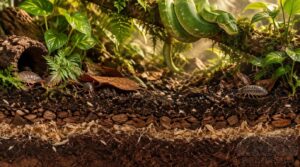
Substrate choice shapes every system in your naturalistic snake setup, from moisture retention and microfauna activity to long-term plant health.
For milk snake keepers weighing options like aspen, cypress mulch, or bioactive mixes, this guide to the best substrates for milk snakes breaks down the pros and cons of each. Keepers working with juveniles should also check this guide to safe substrate materials for young snakes, which covers impaction risks and quarantine setups.
Eight materials consistently outperform the alternatives when building setups that replicate wild conditions. Each has distinct properties, ideal applications, and trade-offs worth understanding before you commit.
Organic Topsoil
Your foundation starts with certified organic topsoil, a mineral-rich base that anchors naturalistic setups and sustains the microbial activity isopods and springtails depend on.
Stick to loamy, unfertilized varieties with a pH between 5.5 and 7.0. Avoid any topsoil blended with cedar or juniper mulch, since allelopathic compounds in those materials compromise substrate safety and stress your snake over time.
Coco Coir
pairs naturally with topsoil as a moisture-regulating amendment. Holding 8–12x its weight in water, it suits humidity-dependent species exceptionally well, but it’s entirely inert without amendments.
For bioactive naturalistic setups, add calcium-rich inputs like gypsum to prevent deficiency and support soil life. Always rinse and buffer coir before use; residual salts stress microbial communities and undermine substrate safety.
Sphagnum Moss
Where coir regulates bulk moisture, sphagnum moss controls it right at the surface. In naturalistic setups, it creates stable humidity microclimates around snake retreat sites, holding 12–25x its weight in water and releasing it gradually during dry periods.
This steady release pairs well with the substrate’s own moisture retention, and our guide to substrate moisture retention for snakes explains how to balance the two. For a deeper look at pairing these layers effectively, our guide to substrate materials for humidity control covers the balance in detail.
Keep layers under 4–6 cm; dense mats restrict natural burrowing behavior. Replace every 6–12 months and check for mold if airflow drops.
Orchid Bark
Where moss controls surface moisture, orchid bark works deeper, improving drainage and substrate porosity throughout the profile. Use 2-6 mm particles in bioactive setups; they’ll wick moisture quickly without waterlogging the mix. Coarse grades reduce anaerobic pockets and actively support isopod activity.
Rinse before use, replace portions every 6-12 months, and mix with coir or leaf litter to prevent compaction.
Cypress Mulch
Although Cypress Mulch resists decomposition better than shredded hardwoods, it’s the structure that matters: it holds a loose, burrowing-friendly texture even under moderate humidity.
The trade-off is drainage. Used alone, it compacts and pools moisture. Mix it with coco coir or topsoil to fix that.
It also buffers temperature swings better than finer substrates, making it a reliable mid-layer component.
Leaf Litter
Because leaf litter anchors the upper layer of most naturalistic setups, treat it as habitat, not decoration. Spread a 1–2 inch topcoat over your substrate so burrowing species can push through it.
Choose from these proven options:
- Oak, beech, or maple leaves for chemical diversity
- Pesticide-free, untreated sourcing only
- Partially decayed litter for faster colonization
- Moderate blends to temper tannins
- Coarse fragments at depth for airflow
Isopods and springtails colonize within weeks, sustaining bioactive setups.
Horticultural Charcoal
Think of charcoal as the substrate’s air filter, quietly scrubbing what you can’t see. In naturalistic setups, it adsorbs tannins and organic acids released during decomposition, buffering pH swings and curbing mold growth. Its porous structure shelters beneficial microfauna while adding drainage without sacrificing humidity retention.
Horticultural charcoal acts as the substrate’s invisible air filter, adsorbing tannins, buffering pH, and sheltering beneficial microfauna
Use 5–15% by volume, rinsed first, and choose untreated horticultural grade only.
Play Sand
acts like ballast in a substrate mix, anchoring loose organics and adding texture.
For naturalistic setups, choose kiln-dried silica sand at 0.3-0.8mm grain size. Finer grades compact under moisture, raising substrate impaction risk. Don’t let it stay wet; damp sand breeds anaerobic zones. In herpetoculture, it works best blended, never as a standalone fill in your reptile enclosure.
How to Layer Bioactive Substrate Properly
Sequence is everything. Get your terrarium substrate layers wrong and the entire bioactive community collapses into compacted, anaerobic muck within weeks.
Build from the bottom up:
- Screened gravel or expanded clay, 1–2 cm, forms the drainage foundation and void space.
- Horticultural charcoal at 0.5–1 cm controls odor and intercepts decomposing runoff.
- Mixed soil, coco coir, and sphagnum at 5–8 cm drives the decomposition process and microbial activity.
- Coarse orchid bark at 1–2 cm stops fine particles migrating downward.
- Leaf litter top dressing at 1–3 cm mimics natural microhabitats and encourages foraging.
Your substrate depth calculation should reserve 4–8% of total volume as void space. Moisture retention lives in that middle zone; keep it at 40–60% or you’ll invite mold fast.
DIY Substrate Mixes for Different Habitats
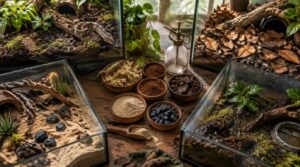
One mix never fits every species, and that’s where DIY Substrate Mixes earn their keep. For a humid forest-floor habitat, mix 60% organic topsoil, 20% coco coir, and 20% play sand, then fold in 5% sphagnum moss chips and 2–4 mm orchid bark for aeration. Arboreal species do better on 50% leaf litter, 30% coco coir, 20% sphagnum, topped with 1–2 cm of cypress mulch.
Arid setups flip the ratio: 70% play sand, 20% orchid bark, 10% horticultural charcoal. Wetland enclosures want 40% sphagnum, 40% topsoil, 20% cypress mulch, kept from pooling. Burrowers need the 50/25/15/10 topsoil-coir-litter-bark mix.
Whatever you build, verify sources. Pesticide-treated leaves undermine natural substrates and complicate substrate impaction prevention in your reptile habitat design.
Choosing Drainage and Hardscape Materials
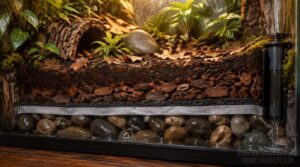
Your substrate mix is only as good as what sits beneath it. A capped drainage layer of 2–4 inches of coarse gravel or coin-sized river rock moves bulk water out fast, and 1–2 inches of mesh or landscape fabric above it stops the substrate from silting down. Slope that bed 1–3% toward a hidden overflow so nothing pools.
For hardscape materials, pick smooth, inert rock and anchored cork rounds; jagged edges injure snakes and trap debris.
Build your stack like this:
- Gravel base, 2–4 inches deep
- Landscape fabric cap
- Charcoal-dusted barrier sprinkle
- Structural orchid bark layer
- Your mixed substrate and leaf litter on top
In bioactive setups, this order keeps airflow alive, prevents anaerobic pockets, and lets your naturalistic vivarium breathe from the bottom up.
Substrate Safety, Maintenance, and Impaction Prevention
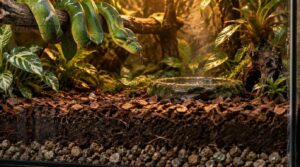
Even the best drainage layer can’t save a snake from a bad substrate choice. Substrate impaction remains the top avoidable risk in naturalistic setups, and your material determines your margin.
Skip fine play sand as a primary layer; loose, flour-like grains cling to prey and get swallowed. Keep particle sizes uniform, with no gaps that trap boluses. During shed cycles, watch feeding closely, since ingestion risk spikes.
Your routine matters as much as the mix. Spotcleaning within hours of defecation, weekly visual checks, and a 2–4 week partial turnover prevent compaction pockets. In bioactive systems, avoid leaf litter deeper than 5 cm; it hides regurgitation debris.
Track the early indicators: reduced defecation, appetite loss, hiding. Weigh weekly, check stool consistency, and stabilize moisture. Consistency is the heart of solid reptile husbandry.
Frequently Asked Questions (FAQs)
What type of substrate is best for a vivarium?
Roughly 80% of captive reptile health issues trace back to enclosure conditions. For a vivarium, your best substrate is a bioactive mix: 40% coco coir, 40% organic topsoil, 20% orchid bark, adjusted for your species’ humidity needs.
What type of substrate is best for a reptile enclosure?
There’s no single winner; the best substrate is the one that mirrors your snake’s wild habitat. For most species, a bioactive soil mix, blending organic topsoil with coco coir, encourages natural burrowing and humidity.
How can I make my own bioactive substrate?
Buying bagged "bioactive" substrate at premium prices, when the raw ingredients cost a fraction, is the joke here. Mix it yourself: mix topsoil, coco coir, and leaf litter, layer drainage beneath, then mist to 60–70% humidity.
What is the best drainage substrate for a terrarium?
Expanded clay balls are your best pick. They drain fast, resist compaction, and stay inert under a geotextile barrier. Coarse gravel works too, but clay’s porosity keeps bioactive setups healthier long-term.
How deep should substrate be for burrowing species?
Start with species size, not a fixed number. Small fossorial species need 5–8 cm; medium burrowers 10–15 cm; large ones 15–20 cm. In naturalistic setups, keep burrowing substrate firm and holds together well.
Can I mix different substrate brands together?
Yes, you can mix brands, but treat it like a recipe: match particle size and moisture behavior first, then run a 2–4 week trial batch to confirm drainage, humidity, and bioactive colonization stay consistent.
How often should loose substrate be fully replaced?
Funny how the "low maintenance" naturalistic setup demands a shovel twice a year. Fully replace loose substrate every 6–12 months, or every 4–6 months with heavy waste, burrowing species, or humidity above 60–70%.
Is substrate from my backyard safe to use?
Short answer: rarely, not without processing. Backyard soil can carry pathogens, parasites, and pesticide residue. If you must use it, bake at 180–200°F for 30–60 minutes, then mix with sterile commercial substrate.
What substrate works best for high-humidity species?
For high-humidity species, combine organic topsoil with sphagnum moss. Topsoil retains moisture 2–3 days longer than coco coir, while moss sustains surface humidity above 65%, buffering fluctuations during nocturnal activity.
Conclusion
Lift a handful of forest floor and you’ll feel it: damp coir, crumbly topsoil, the crackle of leaf litter. That texture is your target.
The best substrate materials for naturalistic setups aren’t a shopping list but a system, each layer doing work the others can’t. Match the mix to your species’ needs, monitor humidity and behavior, and adjust.
Build it right, and your snake won’t just live in the enclosure. It’ll use it.