This site is supported by our readers. We may earn a commission, at no cost to you, if you purchase through links.

A thermostat that fails at 3 a.m. doesn’t send a warning. It just lets your enclosure drift ten degrees while you sleep, and you find out when your snake stops eating.
Experienced keepers know this. You’ve probably cooked a mat, trusted a probe that drifted, or watched a cheap dial swing wildly with the seasons. The best thermostat controllers for experienced keepers do more than hold a number. They handle heating and cooling, manage multiple zones, and fail safely.
Some hold steady with PID control. Others offer Wi-Fi alerts and dual outlets. Here are six worth your money.
Table Of Contents
- Key Takeaways
- Top 6 Thermostat Controllers for Experienced Keepers
- Match Thermostat Modes to Your Snake’s Heaters
- Compare Load Capacity, Independent Zones, and Wi-Fi
- Assess Probe Accuracy, Reliability, and Overheat Protection
- Choose The Right Controller for Your Collection
- Frequently Asked Questions (FAQs)
- What is the best thermostat controller?
- Why do HVAC guys hate nest thermostats?
- Which controller is best for temperature control?
- What are the four types of thermostats?
- How often should I verify probe accuracy?
- Can I plug heat mats directly into wall power?
- How should I clean and maintain thermostat probes?
- Is it safe to split one outlet between heaters?
- What sampling interval works best for data logging?
- Conclusion
Key Takeaways
- Match the controller’s switching mode to your heater: on/off for mats and tape, pulse proportional for ceramic emitters, and dimming for basking bulbs, so you avoid flicker, early burnout, and temperature swings.
- Pick your controller by setup, since the Inkbird ITC-308 suits most single-heater or heat-and-cool needs, while two separate enclosures call for independent zones like the Pymeter or the dual-outlet Inkbird.
- Your probe is the weak link, so place it where your snake actually touches heat, check it in an ice water bath, replace it every couple of years, and cross-check every reading with a separate thermometer.
- Even good controllers can drift or fail without warning, so set an independent high-temperature cutoff, test alarms, and keep a backup, because ball pythons leave you only about a four-degree margin.
Top 6 Thermostat Controllers for Experienced Keepers
You’ve already got the basics down, so this list skips the entry-level plug-and-pray gear. Each of these six controllers earns its spot with tight temperature control, solid safety features, and enough flexibility for a real collection. Here’s what’s worth your outlet space, and what to know before you buy.
1. Inkbird ITC-308 Dual Relay Thermostat
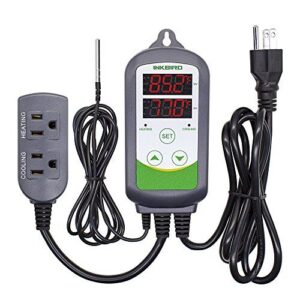
Versatility defines the ITC-308: its dual relays run heating and cooling at once. You plug a heat source into one outlet and a fridge or fan into the other, and it holds your target. Each relay controls 10A, with a 1100W ceiling at 110V.
If you’re unsure whether this controller suits your setup, this comparison of thermostat types for snakes explains how on/off, dimming, and pulse proportional models differ.
The twin display shows measured and set temperatures together. Compressor delay protects freezers from short cycling, and alarms also catch high, low, and sensor faults. Accuracy is ±1°C from -50 to 70°C. Instructions get mixed reviews.
| Best For | Hobbyists and small-scale growers or brewers, such as fermenters, greenhouse owners, and reptile keepers, who need one plug-and-play controller to manage both heating and cooling equipment. |
|---|---|
| Max Output Load | 1100W at 110V |
| Control Mode | Heating and cooling |
| Outlets | Single |
| Temperature Range | -50~120°C / -58~248°F |
| Connectivity | Standalone |
| Alarms | High/low alarms |
| Additional Features |
|
- Dual relays run a heater and a cooling device (fridge, freezer, or fan) at the same time, each rated at 10A with a 1100W ceiling at 110V.
- Dual display shows the measured and set temperatures together, and the wide -50~120°C range covers many uses.
- Compressor delay protects freezers from short cycling, and alarms catch high, low, and sensor faults.
- Customer feedback on instruction clarity is mixed, so setup may take some trial and error.
- Accuracy is only ±1°C (-50~70°C) and ±2°F (-58~160°F), which may not suit work that demands very tight precision.
- The unit itself can only operate in ambient temperatures of -30~75°C (-22~167°F), which limits use in extreme environments.
2. Inkbird WiFi ITC-308 Temperature Controller
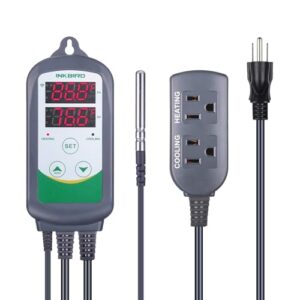
Same hardware, but now it talks to your phone. The WiFi version of the ITC-308 keeps the dual relays and 1100W ceiling at 110V, then adds the Inkbird app for iOS and Android. You can check temps from the couch and get high and low alarms, plus sensor fault warnings, wherever you are.
Here’s the catch: it only works with 2.4 GHz Wi-Fi. No 5 GHz. Some keepers report connection headaches, and the app’s usability gets mixed reviews. Plan on patience.
| Best For | Home brewers, pet breeders, and gardeners who want to monitor and control heating and cooling equipment from their phone. |
|---|---|
| Max Output Load | 1100W at 110V |
| Control Mode | Heating and cooling |
| Outlets | Single |
| Temperature Range | N/A |
| Connectivity | 2.4 GHz Wi-Fi app |
| Alarms | High/low alarms |
| Additional Features |
|
- Dual relay outputs let it control both heating and cooling equipment, up to 1100 W at 110 V.
- The Inkbird app for iOS and Android lets you check temperatures remotely.
- High and low temperature alarms and sensor malfunction detection warn you when something goes wrong.
- It only works with 2.4 GHz Wi-Fi, so 5 GHz networks are not supported.
- Some users report Wi-Fi connectivity problems with the app.
- App usability gets mixed reviews, so setup and daily use may take some patience.
3. REPTIZOO Dimming Thermostat TC02

Prefer no app? The REPTIZOO TC02 keeps things simple. It runs a PID heating mode for steady temps and covers 5°C to 60°C, with a switchable Celsius and Fahrenheit display. It helps up to 300W, so heat lamps, mats, and cables all work. Keep the probe at least 15cm from the heat source, or your readings will lie.
If you’re managing breeding stock, check readings with a separate thermometer, and this guide to breeding venomous snakes safely covers setups where precision matters most.
Now the caveats. Some keepers report accuracy drifting by up to 4 degrees, and the dimming function may quit after short use.
| Best For | Reptile keepers and breeders who want a simple, app-free thermostat for heat lamps, heating mats, or heat cables up to 300W. |
|---|---|
| Max Output Load | 300W |
| Control Mode | Heating only (PID) |
| Outlets | Single |
| Temperature Range | 5~60°C / 41~140°F |
| Connectivity | Standalone |
| Alarms | N/A |
| Additional Features |
|
- PID heating mode keeps temperatures steady.
- Wide 5°C to 60°C (41°F to 140°F) range with a switchable Celsius and Fahrenheit display.
- Works with heat lamps, heating mats, and heat cables, and suits reptile enclosures, breeding, and hatching.
- Some users report temperature inaccuracy of up to 4 degrees.
- The dimming function may stop working after short-term use, according to some users.
- Limited to a 300W maximum load, and not for use with sunlamps.
4. Inkbird WiFi Dual-Outlet Heat Mat Thermostat
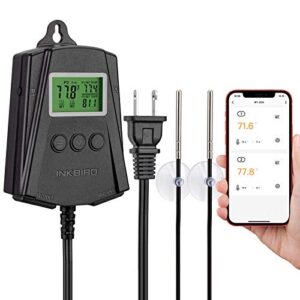
Want an app and two zones? This Inkbird gives you both. Each outlet has its own paired probe and independent control, so two enclosures can run at two different temperatures. Every outlet controls 250 watts, enough for mats, lamps, and other resistive heaters.
If you’re setting up a corn snake enclosure, this reptile thermostat guide for corn snake setups can help you pick the right temperature settings.
The INKBIRD app grips remote monitoring, data logging, export, and alerts for high temps, low temps, and probe errors. It only joins 2.4 GHz WiFi, so 5 GHz networks are out. Some keepers report flaky WiFi, though.
| Best For | Reptile keepers, such as ball python owners, who want to run two separate enclosures at different temperatures and monitor them remotely from their phone. |
|---|---|
| Max Output Load | 250W per outlet |
| Control Mode | Heating only |
| Outlets | Dual, independent |
| Temperature Range | N/A |
| Connectivity | 2.4 GHz Wi-Fi app |
| Alarms | High/low and probe alerts |
| Additional Features |
|
- Two outlets with their own paired probes let each enclosure hold its own temperature.
- Each outlet handles up to 250 watts, so it works with heat mats, heat lamps, and other resistive heaters.
- The INKBIRD app offers remote monitoring, data logging and export, plus alerts for high temps, low temps, and probe errors.
- It only connects to 2.4 GHz WiFi, so 5 GHz networks won’t work.
- It is built for heating only and can’t control cooling.
- Some users report inconsistent temperature control and unreliable WiFi connections.
5. Pymeter Dual Probe Temperature Controller
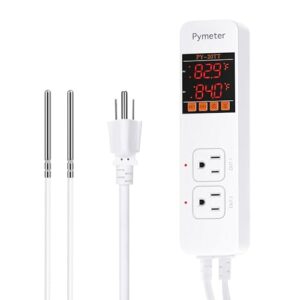
Two outlets, two probes, and zero fuss on setup. The Pymeter PY-20TT runs each outlet independently in heating or cooling mode, rated for 10A and 1200W at 120V. That’s plenty for heat mats, lamps, or pads in a reptile room, and it can also handle aquarium heaters and chillers.
The catch? User reports on temperature accuracy are mixed, and some units die within weeks or months without warning. Misconfigured alarms will also beep at you.
Verify every reading with a separate thermometer, and keep a backup controller handy.
| Best For | Reptile keepers and hobbyists who want to run two heat mats, lamps, or aquarium heaters independently and don’t mind double-checking readings with a separate thermometer. |
|---|---|
| Max Output Load | 1200W at 120V |
| Control Mode | Heating and cooling |
| Outlets | Dual, independent |
| Temperature Range | N/A |
| Connectivity | Standalone |
| Alarms | Alarm settings available |
| Additional Features |
|
- Two outlets with separate temperature control, so each device runs on its own settings
- Dual waterproof probes included, with heating and cooling modes for each outlet
- Rated for 10A and 1200W at 120V, enough for heat mats, lamps, pads, aquarium heaters and chillers, or exhaust fans
- User reports on temperature accuracy and reliability are mixed
- Some units fail within weeks or months without warning
- Misconfigured alarm settings can cause unwanted beeping
WILLHI W408 Digital Temperature Controller
A no-frills single-outlet option, the W408 (also listed as the WILLHI WH2408) suits one heater and nothing more.
Don’t expect dual relay output or proportional temperature regulation. It’s plain on/off control.
Its 0.1° temperature control accuracy is solid, and the time delay protects your heater from short cycling. Still, set a generous thermal safety margin anyway, and trust your own thermometer.
Match Thermostat Modes to Your Snake’s Heaters
Most keepers obsess over the heater. The smarter ones obsess over how it’s switched. A great bulb on the wrong controller still flickers, burns out early, and swings your temps.
Smart keepers obsess over how a heater is switched, because even a great bulb on the wrong controller flickers, burns out early, and swings your temps
Match the mode to the hardware:
- On/off for heat mats, heat tape, and fans, which tolerate full power cycling.
- Pulse proportional control for ceramic heat emitters, which react fast and overshoot.
- Dimming proportional for basking bulbs, so filaments stay happy.
Real PID control is rare at this price, but good pulse units get close. They deliver proportional temperature regulation by adjusting pulse frequency, tightening the thermal feedback loop.
Dimming reacts slower, so expect roughly ±2°F. Put the probe where your snake actually touches heat, never in ambient air or drafts. Any light-emitting basking bulb needs a dimming thermostat type to avoid flickering and extend bulb life.
Compare Load Capacity, Independent Zones, and Wi-Fi
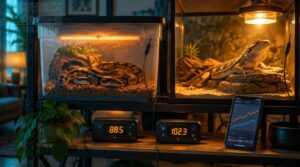
Picture a rack with a ball python tub on one end and a bearded dragon bulb on the other. One controller can’t serve both unless you plan for it.
Start with Load Capacity. The Inkbird ITC-308 controls 1100W at 110V, shared across both outlets. The REPTIZOO TC02 tops out at 300W, fine for a single bulb, not a rack.
Independent Zones matter next. The ITC-308’s Dual Relay Output splits heating and cooling, not two heaters. For two separate temperatures, you want Dualprobe Configurations like the Pymeter, which runs two zones at once.
Wi-Fi is last. The Wi-Fi ITC-308 and Pymeter let you check temps from your phone. The TC02 doesn’t. Buttons only. Decide if midnight alerts justify the extra price.
Assess Probe Accuracy, Reliability, and Overheat Protection
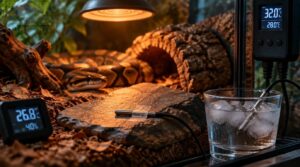
Your thermostat is only as honest as its probe.
A controller can have gorgeous firmware and still cook a snake if the sensor lies. Probe accuracy matters most, so verify yours with an ice water bath at 0°C before trusting it. RTDs hold steady, drifting about 0.05°C a year, while thermistors react faster.
Here’s what to check:
- Probe placement accuracy: tape it at animal level, never dangling in open air.
- Temperature monitoring: run a separate digital thermometer as a cross-check.
- Safety certifications: look for CE or ETL marks on the controller itself.
- Thermal cutoff: set an independent high limit, so one failure doesn’t become two.
Probes drift. Humidity eats cheap ones. Replace yours every couple of years, no excuses. Seriously.
Choose The Right Controller for Your Collection
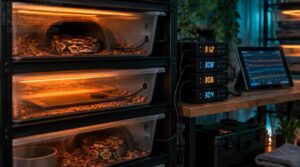
Buying one thermostat is easy. Buying the right one for a whole rack is where keepers go wrong.
Start with your setup, not the spec sheet:
- One or two tubs? A dual-relay unit like the ITC-308 covers you.
- Racks with mixed heaters need multidevice control and independent zones.
- Away often? Pick Wi-Fi and solid temperature alarm systems.
Whatever you buy, run thermal gradient testing before you trust it with animals. Probe placement accuracy matters more than the brand on the box, so keep probes against the heat source’s surface or at hide level. If your ambient swings, PID control earns its price. Skip it, and you’ll chase setpoints all winter. Cheap controllers cost far less than a single lost clutch.
Frequently Asked Questions (FAQs)
What is the best thermostat controller?
Want one controller that just works? Grab the Inkbird ITC-308. Its dual relay outputs, temperature alarm systems, and tight thermal stability suit most setups. Running bulbs? Choose PID control. Wiring dualprobe configurations? Mind probe placement.
Why do HVAC guys hate nest thermostats?
A thermostat is a small promise your heater keeps. Nest breaks it. Its power stealing drains control wires, tricking sensitive boards into short cycling, while thin diagnostics, weak load capacity handling, and direct sales leave technicians frustrated.
Which controller is best for temperature control?
Pick the REPTIZOO TC02. Its proportional control dims your heat lamp smoothly, so temperature precision stays tight at ±5°C. Skip thermal hysteresis swings. Want a PID controller or data logging? Then look at Herpstat instead.
What are the four types of thermostats?
You’ve got four types to choose from: mechanical, non-programmable digital, programmable, and smart. Mechanical units use a bimetallic strip and basic on/off control. Digital adds accuracy. Programmable adds schedules. Smart adds Wi-Fi and learning.
How often should I verify probe accuracy?
Your thermostat swears it’s 88°F, and your snake’s belly disagrees. Check probe calibration weekly with a calibrated thermometer at the probe spot, and run independent verification at substrate level. Monthly, test alarms.
Can I plug heat mats directly into wall power?
Theory: a heat mat plugs straight into the wall safely. Nope. Without a thermostat controller, nothing caps temperature, and thermal fuses are a last resort. Electrical safety standards demand wattage headroom, too. Don’t risk it.
How should I clean and maintain thermostat probes?
A grimy probe lies with a straight face. Wipe the metal tip, keep the crimped end dry, then air dry. Check calibration in ice water for probe drift detection and temperature accuracy, recheck probe placement.
Is it safe to split one outlet between heaters?
Splitting an outlet is like sharing one straw. Check your dualstage outlet’s load capacity, keep wattage headroom, plan inrush current management, and follow outlet naming conventions so you don’t overload anything. Label every plug clearly.
What sampling interval works best for data logging?
Logging every second proves you’re thorough, not smart.
Use 5 to 15 minutes for data logging. It helps temperature trend analysis and thermal drift detection, while probe placement and calibration log maintenance stay manageable too.
Conclusion
Ball pythons want a basking spot around 88 to 92°F, a window about four degrees wide. That’s all the room your thermostat gets. The best thermostat controllers for experienced keepers respect that margin, and they fail safe when something breaks.
Pick the one that fits your heaters, your zones, and your tolerance for surprises. Then trust it, but always verify it with a second thermometer. Reliable heat is boring, and boring keeps snakes healthy.