This site is supported by our readers. We may earn a commission, at no cost to you, if you purchase through links.
A basking bulb that flickers all day stresses your animal, and a controller that cuts power at the wrong moment can swing a habitat by 10°F in minutes. Both problems start with the same mistake: matching the wrong thermostat to the heat source.
Dimming units ease power up and down, holding steady temperatures and extending bulb life by up to 50%. On/Off units suit heat mats and ceramic emitters but punish light-emitting bulbs. Pair the wrong type with a fluorescent, and you risk damaging the ballast.
The thermostat controllers for heat lamps below hold your setpoint, protect your gear, and keep your enclosure safe.
Table Of Contents
- Key Takeaways
- Dimming Vs. On/Off Heat Lamp Thermostats
- Top 4 Thermostat Controllers for Heat Lamps
- Heat Lamp Thermostat Features Worth Paying For
- Set Up Your Heat Lamp Thermostat Safely
- Manage Heat Lamp Temperatures Day and Night
- Frequently Asked Questions (FAQs)
- Do I need a thermostat for a heat lamp?
- What is the best thermostat for a ceramic heat emitter?
- Can you run a heat lamp continuously?
- What is a thermostat controller?
- Can I plug a heat lamp into any thermostat?
- How often should I replace my thermostat probe?
- Is a waterproof thermostat necessary for outdoor enclosures?
- Can one thermostat control multiple heat lamps?
- What wattage rating should my thermostat have?
- Conclusion
Key Takeaways
- Match your thermostat to your heat source: dimming units suit basking bulbs and can extend bulb life by up to 50%, while on/off units belong with heat mats and ceramic emitters, and you should never pair a dimmer with mercury vapor or fluorescent bulbs.
- Check each controller’s wattage rating against your lamp and pick the one that fits your setup, whether that’s an all-in-one fixture, a standalone dimmer, a dual-socket light and heat unit, or a plug-in controller.
- Look for accurate sensing, day/night programming, independent overheat protection, power-loss memory, and separate channels for multiple enclosures, and always verify the probe against a second thermometer.
- Install safely by cutting power at the breaker, tightening every connection, keeping the lamp 6 inches from flammables, shading the probe from the beam, and testing overheat protection before you walk away.
Dimming Vs. On/Off Heat Lamp Thermostats
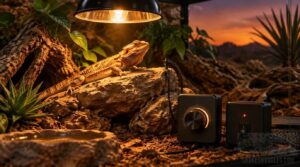
The right temperature controller decides how steady your reptile habitat stays, and the control method matters as much as the brand.
Your snake’s daily habits, from basking to hiding, reveal whether your controller is working, so it helps to understand common snake behavior patterns.
A Dimming Thermostat for heat lamps varies power smoothly, so your heat lamp holds its setpoint without flicker or sharp swings. That’s best for basking bulbs, and it can extend bulb life by up to 50%. Of twelve thermostats reviewed, only three offer true dimming modes, so check the specifications before you buy.
On/Off Thermostats cut power completely at setpoint. They’re simple, affordable, and best for heat mats, heat tape, and ceramic heat emitters. On a light-emitting bulb, though, the constant cycling causes flicker, wider temperature swings, and filament stress.
Never pair a dimmer with mercury vapor, fluorescent, or compact fluorescent bulbs. The ballast won’t tolerate it. Always check your bulb type before you buy anything.
Top 4 Thermostat Controllers for Heat Lamps
These four controllers cover the main ways to manage a heat lamp, from all-in-one fixtures to standalone dimming units. Each one is matched to a specific need, so you can pick the right control method for your setup. Check every wattage rating against your lamp before you buy.
1. juttilax 5.5 inch Reptile Heat Lamp Fixture
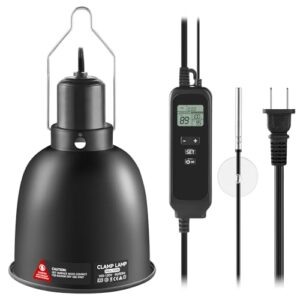
Control starts with the juttilax 5.5 inch fixture, a thermostat and lamp combo built for keepers who want precise heat. Its PID controller holds temperatures between 68°F and 113°F, and a built-in sensor tracks changes in real time. You can program four independent 24-hour periods, so your day and night zones follow a natural cycle.
It works with E26 bulbs up to 100W, including ceramic emitters and UVB lamps. It’s best for bearded dragons and leopard geckos.
Skip sun lamps and energy-saving bulbs. Some users report timer resets, so check settings after every bulb change.
| Best For | Reptile keepers with bearded dragons, leopard geckos, or similar species who want precise, programmable day and night heat control from one fixture. |
|---|---|
| Max Load | 300W |
| Temperature Range | 68°F-113°F |
| Reptile Use | Bearded dragons, leopard geckos |
| Plug-In Design | N/A |
| Timer Function | Four 24-hour periods |
| Display Type | Dual-zone LCD |
| Additional Features |
|
- PID controller holds temperatures between 68°F and 113°F, with a built-in sensor tracking changes in real time
- Four independent 24-hour time periods let you set day and night zones that follow a natural cycle
- Works with E26 bulbs up to 100W, including ceramic heat emitters and UVB lamps
- Not compatible with sun lamps or energy-saving bulbs
- Some users report the timer resetting or readjusting unexpectedly
- The thermostat and timer may stop working after a bulb replacement or extended use
2. Lucky Herp Reptile Dimming Thermostat
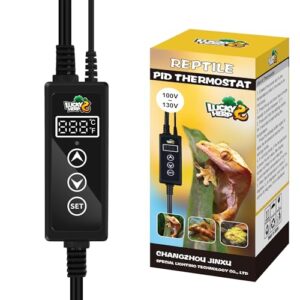
Already own a fixture? The Lucky Herp gives you dimming control without replacing it. Its PID control adjusts power smoothly, and the LED display shows ambient and set temperature. It covers 68°F to 122°F, controls up to 300W, and restores your last setting after a power outage. You can switch between Celsius and Fahrenheit.
Since apartment wiring and shared walls raise the stakes, check this guide to reptile thermostats for apartment living before choosing safety features like probe-failure shutoff.
It’s best for bearded dragons and ball pythons, and it also suits incubation. Some users report inaccuracies, so verify with a second thermometer. Read internal instructions.
| Best For | Reptile keepers who already own a heat lamp or heating pad and want smooth, stable temperature control for animals like bearded dragons and ball pythons, or for incubation and seed germination. |
|---|---|
| Max Load | 300W |
| Temperature Range | 68°F-122°F |
| Reptile Use | Bearded dragons, ball pythons |
| Plug-In Design | N/A |
| Timer Function | N/A |
| Display Type | LED digital |
| Additional Features |
|
- PID control adjusts power automatically for steady temperatures
- LED display shows both ambient and set temperature, with Celsius and Fahrenheit options
- Remembers your last setting after a power outage
- Some users report temperature reading inaccuracies, so a second thermometer is a good idea
- Setup may require reading the internal instructions instead of the box labels
- Display shows LL below 0°C and HH above 60°C, and the control range is limited to 20°C to 50°C (68°F to 122°F)
3. REPTITRIP Reptile Thermostat Light Timer
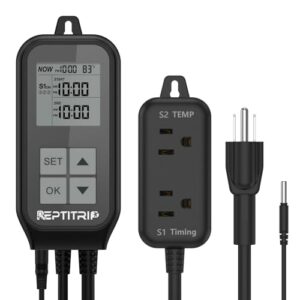
Need two functions in one unit? The REPTITRIP splits the job across two sockets. S1 runs a timer for your UVB light with three programmable schedules, while S2 holds heat lamps or pads at set temperatures. Control stays independent.
You can program separate day and night targets between 32°F and 140°F, and it controls up to 1250W at 10A. Accuracy is ±2°F, so verify with a second thermometer. There’s no date function or memory retention, so recheck settings after outages.
| Best For | Reptile keepers who want one unit to run a UVB light on a timer and a heat lamp or heating pad on a thermostat, each on its own socket. |
|---|---|
| Max Load | 1250W |
| Temperature Range | 32°F-140°F |
| Reptile Use | UVB, heat lamps, pads |
| Plug-In Design | Dual sockets |
| Timer Function | Three S1 programs |
| Display Type | N/A |
| Additional Features |
|
- Dual sockets let the S1 timer and S2 thermostat work independently
- Three programmable timing schedules for the S1 light, plus day and night temperature targets from 32–140°F
- Handles up to 1250W at 10A, enough for common UVB lights, heat lamps, and heating pads
- No battery backup or memory retention, so settings must be rechecked after a power outage
- Temperature accuracy is only ±2°F, so a second thermometer is recommended
- No date function or automatic daylight saving adjustment, and each function is limited to a single outlet
4. Diymore Digital Thermostat Temperature Controller
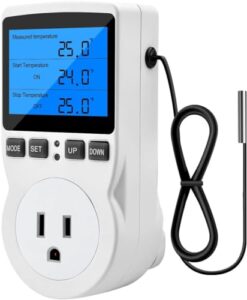
The Diymore Digital Thermostat Temperature Controller is best for keepers who want plug-in control. You skip wiring, and it controls heaters, coolers, and fans up to 1800W. The backlit LED display stays clearly readable in low light, and the 6-foot sensor cord reaches most setups.
If your enclosure sits in a tight space, pair the thermostat with one of these reptile humidity gauges for small apartments, and keep it at least 6 inches from the heat lamp.
It covers -40°F to 248°F with ±1°F accuracy, which suits RV bedrooms, terrariums, and greenhouses.
You can’t run the timer and thermostat functions together. The probe can’t be submerged, and overshoot may need manual tuning.
| Best For | Keepers of reptile terrariums, greenhouse growers, and RV owners who want plug-in temperature control for heaters, coolers, or fans up to 1800W without any wiring. |
|---|---|
| Max Load | 1800W |
| Temperature Range | -40°F-248°F |
| Reptile Use | Terrarium habitats |
| Plug-In Design | No wiring required |
| Timer Function | Timer mode |
| Display Type | Backlit LED |
| Additional Features |
|
- Plug-in setup with no wiring, controlling heaters, coolers, and fans up to 1800W
- Wide -40°F to 248°F range with ±1°F accuracy, plus a 6-foot sensor cord
- Backlit LED display that stays easy to read in low light
- Timer and thermostat plug functions can’t be used at the same time
- Sensor probe isn’t designed to be submerged in liquid
- May need manual fine-tuning to compensate for overshoot in some applications
Heat Lamp Thermostat Features Worth Paying For
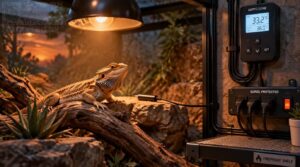
A good heat lamp thermostat does more than switch power on and off. Six features separate a safe, reliable controller from a risky one, and each earns its place in your setup. Use the list below to match your heat source and habitat to the right controls.
Smooth Dimming Control
Want longer bulb life? Choose smooth dimming control. A dimming thermostat uses proportional control and PID dimming technology for gradual temperature adjustment.
- Fewer filament shocks extend bulb life.
- Steadier basking temperatures protect your reptile.
- Less overshoot means fewer corrections.
- Lower energy use cuts running costs.
- No harsh on/off clicking.
Avoid basic on/off units if you want precise, safe control.
Accurate Temperature Sensing
Say your basking spot reads 95°F on the thermostat, but a separate digital thermometer shows 101°F. That gap can stress your animal, so temperature accuracy matters.
Pick a unit with fine temperature setpoint resolution, ideally 1°F steps. Place the sensor probe directly under the lamp, on the ground, and keep it away from airflow. Then verify it against a trusted thermometer.
Programmable Day/Night Settings
A heat lamp that runs flat out all night isn’t warm, it’s wasteful. Programmable day/night settings fix that. You set a basking temperature for daylight and a cooler one after dark, and the controller controls both.
Look for day and night temperature modes, customizable timing programs, and independent day and night temperature control. A dual channel temperature control system suits setups with separate lamps.
Overheat And Sensor Protection
A thermostat that trusts one sensor is one failure from a fried enclosure. Look for overheat protection that works independently of the main controls.
A thermostat relying on a single sensor is one failure from disaster, so insist on overheat protection that works independently
Check these four features:
- A high-limit cutoff that kills power if the primary thermostat drifts.
- A durable sensor probe with a secure mount.
- Strong temperature accuracy and probe placement accuracy.
- Temperature overshoot prevention with manual reset.
Power-Loss Memory
A power outage shouldn’t undo your setup. With power loss memory, your thermostat saves its setpoint and mode in non-volatile storage, so it resumes exactly where it stopped. No battery needed.
Without it, a controller can fall back to defaults and overheat or chill your reptile habitat. Look for it in any dimming temperature controller you trust with a heat lamp.
Independent Channel Control
Running two enclosures off one controller only works if each zone gets its own control. Independent channel control gives every outlet a dedicated probe and relay, so a hot tank never skews the reading for a cool one.
A dual relay, dual socket design lets you set separate day and night temperatures per enclosure. If one probe fails, only that channel shuts down, and power loss memory restores each setting after an outage.
Set Up Your Heat Lamp Thermostat Safely
Once you’ve matched the features to your habitat, setup decides whether they actually protect you. Start at the breaker. Shut off power, then use a multimeter to confirm zero voltage at the heat lamp socket before you touch a wire.
Connect the line wires to supply power, black to black and white to white, and the load wire to the heat lamp. Follow the terminal markings and tighten every connection. Loose wiring causes arcing and heat.
Mount the temperature controller in a UL/cUL certified junction box with strain relief. In damp enclosures, use a GFCI-protected circuit, but never stack two GFCIs in series.
Keep the lamp 6 inches from flammable materials and add a wire guard. Place the probe in shade, away from the beam. Before you leave, test overheat protection and confirm the breaker trips properly.
Manage Heat Lamp Temperatures Day and Night
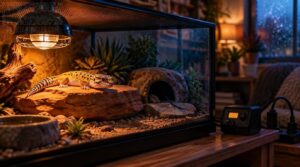
With the wiring checked and the lamp guarded, you can set your daynight cycles. Program a dimming thermostat with a warm daytime basking setpoint and a cooler night setpoint, 10 to 20°F lower. Keep the temperature probe in the shade, away from the beam, so readings stay honest.
A dual relay model lets you run heat and a backup device separately. Confirm the power loss memory function holds your settings, then watch one full cycle.
Picture what a steady setup gives you:
- Your gecko wakes active, not stressed.
- You sleep through storms without worry.
- Night drops arrive gently, never abruptly.
- Your hands stay off the dial.
- Your animal thrives, season after season.
Set it up right once, then trust it.
Frequently Asked Questions (FAQs)
Do I need a thermostat for a heat lamp?
Skip the thermostat and your heat lamp becomes a sun with no off switch.
You need a temperature controller that meets electrical safety standards, and one with power outage resiliency, so your setup stays predictable.
What is the best thermostat for a ceramic heat emitter?
Picture a ceramic heat emitter glowing dark and steady, never flickering. For that, pick a pulse proportional thermostat. It’s best for precision temperature control, holding ±1°C. The VE-300 suits most setups, while Herpstat models handle multiple heat sources.
Can you run a heat lamp continuously?
A steady flame never sleeps unwatched. You can run a heat lamp continuously, but only with a temperature controller, dual relay, heating only mode, wattage limit, and ambient temperature monitoring. Skip any and you’re gambling.
What is a thermostat controller?
Picture a basking spot that stays warm without ever scorching. That’s your thermostat controller at work. It reads your probe, compares it to your setpoint, and adjusts power to your heat lamp automatically.
Can I plug a heat lamp into any thermostat?
No, you can’t. A heat lamp thermostat must match your lamp’s voltage and wattage. A plug and play setup works only with a line-voltage temperature controller. Skip low-voltage HVAC units and never overload your controller.
How often should I replace my thermostat probe?
Think of your probe as the eyes of your setup. Replace it every 1 to 3 years, sooner if cheap. Check readings against a thermometer yearly, inspect the cord, and swap it when readings turn erratic.
Is a waterproof thermostat necessary for outdoor enclosures?
Rain is patient, and it always finds the seam. Yes, you need a waterproof thermostat outdoors. Choose an IP66 enclosure rating, a waterproof probe, and moisture resistance, so outdoor heat lamps and your animals stay safe.
Can one thermostat control multiple heat lamps?
Yes, if your total wattage stays under the controller’s rating. A dual relay unit with dual probes gives you zone-specific temperature control, while a heating-only, dual-channel temperature control system keeps each lamp safe and steady.
What wattage rating should my thermostat have?
Add up the wattage of every heating device on the thermostat, then choose a unit whose maximum load rating meets or exceeds that total. Check its amperage rating too. A single 100W lamp needs 100W of power capacity, heating-only.
Conclusion
Think a thermostat is overkill for one bulb? A bad swing can stress your animal and shorten equipment life, so it isn’t.
Choose dimming for bulbs, on/off for mats and emitters, and verify the probe placement before you walk away. The right thermostat controllers for heat lamps do quiet work: they hold your setpoint, absorb power surprises, and protect your gear. Set it once, check it weekly, and your enclosure stays steady, night after night.