This site is supported by our readers. We may earn a commission, at no cost to you, if you purchase through links.
Breed a banana male to a normal female and you might expect a mix of sons and daughters. Instead, you can get roughly 95% males. That single result tells you the banana gene doesn’t play by the usual rules.
Banana ball python genetics blends incomplete dominance with sex-linked inheritance, which means the same pairing can behave differently depending on which sex carries the gene and which maker line it comes from. Get it wrong, and your Punnett square predicts a clutch you’ll never hatch.
You’ll learn how maker lines work, why bananas and Coral Glows look alike yet inherit differently, and what to expect from every pairing.
Table Of Contents
- Key Takeaways
- The Banana Gene in Ball Pythons
- Sex-Linked Inheritance in Banana Ball Pythons
- Banana and Super Banana Breeding Outcomes
- Popular Banana Ball Python Morph Combinations
- Genetic Health and Responsible Banana Ball Python Breeding
- Frequently Asked Questions (FAQs)
- Does the banana gene exist in ball pythons?
- How close are we genetically to a banana?
- What can you breed with a banana ball python?
- How rare is a banana ball python?
- Do ball pythons have banana genes?
- What is a banana ball python?
- How do ball pythons pass on genetics?
- Are banana ball pythons dominant?
- Are banana ball pythons rare?
- Are ball pythons genetic?
- Conclusion
Key Takeaways
- Banana is an incomplete dominant, sex-linked gene, so one copy makes a banana, two make a super banana, and your pairings only play out as predicted once you account for which parent carries it.
- A male maker passes the gene on the Y, so about 95% of his banana offspring are male, while a female maker passes it on the X, so about 95% of hers are female, with recombination producing the rare exceptions under 5%.
- Banana x banana gives roughly 25% super, 50% banana and 25% normal, while a super banana paired with a normal produces all bananas and two supers produce all supers, though these ratios only hold across several clutches.
- Coral Glow can look just like a banana but is inherited differently, and since looks vary by lineage, you should record each parent’s maker line and proof-test before selling offspring.
The Banana Gene in Ball Pythons
The banana gene is one of the most recognizable traits in ball python breeding, and you’ll get far more from it once you understand how it genuinely works.
Banana is a co-dominant trait, so a single copy already changes a snake’s look, which is why a guide to snake breeding genetics and inheritance helps you predict clutch outcomes.
Below, I’ll walk you through how it’s inherited, how banana and super banana animals look, and how it differs from a similar-looking trait. Keep these three points in mind as you read, because they’ll shape every pairing you plan.
Incomplete Dominance Versus Codominance
Many keepers call banana codominant, but that’s not quite right. It’s incomplete dominance, and the difference matters when you’re reading genetic inheritance patterns.
- One copy gives a banana.
- Two copies give a super banana.
- No copies leave a normal.
Because banana is a sex linked gene, your Punnett square analysis needs extra care, so never skip it before pairing snakes.
Banana and Super Banana Appearance
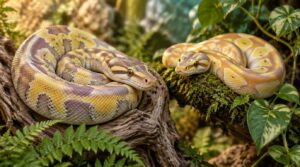
A single-copy banana morph shows warm yellow with lavender blushing, and you’ll often see freckling and orange tones build with age. Super bananas look different: brighter, paler, and nearly spotless, with fewer alien head markings.
If you’re weighing these morphs for a display tank, this guide to colorful snake breeds for vivariums shows how banana lavender and yellow tones stand out beside other vibrant species.
Don’t lean on looks alone, though. Genotype vs phenotype matters here, because lineage changes phenotype expression, and a washed-out banana can fool even experienced keepers.
Banana Versus Coral Glow
Once you’ve learned to tell a banana from a super banana, the next puzzle is that Coral Glow can look nearly identical to a banana, and researchers have found it follows a sex-linked pattern, with a LOD score above 179.1 tying the trait to sex. Here’s the catch: the banana morph and Coral glow can look alike, yet their genetic inheritance differs. Banana is a codominant trait, while Coral glow is a sex linked trait. Before you pair anything, check:
- Record each parent’s lineage carefully.
- Compare sex ratios across clutches.
- Note which sex shows the trait.
- Keep detailed pairing records.
- Proof-test before selling any offspring.
Sex-Linked Inheritance in Banana Ball Pythons
The banana gene doesn’t follow the usual rules, and that’s what makes it so rewarding to work with. Below, you’ll see how the gene travels through females, how males split into two distinct types, and why the occasional surprise hatchling isn’t a mystery. Once these three pieces click, you’ll plan your pairings with genuine confidence.
For a closer look at how banana ball python genetics play out in real clutches, this banana ball python guide walks through sample pairings and outcomes.
How Female Bananas Pass Traits
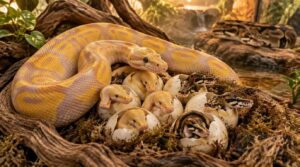
Say you pair your Female maker Banana with a normal male and hatch eight babies. Expect about four Bananas, split evenly between males and females.
Here’s why: the Sex Linked Gene sits on one X chromosome. Her XX chromosomes give every egg a 50% chance of carrying it, and since Female babies and males inherit her X, expect no skewing.
Male Makers Versus Female Makers

Banana ball python genetics hinges on which parent carries the gene’s sex chromosome. A male maker carries the gene on the Y, so roughly 95% of his Banana offspring are male. A female maker carries it on the X, so about 95% of hers are female.
This sexlinked trait makes chromosomal inheritance genuinely useful for planning your pairings well ahead.
Recombination and Unexpected Offspring
Why does a male maker occasionally throw banana daughters? Recombination is the answer.
Banana shows codominant inheritance, and as a sexlinked trait it can hop chromosomes during crossover, bending chromosomal inheritance. Rates stay under 5%.
Unexpected offspring can feel like:
- Genuine shock when hatchlings emerge
- Nervous hope while eggs incubate
- Quiet pride at your discovery
- Sudden joy at every surprise
Banana and Super Banana Breeding Outcomes
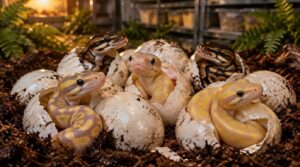
Picture pairing two bananas and getting ten eggs. With banana ball python genetics on your side, you can expect about two or three supers, five bananas, and two or three normals. A ten-egg clutch needs steady heat, so a reliable reptile egg incubator set around 89°F keeps every embryo developing evenly.
That spread comes from codominant inheritance, where each parent hands down one allele. The table shows your three main pairings.
| Pairing | Expected Result | Notes |
|---|---|---|
| Banana x Banana | 25% super, 50% banana, 25% normal | Average across many clutches |
| Super x Normal | 100% banana | All heterozygous |
| Super x Super | 100% super | Guaranteed |
Paired with a normal, a super banana guarantees banana offspring, while two supers give only supers. Because it’s a sex linked gene, maker lines skew which sex gets which outcome. Breeding outcomes prediction genuinely works best across several clutches.
Popular Banana Ball Python Morph Combinations
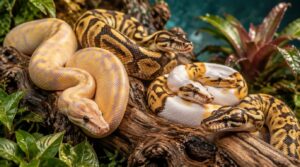
Think of the banana gene as a paint base: what you add on top changes everything. Banana ball python genetics rewards experimentation. Designer combos are where it shines.
The banana gene is a paint base for ball pythons, and whatever morph you layer on top transforms the result
Pastel brightens yellow, Enchi jumbles patterns into tiger stripes, Clown sharpens the head, Pied adds white patches, and Mojave pixelates. A super banana or coral glow carrier becomes a stunning genetic morph.
Genetic Health and Responsible Banana Ball Python Breeding
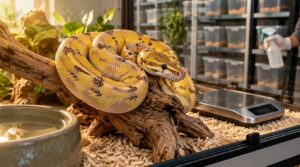
Here’s the good news: the banana gene carries no known health baggage. Genetic health in this morph is genuinely solid, so your biggest risks come from husbandry, not the gene. Since husbandry is where most problems start, a reliable digital thermostat hygrometer for reptiles helps you keep temperature and humidity steady so your banana snakes stay healthy.
Still, don’t overlook fertility. Some male lines show reduced output, so check sperm production and mating success before you commit a male to a project. Since husbandry affects male performance, stocking proven ball python breeding supplies like accurate thermostats and secure hides keeps conditioning consistent before pairings.
Responsible breeding also means respecting the sex-linked trait. Genetic inheritance here skews sex ratios, so plan your pairings carefully and track each male’s results over generations.
Protect your colony, too. Quarantine every new animal, disinfect enclosures regularly, and weigh your snakes often to prevent obesity and fatty liver disease.
Frequently Asked Questions (FAQs)
Does the banana gene exist in ball pythons?
Wondering if it’s real? It absolutely is. The Banana ball python stems from a singlegene banana trait in the Ball python, a codominant gene with a genuinely subtle sex bias that you’ll want to understand.
How close are we genetically to a banana?
You’re practically half banana, myth says! Genuinely, only about 1% of your DNA aligns, yet shared genetic inheritance keeps fundamental cell genes similar, unlike a sex linked gene, codominant gene, singlegene banana, or super banana.
What can you breed with a banana ball python?
Your banana ball python is a paintbrush dipped in sunshine; pair it with pied, pastel, clown, or another banana for a super banana. Skip spider. Its codominant gene and sex linked gene demand selective breeding.
How rare is a banana ball python?
A banana ball python isn’t rare anymore. The first one sold for $25,000, but selective breeding has pushed supply up, so you’ll find adults under $ Super Bananas are scarcer, since only 25% of banana-to-banana clutches produce them.
Do ball pythons have banana genes?
Some do, and the banana gene is a golden thread running through certain lines. Your Banana Ball Python carries a Sex Linked Gene, so Breeder Lineage matters, as do Genetic Health Issues and Morph Combinations.
What is a banana ball python?
Ever wondered what makes a snake look like fruit? A banana ball python shows yellow blotches, lavender background, and random black freckles.
This sexlinked trait, also called coral glow, looks cleaner as a super banana.
How do ball pythons pass on genetics?
Pair a Banana with normals and half your clutch shows the morph, thanks to allele pairing. Sex determination in squamates uses XY chromosomes, so a sex linked trait or chromosome crossover events can shift ratios.
Are banana ball pythons dominant?
Think dimmer switch, not toggle. Your banana ball python has an incomplete dominant trait: one copy gives banana, two give super banana.
Sexlinked trait doesn’t change this. Ask about genetic health issues and morph pricing.
Are banana ball pythons rare?
Picture a hobbyist spotting a banana pied for $ A banana ball python isn’t rare anymore. This sex linked trait breeds easily, keeping morph pricing friendly, though designer morph deserves checking for genetic health issues.
Are ball pythons genetic?
Roughly 95% of a male maker’s banana offspring are male, so your ball python is genetic.
Recessive vs dominant genes, a sexlinked trait, and genetic health in captive reptiles all shape every banana ball python.
Conclusion
A banana looks simple, but its inheritance isn’t. The colors you admire hide rules that shift with the sex of the parent and the maker line behind it. Once you understand banana ball python genetics, those surprises become predictions.
Before every single pairing, check the maker line, sketch your Punnett square, and expect the occasional recombinant. Breed with care, and prioritize healthy animals over flashy ones. Do that, and you’ll hatch clutches you actually planned.