This site is supported by our readers. We may earn a commission, at no cost to you, if you purchase through links.

Your ball python’s enclosure dropped to 65°F overnight, and now your snake won’t move. This scenario terrifies reptile owners because ball pythons, unlike mammals, can’t generate their own body heat—they depend entirely on external warmth to survive.
When temperatures fall below 70°F for extended periods, their immune systems begin to fail, digestion halts, and metabolic processes collapse. The difference between a healthy python and one sliding into hypothermia often comes down to just a few degrees and a handful of hours.
Understanding your snake’s temperature tolerance isn’t optional knowledge—it’s the foundation of responsible ball python ownership that prevents emergency vet visits and potentially fatal cold shock syndrome.
Table Of Contents
- Key Takeaways
- Ball Python Temperature Needs Explained
- How Cold is Too Cold for Ball Pythons?
- Physiological Effects of Cold Temperatures
- Ball Python Cold Survival Behaviors
- Emergency Steps for Cold Exposure
- Maintaining Safe Temperatures Year-Round
- Top 5 Products for Ball Python Heating
- Frequently Asked Questions (FAQs)
- Can ball pythons survive cold weather?
- Is a Ball Python a cold-blooded animal?
- What happens if a ball python is too cold?
- How much humidity does a ball python need?
- Can pythons survive winter?
- How hot should a ball python be?
- How cold is too cold for a ball python?
- How long can a snake be cold before it dies?
- Is 79 too cold for ball python?
- Can pythons survive in cold weather?
- Conclusion
Key Takeaways
- Ball pythons cannot survive prolonged exposure below 70°F—their immune systems fail, digestion halts, and hypothermia develops within 24–48 hours without intervention.
- Your enclosure must maintain a precise thermal gradient of 88–92°F on the basking side and 78–82°F on the cool side, with nighttime temperatures never dropping below 75°F.
- Cold stress triggers cascading physiological failures, including digestive shutdown, immune suppression, and metabolic collapse, that can quickly become fatal without immediate warming and veterinary care.
- Emergency preparedness requires backup heat sources, accurate dual thermometers, and hand warmers ready before power failures occur—temperature monitoring isn’t optional; it’s your python’s lifeline.
Ball Python Temperature Needs Explained
Ball pythons don’t just need warmth—they need precise temperature zones to digest food, fight off infections, and stay alive. Your enclosure must replicate the thermal gradient these snakes experience in West African termite mounds, where they naturally move between warm and cool microhabitats throughout the day.
Understanding these specific temperature requirements isn’t optional; it’s the foundation of responsible ball python care.
Daytime and Nighttime Temperature Ranges

Throughout the day, your ball python requires a basking zone of 88–92°F on the warm side and 78–82°F on the cool side to support thermoregulation and digestion. At night, ambient temperature can drop to 75–80°F, but never below 75°F.
Temperature fluctuations beyond this range compromise thermal gradients, disrupt ambient controls, and impair heat sources essential for effective thermoregulation methods and temperature control.
Understanding language patterns is vital for clear communication about these specific temperature needs.
Importance of a Temperature Gradient
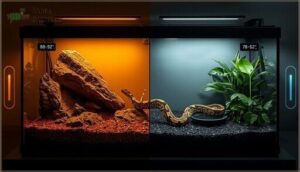
A thermal gradient isn’t optional—it’s the foundation of effective thermoregulation and ball python care. Your snake must access warm zones (88–92°F) for digestion and cooler zones (78–82°F) to prevent overheating.
Gradient design with properly placed heat sources facilitates temperature control by allowing rapid shifts between microhabitats. Without this thermal regulation system, your python can’t select ideal body temperature, leading to metabolic dysfunction and stress.
Ensuring the accuracy of scientific information, such as study summary validation, is vital for making informed decisions about animal care.
Ideal Basking and Cool Side Temperatures

Your basking spot must reach 88–92°F to support digestion and normal metabolism, while the cool side stays at 78–82°F. This heat gradient facilitates proper thermoregulation—your python shifts between zones as thermal needs change.
Use thermostatic controls with reliable heat sources to maintain ambient controls within ±2–3°F. These temperature requirements aren’t negotiable; thermal cycling between basking spots and cooler areas sustains essential physiological functions.
How Cold is Too Cold for Ball Pythons?

You need to understand the exact temperature thresholds that separate safe conditions from dangerous ones for your ball python. Knowing these numbers helps you prevent serious health complications before they develop.
Recognizing early warning signs your snake enclosure is too cold—like lethargy, refusing food, or spending excessive time near heat sources—gives you a critical window to intervene before organ damage begins.
The following sections explain the minimum temperatures your snake can tolerate, what happens when it gets too cold, and how long your python can survive suboptimal conditions.
Before diving into cold tolerance limits, make sure you understand the ideal ball python temperature requirements needed to keep your snake healthy year-round.
Minimum Safe Temperature Thresholds
Your ball python faces serious health risks when ambient temperatures drop below 70°F (21°C) for prolonged periods. At this threshold, immune function begins to fail, metabolic efficiency declines, and cold stress accumulates rapidly. Juveniles with higher surface-to-volume ratios experience hypothermia risks even faster.
Maintain thermal gradients between 78–82°F on the cool side and 88–92°F near heat sources to prevent cold shock syndrome and meet essential temperature requirements.
Effects of Temperatures Below 70°F
When ambient conditions drop below 70°F, your ball python’s physiology enters a state of crisis. Cold stress symptoms manifest across multiple systems, creating cascading health threats that demand immediate intervention.
Investing in quality heating equipment and accurate thermostats helps you maintain the stable thermal gradient your snake needs to recover and thrive.
Critical effects of suboptimal temperatures include:
- Digestive shutdown – enzyme activity plummets, halting food passage and risking regurgitation or impaction as gastric processes fail completely.
- Immune suppression – white blood cell function deteriorates, opening pathways for respiratory infections and opportunistic pathogens that exploit weakened defenses.
- Metabolic collapse – oxygen consumption decreases, cardiovascular demand shifts, and prolonged cold exposure triggers hypothermia and cold shock syndrome without corrective thermal gradient access.
Maintain proper reptile temperature management to prevent these life-threatening complications in ball python care.
Duration of Cold Exposure and Risks
How long your ball python endures cold determines survival outcomes. Cold exposure limits narrow quickly: several hours below 70°F trigger cold stress response and appetite suppression, while extended periods lasting days invite hypothermia risks, thermal shock syndrome, and respiratory infections. Temperature fluctuations below 60°F devastate activity and feeding.
Proper reptile temperature management and a stable temperature gradient are non-negotiable in ball python care.
Physiological Effects of Cold Temperatures

Cold temperatures don’t just make your ball python uncomfortable—they trigger a cascade of physiological breakdowns that can quickly become life-threatening. When the mercury drops below safe thresholds, every major body system from digestion to immune defense begins to fail.
Cold temperatures don’t just discomfort ball pythons—they trigger cascading physiological breakdowns across every major body system, quickly becoming life-threatening
Understanding these specific impacts will help you recognize the warning signs before minor cold exposure becomes a medical emergency.
Impact on Digestion and Metabolism
When your snake’s body temperature drops, digestive enzyme activity plummets, slowing gastric emptying and nutrient absorption efficiency. Cold stress effects trigger metabolic shifts that reduce baseline energy use, forcing your python’s body to prioritize maintenance over growth.
Temperature gradient disruptions prolong digestion rates and compromise energy balance, while prolonged cold exposure can lead to regurgitation, impaction, or complete digestive shutdown requiring thermal management intervention.
Immune System Suppression
Your python’s immune function collapses when cold stress response kicks in, leaving it vulnerable to infections that healthy snakes would easily resist. Temperature fluctuation impairs reptile immunology by disrupting cellular defenses and stress hormone balance.
- Lymphocyte counts decline during prolonged cold exposure, weakening pathogen resistance
- Elevated corticosterone levels reduce immune responsiveness and phagocytic activity
- Leukocyte efficiency drops, slowing clearance of bacteria and viruses
- Gut immunity weakens, increasing susceptibility to enteric infections
- Recovery requires gradual warming to restore normal immune function
Signs of Hypothermia and Cold Shock Syndrome
You’ll notice cold stress symptoms before hypothermia becomes critical—watch for lethargy, weak reflexes, and gasping breaths that signal respiratory distress.
Cold shock syndrome manifests as pale skin, impaired coordination, and an inability to right themselves.
Ball pythons experiencing thermal shock may stop seeking heat entirely, their sensory processing compromised. Document these signs immediately to guide emergency care tips and veterinary treatment.
Ball Python Cold Survival Behaviors
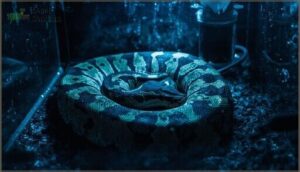
When temperatures drop, your ball python doesn’t passively accept the cold—it actively responds with specific survival behaviors. These thermoregulatory actions are hardwired instincts that help the snake seek warmth and minimize heat loss in suboptimal conditions.
Understanding these behaviors allows you to recognize early warning signs of cold stress and intervene before serious health complications develop.
Thermoregulation and Heat-Seeking Actions
When temperatures drop, your ball python relies on thermoregulation to maintain its core body temperature and avoid hypothermia or cold shock syndrome. Heat-seeking behavior drives your snake to actively move toward warmer zones in the temperature gradient you’ve established.
Key thermoregulation strategies include:
- Locating radiant heat sources using thermosensitive pits to find basking spots at 88–92°F
- Shifting repeatedly between cool and warm zones for ideal temperature control
- Increasing metabolic rate once suitable warmth is reached to support digestion
- Reducing exploratory movement during prolonged cold exposure as cold adaptation fails
- Relying on thermal gradients and environmental enrichment to prevent life-threatening temperature drops
Monitor these behaviors closely to verify proper thermoregulation and temperature control.
Shelter Seeking During Cold Snaps
During cold snaps, your ball python prioritizes shelter selection by relocating toward thermal refuge zones that offer stable warmth and humidity. This winter survival behavior reinforces the reptile temperature regulation provided by your established temperature gradient, preventing fatal cold exposure.
Microhabitat choice drives cold snap strategies—your snake seeks deeper substrate layers, enclosed hides, or crevice spaces that buffer against hypothermia and cold shock syndrome.
Differences in Juvenile and Adult Responses
Your juvenile ball python shows more urgent heat-seeking behavior than adults during cold stress. Juveniles exhibit a higher preference for basking spots and make frequent shifts between temperature gradient zones due to their growth rates and elevated metabolic demands. Adults, on the other hand, maintain more stable enclosure locations with slower behavioral reactions. Both age groups face risks of hypothermia and cold shock syndrome, yet juveniles display greater vulnerability owing to immature thermoregulation strategies and handling stress.
- Juveniles scramble constantly between warm and cool zones, burning energy reserves faster during temperature drops
- Adults conserve their strength with methodical thermoregulation strategies, yet both face organ shutdown if cold persists
- Young snakes suffer disproportionately—their small bodies lose heat rapidly, racing against time to find warmth before cold stress becomes fatal
Emergency Steps for Cold Exposure

If your ball python’s enclosure drops below safe temperatures, you need to act immediately to prevent hypothermia and organ damage. The right emergency response depends on how quickly you can restore heat and whether your snake is already showing signs of cold stress.
Follow these three critical steps to protect your ball python during unexpected temperature drops.
Using Hand Warmers and Hot Water Bottles
When power fails or your Heat Source Alternatives stop working, hand warmers and hot water bottles become your Emergency Thermal lifeline. These Temporary Heating solutions deliver localized warmth through chemical reactions or stored thermal energy, creating a controlled microclimate beneath your Ball Python.
Proper Microclimate Management requires positioning them under the warm side to maintain your temperature gradient. Monitor continuously—overheating or moisture buildup can trigger hypothermia or cold shock syndrome if your reptile care setup fails.
Relocating The Snake if Temperatures Drop
When hand warmers can’t stabilize your enclosure, Snake Relocation becomes necessary. Move your ball python to a room with reliable Heat Source Backup—an area maintaining a proper Temperature Gradient and stable Nighttime Temperature.
Emergency Shelters must provide consistent Temperature Control to prevent Hypothermia and Cold Shock Syndrome.
Use Temperature Monitoring throughout the transfer, minimizing handling to reduce Thermal Stress Management complications during this critical intervention.
When to Seek Veterinary Attention
Veterinary Care is essential when you observe persistent lethargy, regurgitation, or unresponsive behavior following Cold Stress.
Reptile Emergencies demand immediate Medical Intervention if your snake shows sunken eyes, tacky mucous membranes, or can’t lift its head consistently.
Health Checks by a reptile-experienced veterinarian rule out Hypothermia complications, Cold Shock Syndrome, and secondary infections that threaten Snake Health and Wellness during critical recovery periods.
Maintaining Safe Temperatures Year-Round

Keeping your ball python’s enclosure at safe temperatures requires consistent monitoring and planning ahead for equipment failures. You can’t rely on guesswork—accurate measurement tools and reliable backup systems protect your snake from dangerous cold exposure.
The following sections explain essential equipment for year-round temperature stability and emergency preparedness.
Thermometers and Hygrometers for Monitoring
Accurate temperature sensors and humidity control devices are non-negotiable for your enclosure temperature management. Digital thermometers with probe sensors provide continuous heat monitoring across thermal regulation zones, while hygrometers track relative humidity levels. Implement these calibration methods for reliable
- Place digital thermometer probes under basking zones and on cool sides to verify gradient consistency.
- Calibrate devices quarterly using manufacturer procedures to maintain accuracy within ±0.5°C.
- Select combined thermometer-hygrometer units with data logging and alert thresholds for temperature and humidity control.
- Replace probes and batteries regularly to prevent drift in temperature control readings.
Backup Heat Sources and Power Outages
When electrical failure threatens your snake’s survival, you need Emergency Heat Kits that function independently of mains power. Battery-backed Ceramic Heat Emitters and gas-powered Alternative Heating systems with thermostatic Temperature Control Systems provide reliable Backup Heat Sources during extended outages.
Incorporate Thermal Mass elements like insulated substrates to create Heat Storage capacity, slowing temperature decline while your Power Backup systems maintain critical warmth through Emergency Heating protocols.
Insulation and Enclosure Design Tips
Proper Snake Enclosure Design acts like a thermos—locking warmth inside while blocking drafts that steal critical heat. Choose non-porous Enclosure Materials with sealed corners to minimize heat loss, then layer substrate over a non-toxic Insulation Types underlay to stabilize your Heat Gradient and maintain consistent Enclosure Heating and Insulation.
- Install radiant heat panels or ceramic emitters to guarantee even Heat Distribution across multiple microclimates.
- Position thermometers at warm, cool, and mid-enclosure zones to monitor your Heat Gradient accurately.
- Incorporate Thermal Mass elements and balanced Ventilation Systems to retain warmth without trapping excess humidity.
Top 5 Products for Ball Python Heating
Maintaining consistent temperatures requires reliable equipment designed specifically for reptile care. The following products provide precise heat control, accurate monitoring, and essential environmental stability for your ball python’s enclosure.
Each item covers a critical component of thermal management, from heat generation to temperature tracking.
1. Arcadia Deep Heat Emitter
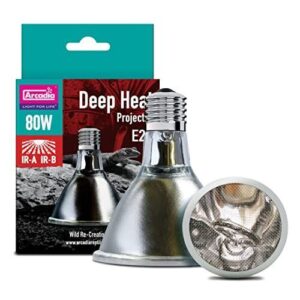
The Arcadia Deep Heat Emitter delivers near infrared heating through a ceramic element designed for continuous use, making it an excellent heat source for maintaining your ball python’s thermal gradient.
This ceramic heat emitter provides deep penetrating heat without visible light, which won’t disrupt your snake’s day-night cycle or cause stress. You must pair it with reliable thermostat control to prevent overheating and guarantee heat emitter safety.
Position it strategically to create a defined basking zone while supporting proper enclosure heating and insulation for effective reptile temperature management.
| Best For | Ball python and reptile owners who need reliable, around-the-clock heating that won’t mess with their pet’s sleep cycle or stress out light-sensitive species. |
|---|---|
| Brand | Arcadia |
| Primary Use | Heating |
| Material Type | Glass/Metal |
| Ease of Cleaning | No Cleaning Required |
| Suitable Reptiles | Bearded Dragons, Leopard Geckos |
| Power Source | 220-240V Electric |
| Additional Features |
|
- Produces deep infrared heat without any visible light, so it’s perfect for nocturnal animals and won’t disrupt natural behaviors
- Ceramic element is built for 24/7 operation, giving you consistent heat output day and night
- Creates a well-defined basking spot that makes it easy to set up proper temperature gradients in your enclosure
- You’ll need to buy a separate thermostat to control it safely—it doesn’t come with one and can overheat without proper regulation
- Some users report quality control issues, with units failing after just a few months of use
- May not put out enough heat on its own for larger enclosures or species that need higher temps, so you might need a backup heat source
2. Reptizoo Dimming Reptile Thermostat Controller
A properly calibrated thermostat remains your most critical defense against fatal temperature swings in your ball python’s enclosure. The Reptizoo Dimming Reptile Thermostat Controller provides precise temperature control through gradual dimming functions rather than abrupt on-off cycling, which reduces stress on both your heat source and your snake.
You’ll adjust thermostat settings between 88-92°F for the basking zone, ensuring heat source compatibility with lamps, ceramic emitters, or heat mats up to 300W.
Verify temperature calibration weekly using an independent thermometer, and conduct routine controller maintenance to prevent sensor drift that compromises reptile temperature management.
| Best For | Ball python owners who need reliable temperature control with gradual dimming to maintain consistent basking zones between 88-92°F without stressing their snake or heating equipment. |
|---|---|
| Brand | REPTI ZOO |
| Primary Use | Temperature Control |
| Material Type | ABS Plastic |
| Ease of Cleaning | Easy Maintenance |
| Suitable Reptiles | Various Reptiles |
| Power Source | 300W Max Load |
| Additional Features |
|
- Gradual dimming prevents sudden temperature swings that can stress ball pythons, unlike basic on-off thermostats
- Works with multiple heat sources up to 300W including lamps, ceramic emitters, and heat mats
- Digital display and memory function make it easy to monitor and maintain your exact temperature settings
- Requires weekly calibration checks with a separate thermometer since some users report accuracy drift over time
- Not compatible with sunlamps, limiting your heating options
- Some customers report unit failures, suggesting quality control issues you’ll need to watch for
3. Exo Terra Reptile Water Dish
Your ball python’s water source directly impacts thermoregulation and overall reptile care. When hypothermia or cold shock syndrome threatens your snake, adequate water quality becomes critical for physiological recovery.
The Exo Terra Reptile Water Dish offers a non-porous 2.1 cm ceramic surface that prevents bacterial accumulation while supporting reptile hydration needs during temperature stress. Position this enclosure accessory near the cool side, refill daily, and clean weekly with reptile-safe disinfectant to maintain pet safety standards.
The resin-ceramic composite withstands heating cycles without cracking, ensuring reliable access to hydration year-round.
| Best For | Ball python owners who need a stable, bacteria-resistant water dish that can handle daily cleaning and won’t crack under enclosure heating cycles. |
|---|---|
| Brand | Exo Terra |
| Primary Use | Hydration |
| Material Type | Food-Grade Resin |
| Ease of Cleaning | Non-Porous Surface |
| Suitable Reptiles | Tortoises, Frogs |
| Power Source | No Power Required |
| Additional Features |
|
- Non-porous ceramic surface prevents bacterial buildup and makes weekly cleaning straightforward
- Resin-ceramic composite stays intact through temperature changes without cracking or warping
- Low 2.1 cm profile lets ball pythons access water easily while reducing drowning risk
- Some buyers report the listed dimensions don’t match what arrives, which matters when space is tight
- Textured areas on certain models can trap debris and make scrubbing harder than expected
- Might be too deep for smaller reptiles like dart frogs if you’re housing multiple species
4. Digital Indoor Thermometer Hygrometer Monitor
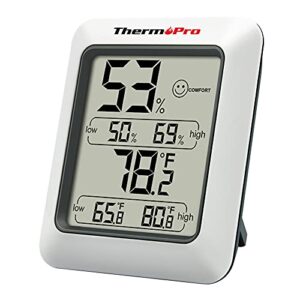
Accurate temperature monitoring prevents respiratory infections and metabolic collapse in ball pythons. Install a digital indoor thermometer hygrometer monitor—such as the ThermoPro TP50—to track both ambient temperature and humidity control across your enclosure’s gradient.
Position one sensor near the basking zone (88-92°F) and another on the cool side (75-80°F) for reliable thermal regulation data. Models with sensor accuracy of ±1°F and data logging capabilities enable you to detect dangerous overnight drops before hypothermia develops.
Calibrate your thermostat quarterly using reference instruments to maintain precision during critical temperature control periods.
| Best For | Ball python keepers who need precise dual-zone temperature and humidity tracking to prevent respiratory infections and maintain proper thermal gradients. |
|---|---|
| Brand | ThermoPro |
| Primary Use | Climate Monitoring |
| Material Type | Plastic |
| Ease of Cleaning | Simple Wipe Down |
| Suitable Reptiles | Various Environments |
| Power Source | AAA Battery |
| Additional Features |
|
- High accuracy (±1°F and ±2-3%RH) with 10-second updates lets you catch dangerous temperature drops before they harm your snake
- Dual placement capability allows monitoring of both basking zone (88-92°F) and cool side (75-80°F) in a single glance
- Includes min/max memory and wellness indicators to quickly assess whether your enclosure conditions stayed stable overnight
- No backlight makes nighttime checks difficult without disturbing your python
- Lacks data logging or app connectivity, so you can’t track long-term trends or get alerts during power outages
- Display can be hard to read from across the room, requiring you to approach the enclosure more frequently
5. Zoo Med Forest Floor Bedding
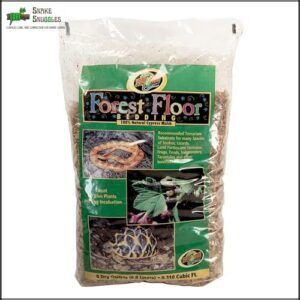
Zoo Med Forest Floor Bedding (model CM-8) delivers substrate moisture retention that stabilizes enclosure humidity at 50-60% without waterlogging.
The cypress mulch composition provides thermal insulation between your ball python’s ventral scales and cold glass floors, reducing heat loss during nighttime temperature drops to 75°F.
Spread this forest floor material 2-4 inches deep to permit shallow burrowing while maintaining your temperature gradient.
Replace bedding materials every 4-6 weeks to prevent mold accumulation that compromises respiratory health and disrupts humidity control in your reptile care protocol.
| Best For | Ball python owners who need a natural substrate that holds humidity well and allows some burrowing behavior. |
|---|---|
| Brand | Zoo Med |
| Primary Use | Substrate |
| Material Type | Cypress Mulch |
| Ease of Cleaning | Spot Cleanable |
| Suitable Reptiles | Snakes, Tortoises |
| Power Source | No Power Required |
| Additional Features |
|
- Retains moisture effectively to maintain 50-60% humidity without getting soggy
- Provides natural insulation between your snake and cold enclosure floors
- Easy to spot clean and offers a realistic forest floor appearance
- Can arrive dusty and may need rinsing before use to avoid respiratory issues
- Some batches have arrived with mites or bugs that require treatment
- May compress over time, reducing airflow and burrowing space
Frequently Asked Questions (FAQs)
Can ball pythons survive cold weather?
Short-term cold exposure may not kill a ball python immediately, but temperatures below 70°F trigger a cold stress response, compromising immune function and digestion.
Prolonged drops lead to hypothermia or cold shock syndrome.
Is a Ball Python a cold-blooded animal?
Yes, your ball python is a cold-blooded ectothermic animal. Reptile physiology depends entirely on external heat sources to maintain metabolic rates and regulate body temperature through active thermoregulation behaviors within their environment.
What happens if a ball python is too cold?
When your ball python gets too cold, its metabolism slows dramatically, digestion halts, and immune function weakens. Prolonged cold stress below 70°F triggers lethargy, respiratory infections, and potentially fatal hypothermia or cold shock syndrome.
How much humidity does a ball python need?
Your ball python needs 50-60% humidity normally, spiking to 70% during shedding. Juveniles thrive at 60-70%.
Monitor with a hygrometer, adjust substrate moisture, and mist occasionally to prevent dehydration and retained shed.
Can pythons survive winter?
Wild ball pythons avoid winter-like conditions by seeking stable thermal refugia in tropical West Africa. Cold-blooded reptiles can’t undergo true snake hibernation or brumation; instead, prolonged hypothermia from low ambient temperature triggers cold stress response and organ failure.
How hot should a ball python be?
Your ball python’s basking spot should stay between 88–92°F during the day, with the cool side at 78–82°F. Nighttime temperatures can safely drop to 72–78°F without harming your snake.
How cold is too cold for a ball python?
Anything below 70°F crosses the thermal limits for ball pythons, triggering cold stress that feels like walking into a freezer—hypothermia risk climbs fast, compromising this cold-blooded species’ metabolism and immune defenses against cold shock syndrome.
How long can a snake be cold before it dies?
Prolonged cold below 70°F lasting 24–48 hours markedly raises mortality risk through hypothermia and cold shock syndrome.
Short drops to 60–65°F may be recoverable with rapid intervention, but immediate veterinary assessment remains critical.
Is 79 too cold for ball python?
Seventy-nine degrees Fahrenheit sits slightly below the safe threshold for ball pythons. Your snake needs consistent ambient temperature above 75°F, plus a thermal gradient providing warmer zones to prevent cold stress and hypothermia.
Can pythons survive in cold weather?
Ball pythons can’t survive prolonged cold weather exposure. As ectothermic animals, they lack internal heat generation and depend entirely on external warmth for thermoregulation strategies, making temperature fluctuations below 70°F life-threatening without intervention.
Conclusion
Your python’s survival hinges on the same principle that keeps your own body functioning—consistent warmth isn’t negotiable. While ball pythons can temporarily withstand brief cold exposure, prolonged temperatures below 70°F trigger cascading failures you can’t reverse at home.
Install dual thermometers, maintain backup heat sources, and memorize emergency warming protocols before crisis strikes. The difference between a thriving snake and a veterinary emergency exists in those few degrees you monitor daily.
Temperature vigilance isn’t paranoia—it’s your python’s lifeline.
- https://www.petmd.com/reptile/conditions/systemic/hypothermia-reptiles
- https://www.ncbi.nlm.nih.gov/pmc/articles/PMC4786079/
- https://pmc.ncbi.nlm.nih.gov/articles/instance/9553038/bin/pone.0275964.s005.docx
- https://academichelpexpress.blog/2024/08/please-use-the-bulleted-points-and-the-rubric-below-to-guide-your-work-your-pa/
- https://www.onelook.com/?loc=olthes1&w=subpoint