This site is supported by our readers. We may earn a commission, at no cost to you, if you purchase through links.

A ball python’s belly can’t feel a burn coming. Ventral scales lack the pain receptors that would normally warn a snake it’s resting on something too hot, which means a poorly calibrated heat mat or an unshielded bulb can cause serious tissue damage before you notice anything wrong. I’ve treated cases where owners had no idea their setup was the problem until the damage was done.
Getting the best temperatures for keeping a ball python right isn’t about guesswork or "close enough." It’s about precise, measurable zones, a warm side, a cool side, and a basking spot, each calibrated to support digestion, thermoregulation, and long-term health.
Below, you’ll find the exact ranges, the tools to hit them, and the setup details that keep your snake safe in every season.
Table Of Contents
- Key Takeaways
- Best Ball Python Temperatures by Zone
- How to Create a Safe Thermal Gradient
- Best Heating Options for Ball Pythons
- Monitoring Temperatures and Preventing Health Problems
- Top 3 Ball Python Temperature Tools
- Frequently Asked Questions (FAQs)
- Is 72 degrees too cold for a ball python?
- Is 92 degrees too hot for a ball python?
- What temperature should I keep my ball python’s cage at?
- What is too cold for a ball python at night?
- How often should I check the temperatures in my ball python’s enclosure?
- How can I safely lower enclosure temperature in summer?
- What are signs of temperature-related stress in ball pythons?
- Is fluctuating temperature throughout the day harmful?
- Can ball pythons tolerate brief power outages?
- How do seasonal changes affect temperature management?
- Conclusion
Key Takeaways
- Ball pythons can’t feel a burn coming because their belly scales lack pain receptors, so an uncalibrated heat source can cause serious tissue damage before you ever notice a problem.
- Your enclosure needs three precise zones to work properly: a warm side at 88°F–92°F, a cool side at 75°F–80°F, and a basking spot at 90°F–95°F, creating the 10–15°F gradient your snake needs to thermoregulate and digest.
- Every heat source should run through a dedicated thermostat, since unregulated bulbs or heating pads risk burns above 95°F and heat rocks should be avoided entirely because they can’t be regulated at all.
- Consistent monitoring matters just as much as hitting the right numbers, so check temperatures at least twice daily with digital probes and an infrared thermometer, and adjust setpoints seasonally to account for winter drops and summer heat waves.
Best Ball Python Temperatures by Zone
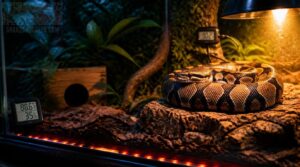
Your ball python can’t tell you when its enclosure feels wrong, so the numbers have to do the talking. Every zone in that tank has a purpose, and getting even one range off can throw the whole setup out of balance. Here’s exactly what each zone should read on your thermometer.
Picking the right heat lamp for your ball python makes hitting those precise zone temperatures far easier to manage day to day.
Warm Side: 88°F–92°F
Belly heat, not air temperature, drives digestion in a ball python. Keep the warm side at 88°F to 92°F, calibrated at substrate level, where ceramic heat emitters or heat pads deliver steady belly heat transfer. Always verify readings with an infrared temperature gun rather than relying on thermostat displays alone.
- Confirm thermostat accuracy within 1-2°F
- Check surface readings, not ambient air
- Maintain warm zone day and night
- Adjust seasonally for consistent digestive heat requirements
Cool Side: 75°F–80°F
Once digestion is handled, your snake needs somewhere to cool off. Keep that zone at 75°F to 80°F, creating the 10-15°F gradient pythons rely on for thermoregulation.
| Cool Side Factor | Target Range |
|---|---|
| Air Temperature | 75-80°F |
| Nighttime Drop | 72-76°F |
| Humidity | 50-60% |
| Substrate Depth | 3-4 inches |
| Hide Moisture | Damp peat moss |
Basking Surface: 90°F–95°F
Within that gradient sits one hotspot that matters most: the basking surface, held at 90°F–95°F. Keep it 6-8 inches wide, using ceramic tile or slate for even heat transfer.
Position lamps 8-12 inches above substrate. Verify with a probe thermometer or infrared gun, and pair every heat source with a temperature controller to prevent burns.
Nighttime Minimum: Above 70°F
Lights off doesn’t mean heat off. Your ball python needs nighttime ambient temperatures above 70°F, with 72°F as a safer target buffer.
- Use ceramic heat emitters or radiant panels (no visible light)
- Set thermostat night mode to 71-72°F
- Monitor room temp separately from enclosure readings
- Adjust seasonally, winter often demands 2-4°F higher setpoints
Below 70°F risks regurgitation, poor immunity, and respiratory infection.
10°F–15°F Thermal Gradient
Think of the gradient as a hallway, not a single room. Keeping warm side temperatures at 88-92°F and cool side temperatures at 75-80°F creates that critical 10-15°F thermal gradient, letting gradient behavior unfold naturally as your snake migrates to regulate digestion.
For a full breakdown of setup basics, this guide to proper snake enclosure temperature gradients walks through picking the right heat sources for each end.
Gradient monitoring with dual probes confirms stability. Gradient feeding success depends on it, an animal that can’t reach 88°F won’t digest safely.
How to Create a Safe Thermal Gradient
Knowing the target temperatures is only half the job—your enclosure has to deliver them safely and consistently. That means thinking about where you place hides, how you keep the ambient temperature stable, and how you adjust for the seasons as they change. Here’s what you need to get right, piece by piece.
Warm and Cool Hide Placement
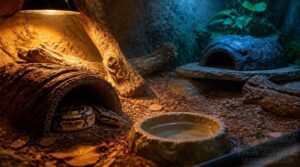
Hide placement makes or breaks your gradient. Your ball python needs two distinct retreats:
- Warm hide on substrate, warm side, offset 1–2 inches from the heat source
- Cool hide elevated slightly, with an air gap underneath
- Entrances facing opposite directions to limit heat bleed
- Hides spaced 8–12 inches apart minimum
Proper spacing lets your snake self-regulate without stress.
Stable Ambient Temperature Setup
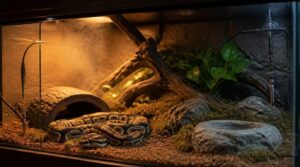
A drafty enclosure undermines even the best heater. Ambient insulation and tight enclosure sealing prevent heat loss, keeping your gradient stable rather than fluctuating hour to hour.
Calibrate your thermostat monthly and pair it with consistent ambient temperature monitoring using probes at multiple points. This combination maintains temperature stability across the 78–82°F range, protecting your snake from the stress that unstable ambient temperatures cause.
Basking Spot Positioning

Where you mount the heat source matters as much as its wattage. Position basking surfaces higher than the warm hide for a natural vertical gradient, with Height Adjustment keeping surface readings at 90°F–95°F.
Check Fixture Alignment and Beam Spread: heat lamps and ceramic heat emitters need broad, diffuse coverage. Maintain Distance from Hide to avoid drafts, and verify Surface Orientation through consistent temperature monitoring.
Winter Temperature Adjustments
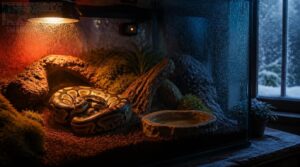
Winter heating demands are real: as home temperatures drop, so does your enclosure’s thermal gradient. Raise thermostat setpoints 2°F to 4°F to compensate.
- Increase warm side thermostat settings seasonally
- Maintain nighttime temperature above 70°F
- Boost humidity to offset dry indoor heating
Check settings weekly. A stable thermal gradient prevents feeding refusal and shedding complications during cold months.
Summer Overheating Prevention
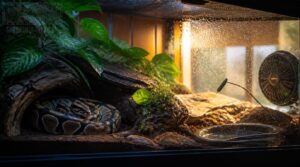
Heat waves flip the script fast: ambient air climbing past 85°F pushes surface temps toward 104°F, well past safe range.
Widen ventilation, add fans with light misting for evaporative cooling, and relocate enclosures from windows. If temps exceed 95°F, shut off heat and cool within 30 minutes. Temperature alarms catch trouble before your snake shows stress.
Best Heating Options for Ball Pythons
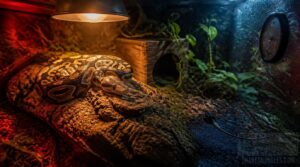
Choosing the right heat source is just as important as hitting the right numbers. Not every option belongs in your enclosure, and some carry real safety risks if used carelessly. Here’s what actually works, and what to watch out for with each one.
Heat Lamps and Basking Bulbs
When choosing overhead heat lamps, aim for 90–95°F at the basking spot, positioned 12–18 inches up per Safety Distance Rules.
Infrared basking bulbs work well overnight; UVB heat lamps add ultraviolet benefit.
Bulb Wattage Guide:
- 75–150W for small tanks
- 150–250W for larger setups
- Ceramic heat emitter for light-free warmth
Fixture Placement Tips matter, always pair with a thermostat.
Under-Tank Heating Pad Safety
Overhead bulbs aren’t your only option. An undertank heating pad works well too, but only when paired with a dedicated thermostat, never left running unchecked.
Set it on a nonconductive base, add a barrier so your snake can’t chew the wiring, and inspect cords weekly. Choose moisture resistant coatings. Skipping these steps risks thermal burns.
Ceramic Heat Emitters
Ceramic emitters skip visible light and radiate infrared heat that warms surfaces, not air, mimicking natural solar gain. Mount yours 8-12 inches above the basking zone, always with a dedicated thermostat.
Check clearance monthly, and wipe dust from the housing to preserve output. These units last years with minimal upkeep, a solid return for maintaining your basking spot temperature.
Thermostats for Every Heat Source
No thermostat, no heat source, period. Match wattage ratings exactly to your lamp or emitter, and use dual channel control for warm/cool zones independently.
- Proportional thermostats for basic wattage modulation
- PID thermostats for ±1-2°F precision
- Inkbird Temperature Controller Bundle for dual probes plus app monitoring
Place probes centrally, verify safety cutoffs quarterly.
Why Heat Rocks Are Unsafe
Skip heat rocks entirely. They cause uneven heat distribution, creating burn hazards while ambient air stays cold, no thermal gradient forms.
They’re thermostat-incompatible, so overheating and fire hazard risk climb fast.
| Heat Rock Problem | Consequence |
|---|---|
| No regulation | Thermal burns |
| Uneven heating | Poor thermoregulation |
| Air stays cold | Inadequate ambient heating |
Use proper temperature monitoring tools with a regulated heat source instead.
Monitoring Temperatures and Preventing Health Problems
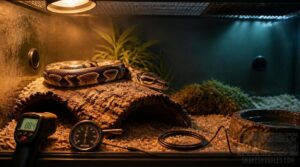
Getting the gradient right on paper means nothing if you’re not tracking it accurately day to day. Your thermostat can fail, your bulb can dim, and your snake will show the consequences before you notice the numbers have drifted. Here’s what proper monitoring looks like, and where things go wrong when it’s skipped.
Digital Probe Thermometer Placement
Where you mount your probes matters as much as owning them.
Use dual probe monitoring: one on the warm hide, one on the cool side, positioned at snake level, never buried in substrate. Secure wiring away from your snake’s path.
Calibrate every 3-6 months against a known-accurate thermometer.
Sloppy placement gives you false confidence, and false confidence burns snakes.
Infrared Surface Temperature Checks
When probes seem right but you’re still uneasy, grab an infrared thermometer for a second opinion. Set emissivity to 0.95, hold 12-25cm away, and avoid reflections off glossy surfaces.
Remember: this reads surface temperatures, not air. Take 3-5 shots at the basking spot for reading consistency, then cross-check against your digital probe thermometers before trusting the gradient.
Thermostat Settings and Safety Alarms
A proportional thermostat does more than switch power on and off, it modulates output to hold your setpoint within 1-2°F.
Configure dual-channel control, alarm thresholds, and remote alerts (like the Inkbird bundle offers) so deviations, sensor faults, or failures notify you instantly.
Schedule quarterly calibration checks against a known reference to keep readings trustworthy.
Overheating and Thermal Burn Risks
Ball pythons won’t retreat from a hot spot the way you would. Belly scales lack pain receptors, so thermal burn risks climb fast once surface temps pass 95°F, causing ventral scale burns and deeper tissue damage.
Ball pythons can’t feel a burn coming, so surface heat past 95°F silently damages their belly scales
Watch for reduced movement or refusal to leave the basking area. Thermostat-controlled heat sources and temperature alarm systems catch failures before thermal injury sets in.
Top 3 Ball Python Temperature Tools
Getting the numbers right means nothing without gear you can trust to measure and hold them. You don’t need a dozen gadgets cluttering your setup, just a few reliable tools that do their jobs well. Here are three worth adding to your ball python’s enclosure.
1. Etekcity Laser Infrared Temperature Measurement Gun
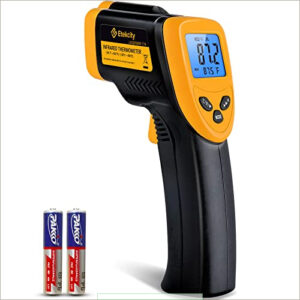
Guessing at surface temperatures is how burns and cold spots slip past you. The Etekcity Laser Infrared Temperature Measurement Gun solves that by reading -58°F to 842°F with 12:1 targeting accuracy from about 14 inches away, close enough to work safely, far enough to avoid disturbing your snake.
Sweep it across basking rocks, hides, and substrate to confirm your warm side hits 88°F to 92°F and your cool zone holds 75°F to 80°F. It won’t read through glass accurately, so aim through open mesh or an access door instead.
Adjustable emissivity helps you dial in accuracy for different surfaces, and the hold feature locks readings so you’re not squinting mid-sweep.
| Best For | Reptile owners, home cooks, and DIY-minded folks who want a fast, no-contact way to check surface temperatures on anything from a basking rock to a griddle. |
|---|---|
| Temperature Monitoring | Infrared surface reading |
| Reptile Use | Checks enclosure hot/cool zones |
| Temperature Range | -58°F to 842°F |
| Setup Complexity | Handheld, no install |
| Power Source | Battery operated |
| Precision Control | Adjustable emissivity |
| Additional Features |
|
- Reads a wide range (-58°F to 842°F) in under half a second, so you get instant feedback
- 12:1 distance-to-spot ratio lets you take accurate readings from about 14 inches away without disturbing pets or getting too close to heat
- Adjustable emissivity (0.1–1.0) means you can fine-tune accuracy across different surface types, from matte terrarium rock to shiny cookware
- Can’t measure through glass or plastic accurately, so you’ll need an open mesh panel or access door for enclosed setups
- Not designed for measuring human body temperature
- Requires a clear line of sight, and the measurement spot grows with distance, so you need to get the aim and range right for reliable readings
2. Repti Zoo Heat Lamp Bulb
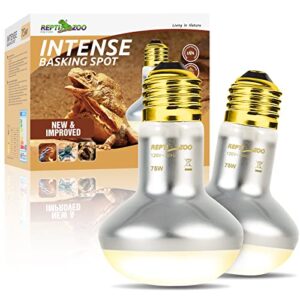
Once your gun confirms a cold spot, the fix is often just a better bulb. The Repti Zoo Heat Lamp Bulb comes in 75W and 100W options and mounts in any standard E26 fixture, no adapters needed.
Positioned 8-12 inches above substrate, it produces basking temperatures in the 90-95°F range, right where ball pythons need them for enclosures up to 40 gallons.
Its flat bottom reflector focuses roughly 35% more heat and light into the beam than older bulb designs, and the vacuum aluminizing process pushes lifespan to 2000-3000 hours. Pair it with a thermostat; unregulated bulbs risk thermal burns above 95°F.
| Best For | Reptile keepers, especially ball python owners, who need a reliable basking heat source for enclosures up to 40 gallons and want a bulb that fits standard fixtures without extra adapters. |
|---|---|
| Temperature Monitoring | Indirect via basking output |
| Reptile Use | Provides basking heat |
| Temperature Range | Basking 90-95°F |
| Setup Complexity | Screw into E26 fixture |
| Power Source | Standard socket power |
| Precision Control | Requires external thermostat |
| Additional Features |
|
- Flat bottom reflector concentrates about 35% more heat and light into the beam than standard bulbs, making it easier to hit target basking temps
- Extended 2000-3000 hour lifespan thanks to an updated vacuum aluminizing process, so you’re not replacing bulbs constantly
- Fits standard E26 sockets and operates without buzzing or flickering, keeping the thermal environment stable
- Doesn’t provide UVB radiation, so reptiles still need a separate UVB light for proper vitamin D3 synthesis
- Glass envelope is fragile and can shatter from water exposure, sudden temperature shifts, or impact
- Should be paired with a thermostat, since unregulated use above 95°F can risk thermal burns
3. Inkbird Temperature Controller and Thermometer Bundle
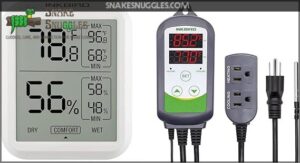
A bulb solves basking heat, but you still need to know what’s happening everywhere else, day and night. That’s where the Inkbird bundle earns its keep. It pairs a dual-channel thermostat with waterproof probes, letting you regulate warm and cool sides independently instead of guessing.
Accuracy runs within ±1°C, with relays handling loads up to 1100W, comfortably covering lamps, pads, or emitters. High-temperature alarms and shutoffs catch spikes before they cause burns above 95°F. Wi-Fi alerts flag fluctuations remotely, so a failed probe doesn’t go unnoticed overnight, when temps below 75°F risk respiratory trouble.
| Best For | This controller is best for hobbyists and small-space growers who need reliable, hands-off temperature and humidity regulation for plants, nurseries, or storage areas. |
|---|---|
| Temperature Monitoring | Digital ambient sensor |
| Reptile Use | Controls enclosure climate |
| Temperature Range | 14°F to 122°F |
| Setup Complexity | Wire to relay loads |
| Power Source | Plug-in with relay wiring |
| Precision Control | Built-in dual relay control |
| Additional Features |
|
- Dual relay outputs allow simultaneous heating and cooling control from one unit
- Easy-to-read LCD displays temperature, humidity, and comfort-level icons at a glance
- Compact, flexible design fits tabletop or wall-mount setups in tight spaces
- Temperature range is limited to –10°C to 50°C, so it won’t suit extreme environments
- No built-in power outlet, meaning you’ll need to wire your own heating or cooling equipment
- Small screen size can make readings hard to see from a distance
Frequently Asked Questions (FAQs)
Is 72 degrees too cold for a ball python?
Like Goldilocks searching for "just right," 72°F misses the mark. It’s technically above the 70°F nighttime floor, but sits well below the 75°F to 80°F cool-side target, risking sluggish digestion and immune stress.
Is 92 degrees too hot for a ball python?
Not quite, 92°F sits right at the top of the safe warm-side range. It’s fine short-term for digestion, but push much higher and you risk appetite loss or metabolic stress. Keep it steady, don’t let it climb further.
What temperature should I keep my ball python’s cage at?
Set up a gradient, not one number: warm side at 88°F–92°F, cool side at 75°F–80°F, basking spot 90°F–95°F, and nighttime lows staying above 70°F for safe thermoregulation.
What is too cold for a ball python at night?
A cooler night can still be too warm a risk. Below 70°F, your ball python loses safe footing on the gradient, appetite drops, and immunity weakens, so keep the cool side no lower than the high 60s.
How often should I check the temperatures in my ball python’s enclosure?
Check twice daily, minimum. Use two digital thermometers on warm and cool sides, then confirm the basking surface with an infrared gun after any bulb change, thermostat adjustment, or room temperature swing that could shift your gradient.
How can I safely lower enclosure temperature in summer?
Think of summer heat as a pot left too long on the stove, it needs a lower flame. Drop your thermostat to 88–90°F, add fans for airflow, and cut nighttime heating once room temps top 75°F.
What are signs of temperature-related stress in ball pythons?
Your snake tells you before a thermometer does. Restless pacing and repeated repositioning signal overheating, while sluggish, hide-bound behavior points to cold stress. Watch feeding refusal, labored breathing, or stuck shed, all classic red flags of thermal imbalance.
Is fluctuating temperature throughout the day harmful?
Like a tide that rises and falls without ever flooding the shore, small daily swings within your gradient are natural, not dangerous. Rapid drops or chronic instability outside safe ranges are what actually trigger stress and illness.
Can ball pythons tolerate brief power outages?
Yes, brief outages rarely cause harm. Your ball python tolerates short cooling if the enclosure stays above 70°F, but temperatures near 60°F trigger stress within 12 hours, so monitor closely and apply backup heat sources promptly.
How do seasonal changes affect temperature management?
Room temperature swings shift your enclosure’s baseline. Winter demands raising thermostat setpoints 2°F to 4°F and watching nighttime lows, while summer calls for better ventilation and reduced heat output, protecting that critical 10°F to 15°F gradient your snake depends on.
Conclusion
A single degree can feel like a thousand miles to a snake that can’t tell you it’s hurting. That’s the reality of ectothermic care.
Getting the best temperatures for keeping a ball python right isn’t a luxury, it’s the foundation behind every healthy shed, meal, and year your snake lives.
Buy the thermostat. Check the gradient daily. Trust the numbers over your hand.
Precision keeps snakes alive, good intentions don’t.