This site is supported by our readers. We may earn a commission, at no cost to you, if you purchase through links.

A corn snake can sit on a perfectly good heating pad and still end up cold, stressed, and refusing dinner. The pad isn’t the problem. The setup is.
Too big, and your snake has nowhere to cool off. Plugged straight into the wall, it can climb past 120°F and scorch the substrate. Placed under the wrong spot, it heats the air but never the belly your snake needs warmed to digest.
A solid heating pad setup for corn snake terrarium builds takes five small decisions, and each one protects your animal. You’ll start with choosing the right pad.
Table Of Contents
- Key Takeaways
- Choose a Heat Pad That Fits Your Corn Snake’s Terrarium
- Install The Heat Pad Beneath The Warm Hide
- Connect a Thermostat and Secure Its Probe
- Check Surface and Air Temperatures Across The Terrarium
- Maintain The Heat Pad and Prevent Overheating
- Frequently Asked Questions (FAQs)
- What temperature should a heat mat be for a corn snake?
- Where to put a heat mat in a snake enclosure?
- What is the best way to heat a corn snake?
- Is a heat pad necessary for a corn snake?
- How do you heat a corn snake tank?
- How do you heat a corn snake cage?
- How do you keep a corn snake warm?
- How do you make a corn snake terrarium?
- What temperature should a corn snake terrarium be?
- Where do you put the heat mat on a corn snake?
- Conclusion
Key Takeaways
- You’ll want a flexible, low-profile pad sized to cover about a third of the floor (4 to 6 inches for a 20 to 30 gallon tank), so your snake always has a cool side to retreat to.
- You’ll stick the pad to the outside of the glass directly under the warm hide, keep the bedding over it thin, and keep cords and the pad itself away from damp spots and the water dish.
- You’ll plug the pad into a thermostat, never straight into the wall, and secure the probe in the warm hide area with high-temp silicone, since a bare pad can run away and scorch the substrate.
- You’ll verify the setup with two digital thermometers, aiming for a warm side around 85 to 90°F and a cool side of 75 to 80°F, then log temperatures for 24 hours and inspect the pad monthly for scorch marks or drift.
Choose a Heat Pad That Fits Your Corn Snake’s Terrarium
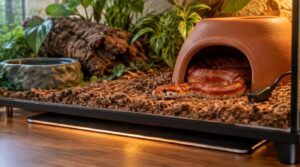
Because your corn snake can’t make its own heat, the pad you pick matters. Match the pad to the floor space. For a 20 to 30 gallon tank, choose a 4 to 6 inch pad. For a 40 to 60 gallon tank, go with 6 to 9 inches.
If you’re unsure which size fits your setup, this snake heating pad size guide shows how to cover about a third of the floor.
You’ll want a flexible, low-profile pad under a quarter inch thick, rated for animal enclosures. Skip rigid ceramic types, since they can crack glass. Look for built-in thermal cutoff near 120 to 125°F and a layer of insulation underneath.
Your pad should cover the warm hide’s footprint, so it won’t leave cold gaps. Corn snakes need 88 to 92°F on the warm side, and a properly sized pad gets you there safely.
Install The Heat Pad Beneath The Warm Hide
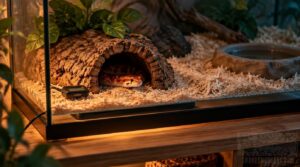
With your pad picked, put it where it counts. Heat pad placement starts with the warm hide. Set the hide on one side of the terrarium, then stick the pad to the outside of the glass bottom, centered right under the hide’s opening.
Since snakes judge a hide by how secure it feels, it helps to know what makes a good snake hide before you commit to one spot.
Leave 2 to 3 cm of clearance around the pad’s edges, so it never touches the walls or damp spots. You’ll want the pad covering only part of the floor, never all of it, so your snake can always cool off on the other side.
Mind your substrate layering. Keep bedding over the hotspot thin, since thick layers give false readings. For heat pad safety, never let cords or the pad touch bedding, and start temperature monitoring.
Connect a Thermostat and Secure Its Probe
Now your heat pad needs a brain. Plug it into a thermostat, never straight into the wall, because a bare pad can run away on you.
If you’re keeping hatchlings, this guide to reptile heating pads for hatchling snakes explains how to match pad size and thermostat settings to their delicate needs.
Place the probe off-center from the pad’s edge, since edges run hotter and give skewed readings. Rest the sensing tip in the warm hide area, not a cold corner. Secure it with high-temp adhesive or silicone. Tape peels under heat, so skip it.
Run the cable along the wall with heat-resistant clips. Keep it clear of the water dish and damp bedding. Tidy heat pad placement means no snagging, no shorts.
Set a low-temperature alert 2 to 3°C below your target. Pick a thermostat with an auto-off cutout too. That’s real temperature monitoring insurance.
Check Surface and Air Temperatures Across The Terrarium
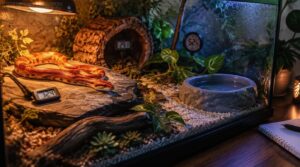
Your thermostat is running, so now you’ll prove it works. Good probe placement only controls the heat. It doesn’t tell you what your snake actually feels.
A thermostat only controls the heat; thermometers show what your snake actually feels
Grab two digital thermometers and run these surface temperature checks:
- Measure the basking spot on the warm side. Aim for 28 to 32°C (82 to 90°F).
- Check the air at head height in the warm hide. Aim for 24 to 28°C (75 to 82°F).
- Read the cool side. You want a 10 to 15°C gradient.
- Log nighttime air. It shouldn’t drop below 20°C (68°F).
Add air and humidity monitoring to the same routine, since damp bedding skews readings. Record everything for 24 hours. Steady numbers mean thermal gradient stability, and that’s your green light.
Maintain The Heat Pad and Prevent Overheating
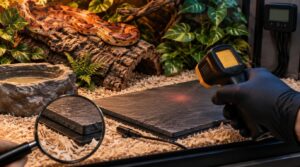
Because a little routine goes a long way, you’ll want to make heat pad maintenance a monthly habit. Check the cord, the probe, and the edges. Look for scorch marks or melted substrate. Those are red flags, so don’t ignore them.
Good temperature monitoring keeps you ahead of trouble. Aim for a surface reading within ±2°C of your target, and log it for two to three weeks after any change. If readings drift more than 5°C from baseline, replace the pad. Every six months, recalibrate your thermostat and test the insulation.
Burn prevention starts with a barrier. Keep a tile or smooth rock between the pad and decor. Heat pad safety isn’t glamorous, but it’s cheap insurance. Spot overheating risk early.
Frequently Asked Questions (FAQs)
What temperature should a heat mat be for a corn snake?
Worried a mat will cook your snake? It won’t. Keep the warm side temperature at 80-85°F and the cool side temperature at 75-82°F.
Once your enclosure is dialed in, you can explore the most popular rosy boa morphs, from striking albinos to vivid high-contrast patterns.
Since size mismatches are the top reason pets get rehomed, it helps to start with one of the best snake breeds that stay small so your setup always fits.
Smart heat pad placement and a thermostat hold that temperature gradient steady.
For nighttime, a heat mat under the basking area can be held at 80°F with an on/off thermostat to keep conditions safe.
Where to put a heat mat in a snake enclosure?
Corn snakes love one cozy corner. Use that: heat pad placement goes under the warm hide, never beneath water.
You’ll build a thermal gradient, with warm side temperature, cool side temperature, and thin substrate layering
What is the best way to heat a corn snake?
Warmth is a snake’s quiet compass, so give it a map.
Use a thermostat-controlled heating pad under one end for a thermal gradient: warm side temperature near 30°C, cool side temperature lower, with substrate layering.
Is a heat pad necessary for a corn snake?
That’s a myth. Your snake needs heat, not a heating pad specifically. If your room meets corn snake temperature requirements, a thermal gradient controls temperature regulation.
Otherwise, add a pad, and plan easy substrate replacement.
How do you heat a corn snake tank?
You’ll heat the tank with a pad under one side. Match heat pad types and sizes to your floor.
For best heat pad setup, use temperature gradient control: 85-90°F warm, 75-80°F cool. Add a thermostat.
How do you heat a corn snake cage?
Picture your snake gliding from a toasty hide into cooler shade. That’s the temperature gradient you’ll create: install a heat pad under one-third of the tank, controlled by a thermostat set to 85°F.
How do you keep a corn snake warm?
Keeping your corn snake warm means creating a thermal gradient. Place a heating pad under the warm hide for a basking spot of 85-90°F, keep the cool side at 75-80°F, and always use a thermostat for control.
How do you make a corn snake terrarium?
You’ll set up a 20–30 gallon terrarium with a secure lid, aspen substrate, two hide boxes, a water bowl, and climbing branches. Place your heat pad under one hide, add a thermostat and thermometer, and maintain a 75–85°F gradient.
What temperature should a corn snake terrarium be?
Ready to nail it? Your basking spot temperature should hit 85-90°F, while the cool side stays 75-80°F.
If your current setup struggles to hold those numbers, our comparison of the best corn snake enclosure heaters shows which options keep temperatures steady.
Offer a warm hide and cool hide for that temperature gradient. Check with thermostat and digital probe thermometer.
Where do you put the heat mat on a corn snake?
Warm side is sunlight, cool side is shade.
Heat mat placement: put the under tank heater beneath one end, covering one-third of the floor. Raise corners for airflow, add a thermostat to guard your gradient.
Conclusion
Think of the heat pad as a furnace and the thermostat as its steady hand on the dial. A good heating pad setup for corn snake terrarium care puts both in balance, so warmth reaches the belly without ever turning into a hazard.
Right-size the pad, place it under the warm hide, secure the probe, and check temperatures often. Do that, and your snake will digest well, eat eagerly, and thrive for years to come.