This site is supported by our readers. We may earn a commission, at no cost to you, if you purchase through links.

You might walk past one a dozen times without noticing. Snake nests don’t announce themselves with the tidy, woven architecture of bird nests—they’re masters of concealment, tucked into rock crevices, buried under leaf piles, or hidden in the dark spaces beneath your deck. Most resemble nothing more than a small depression lined with decomposing vegetation, easily mistaken for natural debris.
The truth is, identifying a snake nest requires knowing what separates a random collection of leaves from a deliberate incubation chamber. Different species employ vastly different strategies: king cobras construct elaborate mounds and stand guard for weeks, while rat snakes simply abandon their eggs in rotting logs.
Understanding these variations, along with the subtle signs of snake activity around your property, can help you spot potential nests before an unexpected encounter occurs.
Table Of Contents
- Key Takeaways
- What Does a Snake Nest Look Like?
- Do All Snakes Build Nests?
- Where Are Snake Nests Commonly Found?
- How to Recognize a Snake Nest
- What Does a King Cobra Nest Look Like?
- What Are The Signs of a Snake Nest Nearby?
- Can Snakes Nest Inside Homes?
- What Do Snake Holes Look Like?
- How to Safely Remove a Snake Nest
- How to Prevent Snakes From Nesting Nearby
- Frequently Asked Questions (FAQs)
- What do snake nests look like?
- What is a snake nest?
- Do snakes build nests?
- How do you find a snake nest?
- What Types of Non-Venomous Snakes Build Nests?
- What Are the Benefits of Having Snakes Around?
- What Are the Signs of Occupied Snake Holes?
- What are the Best Practices for Managing Snake Nests?
- When is it Necessary to Contact Professional Snake Removal Services?
- How long do snake eggs take to hatch?
- Conclusion
Key Takeaways
- Snake nests are typically concealed clusters of eggs hidden in organic debris, rock crevices, or abandoned burrows rather than constructed structures, with most species simply depositing eggs in existing cavities while only king cobras actively build elevated leaf mounds up to a meter high.
- Roughly 70% of snake species lay eggs (oviparous) in protected sites, while 30% give birth to live young (viviparous) without creating traditional nests, making reproductive mode the key factor in whether you’ll encounter an actual nest.
- You can identify snake activity near your property through indirect signs like shed skins appearing every 3-4 weeks for juveniles, S-shaped slither tracks in soil or dust, dark droppings with white uric acid caps, and distinctive musky odors in enclosed spaces.
- Prevention requires eliminating attractants through yard maintenance (keeping grass below three inches, removing debris piles), sealing entry points as small as 6 millimeters with hardware cloth or caulk, and installing 36-inch smooth fencing with buried edges to physically exclude snakes from nesting near structures.
What Does a Snake Nest Look Like?
Snake nests don’t follow a universal blueprint—what you’ll encounter depends heavily on the species and where it’s decided to settle. Most nests are surprisingly inconspicuous, blending seamlessly into their surroundings as simple collections of crushed vegetation or hidden cavities beneath rocks and logs.
Understanding the typical appearance, materials involved, and species-specific variations will help you recognize these sites when you come across them.
Typical Appearance and Structure
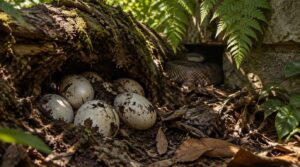
A snake nest rarely resembles the tidy bowls you’d associate with bird nesting habits. Instead, most egg clusters appear as compact, leathery heaps buried several centimeters within organic debris—think rotting logs or mulch piles.
Pythons demonstrate unique nesting behavior by coiling their bodies around eggs, forming a living nest architecture that spans 30 to 60 centimeters. You won’t find open, constructed snake dens; concealment defines their nesting place.
Understanding snake nest types is essential for identifying these hidden locations.
Materials Used in Nest Construction
Leaf litter and decaying vegetation form the backbone of most snake nest architecture. King cobras sweep together compacted masses of dried leaves—often pine or eucalyptus—mixed with small twigs to build mounds nearly a meter high.
Soil composition also plays a role: many species dig shallow burrows in sandy loam, while others exploit compost piles where organic matter generates gentle microbial heat for incubation.
Differences by Snake Species
Beyond raw materials, reproductive modes and snake species drive striking contrasts in nesting habits. Here’s how different reptile habitats shape snake nesting behavior:
- King cobras construct raised leaf mounds above ground, guarding 20–50 eggs for weeks—unusual brooding behavior among snakes.
- Pythons coil around 50+ eggs in burrows, generating heat through muscular shivering.
- Rat snakes abandon 10–25 eggs in logs without parental care.
- Rattlesnakes bear live young in communal rock dens, producing no egg-laying sites.
- Garter snakes deliver 10–40 live offspring under surface cover objects.
The unique reproductive methods, including ovoviviparity processes, influence the diversity of snake nesting behaviors.
Do All Snakes Build Nests?
Not all snakes build nests—in fact, most don’t. The key difference lies in how they reproduce: some lay eggs and select protected sites for them, while others give birth to live young and skip nest-building altogether.
Understanding these reproductive strategies helps you recognize whether a snake in your area is likely to create a nesting site.
Oviparous Vs. Viviparous Reproduction
Not all snakes follow the same path regarding reptile reproduction. There are two main reproductive modes among these fascinating creatures: oviparous snakes deposit eggs in carefully selected sites, while viviparous snakes retain embryos internally until live birth. This fundamental difference in snake nesting behavior shapes maternal investment strategies and determines whether you’ll encounter an actual snake nest with eggs or simply witness newborns emerging fully formed.
| Characteristic | Oviparous Snakes | Viviparous Snakes |
|---|---|---|
| Egg Development | External, in nests or protected sites | Internal, within mother’s body |
| Maternal Investment | Lower post-oviposition care | Higher energetic cost during pregnancy |
| Climate Adaptation | Mostly in warmer regions | Common in cold, high-elevation areas |
| Nest Construction | May create or modify egg-laying sites | No traditional nest required |
Understanding these reproductive strategies helps you recognize that roughly 70% of snake species are oviparous, while the remaining 30% exhibit viviparity—a pattern driven by snake evolution responding to environmental pressures.
Viviparous advantages become clear in colder climates, where maternal thermoregulation accelerates embryonic development and improves offspring survival compared to eggs left vulnerable to temperature fluctuations.
Species That Lay Eggs Vs. Live Birth
Familiar garden inhabitants like corn snakes and pythons exemplify oviparous snakes, depositing 10–30 or even 100+ eggs in snake nests under leaves or burrows. Meanwhile, viviparous species such as garters and rattlesnakes carry snake embryos internally, birthing 10–40 live young without traditional nests.
Common egg layers include:
- Corn snakes (10–30 eggs)
- Ball pythons (4–10 eggs)
- King cobras (20–50 eggs)
- Reticulated pythons (20–100+ eggs)
Understanding these reproductive modes helps you identify what you’re actually encountering outdoors.
Where Are Snake Nests Commonly Found?
Snakes don’t choose nesting sites at random—they’re looking for specific conditions that keep their eggs or young safe from predators and temperature extremes. You’ll find these sites in both wild landscapes and surprisingly close to human activity, depending on what meets their survival needs.
The locations break down into three main categories: natural outdoor habitats, areas around homes and buildings, and the environmental conditions that make a spot attractive in the first place.
Natural Outdoor Locations
You’ll often find snake nests in the wild where shelter meets warmth. Forest habitats with rotting logs and thick leaf litter attract egg-laying species, while grassland ecology accommodates nesting in tall vegetation and scattered woody cover.
Sandy uplands, especially pine woods with loose soil, provide ideal ground nests. Riparian zones and wetland conservation areas offer moisture-rich sites where tree nests occasionally occur near water, reflecting diverse snake nesting habits across varied snake habitats.
Man-Made and Residential Areas
Human development has created unexpected urban snake habitats and residential dens. Backyard encounters now regularly occur where structural access meets prey abundance, making snake proofing essential for modern homeowners.
Wildlife removal specialists confirm that properties with rodent activity face markedly higher risk, as abandoned burrows double as ready-made nests requiring professional snake removal and ongoing garden pest control.
- Under houses, decks, and sheds – damaged skirting and rodent burrows grant access to stable, shaded dens
- Basement and crawl spaces – suburban infestations thrive where gaps around pipes allow entry
- Pool equipment pads – erosion beneath concrete creates humid refuges for nesting habits
- Multi-story ledges and balconies – textured walls and plantings enable vertical access in dense cities
Environmental Factors Influencing Nest Sites
Thermal conditions drive every oviparous female’s choice—you’ll find nests clustered where soil stays between 24–32°C and moisture persists through incubation. Climate shifts and habitat fragmentation now force snakes to seek cooler, vegetated refuges as urban heat islands push traditional snake habitats beyond safe thermal gradients, altering nesting habits and disrupting ecosystem balance.
| Environmental Factor | Optimal Range | Impact on Snake Nest |
|---|---|---|
| Soil Temperature | 24–32°C | Determines embryo survival and hatching success |
| Soil Moisture | Moderate hydric levels | Prevents desiccation; influences nest depth selection |
| Vegetation Cover | Dense litter/canopy | Buffers thermal extremes; maintains nest microclimates |
| Predation Pressure | Low contact rates | Shapes microhabitat choice and clutch placement |
| Landscape Connectivity | Unfragmented corridors | Ensures access to suitable nesting sites across seasons |
Environmental management that preserves shaded, moist microhabitats fosters reproductive success and maintains local biodiversity.
How to Recognize a Snake Nest
Recognizing a snake nest isn’t always straightforward—these sites are often well-hidden and designed by nature to escape notice. You’ll need to know what physical clues to look for and how to tell snake activity apart from other burrowing animals.
Let’s break down the key signs that indicate you’ve found an actual snake nest.
Physical Signs and Camouflage
You’ll spot subtle clues before the snake itself. Look for narrow, sinuous tracks—trails 0.5 to 2.5 centimeters wide in dust or soil—radiating from concealed ground nests like spokes from a hub.
Shed skin near burrows, rock piles, or debris signals repeated use. Surface disturbance with flattened grass and drag marks points to active nesting behavior.
Snake dens exploit natural camouflage techniques, blending nest materials with surrounding foliage and shadows.
Distinguishing Nests From Other Animal Sites
Snake nests differ sharply from rodent or bird sites. Rodent nests show dense, woven layering with shredded paper and gnawed materials—10 to 20 centimeters across—while snake nesting areas appear as simple ground depressions without constructed frameworks.
Bird nests feature twigs and feathers in deliberate patterns above ground, contrasting with snake dens that occupy bare soil cavities or rock gaps at ground level.
What Does a King Cobra Nest Look Like?
King cobras stand apart from most snakes because they’re one of the few species that actually construct a proper nest. The female carefully gathers leaves, twigs, and forest debris into a sizeable mound where she’ll guard her eggs with extraordinary dedication.
Here’s what makes these nests distinctive and how you can identify one if you encounter it.
Unique Nesting Behavior
Among over 3,700 snake species worldwide, you’ll find that only the king cobra (Ophiophagus hannah) actively constructs above-ground nests for egg incubation—a striking deviation from typical snake behavior and habitat patterns.
Of over 3,700 snake species worldwide, only the king cobra builds an actual above-ground nest for its eggs
This unique approach to reproductive habits transforms ordinary snake dens into engineered nesting strategies, where females build multi-layered structures specifically designed for thermal regulation during the incubation period, setting nesting habits and animal nesting behavior apart from all other serpents.
Appearance of King Cobra Leaf Nests
When you encounter one of these carefully constructed mounds, you’ll recognize three distinctive features that set king cobra nests apart:
- Dome-shaped leaf piles reaching 55–100 cm high and 130–180 cm wide at the base
- Compressed dead leaves from oak, pine, and local trees mixed with twigs and occasional soil
- Central egg chamber hollowed within the mound, maintaining 27°C and 90% humidity for thermal regulation throughout the 70–100 day incubation period
These camouflage techniques blend seamlessly into forest floors, appearing as natural leaf litter while housing up to 53 eggs—an exceptional example of reptile habitat engineering among snake species with unique nesting habits.
What Are The Signs of a Snake Nest Nearby?
You won’t always stumble across an actual nest when snakes are nearby—they’re masters at staying hidden. Instead, you’ll need to look for indirect clues that signal their presence and activity in your space.
A few key signs can tell you whether snakes have been living, breeding, or sheltering close to your home.
Presence of Eggs or Young Snakes
The clearest confirmation you’re near a nesting site is finding the eggs themselves. Oviparous snakes deposit clutches ranging from 3 eggs in smaller species to 46 in large pythons, often clustered tightly together—about 77% of eggs in some species physically attach to one another. You might encounter soft-shelled, elongated eggs in humid spots like compost piles or building voids.
| Feature | Egg-Laying Species | Live-Bearing Species |
|---|---|---|
| Reproductive Cycles | Deposit 3–46 eggs per clutch depending on size | Give birth to fully formed snake hatchlings |
| Nesting Behavior | Select protected sites with stable moisture and temperature | Use secure refuges but don’t create traditional nests |
| Young Snake Care | Most abandon eggs; king cobras guard nests 12–15 days | Some vipers remain with neonates up to two weeks |
In communal nesting habits observed in neotropical snake species, multiple females may deposit eggs at a single prime site, creating large clusters. King cobras build conspicuous leaf nests containing 23–43 eggs, with females standing guard during egg incubation.
For viviparous snakes in your crawl space or basement, you won’t find eggs—instead, you’ll discover live young during their brief two-week window near the birthing site. Understanding these reproductive cycles and oviparous snakes’ nesting habits helps you recognize whether that sheltered corner harbors developing embryos or recently born hatchlings, both indicators of active reptile habitat and conservation concerns in your immediate surroundings.
Shed Skins and Slither Tracks
Beyond eggs and young, you’ll often spot translucent, papery shed skins—sometimes a full meter or more—draped over fence rails or snagged in foundation cracks. Juveniles shed every 3 to 4 weeks, adults about 3 to 4 times yearly, so fresh molted skin near your deck signals active snake behavior.
Slither tracks in dusty crawl spaces or garden soil reveal distinctive S-shaped grooves matching reptile movement patterns and body width, confirming regular passage.
Odors and Droppings
A sharp fecal odor often heralds nearby snakes, especially when concentrated droppings accumulate near suspected nests. Snake identification through droppings reveals dark, oblong masses tipped with white uric acid—a signature of reptile behavior distinct from rodent attractants.
Wildlife removal professionals rely on three key signs:
- Persistent musky smell in crawl spaces or sheds, intensifying after feeding
- Fresh droppings with undigested hair or bones near entry points
- Overlapping rodent and snake waste, indicating pest control failures drawing predators
Nest sanitation and prompt snake removal and prevention reduce health risks from Salmonella-laden feces.
Can Snakes Nest Inside Homes?
Yes, snakes can and do nest inside homes when conditions allow it. They’re drawn to places that offer shelter, warmth, and access to food like rodents.
Understanding where they usually settle and how they get in helps you address the problem before it starts.
Typical Indoor Nesting Spots
You’ll often find snakes occupying areas you rarely visit—basements with cracked foundations, cluttered crawl spaces, and attic dens where warmth and concealment converge. Indoor hiding spots also include garage habitats stacked with boxes, utility rooms behind appliances, and spaces beneath flooring.
Animal habitat selection reflects reptile behavior: snakes favor dark, undisturbed zones with stable temperature. Understanding these nesting habits informs effective snake removal and prevention, especially during basement inspection of older structures where multiple snake species may overwinter.
Entry Points and Attractants
Foundation gaps as narrow as 6 millimeters permit snake entry—particularly when soil settling compromises your home’s structural integrity. Recognizing how nesting habits intersect with prey attractants and moisture sources helps you maintain ecological balance while protecting indoor spaces across diverse snake species and animal habitat contexts supporting wildlife conservation.
- Foundation Gaps: Freeze–thaw cycles create cracks in basements and crawl spaces, providing direct access routes for numerous snake species
- Vent Screens: Damaged or missing mesh on foundation and attic vents allows snakes to exploit under-floor and roof spaces
- Door Thresholds: Worn sweeps and warped jambs create linear openings that function as primary entry points, especially in garages
- Prey Attractants: Rodent populations drawn by outdoor pet food, bird feeders, and unsealed garbage increase snake presence near structures
What Do Snake Holes Look Like?
If you’ve spotted a hole in your yard and you’re wondering whether a snake might be responsible, you’re not alone in that concern. Snake holes aren’t always easy to identify since snakes often repurpose existing burrows rather than digging their own.
Let’s look at what these entrance points usually look like and where you’re most likely to find them.
Identifying Snake Holes in Soil
You’ll spot snake burrow characteristics by looking for circular openings 1–3 inches across with smooth, compacted edges—no claw marks or fresh soil piles. Soil disturbance analysis reveals the difference: mammals excavate and leave mounds, while reptile biology dictates snakes can’t dig.
Check tunnel systems near vegetation or foundations for shed skin, which confirms snake den detection. Ground nests and burrow nests show slither tracks, not footprints, in fine soil.
Other Common Entrance Types
Beyond soil burrows, you’ll find snakes using foundation gaps as narrow as 6–9 millimeters, unscreened vent screens, and roof access points near eaves. Wall openings around pipes, rock crevices, and tree cavities serve as burrow entrances for different nesting habits depending on snake species.
Ground nests, burrow nests, and tree nests all depend on these natural and structural entry types.
How to Safely Remove a Snake Nest
Removing a snake nest isn’t something you should tackle alone—these situations can turn dangerous fast if you don’t know what you’re dealing with. Whether you choose professional help or careful DIY methods, your safety depends on the right approach and equipment.
Here’s what you need to know before taking any action.
When to Call Professionals
You should contact professional wildlife removal or animal control immediately when you find venomous species, encounter snakes inside living spaces, or discover multiple shed skins and eggs indicating infestation.
Emergency response is critical if you can’t confidently identify the snake—liability concerns and safety precautions demand expertise. Licensed specialists use proven snake removal techniques and repellent strategies, ensuring humane pest control while addressing structural entry points you might miss.
Protective Measures and Tools
Once professionals arrive, observe their protective measures: snake-proof boots or gaiters shield lower legs, while leather gloves protect hands during debris removal. Snake tongs maintain roughly 1.5 meters of distance—your safety buffer. Eye protection guards against defensive strikes.
Exclusion barriers using ¼-inch hardware cloth, buried 6 inches deep, prevent re-entry. Chemical snake repellents lack field-proven efficacy, so rely on structural pest management and wildlife control expertise instead.
How to Prevent Snakes From Nesting Nearby
You don’t have to live with the worry of snakes setting up shop in your yard or home. Prevention comes down to making your property less attractive and accessible to these reptiles.
The following strategies address both habitat management and physical barriers to keep snakes from establishing nests on your property.
Yard and Home Maintenance Tips
Routine Lawn Care combined with Yard Sanitation cuts available cover that attracts snakes near your home. Keep grass trimmed below three inches, dispose of leaf piles promptly, and relocate woodpiles several meters from structures during regular Garden Maintenance.
Eliminate rodent attractants like spilled birdseed through effective Pest Control—this removes the primary prey drawing snakes toward your Yard, naturally discouraging Snake Nesting Habits without relying solely on Snake Repellents.
Exclusion Techniques and Barriers
Physical barriers shift the odds when you understand Snake Species and their Nesting Habits. Effective Fence Designs incorporate Barrier Materials that block access while supporting Ecological Balance through Wildlife Management:
- Install 36-inch smooth fencing with Subsurface Skirts extending outward
- Use Netting Types with apertures under 6.35 mm at ground level
- Apply Exclusion Devices like door sweeps and weep-hole covers
- Seal foundation gaps with caulk before installing hardware cloth
- Bury mesh edges to prevent burrowing beneath the Reptile Control perimeter
Frequently Asked Questions (FAQs)
What do snake nests look like?
Snake nests usually appear as concealed piles of crushed leaves, vegetation, or debris hiding egg clusters in cavities beneath rocks, logs, or inside abandoned burrows, often camouflaged within their surroundings.
What is a snake nest?
You’ll find that in herpetology, a snake nest refers to the specific site where egg-laying species deposit clutches—distinct from communal overwintering dens used for thermal refuge during brumation.
Do snakes build nests?
Most species don’t construct nests—they deposit eggs in existing cavities like burrows or hollow logs.
The king cobra stands alone, deliberately building elevated leaf mounds for egg incubation, a unique reproductive behavior among snakes.
How do you find a snake nest?
Like following breadcrumbs in the wild, you can find a snake nest by spotting shed skins, droppings with white deposits, S-shaped tracks in dust, and clean burrow entrances near woodpiles or dense vegetation.
What Types of Non-Venomous Snakes Build Nests?
Most non-venomous snakes don’t build elaborate nests. Colubrids like kingsnakes and corn snakes deposit eggs in existing cavities, while pine snakes excavate underground burrow nests.
Grass snakes favor decomposing vegetation, providing natural incubation heat.
What Are the Benefits of Having Snakes Around?
You might say snakes are worth their weight in rodents—their ecological benefits include natural pest control, ecosystem balance, and biodiversity support, making snake conservation essential for wildlife preservation and ecological importance.
What Are the Signs of Occupied Snake Holes?
You’ll find fresh snake tracks—those wavy S-shaped impressions—near burrow entrances, along with shed skins, dark droppings capped with white uric acid, and an absence of spiderwebs blocking the opening.
What are the Best Practices for Managing Snake Nests?
Professional guidance, habitat modification, and exclusion barriers form the cornerstone of effective snake nest management.
You’ll reduce risk by maintaining clear yards, installing fine-mesh fencing, and consulting wildlife experts for safe, conservation-minded removal.
When is it Necessary to Contact Professional Snake Removal Services?
You should contact professional snake removal services when dealing with venomous species, repeated sightings, snakes inside homes, or uncertain identification.
Prioritize safety precautions over snakebite risks and liability concerns despite removal costs.
How long do snake eggs take to hatch?
Ever wonder how long those leathery eggs sit before baby snakes emerge? Incubation periods for snake eggs usually range from 40 to 90 days, depending on snake species, temperature effects, and humidity levels during egg development.
Conclusion
A homeowner once mistook a clutch of snake eggs for mushrooms sprouting beneath her porch—until one began to hatch. That moment of recognition transformed her entire approach to yard management.
Now you understand what a snake nest looks like, where these concealed incubation sites appear, and how to respond appropriately. Knowledge doesn’t eliminate every surprise, but it does replace panic with informed action. Your property remains yours; you’re simply sharing space more intelligently.
- https://www.thebhs.org/publications/the-herpetological-bulletin/issue-number-106-winter-2008/163-07-communal-egg-laying-and-nest-sites-of-the-goo-eater-i-sibynomorphus-mikanii-i-colubridae-dipsadinae-in-southeastern-brazil/file
- https://www.nature.com/articles/srep13385
- https://vettoday.com/blog/pet-health/snake-reproduction/
- https://pmc.ncbi.nlm.nih.gov/articles/PMC5071763/
- https://biozoojournals.ro/nwjz/content/v18n2/nwjz_227501_Amaral.pdf