This site is supported by our readers. We may earn a commission, at no cost to you, if you purchase through links.

Rattlesnakes carry a bite that kills, yet one snake shrugs it off and eats the source. That’s the mexican black kingsnake for you, a glossy, jet black constrictor with a natural immunity to pit viper venom and an appetite that includes other snakes.
You won’t find flashy patterns here. Just deep, iridescent black scales that shift blue under direct light, wrapped around a calm, predictable temperament that makes this species a favorite among keepers who want confidence without chaos.
From proper enclosure dimensions to feeding schedules built around body weight ratios, getting this animal’s care right comes down to understanding what makes it thrive in captivity.
Table Of Contents
- Key Takeaways
- Mexican Black Kingsnake Species Profile
- Mexican Black Kingsnake Enclosure Setup
- Mexican Black Kingsnake Diet and Feeding
- Temperament, Handling, Shedding, and Health
- Top 3 Products for Mexican Black Kingsnake Care
- Frequently Asked Questions (FAQs)
- Is the black king snake poisonous?
- Do Mexican black kingsnake bites hurt?
- How large can Mexican black kingsnakes get?
- Is the Mexican black kingsnake venomous?
- Are Mexican Black Kingsnakes bitey?
- What is the personality of a Mexican black kingsnake?
- Do Mexican Black Kingsnakes lay eggs?
- Is a Mexican black kingsnake a good pet?
- Are black kingsnakes aggressive?
- How often do Mexican black kingsnakes shed their skin?
- Conclusion
Key Takeaways
- Mexican black kingsnakes have a natural immunity to rattlesnake venom, letting them hunt and eat pit vipers without harm—true predator-prey coevolution at work.
- Getting the enclosure right is non-negotiable: you’ll need at least a 48x18x16 inch tank with a secure locking lid, a basking zone of 85-90°F, and humidity held between 40-60%.
- Feeding success comes down to sizing prey no wider than 1.5 times your snake’s head and following an age-based schedule, from every 5-7 days for juveniles to every 14-21 days for adults.
- These snakes make excellent long-term pets thanks to their calm, docile temperament, but you’re signing up for a real commitment—15 to 20+ years of care and strictly solo housing, since they’ll eat other snakes given the chance.
Mexican Black Kingsnake Species Profile
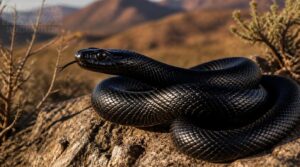
Before you set up an enclosure or plan a feeding schedule, you need to know exactly what you’re working with. This snake carries a specific taxonomic identity, a defined native range, and physical traits that set it apart from every other kingsnake subspecies. Here’s the full profile, starting with where it comes from and where it stands today.
Once you’ve pinned down its origins and traits, this complete guide to kingsnakes as pets walks you through turning that knowledge into a proper enclosure setup and feeding routine.
Classification, Origin, and Conservation
Before you fall for that glossy black coloring, know what you’re actually getting: Lampropeltis getula nigrita, a kingsnake subspecies native to the Sonoran Desert of Sinaloa, Sonora, and southern Arizona.
Some references lump it into the broader L. californiae complex, but taxonomy aside, wild populations remain stable.
This kind of subspecies debate is exactly why researchers advocate for unified taxonomic data systems that integrate species concept justifications across sources.
Conservation status sits at Least Concern, no significant habitat loss threats currently.
Appearance, Iridescence, and Morphs
Genetics settle the taxonomy question, but your eyes settle the identification one. Jet black scales with a smooth, glassy texture catch light as a blue iridescent sheen, most visible at angles. Some individuals show pale chin markings. Juveniles run grayer, darkening with age.
Over 50 morph varieties exist, though true Mexican Black Kingsnakes stay uniformly dark, minimal patterning throughout.
Adult Size and Growth
That glossy sheen carries a solid frame. Adults reach 3 to 5 feet, some pushing 6 in captivity, with females outsizing males.
- Hatchlings: 6–8 inches
- Year one: rapid growth
- Maturity: 2–3 years
- Full size: 3–4 years
- Girth thickens with length
Growth slows post-year one; steady heat and feeding drive it toward maximum size.
Lifespan and Long-Term Commitment
That size holds steady for decades, not just years. Expect 15 to 20 years in captivity, with disciplined husbandry pushing some individuals past 20 plus years. This isn’t a starter pet timeline.
Longevity planning matters as much as enclosure setup, since habitat upgrades, health monitoring, and yearly care commitment will follow your snake well into the 2030s if you acquire one today.
Pricing and Reputable Breeder Selection
Expect to pay $100–$200 for a captive-bred Mexican black kingsnake, depending on lineage and morph rarity. Reputable breeders offer written health guarantees, parent health testing, and detailed purchase contracts with after-sale support.
Check Kingsnake.com classifieds or the ARAV vet directory for verified sellers. Demand lineage transparency records, and avoid handling your new snake for at least two weeks after arrival.
Mexican Black Kingsnake Enclosure Setup
Getting the enclosure right isn’t optional with this species — it’s the foundation everything else builds on. Size, temperature, humidity, and hiding spots all work together to keep your kingsnake secure and thriving. Here’s exactly what you need to get each piece right.
If you’re starting from scratch, a complete snake habitat setup guide walks you through every component in order.
Adult Enclosure Size and Security
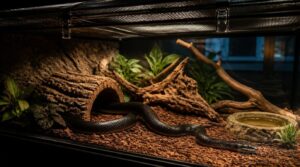
A four-foot kingsnake needs room to actually be a snake, not just survive in a box. Minimum 48x18x16 inches, though 48x24x24 gives better floor area for coiling and exploration.
If you’re weighing enclosure materials, the Ecoflex Mojave Reptile Lounge offers a moisture-resistant option for kingsnake tanks that holds up well to regular cleaning.
Escape prevention matters just as much as square footage. Use a secure, locking lid, check gaps under a quarter inch, and inspect latches weekly, these snakes are notorious escape artists.
Temperature Gradient and Basking Zone
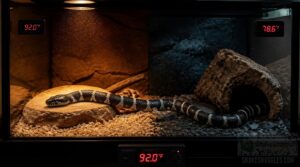
Get the gradient right and thermoregulation happens on autopilot. Place heat on one end only, basking surface at 85-90°F, ambient side dropping to 72-78°F across 8-12 inches of usable space.
- Ceramic heat emitter or ultra-slim heat panel
- Two digital thermometers, hot and cool zones
- Thermostat for stable output
- Solid, non-slippery basking surface
Watch behavior daily, it won’t lie to you.
Humidity, Ventilation, and Moisture Control
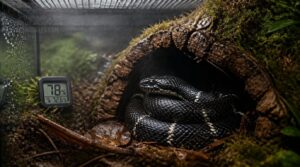
Too humid and mold creeps in, too dry and shedding turns into a fight. Keep RH at 40-60%, checked daily with a hygrometer.
| Tool | Function | Target |
|---|---|---|
| Hygrometer | Daily monitoring | 40-60% RH |
| Screened vents | Airflow, no drafts | Steady exchange |
| Humid hide | Sphagnum moss | Shed support |
Wipe condensation, dry wet spots, ventilate consistently.
Substrate, Hides, Water, and Enrichment
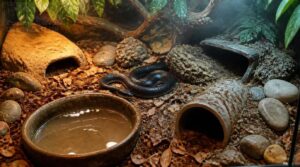
Your substrate does double duty: burrowing medium and humidity buffer. Cypress mulch holds moisture without molding, at 2-4 inches deep. Place hides on warm and cool sides, tight-fitting for security. Use a water bowl sized for full-body soaking.
Enrichment essentials:
- Cork bark
- Leaf litter
- Smooth stones
- PVC tunnels
- Rotating hides
Lighting Cycle and Photoperiod
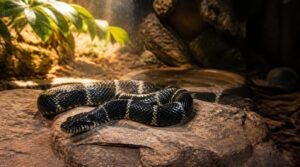
Light shapes behavior as much as heat does, yet keepers overlook it. Run a 12 hour light cycle year-round for baseline circadian rhythm support, adjusting seasonally for natural day length adjustment.
| Season | Light Hours | Purpose |
|---|---|---|
| Spring/Summer | 13-14 | Boosts appetite |
| Fall/Winter | 10-11 | Signals rest |
UVB lighting isn’t required for calcium metabolism, but a UVB 50 tube helps natural coloration.
Mexican Black Kingsnake Diet and Feeding
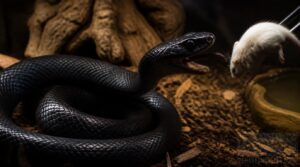
Feeding a Mexican Black Kingsnake isn’t complicated, but getting it right matters more than most owners realize. Their diet reflects a predator built for efficiency, from what they eat in the wild to how you’ll feed them in captivity. Here’s what you need to know before that first rodent hits the enclosure.
Natural Diet and Snake-Eating Behavior
Track, strike, constrict, swallow: that’s the kingsnake’s four-step hunting rhythm. Tongue flicks map scent trails toward rodents, lizards, birds, and smaller snakes across the Sonoran range.
- Ambush-style patience near prey hotspots
- Head-first swallowing after repositioning
- Opportunistic feeding on eggs when rodents thin out
- Girth-matched prey selection
- Cooler or warmer hunting windows depending on scent activity
Venom Resistance and Rattlesnake Predation
That opportunistic streak extends to rattlesnakes, thanks to real venom immunity. Serum proteins bind haemotoxic and metalloproteinase components, neutralizing pit viper venom before it does damage.
Mexican Black Kingsnakes hunt rattlesnakes fearlessly, their blood proteins neutralizing venom before it can cause harm
This resistance reflects genuine predator-prey coevolution, sharpened by generations of exposure to venomous prey. So when your kingsnake tangles with a rattler, biology’s already stacked the odds in its favor.
Prey Size and Rodent Selection
Rattlesnake predation aside, most meals come down to frozen-thawed rodents sized correctly. Prey width shouldn’t exceed 1.5 times your snake’s head width, preventing regurgitation.
Hatchlings get pinky mice; juveniles need fuzzies or hoppers. Rodent sizing matters more than frequency, since oversized prey causes swallowing struggles.
Watch your snake’s feeding response: smooth, one-gulp swallows signal proper sizing every time.
Age-Based Feeding Schedule
Correct sizing solves half the equation; timing solves the rest.
Juveniles eat every 5 to 7 days, subadults stretch to 10 to 14 days, and adults settle into 14 to 21 day intervals as growth slows near 3 to 4 years.
Prey should equal 6 to 15% body weight, scaling down with age.
Cooler months call for reduced frequency, matching metabolic slowdown.
Feeding Safety and Regurgitation Prevention
Warm frozen-thawed rodents to 75-90°F before offering, since cold prey slows digestion and triggers strikes at your fingers instead.
Skip handling for the full 24-48 hour postfeeding window, letting digestive enzymes work undisturbed on the warm side (84-88°F).
Monitor for regurgitation, then wait two weeks before feeding again. Consistent temps and a quiet feeding enclosure prevent most issues outright.
Temperament, Handling, Shedding, and Health
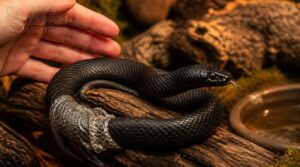
Feeding behavior only tells part of the story — how a kingsnake acts day to day, and how it copes stress, matters just as much for long-term care.
Temperament shifts with age, shedding brings its own set of warning signs to watch for, and cohabitation habits can make or break your snake’s health.
Here’s what you need to know to keep your Mexican Black Kingsnake calm, healthy, and thriving.
Typical Temperament and Activity
Calm, predictable, unbothered: that’s the Mexican Black Kingsnake in three words. Daily activity peaks at dusk, reflecting crepuscular tendencies with steady tongue flicking as they explore. Well-handled adults rarely coil defensively.
Three traits define temperament:
- Steady daytime rest in secure hides
- Moderate exploratory drives during enclosure time
- Consistent, low-aggression handling response
Temperature and feeding schedules shape mood daily.
Juvenile Defensiveness and Acclimation
Fresh hatchlings weigh just 15 grams and treat everything as a threat. Musking and nipping fade within 4-6 weeks of gentle handling, once weight hits 100-150 grams.
| Stage | Timeframe |
|---|---|
| No handling | 1-2 weeks |
| First sessions | Week 2+ |
| Reduced nipping | 4-6 weeks |
| Full acclimation | 3-4 months |
| Adult calm | Year 2 |
Safe Handling and Stress Reduction
Hand washing before every session removes prey scent, preventing mistaken strikes. Approach slowly from below, never over the head.
Handle one to two times weekly once feeding stabilizes, sessions under five minutes at first. Watch for musking, rapid tongue flicks, or coiling. Wait 48 hours post-feeding. These habits build trust and cut stress dramatically over time.
Shedding and Common Health Problems
Cloudy eyes signal an approaching shed, usually every 4-6 weeks in juveniles, less often in adults. Keep humidity at 40-60% with a damp hide to prevent incomplete sheds.
Watch for respiratory infections (wheezing, discharge), mouth rot, and snake mites. Check feces for parasites. Digestive health depends on proper prey size and undisturbed post-feeding rest.
Feeding prey that has been fully thawed and warmed helps prevent digestive trouble, and this snow corn snake care guide covers feeding routines and health basics in more detail.
Why Cohabitation is Unsafe
One kingsnake, one enclosure, always. This species is ophiophagous by nature, meaning cage mates risk tail-eating behavior and predation, not companionship.
House them alone; cohabitation invites bite wounds, stress, and stunted growth. Even brief pairing during feeding turns dangerous fast.
Think of your snake like a solitary hunter guarding territory: enclosure security isn’t optional, it’s survival.
Top 3 Products for Mexican Black Kingsnake Care
The right gear makes daily care easier and keeps your kingsnake secure, healthy, and stress-free. Not every product on the market fits this species’ specific needs, so choosing carefully matters. Here are three options worth considering for your setup.
1. Eco Friendly Reptile Habitat Enclosure
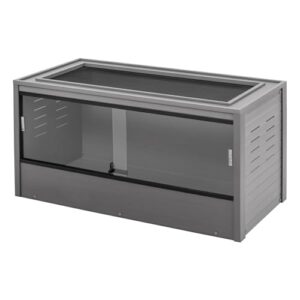
A durable enclosure makes or breaks long-term husbandry, and the New Age Pet ECOFLEX terrarium (model EHRML17-05L) delivers on that front. Built from recycled polymers and reclaimed wood fiber, it offers 46.46"L x 22.32"W x 21.26"H of interior space, comfortably housing an adult kingsnake.
Sliding lockable doors give secure feeding access, while vented side panels and a mesh top handle airflow and support heat lamp placement. Keep in mind it’s moisture-resistant, not waterproof, so it’s unsuited for high-humidity setups.
Assembly takes 20-30 minutes, and a 10-year warranty backs your investment against long-term wear.
For a deeper look at how these features stack up across price points, budget-friendly boa constrictor enclosures worth considering walks you through the trade-offs so you can shop with confidence.
| Best For | This enclosure is best for reptile owners housing snakes, lizards, or tortoises who want a natural-looking, well-ventilated habitat with easy front access for daily care. |
|---|---|
| Reptile Suitable | Yes |
| Ease Of Use | Simple Sliding Doors |
| Material Safety | Non-Toxic Recycled Materials |
| Ventilation/Airflow | Mesh Top Vented |
| Model Number | EHRML17-05L |
| Origin | Not Specified |
| Additional Features |
|
- Spacious interior (46.46"L x 22.32"W x 21.26"H) comfortably fits an adult kingsnake or similar reptile
- Sliding lockable doors make feeding and cleaning simple and secure
- 10-year warranty offers strong long-term value and peace of mind
- Not waterproof, so it’s a poor fit for high-humidity reptile setups
- ECOFLEX material isn’t chew-proof and can be damaged by persistent gnawing
- Top mesh panel doesn’t open, so full access requires partial disassembly
2. Bearded Dragon Reptile Tank Enclosure
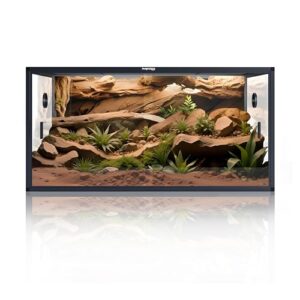
If the ECOFLEX build appeals to your minimalist side, the Phailozoo REPMAC120G-UB answers with sheer volume. At 48"x24"x24", this 120-gallon enclosure gives an adult kingsnake room to stretch, explore, and establish separate thermal zones without feeling boxed in.
Front-sliding tempered glass doors resist scratching from claws and simplify feeding access. Up top, a rust-proof metal mesh screen (28% blockage) keeps airflow steady while letting UVB and heat lamps do their job.
Keep in mind the silicone-sealed bottom isn’t leakproof, and doors lack locking mechanisms, so escape-prone individuals may need aftermarket security added.
| Best For | Bearded dragon owners who want a spacious, easy-access enclosure with strong airflow for heat and UVB lighting. |
|---|---|
| Reptile Suitable | Yes (Best For Dragons) |
| Ease Of Use | Simple Sliding Doors |
| Material Safety | Non-Toxic Glass/Metal |
| Ventilation/Airflow | Metal Mesh Screen Top |
| Model Number | REPMAC120G-UB |
| Origin | Not Specified |
| Additional Features |
|
- Generous 120-gallon size gives bearded dragons plenty of room to roam and thermoregulate
- Front-sliding tempered glass doors make feeding and cleaning simple while resisting claw scratches
- Rust-proof metal mesh top (28% blockage) ensures steady airflow and full UVB/heat penetration
- Silicone-sealed bottom isn’t leakproof, so bioactive or wet substrate setups need extra resealing
- Doors have no locking mechanism, which could be a problem for a bearded dragon prone to pushing at gaps
- Only compatible with Phailozoo V2 Stackers, limiting future expansion options
3. Natural Pet Antiseptic Skin Spray
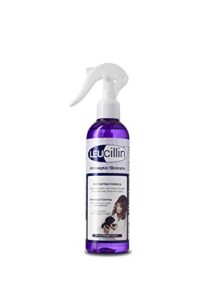
A spacious tank means little if a scale infection sets in unnoticed. That’s where a good antiseptic spray earns its place in your kit.
Leucillin’s hypochlorous acid formula is pH-neutral and non-stinging, safe even if licked, so treating hot spots or minor wounds won’t add stress to an already irritated snake. It’s suited for dermatitis, pyoderma, and general wound care across dogs, cats, birds, and reptiles alike.
Made in the UK without steroids, antibiotics, or alcohol, it won’t aggravate sensitive tissue. Just skip it on amphibians, since one report flagged possible adverse effects there. For kingsnake keepers, it’s a practical, low-risk addition to routine care.
| Best For | Reptile keepers, including kingsnake owners, who want a gentle, non-stinging antiseptic for treating hot spots, minor wounds, or skin irritation without added stress to their pet. |
|---|---|
| Reptile Suitable | Yes |
| Ease Of Use | Simple Spray Application |
| Material Safety | Non-Toxic, Pet Safe |
| Ventilation/Airflow | N/A – Not Applicable |
| Model Number | 844344 |
| Origin | Made In UK |
- PH-neutral, non-stinging formula that’s safe even if licked
- Free from steroids, antibiotics, and alcohol, making it gentle on sensitive tissue
- Versatile enough for dogs, cats, birds, and reptiles, covering wound care, dermatitis, and pyoderma
- Not recommended for amphibians due to a reported adverse effect
- Some users note skin irritation or rash exacerbation rather than relief
- Effectiveness and odor are inconsistent, with mixed reviews on value for money
Frequently Asked Questions (FAQs)
Is the black king snake poisonous?
Picture a keeper reaching in expecting a strike, only to get a firm coil and a bluff hiss. No fangs, no venom. This species is completely non-venomous, relying purely on constriction and muscle to subdue prey.
Curious where these powerful constrictors actually live? This python snake distribution guide maps their native ranges across continents and habitats.
Do Mexican black kingsnake bites hurt?
Yes, but only mildly. Expect a quick pinch rather than real pain, since these snakes are non-venomous. Discomfort fades within seconds, bleeding stays minor, and no lasting injury results from a defensive strike.
How large can Mexican black kingsnakes get?
Most adults settle in at 3 to 4 feet, with well-fed captives occasionally pushing past Wild specimens run slightly shorter, around 5 to 4 feet, while standout captive individuals can approach the 5-foot mark.
Is the Mexican black kingsnake venomous?
A wolf in sheep’s clothing fools by appearance, not by weapon. This snake works the same trick: it eats rattlesnakes yet carries no venom glands, no fangs, just resistance built for predation, never for defense.
Are Mexican Black Kingsnakes bitey?
Not really, once settled in. Captive-bred snakes rarely bite without cause, reserving defensive strikes for startling handling. Juveniles nip more often while learning trust, but consistent, gentle handling quickly builds confidence and calms that feisty streak.
What is the personality of a Mexican black kingsnake?
Calm and observant, this snake studies its surroundings rather than reacting to them. Expect curious, low-defensive behavior, gradual acclimation to handling, and steady exploration once it trusts its enclosure and routine.
Do Mexican Black Kingsnakes lay eggs?
No parental care, total independence: hatchlings emerge ready to hunt alone. Yes, these kingsnakes are oviparous, laying 4 to 24 eggs in concealed nests each spring, with incubation running 50 to 60 days before self-sufficient young appear.
Is a Mexican black kingsnake a good pet?
Yes, for most keepers. You get a docile temperament, manageable 3-5 foot size, and simple husbandry once dialed in. The catch: a 20-25 year lifespan means committing to real kingsnake care, not a passing hobby.
Are black kingsnakes aggressive?
Think "spirited" rather than hostile. These animals aren’t looking for a fight, they’re misunderstood more than mean. Stress or clumsy handling triggers defensiveness, not true aggression. Give consistent, gentle care and yours will settle into a calm, predictable companion.
How often do Mexican black kingsnakes shed their skin?
Expect a shed every 4 to 6 weeks during juvenile growth spurts, slowing to every 2 to 4 months in adults. Stable humidity around 50-60% keeps the cycle predictable and complete.
Conclusion
Like a seasoned diplomat immune to poison politics, this snake moves through danger unbothered and unafraid. That immunity isn’t just biology, it’s a blueprint for how you approach its care: steady, informed, and deliberate.
Master the temperature gradients, respect the feeding schedule, and skip cohabitation entirely, and the mexican black kingsnake rewards you with decades of calm companionship. Few reptiles offer this much confidence in one glossy black body. Get the basics right, and it thrives.