This site is supported by our readers. We may earn a commission, at no cost to you, if you purchase through links.

Ball pythons carry a reputation as the beginner snake. That label does them a disservice. A poorly set up enclosure won’t kill them overnight, but it creates a slow grind of stress, failed sheds, and chronic dehydration that cuts years off a 20-plus-year lifespan.
Enclosure size, temperature gradients, and humidity aren’t features you can approximate. They’re biological requirements. Get them right, and you’ll have a snake that eats on schedule, sheds in one clean piece, and seems genuinely settled in its space.
The details below cover every layer of a proper ball python cage setup, from first enclosure to long-term maintenance.
Table Of Contents
- Key Takeaways
- Choose The Right Ball Python Enclosure
- Build a Safe Temperature Gradient
- Maintain Ball Python Humidity and Hydration
- Choose Substrate, Hides, and Enrichment
- Monitor, Clean, and Maintain The Cage
- Frequently Asked Questions (FAQs)
- How should a ball python enclosure be set up?
- What do ball pythons like in their cages?
- What is the best enclosure setup for a ball python?
- Do snakes get bored in their enclosure?
- How often should you completely clean the enclosure?
- What should you do if mold appears in the cage?
- How can you safely introduce new décor items?
- Can live plants cause issues in the enclosure?
- What signs indicate your ball python is stressed?
- How often should ball pythons be handled?
- Conclusion
Key Takeaways
- Your ball python’s enclosure size, temperature gradient (88–92°F warm side, 78–82°F cool side), and humidity (50–60% daily) aren’t optional tweaks — they’re hard biological requirements that directly affect lifespan.
- Front-opening PVC enclosures with built-in vents give you the best control over humidity and temperature, while stressing your snake less during handling than top-opening designs.
- A proper maintenance routine — daily spot cleaning, full substrate replacement every 1–3 months, and monthly electrical safety checks — is what keeps a well-built setup from quietly becoming a health hazard.
- Stress in ball pythons shows up as feeding refusal, nose-rubbing, and constant escape attempts, and the fix almost always starts with correcting humidity and temperature, not handling changes.
Choose The Right Ball Python Enclosure
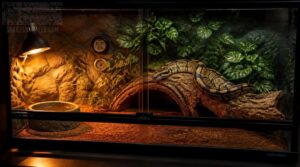
Picking the right enclosure is the first real decision you’ll make as a ball python keeper, and it shapes everything else. The size, material, and design all affect how well you can control temperature, humidity, and your snake’s sense of security. Here’s what to know before you buy.
If you want a side-by-side breakdown of the top options, this ball python enclosure buyers guide walks through six enclosures honestly, covering exactly those factors.
Hatchling, Juvenile, and Adult Sizes
Ball pythons grow fast, and your enclosure setup needs to keep up. A hatchling starts at 10–20 grams, but adults reach 3 to 5 feet. Each stage calls for a different size to support proper thermoregulation and feeding.
- Hatchlings (10–20g): 10-gallon enclosure
- Juveniles (up to 300g): 20-gallon minimum
- Larger juveniles: 40-gallon or 36"×18"×18"
- Sub-adults: 48"×24"×24" enclosure
- Adults (3–5 ft): 4’×2’×2′ PVC cage minimum
Glass, PVC, and Plastic Compared
Once you’ve picked the right size, the material shapes everything else.
| Material | Key Trait |
|---|---|
| Glass | Strong thermal mass |
| PVC | High impact resistance |
| Plastic | Flexible, shatter-resistant |
| Double-wall PVC | Better heat retention |
Glass tanks don’t absorb moisture and stay clear for years. PVC enclosures have built-in vents, which helps keep humidity between 50-60%. For steady temperature gradients, glass holds heat more reliably. PVC is also valued for its high impact resistance properties, with tensile strength ranging up to 156 MPa in flexible forms.
Front-Opening Versus Top-Opening Cages
The cage opening matters as much as the material. Front-opening designs let you reach in at eye level, which feels far less threatening to your snake than a hand dropping from above. They also rely on magnetic or lockable latches that seal cleanly, cutting escape risk.
Top-opening cages simplify lighting and heat installs but can startle shy snakes during handling.
Ventilation Without Excess Moisture Loss
Good airflow balance keeps humidity stable without pulling moisture from the enclosure. Vent placement really matters.
- Place intake vents high to let warm air rise and exit
- Target 10 to 15 percent vent area of floor space
- Dial in humidity control with adjustable louvers
- Avoid placing vents directly over water bowls
- Open vents wider during humid seasons
Check airflow weekly.
Locks and Escape-Proof Openings
Escape prevention starts with the right latch hardware. Clip-style latches provide a tactile lock that stays closed even when bumped or jostled.
For added peace of mind, check out this ball python temperament and handling guide to understand how your snake’s behavior can influence the type of enclosure security you actually need.
For front-opening designs, two-point locking reduces hinge power a lot. Keep door gaps under 2 millimeters, since snouts probe every edge.
Stainless steel holds up better against humidity and corrosion. Inspect latches weekly and keep spare hardware on hand.
Build a Safe Temperature Gradient
Getting the temperature right inside your ball python’s enclosure isn’t complicated, but it does require a few specific tools and deliberate setup choices.
Your snake depends on moving between warm and cool zones to regulate its own body temperature — and that only works if each zone hits the right numbers consistently.
Here’s what you need to set it up correctly.
Warm-Side and Cool-Side Targets
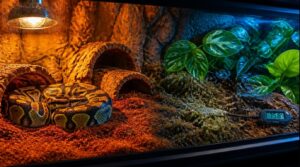
Your snake needs a clear thermal gradient to move freely between warmth and cooler air on its own terms. Keep the basking zone at 88–92°F and the cool side at 78–82°F.
- Warm zone: covers one-third to half the enclosure floor
- Cool side monitoring: place a digital probe at floor level
- Temperature probe accuracy: keep probes away from direct heat sources
Basking Surface and Night Temperatures

On the warm side, basking areas reach 88-92°F during the day. Dark, non-reflective surfaces hold heat most effectively.
| Condition | Target |
|---|---|
| Basking surface | 88-92°F |
| Cool side (day) | 75–80°F |
| Warm side (night) | 72–78°F |
| Cool side (night) | 70–75°F |
A nocturnal temperature drop of 5–10°F is natural and safe. Temperature monitoring with a thermostat probe placed on the basking surface keeps your readings accurate.
Heat Source Placement and Guards

Heat travels wherever you put it. Placing your heat source under one side only creates the gradient your ball python needs to self-regulate. Keep the opposite end cool.
- Mount ceramic heat emitters 5-15 cm above the substrate
- Cover heat mats with a rigid polycarbonate guard
- Route all wires outside the snake’s reach
- Install an overheat cutoff set below 95°F
Thermostats, Probes, and Thermometers
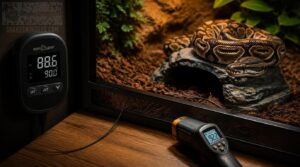
Guessing temperatures isn’t a strategy. A digital thermostat locks your heat mat to a precise setpoint, so spikes don’t sneak past you.
Place your probe on the warm side, just under the substrate surface, not directly beneath the mat. Spot-check the basking spot with an infrared thermometer weekly.
Calibrate probes quarterly against a known reference to keep readings trustworthy.
Lighting Cycles and Optional UVB

Use a 12-hour light-dark cycle on a timer. Add 15–30 minute dawn and dusk transitions when possible. Full-spectrum lighting benefits your viewing and reinforces daily cues, but ambient lighting sufficiency is usually enough.
- Keep night heat separate from lights.
- Don’t use lights as primary heat.
- UV radiation unnecessary, though low UVB is optional.
- Replace UVB bulbs every 6–12 months.
Maintain Ball Python Humidity and Hydration
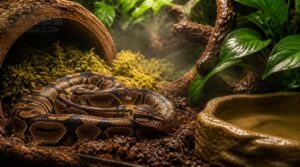
Humidity affects your ball python’s sheds, hydration, and day-to-day comfort. The goal is steady moisture without leaving the enclosure wet or stale. Use the following setup points to balance humidity, water access, and airflow.
Everyday and Shedding Humidity Targets
Ball pythons need 50 to have 50 to 60 percent RH daily for stable hydration. Drop below 40 percent and your snake can’t shed cleanly. During shedding, raise it briefly to 65 to 75 percent** to soften the old skin. Overnight, keep it between 45 and 60 percent.
A moisture-retaining substrate like coconut fiber or cypress mulch holds RH steady without constant misting.
Digital Hygrometer Placement
Knowing your humidity level is only half the job. Where you put the hygrometer decides how accurate that number actually is.
Mount it on the side wall, roughly at the snake’s breathing height, centered in the enclosure. That position captures ambient air conditions, not a localized hot or cold pocket. Keep it well away from any heat source and away from vent openings where airflow skews readings low.
Humid Hide Setup
When shedding starts, a humid hide gives your snake a place to hit 65 to 75 percent humidity.
Cut an entry hole in a plastic tub, sized 1.5 times your snake’s widest point, then sand edges smooth. Fill with sphagnum moss soaked 10 minutes, damp but not dripping.
Position on the warm side. Replace moss every 2 to 4 weeks.
Water Bowl Size and Placement
Once the humid hide is set, the water bowl is next. Place it on the cool side to slow evaporation. A 2.5 to 4 cm deep ceramic or plastic bowl keeps water accessible without spills.
- Refill daily to limit bacteria growth
- Match size to snake: 250 ml juveniles, 750 ml adults
- Look for wrinkled skin, a clear sign of dehydration
Fixing Humidity and Ventilation Imbalances
When humidity sits outside 50-60%, start with vent airflow control. Partially covering mesh screen panels slows moisture loss quickly.
Check substrate moisture balance by pressing in gently. Slight clumping means it’s right. Too wet breeds mold; too dry stalls shedding.
Use two hygrometers at snake level and near the humid hide. In dry months, reduce ventilation and increase misting frequency.
Choose Substrate, Hides, and Enrichment
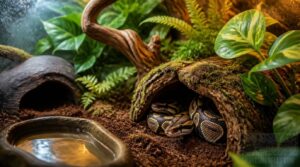
What’s inside your ball python’s enclosure matters just as much as its size. The substrate, hides, and enrichment you choose directly shape how comfortable, healthy, and stress-free your snake stays day to day. Here’s what to get right in each area.
Moisture-Retaining Substrate Options
The substrate you choose does most of the humidity work for you. Coconut fiber and cypress mulch top the list for a reason. Both support moisture retention and natural burrowing without compacting.
A 45/45/10 mix of cypress mulch, coconut husk, and sphagnum moss hits a stable balance. For hatchlings, Cavendish moss holds surface moisture and creates a gentle humid microclimate.
Safe Substrate Depth
Depth is easy to overlook, but it drives burrowing and moisture retention. Scale it by age:
- Hatchlings: 1-2 inches
- Juveniles: 2-3 inches
- Adults: 3-4 inches minimum
- Scale to enclosure size for at least 1.5 body-widths of usable depth
- Cap at 4-5 inches or prey and debris will get buried too
Your substrate choice and depth work together.
Warm-Side and Cool-Side Hides
Your ball python needs two hides, one on each side. The warm-side hide sits under the heat gradient, holding 84-88°F inside for adults. The cool side stays at 78-82°F. Both should touch three sides when the snake coils. Opaque hides reduce visual stress. Choose smooth interiors and avoid seams where substrate collects.
| Feature | Warm-Side Hide | Cool-Side Hide |
|---|---|---|
| Temp Target | 84-88°F adults / 88-92°F hatchlings | 78-82°F ambient |
| Best Material | Ceramic or stone for thermal mass | Plastic or untreated wood |
| Humidity Role | Dry to moderate | 60-70% with sphagnum moss |
Branches, Plants, and Visual Cover
Ball pythons aren’t climbers by nature, but they do explore vertical space when given a chance. Cork oak and manzanita branches work well because they’re sturdy and splinter-free. Anchor each branch firmly so it won’t shift under the snake’s full body weight.
For plants, pothos and snake plant are safe, non-toxic choices. Distribute cover across both warm and cool zones.
Safe, Cluttered Cage Layouts
Think of your ball python’s cage the way a forest floor works: layered, textured, and full of options. Place warm-side hides near the heat mat, cool-side hides away from direct airflow, and leave clear pathways between them.
Design your ball python’s cage like a forest floor: layered, textured, and full of options
Multiple hides and varied textures reduce stress without blocking movement, giving your snake both security and room to explore.
Monitor, Clean, and Maintain The Cage
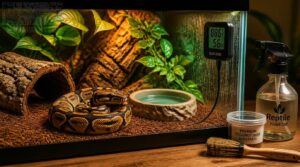
Setting up the perfect habitat is just the beginning — keeping it that way is where the real work happens. A consistent maintenance routine protects your snake from hidden threats like bacteria buildup, temperature swings, and poor air quality. Here’s what you need to stay on top of regularly.
Daily Temperature and Humidity Checks
Every morning, run three quick checks:
- Probe warm-side temperature on the basking surface: 88 to 92°F.
- Verify the cool side holds 78 to 82°F for a stable thermal gradient.
- Read your digital hygrometer: 40 to 60 percent humidity normally.
Log readings at the same time each day. That consistency turns raw data into a temperature log that catches drift early.
Waste and Uneaten Prey Removal
Once your temperature logs are checked, turn to the enclosure floor. Remove uneaten prey within two to four hours to stop spoilage and odor. Leaving it longer invites bacteria and mites.
For waste, spot clean daily using a scoop or disposable gloves. Pull feces and urates before they harden into the substrate. Replace only the disturbed substrate to protect humidity.
Substrate and Décor Cleaning Schedule
Spot cleaning takes care of the daily grind, but your substrate refresh cycle needs a real schedule. Use this:
- Swap the top 1-2 inches weekly
- Full substrate replacement every 1-3 months
- Décor sanitization with reptile-safe soap weekly
- Deep cleaning every four to six weeks with veterinary-grade disinfectants
- Mold prevention checks at every substrate change
Mold found? Replace everything within 48 hours.
Seasonal Environment Adjustments
Your cleaning schedule stays constant, but the environment shifts seasonally. Winter heating should reach 28 to 32°C on the warm side. Nights drop safely to 22 to 26°C. Keep humidity levels at 50 to 60 percent. Rapid swings cause illness, so thermostat calibration matters most.
| Season | Adjustment |
|---|---|
| Winter warm side | 28–32°C |
| Night drop | 22–26°C |
| Daily humidity | 50–60% |
| Shedding humidity | 65–75% |
Electrical and Fire Safety Checks
Check your heat lamp connections and cables monthly for frayed insulation or loose fittings. Mount power strips off the floor, and never daisy-chain heaters onto a single outlet. GFCI outlets reduce shock risk near any water source.
Test your smoke detector weekly and verify outlet grounding annually. Keep a Class C fire extinguisher within 10 feet of your enclosure setup.
Frequently Asked Questions (FAQs)
How should a ball python enclosure be set up?
A proper ball python enclosure balances thermal gradient, humidity control, and secure hides within a correctly sized space. Get those three elements right, and you’ve built a habitat your snake can actually thrive in.
What do ball pythons like in their cages?
Ball pythons are like puzzle pieces that only feel complete when tucked into tight, warm hides. They do best with a full thermal gradient, moisture-retaining substrate, and a water bowl set on the warm side.
What is the best enclosure setup for a ball python?
The best ball python enclosure setup pairs a 48" x 24" x 24" enclosure with a solid thermal gradient, 50-65% humidity, a moisture-retaining substrate, and a secure lid to keep your snake safe and thriving.
Do snakes get bored in their enclosure?
Yes, snakes can experience something close to boredom. Without varied hides, textures, or scent changes, ball pythons repeat the same movements and stop exploring, which signals understimulation rather than contentment.
How often should you completely clean the enclosure?
Like spring cleaning for your house, deep clean the enclosure every one to three months. Spot clean daily and replace substrate entirely each quarter. Visible mold or illness always means immediate full sanitation, no exceptions.
What should you do if mold appears in the cage?
Remove your snake first. Discard all moldy substrate, since porous materials trap spores and can’t be reliably cleaned. Scrub hard surfaces with detergent, dry completely, then fix the moisture source and improve ventilation before rebuilding.
How can you safely introduce new décor items?
Slow and steady wins the race. Quarantine new décor for a week, then disinfect with veterinary-grade cleaners. Add one item at a time, wait 48 hours, and watch for stress signs before adding anything more.
Can live plants cause issues in the enclosure?
Live plants can introduce real risks into your enclosure. Toxicity, pests, and mold are the main concerns. Even reptile-safe species like pothos need quarantine. Substrate compaction and humidity spikes from dense foliage are real trade-offs.
What signs indicate your ball python is stressed?
Feeding refusal, excessive hiding, and defensive striking are early warning signs. Constant escape attempts, nose-rubbing against surfaces, and scale discoloration point to deeper stress. Fixing humidity and temperature is almost always the right first step.
How often should ball pythons be handled?
Handle your ball python 1 to 2 times per week, keeping early sessions to 5 to 15 minutes. Skip handling the day of and the day after feeding to protect digestion and reduce stress.
Conclusion
An ounce of prevention is worth a pound of cure, and nowhere is that more true than in reptile keeping.
Regularly reviewing how often to change snake substrate helps prevent hygiene issues before they threaten your reptile’s health.
The ball python cage setup tips covered here all point to the same truth: the enclosure does the heavy work when it’s built right. Nail the temperature gradient, lock in humidity, and give your snake real, functional hides.
Do that consistently, and you won’t be troubleshooting. You’ll just be watching a healthy snake quietly thrive.