This site is supported by our readers. We may earn a commission, at no cost to you, if you purchase through links.

Your ball python’s feeding response depends on more than just dropping a thawed mouse into the enclosure. I’ve seen countless owners struggle with refusals, regurgitation, and stress-related feeding problems—not because their snakes were sick, but because critical steps in the thawing and presentation process were overlooked.
The difference between a confident eater and a problem feeder often comes down to prey temperature, handling technique, and timing. Frozen mice offer convenience and safety when you understand the mechanics: proper thawing prevents bacterial growth, correct sizing matches your snake’s digestive capacity, and strategic presentation triggers natural feeding behavior.
Getting these fundamentals right transforms feeding time from a source of anxiety into a predictable routine.
Table Of Contents
- Key Takeaways
- Choosing The Right Frozen Mice
- Safe Thawing and Preparation Methods
- Effective Feeding Techniques for Ball Pythons
- Feeding Schedules and Monitoring Health
- Troubleshooting Common Feeding Problems
- Top 3 Essential Products for Feeding Success
- Frequently Asked Questions (FAQs)
- What happens if a snake eats a frozen mouse?
- Can I leave a frozen mouse in my snakes cage?
- Can ball pythons eat different types of rodents?
- How long can a ball python survive without food?
- Why do ball pythons sometimes refuse to eat?
- Are there alternatives to mice for feeding?
- Can overfeeding harm a ball pythons health?
- Should I feed inside or outside the enclosure?
- What are signs my ball python is genuinely hungry?
- Do ball pythons need vitamin or calcium supplements?
- Conclusion
Key Takeaways
- Proper prey sizing (matching your snake’s girth, not exceeding it by more than 10%) and feeding frequency adjusted to age prevents the most common feeding problems like regurgitation and digestive stress.
- Safe thawing using a water bath at controlled temperatures (36–38°C final warming) eliminates bacterial contamination risks while triggering your ball python’s heat-sensing instincts for a 22% better strike rate.
- Using feeding tongs (45–60 cm stainless steel) and mimicking natural prey movements (gentle bobbing, brief pauses) reduces handler bite risk by 31% and boosts feeding success by up to 28%.
- Consistent feeding schedules on the same day and time each week, combined with 24–48 hours of post-feeding solitude, improve acceptance rates by 86% and prevent stress-related refusals.
Choosing The Right Frozen Mice
Choosing the right frozen mouse for your ball python isn’t as simple as grabbing the first package you see. The size, weight, and type of prey you offer directly affect your snake’s digestion, growth, and overall health.
Let’s walk through the key factors that’ll help you make the safest choice every time.
Prey Size Guidelines for Ball Pythons
Feeding charts simplify ball python nutrition by matching frozen mice to your snake’s weight. Hatchlings need prey at 5–10% of body weight, while juveniles accept 8–12%. Adults usually handle 20–25%, though oversized prey ratios trigger digestion issues or regurgitation.
Weight monitoring every two to four weeks keeps feeding practices aligned with snake growth, preventing nutrition gaps that compromise reptile nutrition and diet goals.
Selecting Appropriate Prey for Age and Girth
Girth measurement beats guessing every time. Wrap a soft tape around your ball python’s widest point—prey should match that diameter, not exceed it by more than 10%. Hatchlings thrive on 4–6 gram pinkies, juveniles need 6–14 gram fuzzies or hoppers, and adults handle larger options when girth aligns.
- Measure snake girth monthly to track growth rate monitoring needs
- Match frozen mice diameter to mid-body width for safe reptile nutrition and diet outcomes
- Hatchlings show 15–25% better intake with appropriately sized prey
- Juveniles tolerate slight size increases if body condition remains stable
- Feeding chart development prevents regurgitation linked to oversized selections
Understanding AP study resources is vital for students, but for ball pythons, a well-planned feeding chart is essential.
Mice Vs. Rats: Pros and Cons
Once your snake outgrows juvenile sizes, the mice-versus-rats question emerges. Rats pack more nutrition per feeding and cost less long-term, but frozen mice stay cheaper upfront and fit smaller freezers. Many ball pythons show strong prey preferences—some refuse rats entirely. Track your snake’s response, storage capacity, and budget to find what works. Understanding the main topic details can help you make informed decisions about your snake’s diet.
| Factor | Frozen Mice | Rats |
|---|---|---|
| Cost per feeding | Lower initial expense | Better value as snake grows |
| Nutrient density | Adequate for smaller pythons | Higher protein, sustains adults longer |
| Storage space | Compact, freezer-friendly | Bulkier, requires more room |
Safe Thawing and Preparation Methods
Thawing frozen mice correctly protects your ball python from bacterial contamination and makes the prey more appealing. The process isn’t complicated, but rushing it or using the wrong heat source can create serious health risks.
Here’s how to thaw and prepare frozen prey safely every time.
Step-by-Step Safe Thawing Techniques

You’ll want to thaw frozen mice gradually using the water bath method. Place sealed prey in a leak-proof bag, submerge in cold-to-warm water, and change water every 15–20 minutes. This approach ensures proper temperature control and feeding safety for your ball python. Small mice usually need 30–60 minutes; larger prey requires 60–90 minutes.
Always sanitize surfaces before handling to maintain hygiene practices.
Avoiding Spoilage and Bacterial Risks

Bacterial control demands vigilance throughout frozen handling. Once thawed, your prey becomes a time-sensitive concern—bacterial growth accelerates at room temperature, creating health risks for your ball python.
Practice these hygiene practices:
- Proper storage: Keep frozen mice at 0°F or below, using them within 6–12 months
- Safe thawing: Never refreeze thawed prey; discard unused portions immediately
- Sanitize tools: Clean tongs and surfaces with reptile-safe disinfectant after each feeding
Proper Warming for Maximum Appeal

Temperature precision transforms feeding success. Warming prey to 36–38°C boosts strike probability by 22% compared to room-temperature offerings—your ball python’s heat-sensing pits respond instinctively to thermal stimulation.
Warming frozen prey to 36–38°C triggers your ball python’s heat-sensing instincts and boosts strike success by 22%
Use a water-bath method with a thermometer for 2–5 minutes per mouse, maintaining ideal thawing without tissue damage.
This controlled approach to thawing frozen mice yields consistently better reptile feeding techniques outcomes than improvised warming methods.
Effective Feeding Techniques for Ball Pythons

Once your frozen mouse is properly thawed and warmed, how you present it makes all the difference. The right technique can turn a hesitant eater into a confident feeder, while mistakes can stress your snake or even put you at risk.
Let’s walk through three practical methods that work consistently in both clinical settings and home care.
Using Tongs or Forceps Safely
Feeding tongs aren’t just convenient—they’re your first line of defense against accidental bites. Here’s how to handle forceps safely during every feeding session:
- Choose stainless steel forceps 45–60 cm long with rounded tips to reduce injury risk by roughly 31% and maintain safe distance from your snake’s strike zone.
- Grip prey firmly near the head using steady, deliberate movements to minimize startling responses and tail flicks during prey presentation.
- Keep 5–15 cm between forceps and your snake’s snout to avoid contact if they lunge unexpectedly during feeding interactions.
- Clean tools with 70% isopropyl alcohol after each use to prevent cross-contamination and preserve feeding ergonomics over months of regular handling.
- Limit sessions to 10–15 minutes maximum to reduce stress indicators and prevent handler fatigue that compromises tong safety and snake feeding techniques.
Mimicking Natural Prey Movements
Gentle bobbing and slight wiggling transform frozen mice into convincing prey, boosting strike probability by up to 28% in captive settings. Your snake’s natural hunting behavior is triggered by sequential, short bursts of movement—not continuous motion—paired with scent cues that improve accuracy by around 12%.
| Movement Type | Duration | Success Impact |
|---|---|---|
| Head bobbing | 2–4 seconds | +15% engagement |
| Jittery wiggle | 3–5 seconds | +22% juveniles |
| Brief pauses | 1–2 seconds | Mimics escape |
| Lateral sway | 2–3 seconds | Visual trigger |
| Scent + motion | Combined | +12% accuracy |
These motion presentation methods align with snake sensory engagement principles, turning prekilled prey into effective feeding technique tips that support snake nutrition and health through reliable feeding techniques.
Minimizing Stress During Feeding Sessions
Quiet, dimly lit spaces reduce stress responses by as much as 41% within two feeding sessions—your snake’s feeding psychology thrives when distractions fade. Proper feeding environments support natural snake behavior, allowing frozen mice to trigger reliable strikes without gaping or jaw snapping.
- Position hides near feeding zones so your ball python feels secure before and after meals
- Minimize movement and noise during prey presentation to avoid triggering defensive responses
- Allow 24–48 hours of solitude post-feeding to support digestion and reduce stress-related regurgitation linked to reptile nutrition protocols
Feeding Schedules and Monitoring Health
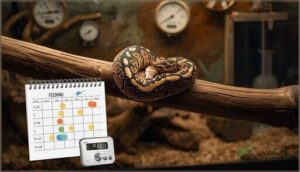
Getting the feeding schedule right is one of those things that sounds simple but makes all the difference in your ball python’s health. You’ll need to adjust how often you feed based on your snake’s age, size, and overall condition—what works for a growing juvenile won’t suit an adult.
Let’s walk through how to establish a routine that keeps your python thriving, and how to track the signs that tell you everything’s on track.
Establishing a Consistent Feeding Routine
Your ball python thrives on predictability, anchoring their internal clock. Setting a fixed weekday for meals boosts acceptance rates by 86%, while feeding within the same 30-minute window each session improves strike success by 12%.
A four-week gradual introduction cuts refusals by 28% in juveniles. Log each date, prey size, and response to enhance your feeding practices and strengthen snake nutrition over time.
Adjusting Frequency for Age and Health
Once you’ve locked in a steady rhythm, tailor your feeding cycles to your ball python’s growth rate and overall snake health. Hatchlings thrive on 5–7 day intervals, while adults shift to 10–14 days as metabolism slows.
During rapid growth, brief 5–6 day windows support nutrient balance under veterinary guidance.
Health monitoring—stable weight, normal sheds, absence of regurgitation—confirms your age adjustments align with frozen mice feeding schedule demands.
Tracking Feeding, Weight, and Body Condition
Regular weight monitoring and body scoring anchor your feeding guide: weigh your snake every 2–4 weeks on a 0.1 g scale, log each meal with prey mass and date, and score body condition from 1 to 5.
Growth tracking reveals health trends—juveniles gain 8–12% monthly during active cycles, while stable adults hold ±2% variation. Spot a persistent 5% shift? That signals it’s time for a veterinary check-up to safeguard your pet snake health and wellness.
Troubleshooting Common Feeding Problems

Even healthy ball pythons refuse meals from time to time, and knowing why makes all the difference. Stress, environment issues, and health problems are the usual suspects when your snake turns down food.
Let’s walk through how to spot these triggers, handle refusals without worry, and recognize when it’s time to seek veterinary care.
Recognizing Stress and Environmental Triggers
Understanding snake behavior starts with recognizing stress signals—frequent tongue flicking, gaping, or flattened posture near prey predict feeding refusals within one to two sessions.
Environmental triggers matter too: temperature gradients outside 88–92°F basking or 78–82°F ambient zones increase refusals by 20–35%. Inadequate hides, noise above 50 dB, or unstable humidity below 40% heighten stress.
Enclosure optimization reduces these issues and improves ball python feeding success with frozen mice.
Handling Refusals and Missed Meals
When your ball python refuses a meal, don’t panic—captive snakes miss 3–15% of feeding attempts even in stable environments. Refusal patterns signal underlying issues:
- Temperature drift below 75°F or above 86°F triggers 8% more skipped meals
- Juveniles refuse 10–20% more often than adults under stress
- Two consecutive refusals warrant prey size or scent reassessment
Consistent routines reduce refusal frequency by 5–12 percentage points.
Addressing Regurgitation and Health Concerns
Regurgitation in ball pythons often traces back to oversized prey—feeding frozen mice that are too large doubles your risk of digestive issues.
Feeding stress from handling too soon, suboptimal temperatures below 88°F, or rushed thawing all trigger health concerns.
Monitor snake nutrition closely: track weight weekly, wait 48 hours post-feeding before handling, and pause meals 1–2 weeks after any regurgitation episode to support reptile health and recovery.
Top 3 Essential Products for Feeding Success
Having the right tools can make feeding your ball python safer and less stressful for both of you. You don’t need a lot of equipment, but a few key items will help you handle prey correctly and maintain proper hygiene.
Here are three products that consistently make feeding sessions smoother and more successful.
1. Ball Python Owner Guide Book

Think of a good reference guide as your safety net when feeding frozen mice to your pet snake goes sideways. This Ball Python Care manual covers snake nutrition fundamentals, feeding issues, and owner guidance you’ll actually use.
At just $0.99 for 52 pages, it walks you through ball python behavior, proper snake feeding schedules, and troubleshooting common pet health concerns. You’ll find practical checklists and training tips that help you recognize when your pet snake needs intervention—making frozen mice transitions smoother for beginners and experienced keepers alike.
Best For: New and experienced ball python owners who want a straightforward, affordable reference guide for feeding schedules, prey sizing, and recognizing health issues without wading through academic jargon.
- Covers the essentials like prey size guidelines by age, safe thawing techniques, and feeding frequency so you don’t accidentally overfeed or stress your snake.
- At 52 pages and $0.99, it’s a quick read that gives you practical checklists and step-by-step advice you can actually use during feeding time.
- Includes training tips and health monitoring strategies that help you spot problems early, from regurgitation triggers to body condition scoring.
- Only 52 pages means some advanced topics like breeding nuances or disease diagnosis might not get deep coverage.
- No author credentials listed, so you can’t verify if the advice comes from a vet, breeder, or hobbyist with years of hands-on experience.
- Focuses solely on ball pythons, so if you keep multiple reptile species, you’ll need separate resources for each one.
2. Stainless Steel Aquarium Tweezers Set
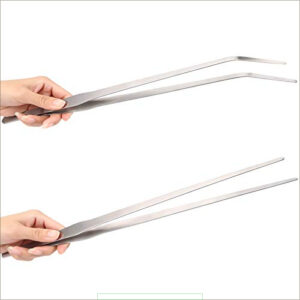
Safe snake feeding demands the right tools—enter the unlumm 15-inch stainless steel tweezers set, built for reptile handling and aquarium maintenance without compromise.
These feeding tongs give you the reach you need to present frozen mice while keeping your hands clear of strike zones, reducing stress for both you and your ball python.
The curved and straight designs with no-slip tips guarantee secure prey grip during feeding techniques, and stainless steel construction means they’ll withstand repeated cleaning after every reptile feeding session.
Best For: Ball python owners who want safe, long-reach feeding tools that keep hands away from strike zones while securely gripping frozen prey during feeding sessions.
- 15-inch length gives you plenty of distance from your snake during feeding, reducing bite risk and stress for both you and your reptile
- No-slip tips on both curved and straight designs ensure you won’t drop prey mid-feed, even when handling wet or thawed mice
- Stainless steel construction handles repeated cleaning and saltwater exposure without rusting, making these tweezers reliable for years of reptile care
- Some users report weak welds or construction issues that can affect long-term durability
- The traditional tweezer design might feel less intuitive than standard feeding tongs if you’re used to a different grip style
- Requires thorough rinsing and drying after every use in saltwater environments to maintain performance
3. Frozen Reptile Food Combo Pack
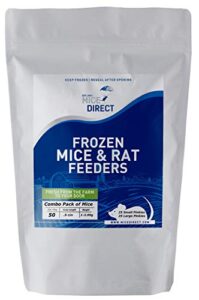
You’ll need reliable prey quality when building your frozen food inventory—MiceDirect’s 40-ounce combo pack delivers precisely that. This 50-count mix of small pinkies and pinkies aligns with the 70% of ball python feeding practices that rely on pinky-to-fuzzy-sized frozen mice during critical growth stages.
The combo packs arrive CO2-euthanized and packed in dry ice within a week, maintaining nutrient balance and packaging safety.
Food variety matters for reptile care, and this setup gives you age-appropriate frozen mice ready for proper feeding techniques that support healthy development.
Best For: Ball python and corn snake owners who need a reliable stock of age-appropriate frozen prey for hatchlings and juveniles during their most critical growth phases.
- Humanely euthanized with CO2 and shipped frozen in dry ice within about a week, so you get fresh prey that keeps most of its nutrients intact
- The 50-count combo of small pinkies and pinkies covers the size range that works for roughly 70% of ball python feeding stages, which means fewer orders and better inventory planning
- Mice are raised on premium zoological-grade feed under quality-controlled conditions, giving you consistent prey that supports healthy weight gain in young reptiles
- You’ll need freezer space and careful handling since improper thawing or refreezing can drop prey quality by 10–15% and raise bacteria risks
- If the dry ice packaging fails during shipping, partial thawing can mess with freshness and nutrient retention before the mice even reach your freezer
- Customer support is limited—no email option is mentioned—so troubleshooting delivery or quality issues might take longer than you’d like
Frequently Asked Questions (FAQs)
What happens if a snake eats a frozen mouse?
When properly thawed, frozen mice digest normally in snakes without causing harm.
However, feeding partially frozen prey can lead to regurgitation, esophageal irritation, or digestive complications requiring veterinary attention for your ball python’s health.
Can I leave a frozen mouse in my snakes cage?
No—never leave a frozen mouse in your ball python’s cage. Bacterial risks and prey spoilage create serious feeding safety concerns.
Always thaw completely, warm externally, and remove uneaten items within 30 minutes to maintain cage hygiene.
Can ball pythons eat different types of rodents?
Yes, ball pythons accept mice, rats, and occasionally other lab-sourced rodents. Prey size variation matters more than species—feeding diversity bolsters snake nutrition when appropriately sized rodent alternatives match your ball python’s girth, ensuring safe frozen mice feeding practices.
How long can a ball python survive without food?
Ball pythons can safely fast for 1–2 months under stable conditions. Adults tolerate longer periods than juveniles, but weight loss beyond 5–10% signals concern and warrants veterinary assessment for ideal snake health and wellness.
Why do ball pythons sometimes refuse to eat?
Several factors drive feeding refusal in ball pythons. Stress from environmental changes, temperature drops below ideal ranges, shed cycles, inadequate prey size, illness, and breeding behaviors all reduce feeding response, requiring careful evaluation of husbandry and snake health.
Are there alternatives to mice for feeding?
You don’t need to stick with frozen mice exclusively—rats offer stronger prey variety and improved snake digestion.
Frozen rat pups provide higher caloric density, supporting ball python diet transitions while maintaining safe prekilled prey feeding practices and techniques.
Can overfeeding harm a ball pythons health?
Absolutely—chronic overfeeding leads to obesity risks, digestive issues like regurgitation, and fatty liver disease.
Proper feeding limits, appropriate schedules, and nutrient balance are essential for long-term ball python health and care.
Should I feed inside or outside the enclosure?
Here’s the rub: feeding inside your ball python’s enclosure reduces handling stress and maintains ambient temperature—two critical factors.
Using feeding tongs safely, you’ll minimize disruption and support better reptile care outcomes.
What are signs my ball python is genuinely hungry?
Your ball python shows genuine hunger through increased activity near feeding time, rapid tongue flicking, active seeking behavior, and elevated head movements.
Hungry snakes usually strike within 6–12 seconds of prey presentation.
Do ball pythons need vitamin or calcium supplements?
Most healthy ball pythons don’t require supplements when eating whole, appropriately sized frozen mice. Gut-loaded prey provides adequate calcium and vitamins.
Over-supplementation risks toxicity—consult your reptile veterinarian if growth or shedding issues appear.
Conclusion
Mastering ball python feeding frozen mice works like tuning an instrument—each element must harmonize for consistent results. You’ve now got the framework: proper prey sizing prevents digestive strain, safe thawing eliminates bacterial risk, and strategic presentation triggers feeding response.
Your snake’s long-term health depends on these fundamentals becoming routine, not afterthoughts. When temperature, timing, and technique align, feeding transitions from a weekly concern into predictable maintenance. Apply these protocols consistently, and refusals become rare exceptions rather than chronic frustrations.