This site is supported by our readers. We may earn a commission, at no cost to you, if you purchase through links.

The oldest ball python on record lived 63 years in captivity at the Saint Louis Zoo. That number stops most people cold, because the common assumption is that snakes are short-lived pets. They’re not.
Ball python lifespan in captivity averages 20 to 30 years, and under consistent, knowledgeable care, 40 years isn’t unusual. In the wild, that same species rarely survives past 20, with juveniles facing predation, parasites, and food scarcity from their first shed.
That longevity makes choosing the right morph a meaningful decision, and the best beginner ball python morphs like the Mojave reward patient owners with decades of calm, handleable companionship.
That gap between wild and captive survival isn’t luck. It’s husbandry, and understanding what drives it changes how you care for your snake.
Table Of Contents
- Key Takeaways
- How Long Do Ball Pythons Live?
- Why Captive Ball Pythons Live Longer
- Ball Python Lifespan by Life Stage
- Care Factors Affecting Ball Python Lifespan
- How to Help Ball Pythons Live Longer
- Frequently Asked Questions (FAQs)
- How long do ball pythons live as pets?
- Will a ball python bite hurt?
- Do ball pythons like being held?
- What snake is worth $100,000?
- Does a ball python bite hurt?
- What factors affect the lifespan of a ball python?
- How long do ball pythons typically live?
- How can you tell if a ball python is dying?
- What is the longest a ball python has lived?
- How old is the oldest ball python?
- Conclusion
Key Takeaways
- Ball pythons routinely live 20–30 years in captivity—and with consistent husbandry, some reach 40 or beyond—making them one of the longest-lived pets you can own. That kind of decades-long commitment deserves serious preparation, and this comprehensive guide for ball python owners covers the husbandry essentials that help them thrive well into old age.
- The gap between a wild lifespan of 10–15 years and a captive one of 30+ comes down to five things you control: predator-free security, reliable feeding, stable temperatures and humidity, clean habitat, and access to a reptile vet.
- Your snake won’t show illness until it’s serious, so monthly weigh-ins, annual fecal checks, and a vet relationship established before emergencies are your earliest warning system.
- Care needs shift across life stages—hatchlings need rapid growth monitoring, adults need steady maintenance, and seniors past 15 years need adjusted feeding schedules, warmer basking zones, and closer health tracking.
How Long Do Ball Pythons Live?
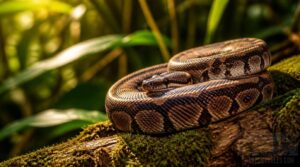
Ball pythons are surprisingly long-lived animals, and knowing what to expect across their lifespan helps you plan care that actually helps them well. Whether you’re a first-time owner or you’ve kept reptiles for years, the numbers here might shift how you think about this commitment.
In fact, ball python size and lifespan expectations show that with the right care, these snakes can easily outlive most pets you’ve ever owned.
Here’s a closer look at how long ball pythons usually live — in the wild, in captivity, and in a few record-breaking cases.
Average Captive Lifespan
The average captive lifespan for a ball python falls between 20 to 30 years with consistent care. If your husbandry is on point, some individuals can reach 40 or more years. Health issues caught and managed early make a genuine difference. Regular veterinary oversight helps this, much like how early disease detection in captivity has been shown to extend the lives of many captive species through chronic condition management.
Veterinary care isn’t just for sick snakes, it’s what keeps your healthy one on track for the long run.
Average Wild Lifespan
In the wild, ball pythons face a much harder reality than their captive counterparts. The average wild lifespan falls between 10 and 20 years, though many individuals never reach that ceiling.
Predation, food scarcity, and parasites all chip away at survivorship consistently. Juvenile mortality is especially steep, with many snakes not surviving even their first year in West African populations.
Oldest Documented Ball Pythons
The upper end of what a ball python can achieve sits at 63 years, documented in a female housed at the Saint Louis Zoo for nearly six decades. The Philadelphia Zoo has recorded individuals approaching 50 years.
These aren’t flukes. They reflect what long-term captive care, consistent veterinary oversight, and stable husbandry can actually produce when sustained across a lifetime.
Why Lifespan Estimates Vary
Those zoo records are outliers, and lifespan estimates rarely agree across sources. Wild lifespan data is sparse, since tracking free-ranging snakes across decades is nearly impossible.
Captive care introduces its own gaps when acquisition dates go undocumented. Longevity factors accumulate quietly, which is why long-term commitment to accurate recordkeeping matters as much as the care you provide.
Why Captive Ball Pythons Live Longer
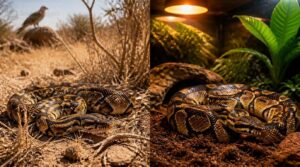
The gap between a wild ball python’s 10–15 years and a captive’s 20–30+ isn’t luck, it’s the direct result of what your husbandry removes from the survival equation.
A captive ball python’s extra decades aren’t luck — they’re what good husbandry quietly removes from the survival equation
In a well-maintained enclosure, the threats that cut lives short in the grasslands of West Africa simply don’t exist.
Here are the five biggest reasons a captive ball python outlives its wild counterparts.
Protection From Predators
Predation is the single greatest killer of wild ball pythons. Monitors, raptors, mongooses, and even other snakes take a heavy toll, compounded by habitat loss that strips away their hiding places.
Your captive-bred python faces none of these threats, which means:
- No ambush predators stalking the enclosure
- No dangerous escapes into hostile territory
- No exposure while vulnerable during shedding
That protection alone adds decades to a ball python’s potential lifespan.
Minimizing daily stress through proper hide placement and substrate depth—explored further in these ball python hide placement ideas for long-term health—gives your snake the consistent security it needs to truly thrive.
Reliable Food and Water
A wild ball python may go months between meals during dry seasons. Your captive snake eats frozen-thawed prey on a predictable schedule, supporting strong digestive health and steady growth.
| Factor | Wild | Captive |
|---|---|---|
| Feeding frequency | Irregular | Scheduled |
| Prey quality | Variable | Gut-loaded |
| Water bowl access | Unreliable | Daily, clean |
Hydration needs stay met through fresh water and prey moisture, preventing dehydration-related illness.
Stable Habitat Conditions
A stable enclosure is the quiet engine behind a long life. In the wild, your snake endures droughts, cold snaps, and temperature swings. In captivity, a proper thermal gradient (88–92°F warm side, 78–82°F cool side) keeps digestion and metabolism running smoothly.
Humidity held at 50–60 percent prevents respiratory infections and bad sheds. Consistent lighting, secure enclosure size, and environmental stability remove stressors that shorten wild lifespans.
Access to Veterinary Care
A wild snake with a respiratory infection has nowhere to turn. Your ball python does, and that single advantage adds years.
Find a vet with reptile experience, not just any clinic. Schedule a yearly wellness exam with a fecal check, because parasite prevention works best before symptoms appear. Regular health monitoring catches what snakes hide, since stress-induced immunosuppression lets small problems grow quietly.
Lower Disease and Parasite Exposure
A wild ball python shares burrows, water, and prey with dozens of other animals, and every one of those contacts is a chance for parasites to pass along. Your snake’s clean enclosure breaks that chain.
Pair it with quarantine procedures for new arrivals and prompt waste removal, and parasite prevention becomes routine rather than rescue medicine.
Ball Python Lifespan by Life Stage
A ball python’s needs shift as it moves from hatchling to senior, and what keeps a young snake thriving can look quite different from what an aging one requires.
Understanding each life stage helps you anticipate changes before they become problems.
Here’s what to expect, stage by stage, from that fragile first year all the way to the long senior years.
Hatchling’s First Year
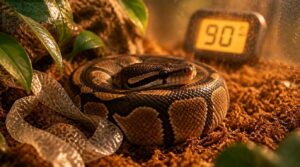
The first year is where your ball python’s future is decided. A healthy hatchling weighs 10 to 20 grams at birth but should reach 200 to 300 grams by month twelve, and that trajectory tells you almost everything about long-term potential.
Expect the first shed within 7 to 14 days, then every 1 to 2 months. Feed small mice every 5 to 7 days, maintain a basking spot of 88 to 92°F, and watch that growth rate closely.
Juvenile Growth Stage
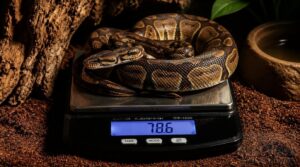
Once your hatchling passes that first-year mark, the juvenile stage takes over, roughly months 12 through 36. Expect steady gains toward 800 to 1,200 grams, with males finishing smaller and faster than females.
Track growth rate monitoring with three habits:
- Weigh monthly to confirm steady gain
- Log shed cycles, every 1 to 2 months
- Adjust prey size, 10 to 15 percent of body weight
Feeding frequency stretches from every 5 to 7 days toward weekly as weight climbs past 300 grams. Size by age varies, but stalled growth signals husbandry problems, not genetics.
Sexual Maturity
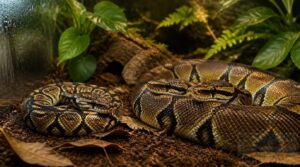
Sexual maturity arrives around 18 months for males, once they reach 700 to 800 grams. Females mature later, usually at 27 to 31 months and 1,200 to 1,500 grams.
Weight matters more than age. A snake can be reproductively capable yet still a poor breeding candidate, because weak body condition raises egg-binding risk and shortens lifespan. Continue growth rate monitoring through this stage before calling any snake a true adult.
Prime Adult Years
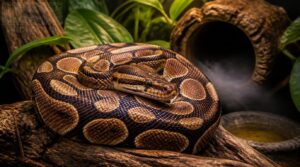
The prime adult years run roughly from age 3 to 7, with peak size and condition around 4 to 5.
Once the juvenile growth rate finishes, weight stabilizes, and your snake settles into maintenance mode. Feed about 10 to 15% of body weight per cycle, keep the basking spot at 88 to 92°F, and hold humidity at 50 to 60%.
Senior Ball Python Years
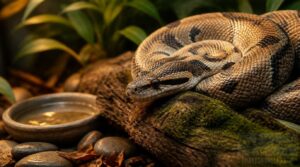
Somewhere past year 15, your snake enters the senior ball python years, and captive care shifts from growth support to maintenance. Expect steadier weight, less frequent sheds, and longer rest periods, all normal aging signs rather than decline.
Watch for these changes:
- Slower, deliberate movement
- Mild appetite reduction
- Softer muscle tone
- Duller scale condition
- Longer illness recovery
Schedule veterinary care exams annually, since early detection of kidney disease or parasites dramatically extends lifespan. Keep temperatures stable, adjust prey size to prevent weight strain, and handle gently. Health monitoring matters most now.
Care Factors Affecting Ball Python Lifespan
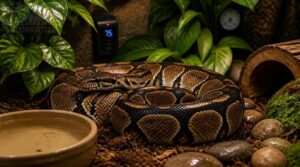
A ball python in your care lives or dies by the details of its husbandry, and most of those details come down to five key factors.
Get these right, and your snake has a realistic shot at 20, 30, even 40 years of healthy life.
Get them wrong, and you’ll spend years chasing avoidable health problems instead of preventing them.
Correct Enclosure Size
Enclosure size quietly shapes lifespan. Cramped quarters disrupt thermal gradient maintenance, causing chronic stress and poor feeding.
Hatchlings need 10 to 20 gallons; adults, 40 to 75.
Oversized cages dilute scent cues and humidity, undermining ambush feeding. Match space to size, provide two hides, and your python’s health stays stable.
Temperature and Humidity Control
Because ball pythons are ectotherms, their entire physiology depends on the climate you build. Keep a thermal gradient of 88 to 92 degrees Fahrenheit on the warm side and 78 to 82 on the cool side, controlled by a thermostat.
Stable temperatures also matter for breeding, since a snake that isn’t in top condition can struggle, so check these ball python breeding health considerations first.
Humidity matters just as much. Hold 50 to 60 percent, rising toward 70 during sheds, and never above 75. Chronic spikes invite respiratory infections, while chronic dryness causes retained shed and stuck eye caps.
Monitor both zones daily with calibrated probes. Stable temperature and humidity control, paired with proper enclosure size, is the single biggest predictor of a long life.
Healthy Feeding and Weight
While a stable climate keeps the engine running, food is the fuel that determines how long it runs. Match prey size to the thickest part of your snake’s body, because oversized meals cause regurgitation and stress. Feed juveniles every 5 to 7 days, adults weekly to biweekly. Most keepers find that stocking up on frozen thawed feeders for ball pythons makes it easy to have the right prey size on hand without the hassle of live feeding.
Obesity is the silent killer here. Check body condition monthly, watching for fat bulges along the spine.
Clean, Secure Habitat
A clean habitat is your snake’s immune system’s first line of defense. Spot clean feces and urates daily, and replace substrate fully every 3-4 months. Wash water bowls often, checking beneath them for hidden moisture. For substrate, coconut fiber reptile bedding holds humidity well and makes spot cleaning straightforward between full replacements.
Use locking lids, never tape, since ball pythons are notorious escape artists. Keep your hygrometer and temperature gradient stable during cleaning to reduce stress.
Low-Stress Handling
Stress doesn’t just make a snake nervous, it suppresses immune function and shortens life. Handling is the most common trigger, so approach from the side, support the mid-body with both hands, and move slowly.
Watch for these stress indicators:
- Curling into a tight ball or repeated striking
- Rapid breathing, hissing, or frantic escape attempts
- Stiff body language and intense pulling
Wait 48 hours after feeding, and skip handling entirely during shed. Keep sessions to 5-15 minutes, once or twice weekly. Handling stress reduction isn’t complicated, it just requires patience and consistency. Your longterm commitment to calm, predictable interaction builds trust, and that trust translates directly into a healthier, longer-lived snake.
How to Help Ball Pythons Live Longer
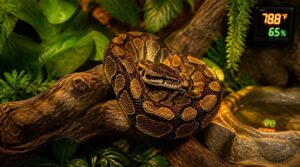
A long, healthy life for a ball python doesn’t happen by accident—it comes from consistent, attentive care over decades. The good news is that most of the work happens in small, everyday routines that any keeper can manage. Here are five practical habits that make the biggest difference in how long your snake lives.
Since so many health issues trace back to poor husbandry, our guide to reptile snake disease prevention covers the warning signs worth catching early.
Monitor Appetite and Weight
Weight tells you things your snake can’t. A digital kitchen scale and a weekly weighing routine will catch problems weeks before symptoms appear, because ball pythons hide illness until it’s serious. Record every feeding date and weight in a log, since patterns matter more than single numbers during vet consultations.
Watch for losses exceeding 10% of body weight, which signals a genuine health problem requiring attention. Juveniles should gain steadily, while adults hold stable weight. Keep prey at 10-15% of body weight, and remember that seasonal fasting is normal if the scale stays steady.
Recognize Common Health Problems
The scale catches problems early, but your eyes confirm them. Learn the warning signs of common illnesses before you need them.
Respiratory infection shows up as wheezing, mouth gaping, or bubbles around the nostrils. Scale rot appears as discolored, blistered belly scales from wet, dirty substrate. Trouble shedding in patches often points to humidity that’s too low, while unexplained weight loss despite regular feeding suggests parasites. Catch any of these, call your reptile vet.
If you spot dark marks on your snake’s skin and can’t tell whether it’s scale rot or something harmless, this guide to black spots on snake skin helps you sort it out.
Schedule Reptile Vet Exams
When you spot those symptoms, a vet relationship already in place saves precious time. Book a yearly wellness exam with an exotic vet, even when your snake looks perfectly healthy. Internal parasites and early organ disease rarely show outward signs. Bring photos of your enclosure, heating, and lighting so your vet can assess husbandry too. If you haven’t found a specialist yet, an exotic reptile vet finder can help you locate experienced exotic animal veterinarians in your area before your snake ever needs urgent care.
- Annual physical exam
- Fecal test every 12 months
- Blood work every 1-3 years
Establishing care early means faster treatment when emergencies strike.
Reduce Chronic Stress
That vet relationship can’t do much if chronic stress is quietly wearing your snake down between visits. Stress-induced immunosuppression suppresses immune function, leaving ball pythons susceptible to infection. Reduce chronic stress through deliberate stress management: consistency, not complexity.
| Stress Indicator | Likely Cause | Recommended Action |
|---|---|---|
| Repeated balling up | Excessive handling | Limit sessions to 10 minutes |
| Feeding refusal | Environmental instability | Check temps, reduce disturbances |
| Constant hiding | Insufficient hides | Add cork bark on both sides |
Environmental stability is the foundation. Avoid frequent enclosure redesigns, keep handling short and predictable, and position the tank away from high-traffic areas.
Adjust Care With Age
Consistency alone won’t carry a ball python through every growth stage. Care requirements shift as your snake ages, and what worked at two years won’t suit a twelve-year-old animal.
Senior ball pythons need feeding every 10-14 days, warmer basking zones reaching 88-92°F, and humidity pushed toward 80% during sheds. Adjust proactively, not reactively, and longevity follows.
Frequently Asked Questions (FAQs)
How long do ball pythons live as pets?
A captive-bred ball python routinely lives 20 to 30 years, outlasting most household pets by decades. With the right longevity factors in place, some have reached well beyond that. The record stands at 62 years.
Will a ball python bite hurt?
A ball python bite is rarely worse than a brief, sharp pinprick. No venom is involved, and most bites trace back to poor handling, keeping this a minor health concern for any beginner pet owner.
Do ball pythons like being held?
Most ball pythons tolerate handling rather than seek it. A calm snake signals comfort through relaxed posture and slow tongue flicks, not genuine preference. Short, routine sessions reduce handling stress signs and build lasting tolerance.
Understanding how pet snakes recognize their owners helps explain why consistent, gentle handling builds trust over time rather than immediate affection.
What snake is worth $100,000?
The blue-green tree python holds that distinction comfortably. Rare morph genetics from a reputable breeder, documented genetic variation, and records of long-term care in active captive breeding programs have driven verified individual sales past $400,
Does a ball python bite hurt?
Think of it as nature’s sharp reminder, startling far more than truly painful. Ball python bites are nonvenomous, so no toxin enters your skin. Wash thoroughly with soap and warm water promptly to prevent infection.
What factors affect the lifespan of a ball python?
How long your snake lives comes down to how well each care variable holds. Temperature, humidity, diet, genetics, and vet care all function as one system, and when any one slips, the others can’t compensate.
How long do ball pythons typically live?
A well-kept ball python can easily outlive the average family dog. Captive care usually provides 20 to 30 years, and some individuals reach In the wild, 10 to 15 years is far more typical.
How can you tell if a ball python is dying?
Rapid weight loss, loss of appetite, and lethargy are the clearest red flags. Wheezing or open-mouth breathing signals failing respiratory health, and a disrupted shedding cycle can mean the body is shutting down. Seek veterinary care immediately.
What is the longest a ball python has lived?
Scales tip toward captivity in any longevity contest. The Saint Louis Zoo’s ball python lived for 62 years, arriving in 1961 and dying in 2021, securing the record for the longest verified captive snake lifespan documented.
How old is the oldest ball python?
The oldest ball python on record reached an estimated 62 years at the St. Louis Zoo, spending nearly six decades there. Before that, a male at the Philadelphia Zoo held the record at
Conclusion
What determines whether your snake reaches 20 years or 40? It comes down to the decisions you make every single day.
Ball python lifespan isn’t fixed at birth. It’s built through consistent temperatures, clean enclosures, steady feeding, and routine veterinary care.
The 63-year record didn’t happen by accident. It happened because someone paid attention, adjusted when needed, and treated longevity as an active practice, not passive hope.
Your snake’s ceiling is higher than you think.