This site is supported by our readers. We may earn a commission, at no cost to you, if you purchase through links.

Pick up a banana ball python and a mahogany from the same clutch, and you’ll swear they came from different species. One drapes across your hand like it owns the place; the other coils tight and stays ready to strike.
Breeders have catalogued hundreds of morphs chasing color and pattern, but ball python morph temperament variations rarely make it onto the sales page. The science is thin, but the keeper observations are loud—and after years of handling thousands of animals across dozens of genetic lines, patterns do emerge.
Knowing what drives those differences could save you from a mismatch you’ll spend years trying to fix.
Table Of Contents
- Key Takeaways
- What Are Ball Python Morphs?
- Defining Ball Python Temperament
- Do Morphs Influence Ball Python Behavior?
- Comparing Temperaments Across Popular Morphs
- Other Factors Affecting Ball Python Temperament
- Choosing a Morph for Desired Temperament
- Frequently Asked Questions (FAQs)
- Can temperature changes affect ball python temperament?
- Do ball pythons recognize their owners over time?
- How does feeding frequency influence defensive behavior?
- Are female ball pythons calmer than males?
- Can multiple morphs mixed create unpredictable temperaments?
- Can diet affect a ball pythons mood?
- Do morphs with neurological issues feel pain?
- How do ball pythons behave during shedding?
- Can two morphs be bred for temperament?
- Conclusion
Key Takeaways
- Morph reputation is a starting point, not a verdict — watch the individual snake, not the label on its enclosure.
- Your husbandry does the heavy lifting: temperatures, hides, humidity, and handling consistency shape temperament far more than genetics ever will.
- A few morphs do carry real behavioral quirks (Spider’s wobble, Mahogany’s edge, Albino’s light sensitivity), but these are tendencies, not guarantees.
- When picking a snake for temperament, request multiple handling sessions across different days — because one good interaction proves nothing.
What Are Ball Python Morphs?
Ball python morphs are the result of genetic mutations that change how a snake looks — color, pattern, and sometimes even scale texture.
With over 3,000 documented morphs in circulation, this ball python morph identification guide can help you figure out exactly what you’re looking at.
Breeders have spent decades stacking these genes together, which is why you’ve got hundreds of distinct morphs in the hobby today.
Here’s what you need to know to make sense of them.
Definition and Genetic Basics
Every ball python morph starts with a single genetic mutation — a shift in gene expression that rewrites color genetics, pattern formation, or both.
Morph inheritance follows clear rules: dominant, recessive, or incomplete dominant. Recessive morphs need two copies to show visually.
These aren’t random accidents. They’re predictable genetic variation, and understanding them puts you in control of what you breed and why.
For more on the science behind these differences, you can explore detailed information about ball python genetic variation.
Common Types of Ball Python Morphs
Once you grasp the genetics, the real variety opens up. Ball python morphs span dozens of recognized types — each driven by specific genetic variation in color patterns or structure.
- Albino: white body, yellow patterning, red eyes
- Banana/Coral Glow: soft yellow and lavender with aging freckles
- Axanthic: grayscale, no yellow pigment
- Clown: bold reduced side pattern, clean head stamp
- Black Pastel: rich dark contrast, near-solid super form
For a deeper dive into the diversity, check out over 4,000 recognized morphs.
Visual and Genetic Identification Tips
Knowing your morph patterns starts with the eyes — compare color, contrast, and headstamp against labeled photos on sites like World of Ball Pythons or MorphMarket. Snake photography helps catch subtle shifts in hue.
For hidden recessives, genetic testing and solid breeding strategies matter more than looks alone. Ball python genetics don’t lie — your records do the real talking.
Defining Ball Python Temperament
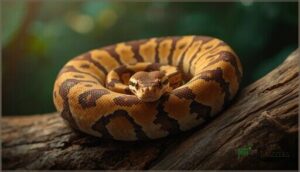
Before you can figure out whether your ball python’s morph affects its personality, you need to understand what temperament actually means for this species. It’s not just about whether a snake bites — there’s a lot more going on under the surface.
Here’s what you need to know about how ball python temperament is defined, measured, and misunderstood.
Natural Disposition and Behavior
Ball pythons aren’t wired to fight — they’re wired to disappear. Your snake’s default snake temperament leans heavily passive, favoring concealment over confrontation. Understanding these behavioral traits puts you in control.
Selective breeding has leaned into that low-key nature too — many common genetic mutations in ball pythons like albino and piebald were easier to establish precisely because these snakes stay calm enough to handle throughout the process.
- Curls tight when threatened — classic defensive mechanisms
- Freezes before striking — docile by design
- Hides during daylight — natural habitat instinct
- Tongue-flicks to assess safety — active snake behavior
- Strikes only under repeated stress — rare, not random
How Temperament is Measured
Measuring your snake’s temperament system isn’t guesswork — it’s a system. Keepers use behavior scoring to track defensive patterns, handling responses, and stress indicators over time.
| Behavior | Stress Level | Temperament Rating |
|---|---|---|
| Loose, relaxed coils | Low | Docile |
| Repeated balling up | Moderate | Shy/Fearful |
| Striking or hissing | High | Defensive |
| Calm tongue-flicking | Minimal | Easygoing |
Log it. Own the data.
Temperament Myths and Misconceptions
Three myths still trip up even experienced keepers:
- Color temperament is real — darker morphs aren’t meaner
- Morph aggression is fixed — it isn’t; husbandry drives most defensiveness
- Handling techniques don’t matter — they absolutely do
Your ball python’s animal temperament reflects genetic influence, environment, and your approach. A docile snake isn’t guaranteed by morph. Environmental impact and consistent handling shape who your snake actually becomes.
Do Morphs Influence Ball Python Behavior?
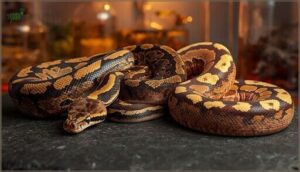
Here’s the question every keeper eventually asks: does the morph actually change the snake, or just the look? The honest answer sits somewhere between lab data and years of hands-on breeding experience.
Here’s what research and real-world observation tell us.
Research Vs. Keeper Observations
Formal scientific studies on animal behavior rarely zoom in on morph-specific temperament — they track species-level traits, not whether your banana looks calmer than your mahogany.
That’s where keeper insights fill the gap. Breeders working with hundreds of ball pythons across morphs and genetics consistently report that individual variation outweighs morph reputation. Your best observation technique? Watch the actual snake, not its label.
Breeders agree: watch the individual snake, not the morph label
Genetic Mutations Linked to Temperament
Not all genetic mutations hit the same systems. Genetic mutations like Spider morph’s head wobble is a neurological trait — behavioral genetics at work, directly wiring how your snake moves and responds.
Color mutations like albino? Morph inheritance through melanin pathways, mostly. Genetic linkages between pigment and temperament are rare but real.
Ball python genetics and genetic testing in reptiles confirm it: docile behavior isn’t guaranteed by color alone.
Limitations of Current Scientific Evidence
Hard truth: there’s no real study here. Herpetological research on ball python morph temperament is built mostly on keeper stories, not controlled study design.
Individual variation almost always outweighs morph identity.
- Data gaps dominate — no standardized behavior scoring exists across morphs
- Sampling errors skew everything — one “spicy” snake becomes a morph’s reputation
- Research bias compounds it — popular morphs hog all the documentation
Comparing Temperaments Across Popular Morphs
Not all ball pythons are wired the same, and morph does play a small part in that story.
Some patterns and colorations come with reputations — earned or otherwise — that keepers talk about constantly in forums and breeding communities.
Here’s how the most popular morphs actually stack up regarding day-to-day temperament.
Banana, Albino, and Black Pastel Behaviors
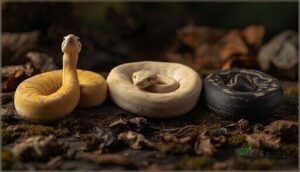
Each morph tells its own story. Banana ball pythons lean curious — often visible, exploratory, and quick to settle during snake handling. Albinos are light-sensitive; keep their environment dim for real temperament stability. Black Pastels stay guarded at first but steady out fast.
| Morph | Behavior Trait | Environmental Impact |
|---|---|---|
| Banana | Curious, exploratory | Tolerates varied lighting |
| Albino | Light-reactive, calm | Needs dimmer enclosures |
| Black Pastel | Defensive juvenile, steady adult | Prefers quiet, dark hides |
Spider, Mahogany, and Puzzle Morph Personality
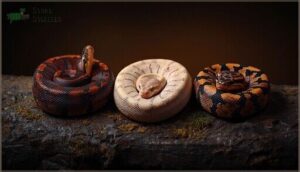
Spider, Mahogany, and Puzzle morphs each come with their own reputation — and for good reason.
- Spider: Docile temperament, but wobble affects balance and prey tracking
- Mahogany: Often “spicy” — defensive hatchlings, reactive adults
- Puzzle: Feisty juveniles; breeding strategies aim to calm the line
- All three: Snake welfare and handling techniques matter more than genetics alone
Piebald, Pinstripe, and Leopard Morph Observations
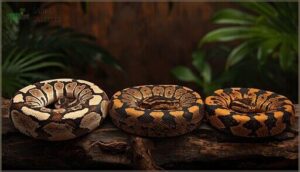
Piebald, Pinstripe, and Leopard ball pythons tell a different story than the morphs above. With these three, morph behavior tracks closely with standard ball python temperament — calm, shy, and manageable.
| Morph | Temperament Notes |
|---|---|
| Piebald | Docile; defensive mechanisms favor hiding |
| Pinstripe | Calm; individual variation dominates |
| Leopard | Alert juveniles; settles with handling |
| Color Genetics | No direct temperament link |
| Snake Handling | Biggest factor across all three |
Your breeding practices and consistency matter more than genetics here.
Other Factors Affecting Ball Python Temperament
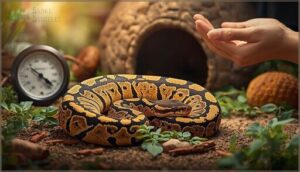
Morph gets a lot of attention, but it’s rarely the whole story in terms of how your ball python actually behaves.
A few other factors carry just as much weight — sometimes more. Here’s what really shapes temperament beyond genetics.
Husbandry and Environmental Conditions
Your enclosure design controls more of your ball python’s temperament than morph ever will.
Temperature control matters — warm side at 88–92°F, cool side at 78–82°F.
Humidity management should stay at 50–70%. Two snug hides. Stable feeding strategies. Minimal disruption. Nail these basics of reptile care and management, and you’ll see the difference in every interaction.
Early Handling and Socialization
Husbandry sets the stage — but early handling and socialization seal the deal. Your handling techniques in those first months shape temperament more than any morph label. Start slow: 5–10 minute sessions, a few times weekly.
- Wait 1–2 weeks before first contact
- Keep early sessions under 10 minutes
- Approach from the side, never head-on
- Wash hands to remove food scent
- Support the full body — no dangling
Age, Sex, and Individual Variation
Age, Sex, and Individual Variation in ball python temperament shifts more than most keepers expect.
| Factor | Behavioral Variations | What It Means |
|---|---|---|
| Age Factors | Hatchlings strike more; adults grow docile | Patience pays off |
| Sex Differences | Males roam during breeding season | Expect restlessness, not aggression |
| Individual Personalities | Genetics shape baseline temperament | Morph doesn’t predict behavior |
Your snake’s animal behavior and psychology ultimately comes down to the individual.
Choosing a Morph for Desired Temperament
Picking a morph based on temperament is trickier than most people expect.
The truth is, individual personality almost always outweighs morph in terms of how a snake actually behaves.
Here’s what to keep in mind when you’re making your choice.
Evaluating Temperament When Selecting a Morph
Don’t trust the label — trust what you see. When choosing a ball python, your own snake handling experience during evaluation matters more than morph genetics alone. Watch the individual, not the tag.
- Ask for multiple handling sessions across different days
- Avoid evaluating snakes post-feeding or mid-shed
- Request breeder selection notes on specific lineage temperament
- Prioritize docile owner experience over morph reputation
Best Practices for Owners Seeking Calm Snakes
Calm ball pythons don’t happen by accident — they’re built through consistent owner responsibilities. Your enclosure design matters: snug hides, stable temps (88–92°F warm side), and 50–60% humidity keep stress reduction working in your favor.
Pair that with smart handling techniques — short sessions, no post-feeding grabs — and your pet’s docile temperament will follow. Calming methods compound over time.
Frequently Asked Questions (FAQs)
Can temperature changes affect ball python temperament?
Think temperature doesn’t shape your ball python’s temperament? It absolutely does.
Heat stress triggers escape behavior, cold shock causes withdrawal, and without proper thermal gradients, even the calmest genetics can’t override environmental influences on animal behavior and psychology.
Do ball pythons recognize their owners over time?
Your ball python won’t recognize your face, but it knows your scent. Through habituation and scent memory, owner recognition builds — your snake learns you’re safe, not a threat.
How does feeding frequency influence defensive behavior?
Oddly enough, feeding schedules shape temperament more than most keepers expect. Hunger levels spike defensive strikes.
Post feeding behavior demands hands-off time. Overfeeding risks food-response bites. Handling timing — midway between meals — keeps your ball python docile.
Are female ball pythons calmer than males?
Sex-based behavior doesn’t reliably separate female from male ball pythons.
Both sexes show docile mechanisms or defensive mechanisms equally.
Calmness factors, hormonal influences, and handling techniques shape temperament far more than sex alone ever will.
Can multiple morphs mixed create unpredictable temperaments?
Stacking morphs doesn’t create a reliable temperament formula. Clutch variability and gene stacking effects mean behavior overlap constantly.
Your ball python’s genetics, breeding line, and husbandry shape personality far more than any morph combination.
Can diet affect a ball pythons mood?
Yes — and it’s more direct than you’d think. Nutrient balance, feeding schedules, and prey size all shape your ball python’s temperament.
Dietary deficiencies quietly dull responsiveness; digestive health keeps behavior steady.
Do morphs with neurological issues feel pain?
Wobble morphs still feel chronic pain. Their neurological issues disrupt balance, not nociception.
Pain perception stays intact, meaning injuries cause real chronic discomfort. Reptile welfare demands you treat their pain seriously — genetics changed their pattern, not their suffering.
How do ball pythons behave during shedding?
During shedding, your ball python’s temperament shifts noticeably.
Pre-shed signs include dull color, cloudy eyes, and defensive postures.
Avoid handling during this phase — shedding mechanics demand focus, and post-shed care restores calm.
Can two morphs be bred for temperament?
You can breed two ball python morphs for temperament — but morph selection matters less than parent behavior.
Genetic breeding works when both adults are reliably calm. Heritability factors mean temperament testing your breeders across seasons pays off.
Conclusion
Picture two doors. Behind one, a banana drapes loose and unbothered across your arm. Behind the other, a mahogany coils like a spring, waiting. Neither door is wrong—but choosing blindly costs you years of patience you didn’t budget for.
Ball python morph temperament variations are the variable breeders rarely advertise but experienced keepers never ignore. Genetics load the gun; your husbandry pulls the trigger. Know what you’re walking into before you open either door.
- https://www.morphmarket.com/morphpedia/ball-pythons/spider/
- https://wheremyscalesslither.weebly.com/the-spider-morph-and-the-wobble.html
- https://pmc.ncbi.nlm.nih.gov/articles/PMC9581371/
- https://www.ophidianodyssey.com/info/morphs
- https://reptilesmagazine.com/a-crash-course-in-ball-python-reptile-genetics/