This site is supported by our readers. We may earn a commission, at no cost to you, if you purchase through links.
Your snake won’t eat, hides constantly, and snaps at you when you reach into the enclosure. Before you panic, check its eyes — if they’ve gone milky blue, everything makes sense.
That’s the blue phase: a 3-to-7-day window where your snake’s body floods the space beneath its old skin with fluid, loosening the entire layer for a clean shed. The problem is, that same fluid turns the eye caps opaque, cutting your snake’s vision to near zero.
A half-blind animal in a strange environment doesn’t feel safe — it feels cornered. Understanding blue phase snake behavior changes how you read those signals and exactly what your snake needs from you right now.
Table Of Contents
- Key Takeaways
- What is The Blue Phase in Snakes?
- Key Physical Signs of The Blue Phase
- Typical Blue Phase Snake Behaviors
- Sensory Changes During The Blue Phase
- Environmental Factors Affecting Blue Phase Behavior
- Caring for Snakes During The Blue Phase
- Common Problems Observed in The Blue Phase
- Supporting Healthy Shedding and Behavior
- Frequently Asked Questions (FAQs)
- Conclusion
Key Takeaways
- Milky blue eyes and defensive behavior during shedding aren’t warning signs — they’re your snake temporarily blind and responding exactly as instinct demands.
- Humidity between 60–70% and a tight, damp hide aren’t optional comfort upgrades; they’re the difference between a clean shed and retained eye caps that need a vet.
- Skip handling entirely during the blue phase — a half-blind snake that strikes isn’t being aggressive, it’s protecting itself from a threat it can’t see clearly.
- After eyes clear, your snake will shed within 2–5 days; if the blue phase stretches past two weeks or you see open-mouth breathing, that’s a vet call, not a husbandry tweak.
What is The Blue Phase in Snakes?
The blue phase is one of the most misunderstood windows in a snake’s life — and one of the most important. It’s a distinct biological stage within the shedding cycle, with its own signs, purpose, and rules.
Understanding exactly what’s happening under the scales — and how to respond — starts with knowing what the blue phase means for your snake’s shedding health.
Here’s what you need to know about what it actually is, why it happens, and how it differs from the rest of the shed.
Definition of The Blue Phase
Blue Phase isn’t just a color shift—it’s a physiological checkpoint in snake shedding. You’ll spot milky blue eyes and dull skin as the fluid layer forms beneath the old scales. For several days, vision fades, behavior changes, and the snake readies for ecdysis. Here’s what marks this stage:
- Milky blue eyes
- Dull, faded skin
- Fluid layer formation
- Snake vision impairment
Biological Purpose of The Blue Phase
What’s really happening during this stage? The Blue Phase kicks off the shedding mechanism—lymph-like fluid separates old skin, prepping for ecdysis. That same fluid shields the eyes, providing temporary eye protection as new scales develop.
It’s all about skin regeneration and adaptive behavior: your snake’s growth patterns and health depend on this cycle, clearing parasites and repairing damage.
Differences From Other Shedding Stages
The Blue Phase isn’t the whole shedding cycle — it’s a 3-to-7-day window inside it. Before blue, your snake’s skin regeneration begins quietly: colors dull, but eyes stay clear. After blue, eyes clear again and shedding follows within 72 hours.
Each snake shedding stage triggers distinct physiological changes and adaptive behaviors. Miss the differences, and retained eye caps or incomplete sheds catch you off guard.
Key Physical Signs of The Blue Phase
Spotting the blue phase isn’t always obvious if you don’t know what to look for. There are a few clear physical signs that show your snake is entering this stage. Here’s what you’ll notice first.
Cloudy or Bluish Eyes
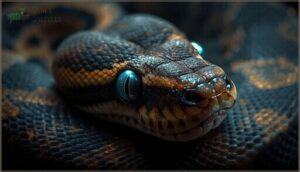
Those milky blue eyes aren’t coming from the eyeball itself — it’s the spectacle, a clear scale fused over the eye, filling with fluid as ecdysis begins. This vision impairment usually lasts 3 to 7 days during the blue phase.
Retained eye caps and ocular health risks rise if spectacle regeneration stalls. Never attempt eye cap removal yourself — that’s a job for your vet.
Dull and Faded Skin Color
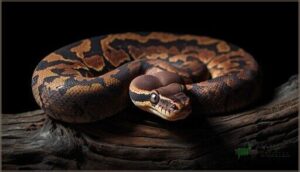
Dullness is your first honest shedding cue. During the blue phase, a thin fluid layer builds between old and new skin — the color change mechanism that drives this fading patterns effect.
Bright reds go muddy, iridescence vanishes, and your snake’s whole pattern loses contrast. That’s ecdysis doing its job: skin pigmentation temporarily muted, dullness indicators signaling the shedding cycle is underway.
Changes in Skin Texture
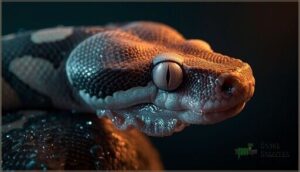
Touch tells the story dullness can’t. During the shedding cycle, epidermal shift changes how your snake actually feels — not just looks.
- Old skin turns chalky and dry from dryness effects
- Scale lifting makes flanks feel faintly like fine sandpaper
- Skin separation creates subtle looseness around the neck
- Texture changes reveal snake shedding stages in real time
- Retained eye caps start here — humidity failures compound fast
Typical Blue Phase Snake Behaviors
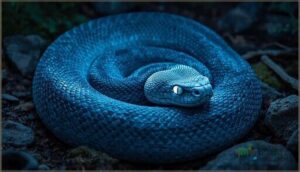
When your snake hits the blue phase, its behavior shifts — and that shift is hard to miss.
The blue phase often signals dehydration stress, so watch for dull, hazy scales alongside signs your snake isn’t getting enough water — both can derail a healthy shed.
It’s not random; it’s your snake responding to real biological changes happening under the skin.
Here’s what you’ll actually see.
Increased Hiding and Seclusion
Ever notice your hognose snake vanish during the Blue Phase? That’s classic Seclusion Behavior—driven by vision loss and heightened Snake Stressors.
Secure Sheltering becomes their top priority, with Hide Box Preferences shifting to humid, tight spaces. Environmental Enrichment matters, but privacy wins.
This retreat isn’t laziness—it’s smart Animal Behavior, protecting Snake Health when sight fades and instincts sharpen.
Reduced Appetite or Food Refusal
Food refusal during the blue phase isn’t a red flag — it’s one of the most predictable Refusal Patterns in Snake Behavior. Cloudy eye caps blur vision, internal fluid pressure builds, and your snake’s body is already working overtime.
Feeding Strategies should adapt: skip the meal, protect Digestive Health, and watch for Appetite Cues returning post-shed. Nutrient Deficits rarely follow one missed feeding.
Defensive or Avoidant Responses
Blind and vulnerable — that’s fundamentally your snake’s reality during blue phase. Defensive Posturing isn’t aggression; it’s survival instinct. Even docile species like the Hognose Snake will strike, musk, or bolt. Support Reptile Health with these Avoidance Tactics built into your Pet Snake Ownership routine:
- Skip handling entirely
- Limit room traffic near the enclosure
- Use Environmental Enrichment — tight hides reduce Stress Reduction needs
- Apply Snake Behavior Modification: approach slowly, never suddenly
Sensory Changes During The Blue Phase
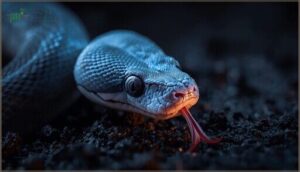
The blue phase doesn’t just change how your snake looks — it changes how it experiences the world. That cloudy fluid layer between old and new skin cuts off its primary sense, forcing it to rely on entirely different tools to navigate.
The blue phase blinds a snake to its world, forcing ancient senses to take the lead
Here’s what’s actually happening in its sensory system during this window.
Vision Impairment and Its Effects
During the blue phase, visual acuity drops sharply — fluid pooling between old and new eye caps basically cuts your snake’s sight to near zero. Depth perception goes with it: expect bumped snout probes and hesitant movement.
These behavioral changes aren’t random; they’re direct environmental impact responses within the shedding cycle. Reptile health depends on you recognizing this sensory adaptation as temporary, not permanent damage.
Reliance on Heat and Chemical Sensing
Sight’s gone — but your snake isn’t flying blind. Heat sensing and chemical signals kick into overdrive. Pit organs detect infrared radiation from warm objects within 30–50 cm, while constant tongue-flicking reads scent marking across every surface.
Four things still guiding your snake right now:
- Infrared thermal mapping via pit organs
- Tongue-flick chemoreception through the vomeronasal organ
- Familiar scent trails across substrate
- Temperature gradient orientation for spatial awareness
Behavioral Adaptations to Limited Sight
Your snake’s world shrinks during visual impairment — and it adapts fast. Watch for sensory compensation in action: slower movement, wall-hugging, and repeated familiar routes. These aren’t signs of distress. They’re behavioral flexibility at work.
| Behavior | Why It Happens | What You’ll See |
|---|---|---|
| Wall-hugging movement | Adaptive navigation replaces open-space crossing | Snake traces enclosure edges |
| Head pressing surfaces | Environmental cues replace visual mapping | Nose-down, deliberate steps |
| Revisiting known paths | Familiar scent trails guide movement | Repeated hide-to-water routes |
| Reduced climbing | Visual impairment limits depth perception | Ground-level preference only |
| Defensive coiling | Snake behavior and health self-protection kicks in | Tight coil, head raised |
Environmental Factors Affecting Blue Phase Behavior
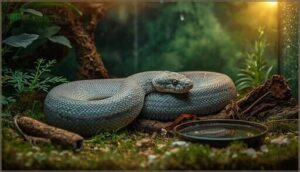
Your snake’s environment doesn’t take a break just because it’s shedding — it actually matters more during the blue phase. Get the conditions wrong, and a clean shed turns into a stuck mess.
Here’s what to dial in before problems start.
Importance of Humidity and Temperature
Two invisible forces shape every shed: humidity and temperature. Get them wrong, and your snake pays the price. For snake shedding success, aim for:
- Humidity control at 60–70% — keeps that fluid layer moist
- Temperature gradients with a warm side at 86–90°F
- Thermal regulation prevents sluggish circulation and delayed sheds
- Snake hydration suffers fast when conditions drop below 40–50% humidity
Role of Shedding Aids and Terrarium Setup
Your terrarium design does a lot of the heavy lifting here. Cork bark, rough branches, and textured rocks give your snake the rubbing points it needs to peel away old skin during the shedding cycle.
A moist hide — packed with damp sphagnum moss — maintains localized humidity control right where skin regeneration happens.
Shedding aid products work best as backup, not your first fix.
Hydration and Accessibility to Water
Hydration is everything during the blue phase — and it’s easy to miss the warning signs. Watch for wrinkled skin, dented eye caps, or skin that won’t snap back when pinched: those are dehydration signs your snake can’t hide.
Water bowl placement matters here; blind snakes struggle to locate bowls.
For rehydration methods, a 30-minute soak in 82–84°F electrolyte-balanced water works fast.
Caring for Snakes During The Blue Phase
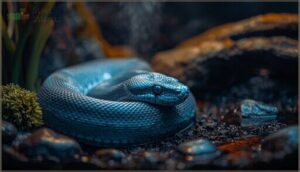
The blue phase calls for a shift in how you interact with your snake — less intervention, more observation. Your job during this window is to reduce stress and keep the environment dialed in.
Here’s what that actually looks like in practice.
Minimizing Handling and Stress
During the blue phase, your snake’s world is basically a blur — and that vulnerability changes everything. Gentle handling becomes less of a preference and more of a rule.
Most keepers skip non-essential contact entirely. If you must intervene, keep it brief: smooth lifts, slow movements, full body support.
Low handling isn’t laziness — it’s smart reptile health and wellness practice.
Adjusting Feeding Routines
Food refusal during the blue phase is normal — don’t panic. Adjust your feeding schedule rather than forcing meals:
- Skip feeding when eyes are fully cloudy
- Downsize prey selection by one rodent size
- Use tongs for prey presentation — heat and scent guide them now
- Wait 24–48 hours post-shed before resuming meal timing
- Log each shed and feeding date to spot patterns
Reptile health and wellness starts with reading your snake, not your calendar.
Providing Proper Hides and Substrates
Your snake’s hide is its bunker during the blue phase — make it count. Choose opaque hides just large enough to coil tightly inside, with one narrow entrance.
For substrate materials, cypress mulch or coconut husk holds humidity without staying soggy. A damp sphagnum moss humidity hide, sitting 70–80% RH, makes the difference between a clean shed and a frustrating retained eye cap.
Common Problems Observed in The Blue Phase

Even with the best setup, the blue phase can throw you a curveball. Most problems trace back to environment — humidity, hydration, or a lack of rough surfaces.
Here are the most common issues you might run into and what to watch for.
Incomplete Sheds and Retained Eye Caps
Incomplete sheds are one of the most common shedding complications you’ll encounter — and retained eye caps are the most serious. When the spectacles (those fused, transparent scales covering each eye) don’t release cleanly, layers stack up like old paint.
To identify and address this issue:
- Check the shed for two clear eye discs
- Watch for a dull, wrinkled, or bluish eye post-shed
- Never attempt dry eye cap removal — you risk permanent corneal damage
Humidity below 50% is almost always the culprit. Warm soaks and proper shedding aids resolve most stuck shed cases before they escalate. Persistent retained spectacles need a reptile vet — no exceptions.
Signs of Dehydration or Shedding Issues
Dehydration doesn’t announce itself loudly — it whispers through small details. Watch for wrinkled skin along the neck, sunken eyes, and dry, chalky urates. These are classic dehydration signs tied directly to shedding problems.
Stuck shed and retained eye caps almost always trace back to low humidity and poor hydration methods. Environmental factors drive nearly every snake shedding issue you’ll face.
When to Seek Veterinary Assistance
Some signs go beyond stuck shed or retained eye caps — they’re emergencies.
Seek veterinary care immediately if you observe:
- Open-mouth breathing or audible wheezing — respiratory distress, not blue phase behavior
- Stargazing, seizures, or loss of balance — serious neurological red flags
- A blue phase lasting beyond 2–3 weeks without completing — possible systemic illness
These snake behavior changes mean medical intervention, not a humidity fix.
Supporting Healthy Shedding and Behavior
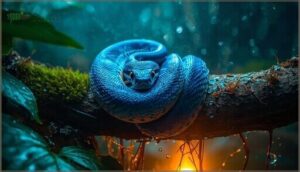
Most shedding problems aren’t bad luck — they’re preventable with the right setup. Your snake’s environment does most of the heavy lifting, and a few consistent habits make all the difference.
Here’s what to focus on to keep every shed clean and stress-free.
Preventative Husbandry Practices
Good snake husbandry starts long before the blue phase hits. Lock in humidity control now — 40 to 60 percent for colubrids, 55 to 70 for tropical species like ball pythons.
Build terrarium design around two hides, a humid moss box, and moisture-holding substrate. Smart environmental monitoring and consistent snake nutrition prevent most shedding aids from ever being needed.
Monitoring Behavioral and Physical Changes
Once your setup is dialed in, your eyes become the next tool. Track shedding patterns across multiple cycles — note when eyes cloud, when they clear, and when the shed drops. Those behavioral cues tell you more than any single observation.
A snake that hides three extra nights before blue phase isn’t being dramatic; that’s your snake health data in real time.
Addressing Repeated Shedding Difficulties
When snake shedding problems repeat cycle after cycle, the pattern itself is the diagnosis. Poor humidity control, inconsistent snake nutrition, and cramped enclosures are almost always the culprits — not bad luck.
Raise ambient humidity to 70–75% during the blue phase, log each shedding frequency shift, and rethink your environmental adjustments. Skin regeneration doesn’t fix itself; your husbandry has to meet the reptile shedding process halfway.
Frequently Asked Questions (FAQs)
How long does the blue phase typically last?
For most captive snakes, the blue phase lasts 3 to 5 days. Humidity control and stable temperatures directly shape shedding cycles — poor conditions can stretch that window to 7 days or longer.
Maintaining proper humidity levels is essential for a healthy shed cycle.
Can snakes recognize their owners during blue phase?
Think of it like trying to recognize your best friend through frosted glass — you sense them, but you can’t be sure. Yes, your snake still detects your scent, but Blue Phase Stress weakens Owner Snake Trust noticeably.
Do all snake species experience a blue phase?
Yes — all snake species experience a blue phase. Eye spectacles replace universally during shedding cycles, though species variation and color morphs affect visibility.
Some snakes barely show it; others turn unmistakably opaque.
Is the blue phase painful or uncomfortable for snakes?
Not painful — but not nothing, either. The blue phase brings mild shedding sensations: skin tightness, pressure near the eyes, reduced vision.
For snake health and animal welfare, think "itchy discomfort," not pain. This discomfort can be related to snake shedding issues.
How soon after blue phase does shedding occur?
After the blue phase clears, most snakes shed within 2 to 5 days. Ball pythons often take 2 to 4 days; corn snakes, just 2 to Watch for clearer eyes — that’s your countdown.
Conclusion
Missing the signs of blue phase snake behavior could cost you months of trust-building with your snake. Those milky eyes aren’t defiance — they’re a biological hard reset, demanding stillness from you both.
Back off the handling, dial in the humidity, and resist the urge to troubleshoot what isn’t broken. Your snake isn’t falling apart; it’s rebuilding itself from the outside in.
Read the signals right, and you’ll come out the other side with a healthier, calmer animal.
- https://reptifiles.com/ball-python-care-guide/ball-python-diseases-health/dehydrated-ball-python/
- https://wheremyscalesslither.weebly.com/dehydration.html
- https://journals.biologists.com/jeb/article/226/15/jeb245925/325821/Dehydrated-snakes-reduce-postprandial-thermophily
- https://pubmed.ncbi.nlm.nih.gov/24457920/
- https://www.thebiodude.com/blogs/reptile-and-amphibian-husbandry-basics/dehydration-in-reptiles-how-to-prevent-it-and-keep-them-hydrated-appropriately