This site is supported by our readers. We may earn a commission, at no cost to you, if you purchase through links.

Your corn snake doesn’t operate on a nine-to-five schedule, and treating it like a pet that should be active during your waking hours is a recipe for frustration. These nocturnal hunters evolved to track warm-blooded prey through darkness using infrared sensors and chemical cues, not to perform on demand when you flip on the lights.
Understanding corn snake behavior and enrichment ideas starts with accepting that your snake’s internal clock runs opposite to yours—activity peaks during dusk transitions, hunting instincts fire up in dim conditions, and those defensive S-curves appear when you’ve disrupted something your snake considers threatening. The gap between what corn snakes need and what many enclosures provide creates stressed, bored animals that barely resemble their wild counterparts.
Closing that gap means rethinking everything from lighting schedules to feeding routines, building environments that trigger natural behaviors instead of suppressing them.
Table Of Contents
- Key Takeaways
- Key Corn Snake Behaviors Explained
- Essential Environmental Enrichment Strategies
- Effective Enrichment Activities for Corn Snakes
- Choosing and Using Enrichment Accessories
- Benefits of Enrichment for Corn Snake Well-Being
- Frequently Asked Questions (FAQs)
- What is the best enrichment for corn snakes?
- What are the enrichment ideas for snakes?
- How to make your corn snake happy?
- How to make corn snakes more active?
- What enrichment activities are suitable for corn snakes?
- How do you enrich a corn snake?
- Do corn snakes need mental stimulation?
- How do you know if a corn snake is enjoying enrichment?
- What activities can a corn snake do?
- How to keep a corn snake healthy and happy?
- Conclusion
Key Takeaways
- Your corn snake’s nocturnal instincts drive peak activity between 8 pm and 2 am, so enrichment efforts work best when timed to these natural rhythms rather than your daytime schedule.
- Real enrichment comes from mimicking wild behaviors through climbing structures, rotating decor every few weeks, varied substrates for texture exploration, and puzzle feeders that turn mealtime into a mental workout.
- Stress signals like S-curved defensive postures, rapid tongue flicking, and retreat into hiding tell you when your snake needs space, while relaxed movement and curious exploration show they’re thriving in their environment.
- Building trust happens through consistent, gentle handling sessions that support the entire body, paired with environmental choices that let your snake exercise natural hunting, climbing, and burrowing instincts instead of suppressing them.
Key Corn Snake Behaviors Explained
Understanding how your corn snake thinks and moves is the first step to creating a space they’ll actually thrive in.
Watching their corn snake size and growth rate helps you adjust their enclosure as they develop from hatchling to adult.
These snakes aren’t just sitting around waiting for food—they’re nocturnal hunters with instincts that shape everything from their nighttime routines to how they react when you reach into their tank. Let’s break down the key behaviors you’ll see so you can read your snake like a book.
Nocturnal Activity Patterns
Your corn snake comes alive after dusk, showing peak activity between 8 pm and 2 am—prime time for nighttime exploration. Understanding these snake behavior patterns transforms your enrichment approach.
- Activity peaks align with dark cycle transitions, not daytime schedules
- Moonlight simulation with dim red bulbs enhances natural rhythms
- Temperature gradients encourage movement during cooler evening hours
- Reptile enrichment activities work best when timed to nocturnal feeding windows
Emerging research highlights the importance of for understanding their unique behavioral patterns.
Hunting and Feeding Instincts
Watch your snake’s feeding instincts in action—they rely on infrared sensing and forked-tongue chemical cues to track prey at night. Ambush tactics meet pursuit styles as they coil and strike within fractions of a second.
Enrichment ideas like puzzle feeding and scent trails tap into these natural hunting behaviors, turning mealtime into mental stimulation that keeps your snake engaged and satisfied.
Learning about a snake’s natural hunting instinct can help reptile owners create more effective and enriching care routines.
Defensive Postures and Stress Signs
When your corn snake feels cornered, you’ll notice defensive coils—the body arches high with the neck curved in an S-shape, ready to strike. Threat response also shows up as rapid tongue flicking, pressed-flat posture, or retreat into hiding.
Environmental triggers like bright light or sudden handling spike snake anxiety. Recognizing these stress signals early lets you adjust enrichment strategies and respect your snake’s boundaries.
Socialization and Handling Responses
As stress fades, your snake starts showing positive handling responses. Calm body coiling, a relaxed mouth, and unhurried movement signal growing trust. Gentle touch builds animal bonding when you support the entire body and avoid sudden grabs.
Key handling techniques for stress reduction:
- Start with 5-10 minute supervised handling sessions
- Use warm, even contact to prevent startling reactions
- Keep sessions consistent to create calming signals
- Allow retreat paths to reduce perceived confinement
- Record progress to track your snake’s comfort growth
Short daily sessions beat long infrequent ones for building trust with pets.
Gentle, consistent snake handling for improved bonding helps reptiles feel secure without overwhelming their sensitive stress responses.
Essential Environmental Enrichment Strategies
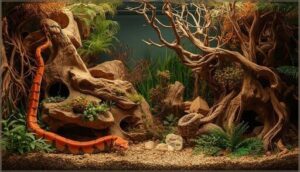
Your corn snake’s enclosure isn’t just a box—it’s their entire world, and getting it right makes all the difference. A well-designed habitat doesn’t just keep them alive; it keeps them engaged, active, and genuinely thriving.
Here are the essential strategies that transform a basic setup into an enriching environment your snake will actually use.
Creating Climbing and Hiding Opportunities
Your snake’s enclosure becomes a living landscape when you add vertical branches and thick vines anchored to sturdy frames—safe climbing structures that let them explore every inch of vertical space. Position hide boxes at warm and cool ends using cork bark or natural caves with generous entry holes. Rotate enrichment layouts every few weeks to keep curiosity alive.
| Enrichment Element | Placement Strategy | Safety Check |
|---|---|---|
| Climbing Structures | Stagger multiple height levels away from top edges | Secure all brackets; inspect for wobbling |
| Hide Box Placement | One warm-side hide, one cool-side hide | Smooth, nonporous materials only |
| Natural Hides | Mid-wall shelves and cork bark caves | Round edges; stabilize heavy pieces |
| Vertical Space Features | Accessible platforms for resting | Non-slip textures on all surfaces |
| Enclosure Layout Rotation | Swap decor locations biweekly | Sanitize before reintroduction |
Varied Substrates for Exploration
Mixing substrate options transforms your enclosure into a sensory playground—layer aspen shavings with cork bark chips for texture variety, or combine cypress mulch with coconut husk for moisture control zones.
Burrowing materials like loose leaf litter encourage natural digging instincts, while smooth reptile carpet sections offer friction contrast. This exploration enrichment lets your corn snake investigate diverse surfaces, keeping curiosity sharp and environmental enrichment vibrant.
Temperature Gradients and Humidity Control
Beyond substrate variety, thermal regulation and humidity management form the backbone of effective microclimate creation.
Set your enclosure with temperature zoning—a warm basking spot at 28 to 32°C, ambient areas around 26 to 28°C, and a cool retreat at 22 to 24°C. Maintain 40 to 60 percent humidity using moisture-buffering substrates and distributed sensors for precise gradient control, giving your corn snake enrichment through choice.
Rotating Decor and Enclosure Layouts
Treating your terrarium design like a stage set—where scenes shift and curiosity never fades—transforms static space into engaging enrichment. Swap hides, rearrange climbing branches, and experiment with layout planning every few weeks to spark exploration.
Rotating displays keep your snake investigating fresh corners, optimizing space without expanding the footprint. Multi-level decor options add vertical interest, turning routine patrols into an adventure that honors natural problem-solving instincts.
Effective Enrichment Activities for Corn Snakes
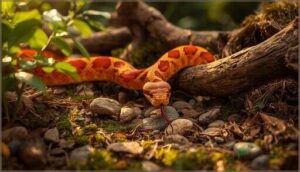
Your corn snake doesn’t need expensive gadgets to thrive—just smart activities that tap into their natural instincts. The best enrichment mimics what they’d experience in the wild: exploring new textures, following scent trails, and traversing safe spaces beyond their everyday enclosure.
Here are four proven strategies that’ll keep your snake mentally sharp and physically engaged.
Supervised Out-of-Enclosure Exploration
Letting your corn snake explore outside the enclosure offers powerful environmental stimulation—but handler preparation and escape prevention come first. Set up a snake-safe space with secure barriers, soft surfaces, and stable temps.
Watch for stress signs like pacing or weaving, and respect your snake’s pace. Short, calm sessions build trust and encourage natural climbing behaviors while keeping enrichment safe and rewarding for both of you.
Puzzle Feeders and Scent Trails
Puzzle feeders tap into your corn snake’s natural foraging drive, turning mealtime into a mental workout. Scent trail design guides them along pathways using mild food odors, while puzzle feeder types—from rotating slots to corrugated mazes—challenge their problem-solving skills.
These enrichment materials promote sensory stimulation and snake exploration, supporting animal welfare through environmental stimulation for reptiles that honors their hunting instincts.
Introducing Safe, Non-Toxic Objects
Your corn snake deserves a hazard-free environment where every object earns its place through safe object introduction. Toxic material avoidance starts with choosing non-toxic substrates like aspen or cypress mulch, then extends to reptile accessories—glass dishes, stainless steel water bowls, untreated cork bark, and ceramic hides.
These reptile enrichment techniques and animal enrichment strategies transform environmental enrichment into enrichment item safety, building trust while honoring natural behaviors.
Scent Enrichment With Natural Materials
Beyond texture and temperature, your snake’s world comes alive through aromatic enrichment. Cedar bark, dried lavender sprigs, and bay leaves become natural scent sources that trigger tongue-flicking surveys and boundary patrols—classic animal enrichment strategies rooted in herpetological research.
Rotate these reptile enrichment techniques every five to fourteen days to prevent habituation, always checking material safety to avoid pesticides. Environmental enrichment through scent rotation delivers enrichment benefits by honoring your corn snake’s chemical-sensing instincts.
Choosing and Using Enrichment Accessories
The right accessories can transform a basic enclosure into a vibrant environment that mirrors what your corn snake would encounter in the wild. You don’t need expensive setups—just thoughtful choices that encourage climbing, hiding, and exploration.
Let’s look at three categories of enrichment items that give your snake both physical challenges and mental stimulation.
Climbing Branches and Vines
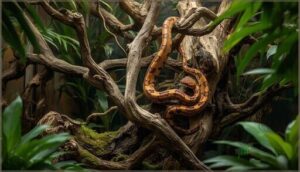
Your snake’s climbing world starts with smart branch selection and vine placement—think natural wood over smooth plastic, and always skip pine or cedar to protect those sensitive airways.
When you’re building vertical space, remember these essentials:
- Choose branches at least 1.5 times your snake’s width for secure grip
- Anchor multiple perches at different heights to create climbing mechanics that feel natural
- Mix texture variety with driftwood and flexible vines for environmental stimulation for reptiles
This reptile enrichment technique transforms basic corn snake care into active snake behavior support.
Hide Boxes and Natural Caves
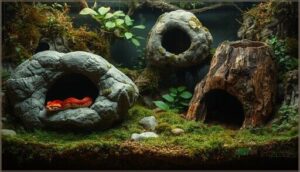
While branches give your corn snake vertical freedom, hides offer something equally essential—security. Your hide box design should feature smooth surfaces with entrance holes 1.5 to 2.5 inches wide, allowing easy access without struggle.
Place these snake shelters away from heat sources to maintain microclimate control, creating thermal gradients that support natural snake behavior. Multiple cave placements at different temperatures let your corn snake choose comfort zones, reducing stress and supporting healthy reptile care routines.
Cork Bark, Driftwood, and Rocks
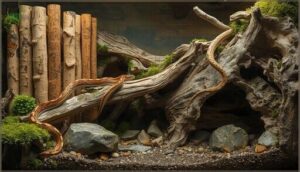
Natural materials transform your enclosure into a living landscape. Cork bark benefits include mold resistance and sustainable sourcing, while driftwood decor adds climbing complexity through natural crevices.
Rock arrangements create thermal refuges when you layer smooth stones into terrarium decoration that encourages exploration. These eco friendly materials support reptile enrichment techniques by offering natural hides that reduce stress and promote animal behavior patterns essential for snake care and maintenance in reptile habitat creation.
Benefits of Enrichment for Corn Snake Well-Being
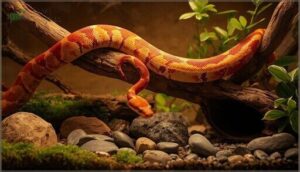
Enrichment isn’t just about making your corn snake’s tank look nice—it genuinely transforms their quality of life. When you give them opportunities to explore, climb, and engage with their environment, you’re supporting their mental and physical health in ways that go far beyond basic survival.
Let’s break down exactly how the right enrichment benefits your snake and strengthens the bond between you.
Reducing Stress and Preventing Boredom
A bored corn snake becomes a stressed corn snake—pacing glass, refusing food, even tail whipping when you approach.
Environmental enrichment and sensory stimulation act as calming techniques, breaking the monotony that fuels anxiety. Rotating substrates, adding climbing branches, and introducing safe scent trails give your snake mental work to do.
Stress management through reptile enrichment techniques isn’t optional—it’s how you prevent boredom and keep those defensive postures at bay.
Encouraging Natural Behaviors
Unlocking your corn snake’s natural instincts transforms captivity into something closer to wild mimicry. Environmental enrichment and behavioral enrichment aren’t just buzzwords from herpetology—they’re how you let your snake be a snake.
- Vertical branches encourage climbing, engaging muscles and heat-seeking behaviors
- Scent trails from safe materials trigger exploratory hunting and foraging drive
- Multiple hides at varied heights support retreat and thermoregulation choices
- Textured surfaces promote natural gripping, coiling, and movement patterns
Snake exploration through environmental stimulation upholds animal welfare while honoring the psychology behind every flick of that forked tongue.
Supporting Physical and Mental Health
Think of enrichment as preventive medicine—it keeps your corn snake sharp, agile, and resilient. Regular physical exercise through climbing and exploration builds muscle tone and joint flexibility, while mental stimulation from puzzle feeders and scent trails fosters cognitive engagement.
Combine environmental enrichment with proactive health monitoring, stress management, and nutrition planning, and you’re not just housing a reptile—you’re championing snake health and wellness through evidence-based animal behavior and psychology.
Building Trust and Human-Snake Bonding
Bonding isn’t built overnight—it’s earned through gentle interaction and consistent owner presence. When you pair enrichment with calm, predictable snake handling, you’re practicing trust building rooted in animal behavior and psychology.
Your corn snake learns to associate you with safety, not stress. That’s the essence of pet snake ownership: bonding techniques that honor instinct while deepening trust through patience and respect.
True bonding with your corn snake means becoming a source of safety, not stress, through patient respect for their instincts
Frequently Asked Questions (FAQs)
What is the best enrichment for corn snakes?
Picture your snake prowling over textured bark at midnight—that’s environmental stimulation.
Environmental stimulation through climbing branches, rotating tank layouts, varied substrates, and food variety trigger behavioral instincts, offering essential mental stimulation corn snakes crave naturally.
What are the enrichment ideas for snakes?
Snake enrichment ideas include environmental stimulation through climbing structures, reptile toys like puzzle feeders, scent trails for exploration, rotating decor for mental stimulation, and supervised handling sessions that encourage natural animal engagement and sensory experiences.
How to make your corn snake happy?
A happy snake is a healthy snake. Keep your corn snake content by establishing a proper habitat with temperature gradients, hiding spots, regular handling, consistent feeding schedules, and enrichment activities that encourage natural behaviors and reduce stress.
How to make corn snakes more active?
To boost activity triggers and snake exercise, align feeding with evening hours, rotate climbing branches weekly for environmental stimulation, and maintain warm zones at 80–85°F—habitat optimization that leverages your corn snake’s natural behavioral enrichment rhythms.
What enrichment activities are suitable for corn snakes?
Enrichment activities for corn snakes include supervised out-of-enclosure exploration, rotating decor for environmental variety, puzzle feeders that challenge natural exploration instincts.
Scent trails, and climbing structures that promote snake agility and sensory stimulation.
How do you enrich a corn snake?
You enrich a corn snake through habitat diversity—add climbing branches, rotate hides, use varied substrates, and introduce scent trails.
These enrichment techniques support behavioral engagement while providing essential environmental stimulation for reptiles.
Do corn snakes need mental stimulation?
A corn snake left in a barren tank with nothing but food and water won’t thrive.
Mental health matters—cognitive stimulation through environmental enrichment, behavioral challenges, and varied reptile enrichment techniques enhances their snake intelligence and overall animal welfare.
How do you know if a corn snake is enjoying enrichment?
Watch for relaxed movement, curious tongue flicking, and active exploration of new items. Your snake should willingly approach enrichment rather than flee, showing calm body language and balanced time between climbing, hiding, and investigating.
What activities can a corn snake do?
Picture a sleek hunter traversing tunnels, scaling branches, stalking prey-scented trails—that’s your corn snake thriving.
Climbing, burrowing, constricting, soaking, exploring new textures, and puzzle-solving during feeding all express natural behavioral patterns through sensory stimulation.
How to keep a corn snake healthy and happy?
Keep your corn snake thriving with proper habitat maintenance, balanced snake nutrition tips, regular health checks, gentle handling techniques, and environmental stimulation—providing secure hides, climbing options, and consistent routines builds trust while supporting natural reptile care needs.
Conclusion
The snake you bought isn’t the snake you’ll have in six months—not if you’re serious about corn snake behavior and enrichment ideas. Every branch you add, every scent trail you create, every dim-light hunting session rewires the relationship between you and an animal that was never meant to be decorative.
Your corn snake won’t thank you with affection, but watch long enough and you’ll see something better: a predator fully alive in its own skin, operating exactly as evolution intended.