This site is supported by our readers. We may earn a commission, at no cost to you, if you purchase through links.
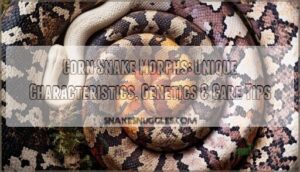
A single genetic switch can transform a corn snake from classic orange and red into a ghostly white serpent with ruby eyes, or a charcoal-gray beauty without a trace of warmth. These aren’t different species—they’re morphs, variants shaped by deliberate breeding strategies that employ recessive genes, dominant mutations, and polygenic traits. Understanding corn snake morphs’ unique characteristics unlocks a world where you’re not just keeping a pet, you’re working with living genetics.
Pattern breaks like Tessera rewrite the rules of dorsal markings, while combinations such as Snow stack multiple traits into specimens that seem almost otherworldly. Whether you’re drawn to the subtle elegance of a Lavender or the radical departure of a Palmetto, each morph carries its own genetic blueprint and care considerations that separate hobbyists from true breeders.
Table Of Contents
Key Takeaways
- Corn snake morphs result from deliberate genetic manipulation involving recessive, dominant, and polygenic traits that control pigment distribution and pattern expression, allowing breeders to predict and create specific color and pattern combinations through strategic pairings.
- Amelanistic morphs eliminate melanin for red-orange palettes with ruby eyes, while anerythristic variants strip red pigments for grayscale patterns, and these single-gene mutations can stack into designer combinations like Snow (double recessive white) or triple-gene morphs commanding $175-$600 price points.
- Pattern mutations like Tessera (dominant, immediate 50% expression) and Motley (recessive, elongated blotches) fundamentally rewrite scale pigmentation through CLCN2 gene disruption, while rare Palmetto morphs create white canvases with colored speckles but carry 15-20% eye defect rates requiring careful management.
- Most morphs share identical care requirements across diet, housing, and temperature needs, though specific variants like Palmetto lines, scaleless morphs, and Bloodred hatchlings present unique health challenges including eye problems, shedding difficulties, and feeding resistance that demand targeted interventions.
Corn Snake Morph Genetics Explained
Understanding the genetics behind corn snake morphs transforms you from a casual keeper into a breeder who can predict outcomes and create stunning combinations.
The science isn’t as complicated as it sounds—once you grasp how traits pass from parents to offspring, you’ll see the logic behind every pattern and color.
Let’s break down the genetic principles that govern morph creation and inheritance.
Recessive Vs. Dominant Traits
Understanding genetic inheritance transforms how you approach breeding corn snake morphs. Recessive traits require two copies to express visually, while dominant genes show up with just one. Here’s what separates them:
- Recessive morphs like amelanistic only appear when both parents contribute the mutation—carriers look completely normal
- Dominant genes express immediately, letting you see trait expression in first-generation offspring
- Gene interaction creates predictable breeding strategies when you know which mutation types you’re working with
Master these genetics, and you’ll discover countless morph possibilities.
Breeding corn snakes involves understanding albino genetics basics to create unique morphs.
Pigment Mutations and Their Effects
Pigment mutations reveal the full spectrum of color variation you’ll see in corn snake morphs. Amelanistic genetics knock out melanin production entirely, giving you those striking albino snakes with red eyes and vivid orange patterns. Meanwhile, anerythristic mutations eliminate red pigments while preserving black melanin, creating dramatic gray-scale beauties.
These gene expression changes affect melanophores, xanthophores, and iridophore function—the cellular architecture behind every morph’s unique appearance. Understanding live animal shipping is essential for the health and well-being of the snakes.
Polygenic Influences on Morphs
Beyond single-gene swaps, you’re dealing with polygenic traits that shape the true artistry of corn snake morphs. Color intensity, pattern complexity, and overall morph expression depend on multiple genes working together.
That “high red” Okeetee or ultra-saturated Lavender? You won’t get there in one generation—genetic variation across several loci stacks incrementally, requiring patient selection over four to six clutches before those visually striking traits stabilize.
Inheritance Patterns in Breeding
Once you’ve mastered polygenic traits, predicting morph outcomes becomes your next power move. Breeding strategies rely on genetic linkage and heritability—when you pair two het albinos, each egg carries a 25% shot at visual expression, following strict Mendelian ratios.
Dominant genes like Tessera express in 50% of offspring from a single-copy parent, while recessive traits demand two copies for pigment mutations to show.
Morph prediction turns breeding into calculated science, not guesswork.
Color Morphs: Unique Variations
Color morphs reveal the full spectrum of genetic artistry in corn snakes, where pigment mutations transform ordinary patterns into something entirely new. From the absence of melanin to the reduction of red pigment, each mutation creates a distinct visual signature that breeders have refined over decades.
Here’s a breakdown of the most striking color morphs you’ll encounter in the breeding world.
Albino Corn Snake Characteristics
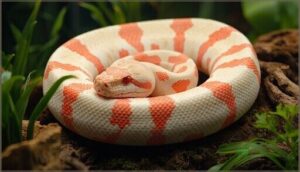
Albino corn snakes—technically called amelanistic—carry a recessive OCA2 gene mutation that completely blocks melanin production, leaving you with striking red, orange, yellow, and white color palettes instead of blacks or grays.
You’ll recognize these genetics instantly: bright ruby-red eyes from visible blood vessels beneath pigment-free tissue, vivid orange blotches on cream backgrounds, and zero dark pattern borders defining this classic morph classification.
Anerythristic Corn Snake Features
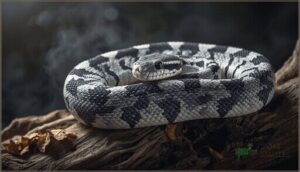
Think of anerythristic corn snakes as the grayscale rebels of the morph world—these genetics strip out erythrin pigments responsible for reds and oranges, leaving you with dramatic silver-gray patterns bordered in black.
You’ll spot hatchlings with stark white backgrounds that fade to charcoal as they mature, plus those signature gray eyes instead of ruby-red.
Anerythristic genetics follow simple recessive inheritance, making breeding predictions straightforward.
Caramel and Butter Morphs
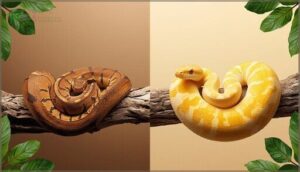
Caramel morphs reveal warm brown and yellow genetics, a recessive mutation from Rich Zuchowski’s 1991 breeding strategies that transformed Morph Market trends. Genetic testing confirms both require double recessive genes for expression, making morph development predictable through Snake Genetics principles.
When you combine caramel with amelanistic genetics, you’ll create Butter morphs featuring vibrant two-tone yellows. These corn snake morphs demonstrate how color enhancements emerge from strategic morph preservation techniques.
Other Notable Color Mutations
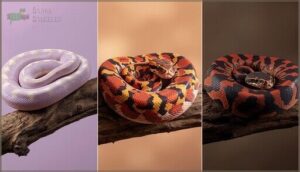
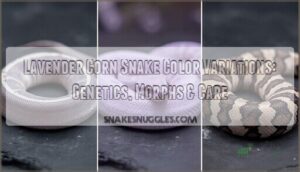
Lavender traits bring soft gray saddles over pale pink backgrounds, first surfacing in the 1980s through careful scale pigmentation studies.
Hypomelanistic genetics reduce melanin while boosting reds and oranges, creating brighter color intensity than standard amelanistic or anerythristic lines.
Okeetee patterns showcase deep-red saddles with jet-black borders, while charcoal mutations eliminate yellow entirely for dramatic pattern expression contrasts.
Pattern Morphs and Distinct Markings
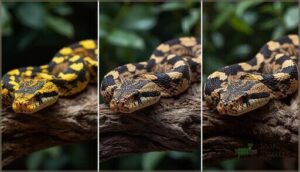
Pattern morphs break the mold just as dramatically as color variations, turning corn snakes into living canvases of stripes, tessellations, and wild asymmetry. These genetic mutations don’t just tweak existing patterns—they completely rewrite how pigment distributes across scales.
From organized stripes to unpredictable splatters, each pattern morph reveals a different chapter in selective breeding innovation.
Striped and Motley Patterns
If you’re after pattern morphs that break the traditional blotched mold, Striped and Motley corn snakes deliver radical visual shifts through a single gene—CLCN2. Both mutations eliminate the classic checkered belly but reshape the body in distinctly different ways:
- Stripe variations replace discrete blotches with four continuous longitudinal lines running nearly head to tail
- Motley expressions stretch dorsal blotches into elongated ovals or chains, reducing lateral markings markedly
- Pattern genetics reveal Motley is epistatic to Stripe, dominating when both alleles are present
- CLCN2 function disruption through regulatory downregulation (Motley) or coding mutation (Stripe) alters chromatophore behavior
- Embryonic development studies confirm altered chloride channel activity redirects pigment cell aggregation, creating linear instead of spotted patterns
You’ll find these morphs stacking beautifully with color mutations—think Striped Amelanistic or Motley Anerythristic—opening endless creative breeding combinations without neurological trade-offs.
Tessera and Diffused Variants
Dominant Tessera flips the breeding game—you’ll see its dorsal stripe and mosaic flanks in 50% of first-generation offspring, while recessive Diffused demands two-copy patience to erase ventral checks and fade dorsal blotches into Blood Red uniformity.
Combining Tessera Genetics with Diffused Patterns yields Albino Tessera and other designer Morphs where striping meets unicolor simplicity, proving strategic Morph Breeding accelerates Color Variations through Genetic Expression mastery in every Corn Snake clutch.
| Trait | Tessera | Diffused |
|---|---|---|
| Inheritance | Dominant (50% F1 visual) | Recessive (homozygous required) |
| Dorsal Pattern | Narrow spine stripe, tessellated sides | Faded/absent blotches, near-solid color |
| Belly Pattern | Variable checkering (15–100%) | Minimal to no checkering |
| Breeding Speed | Immediate visual in crosses | Multi-generation planning needed |
| Popular Combos | Albino Tessera, Anerythristic Tessera | Blood Red, Tessera Diffused |
Palmetto and Other Rare Patterns
While Tessera and Diffused push boundaries, Palmetto Genetics rewrite the leucistic playbook entirely—you’re looking at a white canvas with confetti-like speckles, first documented from South Carolina wild stock in the early 2000s. This incomplete dominant unleashes Pattern Inheritance magic:
- Heterozygotes show partial freckling, homozygotes display full Palmetto patterning
- Leucistic Traits coexist with multicolored spots from retained chromatophores
- Scaleless Morphs from European imports (circa 2012) intensify color saturation by removing scales
- Granite and pied-like Rare Patterns produce granular speckling or bold white patches
- Sinder and ultra-rare combos appear so infrequently that Morph Development tracking becomes a treasure hunt
Palmetto pricing rivals Lavender, proving Corn Snake Morphs thrive when scarcity meets stunning Genetics.
Blotches, Saddles, and Checkered Bellies
Beyond rare gems like Palmetto, you’ll decode the foundation every Corn Snake carries: 30–50 dorsal markings running neck to tail, each blotch outlined in black for crisp contrast. Wild-type animals shift these into narrower saddles, while ventral patterns flash alternating black-and-white squares—your Belly Checker blueprint that genetics dictate and snake camouflage exploits in leaf litter.
| Feature | Wild-Type Blueprint |
|---|---|
| Dorsal Markings | Red blotches, black borders |
| Ventral Patterns | Checkered black-and-white |
| Pattern Genetics | Motley/Stripe alters both |
| Functional Role | Confuses predators mid-escape |
Noteworthy Combination Morphs
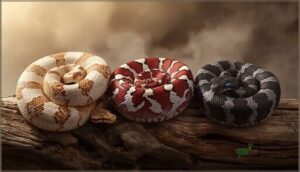
When you reveal multiple genetic traits in a single snake, you release possibilities that would make even the earliest breeders’ jaws drop. These designer morphs aren’t accidents—they’re the result of strategic pairings that stack recessive, dominant, and codominant genes to create truly one-of-a-kind animals.
Designer morphs emerge from strategic gene stacking—recessive, dominant, and codominant traits layered to create truly one-of-a-kind snakes
Here’s how breeders push genetic boundaries to produce combinations that recast what’s possible with corn snake morphs.
Designer Morphs From Mixed Genetics
You’re stepping into territory where breeding strategies get inventive—designer morphs from mixed genetics showcase what happens when breeders layer recessive traits and dominant genes to reveal compound traits never seen in nature. Gene expression becomes your canvas, and the morph market rewards innovation:
- Snow morphs combine amelanistic and anerythristic, creating pure white phenotypes with double recessive architecture
- Phantom combinations stack hypomelanistic with anerythristic for subtle gray-lavender tones
- Genetic hybridity projects like Ultra-derived lines introduce ratsnake ancestry for extreme color shifts
Popular Double and Triple Gene Morphs
When you stack recessive traits like snow (amelanistic + anerythristic) with butter (amelanistic + caramel), your breeding strategies reveal hundreds of genetic variations. Triple-gene combinations—Avalanche, Charcoal Snow, Coral Snow—push color patterns into extreme whites, grays, and pastels.
Morph pricing reflects this complexity: single-gene animals start around $100, while double and triple morphs climb to $175–$600, depending on gene expression and pattern integration.
How Combinations Influence Appearance
Genetic interactions layer color morphs and pattern genes like transparent films over a projector slide—each mutation filters, blocks, or shifts the expression of the next. When you combine amelanistic genes with motley patterns, dark saddle outlines vanish and leave clean orange discs. Stripe mutations rewrite blotch placement into longitudinal bands, and adding caramel shifts those bands from red-brown to golden tan.
- Pigment removal: Snow morphs strip both red and black, leaving white or pale yellow visual phenotypes.
- Pattern rewiring: Motley converts saddles to rounded blotches; stripe reorganizes them into continuous dorsal lines.
- Dominant overlays: Palmetto adds white with colored flecks; tessera imposes linear striping over any color base.
- Additive color shifts: Caramel genes warm anerythristic grays into beige tones, creating caramel snow combinations.
- Gene stacking: Five-trait morphs merge dominant, recessive, and polygenic influences, producing entirely novel snake morphs and color patterns through complex genetic mutations.
Care Considerations for Morph Varieties
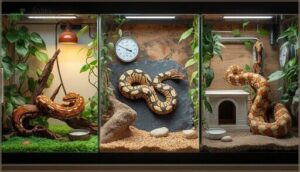
While most corn snake morphs share the same general care requirements, certain varieties demand extra attention to thrive. You’ll find that some morphs carry genetic quirks that affect their feeding response, temperature sensitivity, or vulnerability to specific health issues.
Let’s break down the key care differences you need to know for keeping your morph healthy and thriving.
Diet and Nutrition Differences
You’ll be relieved to know that corn snake morphs don’t require different diets—all varieties thrive on the same frozen-thawed rodent menu. Nutrient requirements, feeding schedules, and dietary needs remain uniform across albinos, anerythristics, and designer combos. Age and size drive your reptile nutrition planning, not color genes, so you can simplify your pet care strategy regardless of which stunning morph you choose.
| Life Stage | Feeding Interval | Prey Size Guide |
|---|---|---|
| Hatchling | Every 5–7 days | Pinkie mice matching body diameter |
| Juvenile | Every 7 days | Small mice equal to mid-body width |
| Adult | Every 10–14 days | Adult mice or small rats as needed |
Housing and Environmental Needs
Your corn snake habitat creation stays consistent across all morphs—albinos, anerythristics, and designer combos share identical terrarium design needs. Snake care and maintenance don’t shift based on color genes, making your reptile care approach refreshingly straightforward.
- Enclosure design: Provide at least 0.56 square meters for adults, with length matching or exceeding body length
- Temperature control: Maintain 88–92°F basking zones with 75–82°F cool ends using thermostats
- Humidity management: Target 40–60% baseline, boosting to 70% during shedding with humid hides
- Substrate selection: Choose coconut fiber or cypress mulch at 5–10 cm depth for burrowing
- Lighting options: Consider low-level UVB on 10–12 hour cycles for behavioral benefits
Health Concerns Linked to Specific Morphs
Most morphs won’t give you sleepless nights, but a few genetic mutations demand extra attention. Palmetto lines show eye problems in 15-20% of hatchlings, creating injury risks during handling. Scaleless variants face skin issues—40% struggle with shedding without proper humidity.
Bloodred hatchlings often present feeding challenges, preferring lizards initially.
Meanwhile, anerythristic and standard recessive traits maintain excellent snake health across generations, proving genetic disorders aren’t universal morph health risks.
Frequently Asked Questions (FAQs)
How much do rare corn snake morphs cost?
Prices span forty dollars for common varieties to four thousand dollars for scaleless Palmetto combinations, driven by rare genetics, breeder reputation, and market trends that reward complex recessive traits in corn snake morphs.
Where can I buy corn snakes safely online?
You’ll find trustworthy corn snakes on MorphMarket, which lists over 3,000 options with seller ratings and buyer protection policies.
South Mountain Reptiles and Snakes at Sunset offer health guarantees and overnight shipping for safe delivery.
Do corn snake morphs have different temperaments?
Picture a painter’s palette where each hue carries identical brushstrokes—that’s corn snake morphs and temperament. No peer-reviewed studies link specific genetics to behavior differences; handling history and environmental factors shape snake personality far more than color patterns.
Which corn snake morphs are easiest for beginners?
You’ll find that wild-type, amelanistic, and anerythristic morphs make excellent starter snakes.
These beginner morphs offer easy care, reliable feeding responses, and predictable snake handling traits without known genetic complications, simplifying your first breeding attempts.
Can different morphs be housed together successfully?
Imagine two snakes competing for the same warm spot—that’s stress in action. You shouldn’t house different corn snake morphs together.
Cohabitation risks include cannibalism, disease transmission, and chronic stress, making individual housing the safest breeding and reptile care strategy.
Conclusion
Think of your first breeding project as decoding a living cipher—each pairing reveals patterns hidden in scales and pigment. Corn snake morphs’ unique characteristics aren’t just cosmetic quirks; they’re genetic blueprints you can manipulate, stack, and polish with precision.
Master the inheritance rules, respect the health trade-offs, and you’ll move beyond collection into creation. The difference between owning exceptional snakes and engineering them starts with understanding what makes each morph genuinely distinct.
- https://phys.org/news/2025-04-gene-corn-snake-skin-pattern.html
- https://reptilesmagazine.com/color-patterns-of-corn-snakes-determined-by-single-gene/
- https://en.wikipedia.org/wiki/Corn_snake
- https://www.morphmarket.com/us/c/reptiles/colubrids/corn-snakes
- https://www.wiseguyreports.com/reports/pet-snakes-market