This site is supported by our readers. We may earn a commission, at no cost to you, if you purchase through links.
A single corn snake can carry the genetic blueprint for a dozen color outcomes without showing a hint of it on its scales. That hidden potential is what makes corn snake morphs visually appealing in ways few other reptiles match.
Three pigment cell types, melanophores, xanthophores, and iridophores, interact in combinations that produce everything from smoky lavender to molten orange. Breeders have learned to read these genetics like a map, predicting hatchling colors before the eggs crack.
Pattern, scale texture, and age-driven color shifts layer over each other, turning each snake into something genuinely worth understanding.
Table Of Contents
- Key Takeaways
- What Makes Corn Snake Morphs Visually Appealing?
- Best Red, Orange, and Golden Morphs
- Best Black, White, and Pastel Morphs
- Most Eye-Catching Pattern Morphs
- Rare Designer Corn Snake Morphs
- Frequently Asked Questions (FAQs)
- What is a color morph corn snake?
- Can you identify corn snake morphs without a PhD?
- How do corn snake morphs form?
- How many morphs are there in a corn snake?
- What does Anery corn snake morph look like?
- Is the motley corn snake a morphological pattern?
- How do corn snake morphs affect temperament?
- Which morphs require special lighting or care?
- Can different morphs be housed together safely?
- Do certain morphs have shorter lifespans?
- Conclusion
Key Takeaways
- Corn snake color comes down to three pigment cell types — melanophores, xanthophores, and iridophores — and understanding how they interact unlocks why morphs look so dramatically different from one another.
- Pattern mutations like Motley, Stripe, and Tessera don’t just tweak a snake’s appearance; they completely rewire how markings are arranged, and stacking them with color genetics multiplies the visual outcomes fast.
- A snake’s coloring isn’t fixed at hatching — ontogenetic shifts mean reds can soften, yellows deepen, and blacks strengthen through the first few years, so the adult look often surprises even experienced breeders.
- Rare designer morphs like the Palmetto and Scaleless command prices up to $2,000 because their visual drama comes from complex multi-gene combinations that take years of selective breeding to reliably produce.
What Makes Corn Snake Morphs Visually Appealing?
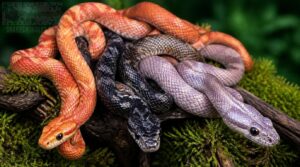
Corn snake morphs stand out because color, pattern, and texture can shift in strikingly different ways. Some traits change pigment, while others redraw the snake’s familiar saddle pattern or alter its scales. The key features to look for are listed below.
Understanding which traits affect pigment versus pattern helps you appreciate just how diverse these animals can be — explore a full breakdown of corn snake morph types and what makes each one unique.
Color Pigment Genetics
Because pigmentation genetics controls each chromatophore type, morph colors can shift dramatically. Amelanistic snakes lack dark melanin, exposing reds and oranges, while anerythristic animals reduce red pigment for silvery gray tones.
Hypomelanistic genes soften black outlines. Lavender genetics alters pigment density and light reflection, producing smoky purples. Together, melanophores, xanthophores, and iridophores create colors that look painted into every scale. Reptile coloration also relies on three pigment cell types, which produce melanin, warm carotenoid hues, and reflective structural colors.
Pattern Inheritance
Pigments set the palette; pattern inheritance arranges it into blotches, stripes, and connected shapes. Dominant genes can appear with one allele, while recessive traits need two.
A snake may be a heterozygous carrier, hiding a pattern allele yet passing it on. Breeders use a Punnett Square Calculator to estimate offspring outcomes, especially when combining stripe, tessera, or diffused lines.
Scale Texture Variations
Genes arrange the pattern, but scalation differences shape how that pattern catches light. Smooth, tightly overlapping dorsal scales can look glossy, while slightly raised micro-ridges create a satin or matte finish.
Look closely at the belly, too. Ventral scales may appear broader or more reflective. Compound morphs and designer morphs can boost these effects. A Scaleless morph lacks most body scales, producing a striking, leather-like surface.
Color Changes With Age
A corn snake’s finish changes as it grows. Ontogenetic coloration often makes hatchlings brighter, then deepens, dulls, or shifts hues through the first year and into maturity.
Color genetics set the potential, but color expression develops gradually. Yellow and orange may intensify, while reds can soften and black or blue areas may strengthen or fade. These phenotypic changes can subtly rebalance inherited pattern contrast.
Identifying Combined Traits
Once you learn to read trait interactions, a corn snake becomes a genetic map. A Motley morph may break saddles into latticework, while a Stripe morph pulls pigment into a dorsal ribbon.
Look for clues: Tessera blocks, Palmetto speckling, or the finish of a Scaleless morph. Confirm lineage, because appearance can mislead.
Best Red, Orange, and Golden Morphs
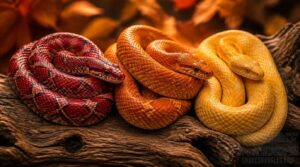
Red, orange, and golden corn snake morphs bring the species’ warmest colors into sharp focus. Some emphasize saturated crimson, while others shift toward amber, honey, or soft buttery yellow. The following morphs show how dramatically those warm tones can develop.
Blood Red
Blood Red morphs turn a corn snake into a living ember: saturated crimson covers the back while the usual belly checkerboard fades or disappears. The recessive diffused trait reduces dark borders and concentrates visual impact after successive sheds.
Pairing the diffused gene with other recessive traits like caramel or snow can push Blood Reds even further—explore how these combinations interact across corn snake morph genetics and visual phenotypes.
Unlike a Crimson morph, Fire morph, Caramel morph, or Honey morph, this look prizes clean red depth over complex contrast. Good husbandry preserves color clarity.
Crimson
A Crimson morph pairs hypomelanistic color genetics with selectively bred Miami-phase influence, producing red-orange saddles edged in dark pigment over a cool silver-gray ground. Rather than one simple gene, the look reflects line breeding, pattern inheritance, and occasionally stacked recessive traits in designer morphs.
- Brick-red dorsal blotches
- Smoky gray background
- Crisp black edging
Expect intensity to strengthen with age; choose animals with contrast and parentage.
Fire
Fire is the red-hot showcase of corn snake color genetics: amelanism removes black melanin, while Diffused softens the usual saddle pattern and clears the checkerboard belly. Selective breeding turns that recipe into snakes that can look almost lacquered in crimson or glowing red-orange.
- A hatchling’s bold markings promise transformation.
- Adults develop a cleaner, molten-red appearance.
- The pale, patternless underside feels unexpectedly refined.
- Their intensity makes designer morphs feel limitless.
Inspect parental photos: faint pattern may persist; snakes sell for $70–$250, while saturation and lineage can raise the price.
Tracking each snake’s lineage and color shifts over time is much easier with a dedicated reptile breeder photo album, letting you document how saturation deepens across generations.
Caramel and Honey
Caramel turns ordinary yellow into burnished gold, often deepening orange midtones while keeping the saddle pattern visible. Lineage matters, because intensity varies between families.
Honey combinations can glow like warm amber. Seek Sunkissed Ultramel for layered gold and peach, or ambitious builds such as Hypo Shatter Tessera Scaleless and Ultramel Anery Pinstripe Motley Scaleless for striking designer contrast.
Butter
Butter morphs look like sunlight filtered through cream, replacing dark contrast with yellows, golds, and peach. Their phenotype results from amelanistic and caramel recessive traits: black melanin is absent, while brown tones are reduced.
Because both genes are recessive, selective breeding matters. Pair two visual Butters and every hatchling should be Butter, making them foundations for designer combinations. Prices often fall near $100 to $200.
Best Black, White, and Pastel Morphs
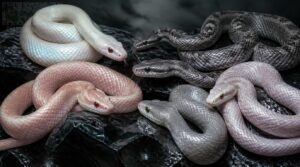
Black, white, and pastel corn snake morphs replace the species’ familiar warm tones with silver, charcoal, cream, and soft pink.
Their appeal comes from pigment reduction and light-reflecting scales, often becoming even more striking as the snake matures.
Here are five standout morphs to check out.
Anerythristic
Because red pigment is suppressed, Anerythristic Anery corn snakes trade warm reds for pale yellow, tan, silver, and sharply defined black saddles. Their dark eyes and clean lateral edges give the pattern a crisp, ink-on-parchment look.
This recessive trait contrasts strongly with Amelanistic lines. Combined with Amelanistic, it produces a Snow morph; further combinations can create Blizzard morph and Coral Snow morph variations.
Charcoal
Where Anerythristic often reads as silver and cream, the Charcoal morph brings a cooler, smokier palette. This recessive mutation alters pigment distribution, suppressing red while retaining strong black and gray pattern elements.
A snake must inherit the gene from both parents, making it homozygous recessive. Melanin production remains prominent, so dorsal saddles appear charcoal-black against a gray base that often brightens with age. Clean-lined, dramatic, and ideal for breeders building cool-toned designer projects.
Blizzard
Cool charcoal tones can vanish almost completely in a Blizzard. This compound corn snake carries amelanistic and charcoal genes as a homozygous recessive combination, producing a near-patternless animal with red eyes. Unlike an anerythristic snake’s silver-gray contrast, a Blizzard matures like fresh snow under bright light.
- Hatchlings often begin glossy pink
- Adults become clean white
- Faint yellow may remain below
- Juveniles usually cost $100–250
Ghost markings sometimes linger, especially along the belly in adults.
Snow
Where a Blizzard trends toward nearly blank white, a Snow morph retains a delicate pastel map. It is a homozygous recessive pairing of amelanistic and anerythristic type A genes, removing black and red pigment while leaving pink, lavender, and cream saddles with ruby eyes.
Hatchlings usually show the strongest color. Over roughly three years, many soften into pale cream-and-white adults, though lighting and individual genetics can preserve subtle pattern contrast.
Opal
The Opal morph pairs amelanistic and lavender genes into a double recessive combination that silences xanthophores and erythrophores, exposing subtle structural color in faint pink-purple saddles on a cream-white ground.
That phenotype leans subtle, not flashy, but the muted palette has real visual coherence when viewed under natural light. Pricing ranges from $65 to $100, which makes Opal one of the most accessible compound morphs you can collect.
Most Eye-Catching Pattern Morphs
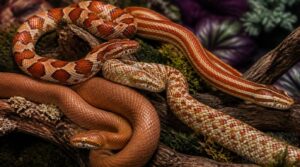
Color is only half the story with corn snakes—pattern is where things get genuinely wild. Mutations like Motley, Stripe, Tessera, and Diffused don’t just tweak the design; they completely rewire how markings are arranged across the body.
Here are the pattern morphs worth knowing, including what happens when breeders start stacking them with color genetics.
Motley
Motley rewires how blotch patterns form, fusing elongated dorsal markings anteriorly while eliminating the lateral spots you’d normally see in wild-type corn snakes.
Five reasons collectors prize this morph:
- Cleaner flanks with no scattered spots
- Mostly white ventral scales, no checkerboard
- Consistent pattern inheritance across generations
- Varied intensity in heterozygous offspring
- Wide pattern variations within a single clutch
That versatility is why Motley works as a reliable foundation for designer morphs priced between $80 and $200+.
Stripe
Unlike wild-type blotches, the Stripe morph replaces them with longitudinal dorsal stripes running neck-to-tail, controlled by a homozygous recessive genotype allelic to Motley. Pattern genetics here eliminate lateral spots entirely, leaving clean flanks and a white ventral with no checkerboard.
Three traits collectors notice first:
- Dorsal bands fragment into segmented dashes near the tail
- Reduced head markings produce a striking "evil eyebrow" effect
- Lateral framing gives the flanks clean, uncluttered visual contrast
Morph inheritance stacks neatly onto amelanistic or anerythristic backgrounds, making Stripe a flexible designer base priced at $100-$200.
Tessera
The Tessera takes its name from tile work: a narrow dorsal stripe, usually tan or pale orange, bordered by dark pigment, creates strikingly crisp linear patterning along the spine. Lateral markings echo an intricate maze.
Pattern genetics here favor breeders. Morph inheritance follows a dominant trait, so the phenotype surfaces in F1 offspring. Hatchlings run $100-$200, with premium combos reaching $500-$600.
Diffused
Where the Tessera demands attention through sharp lines, Diffused works in the opposite direction. Saddles gradually fade into the ground color, and the ventral surface loses its checker pattern entirely, leaving nearly solid white bellies instead.
This is a recessive trait, so pairing two carriers is essential for phenotype expression. Breeders prize it as the key genetic foundation for Blood Red morphs, where combined masque genes intensify pigmentation into deeply saturated, nearly patternless specimens.
Color-Pattern Combinations
When you stack distinct genetics, results multiply fast.
Pairing the Tessera morph with amelanistic removes black pigment entirely, sharpening tiled blocks into vivid orange-on-white contrast.
Run anerythristic through a Diffused morph background and red vanishes completely, leaving cool gray blends.
The Palmetto morph layers bold central banding over mixed base colors, making it a natural anchor for complex multi-gene projects.
Rare Designer Corn Snake Morphs
Some corn snakes push well beyond standard color and pattern combinations into genuinely rare genetic territory. These designer morphs are the result of complex multi-gene pairings, selective lineage work, and sometimes years of careful breeding — and they show it in every scale.
Here’s what sets the most sought-after designer morphs apart.
Palmetto
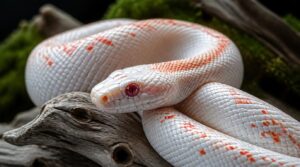
Few corn snakes stop you mid-scroll quite like the Palmetto morph. Its white body carries pixel-like orange-red speckles, produced by combining amelanistic and anerythristic genetics into a single, exceptionally rare phenotype. Only two wild specimens have ever been documented.
The Palmetto morph’s white body dusted with pixel-like orange-red speckles is so rare only two wild specimens have ever been documented
Pricing always reflects that rarity. Expect $350 to $2,000, with females commanding higher prices due to their value in breeding strategies.
Tracking bloodlines and pairing outcomes gets much easier with a dedicated reptile genetics log book, especially when working with high-value morphs like the Palmetto.
Scaleless
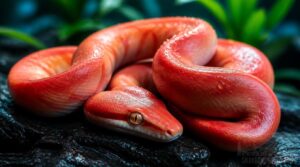
The Scaleless morph takes things even further than the Palmetto’s visual drama. Its scaleless trait strips away traditional scalation entirely, revealing smooth, leather-like skin where colors appear strikingly vivid. This phenotype is driven by recessive genetic inheritance patterns, meaning both parents must carry the gene.
- Colors appear brighter, more saturated without scale texture diffusing light
- Humidity around 50 to 60 percent is critical for comfortable, complete sheds
- Specimens range from $500 to $2,000 depending on lineage
Coral Snow
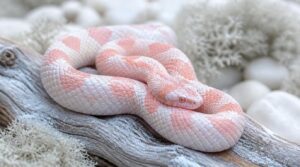
Where the Scaleless morph shocks with texture, the Coral Snow stuns with restraint. This morph stacks two recessive mutations, amelanistic and anerythristic, together to produce a pale, creamy base marked by soft pinkish-orange saddles and almost no dark outlining. The look is frosted rather than washed out.
Juveniles usually sell for $120 to $225, making it one of the more accessible rare color morphs worth adding to your collection.
Designer Morph Pricing
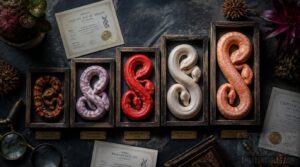
Designer morph pricing follows a clear logic: rarity, lineage, and gene complexity push costs up fast. Double and triple recessive combinations routinely exceed $500, while quad morphs can cross four figures. A solid corn snake morph pricing guide can help breeders benchmark fair market value before listing or buying high-end combinations.
Heterozygous carriers often sell cheaper but remain essential to long-term breeding strategies. Market pricing also rewards documented genetic health, so verified paperwork genuinely moves the needle on what buyers will pay.
Specialized Morph Care
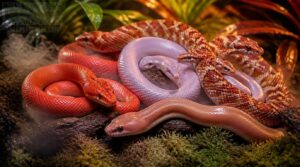
Rare morphs demand husbandry that matches their genetic complexity. Keep temperature gradients at 80-90°F and humidity between 40-60% to protect vivid pigmentation and prevent retained shed.
Feed juveniles every 5-7 days with calcium-dusted prey to actively support color development. Track shedding cycles closely, since high-contrast genetic variations make these morphs more vulnerable to skin and bacterial issues.
Frequently Asked Questions (FAQs)
What is a color morph corn snake?
A color morph in corn snakes is a selectively bred variant of Pantherophis guttatus where specific genetic mutations alter chromatophore function, shifting pigmentation or pattern away from the wild-type phenotype through recessive or dominant traits.
Can you identify corn snake morphs without a PhD?
You don’t need a lab coat. Visual recognition covers most Corn Snake Morphs, note base color, saddle shape, and eye tone. Complex pattern inheritance from selective breeding, like amelanistic or anerythristic traits, needs genetic testing.
How do corn snake morphs form?
Morphs start as random genetic mutations in wild snakes. Breeders spot these variants, then use selective breeding to isolate and boost traits across generations, turning a single lucky gene change into a reliably heritable look.
How many morphs are there in a corn snake?
Do the morph: over 800 Corn Snake Morphs now exist in captivity, each produced through selective breeding and chromatophore manipulation targeting melanophores, xanthophores, iridophores, and a growing catalog of calculable genetic mutations shaping every appearance.
What does Anery corn snake morph look like?
Anerythristic snakes carry recessive genes that eliminate erythrin while letting melanin production continue uninterrupted. Homozygous individuals emerge fully grayscale, with dark charcoal saddles, pale silver sides, and a ventral surface patterned in bold black-and-white checks.
Is the motley corn snake a morphological pattern?
Yes, the motley pattern is a morphological mutation, not a color change. Picture a breeder pairing two motley corn snakes and watching wild-type saddles dissolve into dots and circles, while the pigment genetics stay unchanged.
How do corn snake morphs affect temperament?
Color and pattern genes don’t wire personality. Handling history and clutch origin shape temperament far more than any morph designation. Some breeders notice calmer responses in lavender lines, but individual variation always wins.
Which morphs require special lighting or care?
Not every morph plays by the same rules. Light sensitive albinos need shaded retreats. All morphs need a precise thermal gradient: basking area at 88°F, warm side temperature near 82°F, cool side temperature around 75°F.
Can different morphs be housed together safely?
Housing different corn snake morphs together is technically possible, but cannibalism risk, disease transmission, and compromised genetic diversity make it genuinely risky. Strong husbandry practices and strict biosecurity measures help, yet individual housing is safest.
Do certain morphs have shorter lifespans?
Can a stunning gene also shorten a snake’s life? Most morphs reach 15–20 years, but homozygous recessive mutations can trigger neurological issues worsened by inbreeding effects. Genetic testing before breeding is how you prevent it.
Conclusion
The best canvas is one that paints itself differently every season.
What makes corn snake morphs visually appealing goes deeper than surface color. It’s a genetic truth written in pigment, pattern, and scale texture. From blood red to scaleless palmetto, each morph tells a story your eyes keep re-reading.
Understanding the biology behind that beauty will change how you see and choose them. You’re not just keeping a snake. You’re keeping a living genetic puzzle.