This site is supported by our readers. We may earn a commission, at no cost to you, if you purchase through links.
Most ball pythons don’t bite without warning. They telegraph stress through posture, muscle tone, and movement long before teeth enter the equation—but only if you know what to read.
tight defensive ball looks almost identical to a comfortable resting curl to a new keeper, and that misread is where most handling incidents start.
Defensive ball python body language follows a predictable sequence: subtle tension first, then escalation. Catch the early signals, and you redirect the interaction before it goes wrong. Miss them, and you’re reacting instead of responding.
Table Of Contents
- Key Takeaways
- Defensive Balling and Tight Coils
- Strike Warnings and Escape Signals
- Stress Triggers Behind Defensive Behavior
- Safe Responses to Defensive Postures
- Top 9 Ball Python Care Products
- 1. Designer Ball Python Morph Breeding Guide
- 2. New Keeper’s Guide to Ball Pythons
- 3. Ball Python Manual CompanionHouse Guide
- 4. Ball Python Care Guide for Beginners
- 5. Ball Python Care Handbook
- 6. Ball Python Keeper Handbook
- 7. Ball Python Care Logbook
- 8. Quilax White Snake Climbing Toy
- 9. Horsmiyala DIY Snake Climbing Ring Set
- Frequently Asked Questions (FAQs)
- Conclusion
Key Takeaways
- A defensive ball python telegraphs stress in a predictable sequence—tight coils, tucked head, rigid muscles, and rapid breathing—long before it ever strikes, so catching those early signals lets you redirect instead of react.
- S-shaped neck posture is your clearest pre-strike warning; the moment you see it, stop moving and give the snake space, because that curve means strike energy is already loaded.
- Most defensive episodes trace back to fixable triggers—missing hides, wrong temperature gradients, handling too soon after feeding, or the vulnerability of a shed cycle—so reading behavior is really diagnosing the environment.
- Persistent defensiveness that doesn’t ease with proper husbandry can signal illness, not just stress, so watch for wheezing, open-mouth breathing, or rapid weight loss and treat those as vet-visit emergencies, not handling problems.
Defensive Balling and Tight Coils
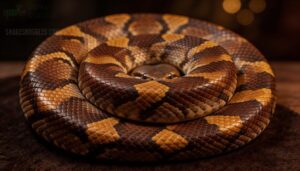
Not every curl means your ball python is comfortable — some are a quiet cry for space. Knowing the difference between a relaxed rest and a defensive ball can change how you respond in the moment.
Learning to read these subtle cues gets easier when you understand which python species are naturally calmer and easier to handle.
Here’s what to look for.
Difference Between a Resting Curl and a Defensive Ball
At first glance, a resting curl and a defensive ball can look similar — but the differences matter.
- Coil Relaxation: Resting coils stay loose; defensive coils compress tightly
- Muscle Stiffness: A calm snake feels soft; a stressed one feels rigid
- Breathing Pattern: Slow and steady at rest; faster under threat
- Enclosure Comfort: Relaxed snakes shift postures easily
- Tight Ball: Defensive balling is a coiled defense mechanism — fear, not comfort
Understanding ball python body language helps identify stress signs.
Head Tucked Inside Coils Vs Relaxed Head Position
Head visibility tells you a lot.
relaxed head resting on coils signals security — the snake isn’t sealing itself off.
But when ball python body language shifts toward a defensive posture in snakes, head tucking mechanics kick in fast.
That tucked head is a stress indicator, not rest.
It’s a coiled defense mechanism in ball pythons.
Treat it as a handling cue: give space.
tight coiling stress indicator helps identify discomfort.
Tight Muscle Tension and Compact Body Shape
Once the head tucks in, feel what the body does next. A defensive ball python becomes a tight knot — coils locked, muscles hardened, body compressed into its smallest possible shape.
These muscle tightness indicators tell you the snake is in full threat mode.
That compact shape benefits the snake by shielding vulnerable areas.
Tension release signals come later: softening coils, looser density, relaxation posture shifts back toward rest.
When Balling Up Means Fear, Not Comfort
Tight muscles and a compressed shape tell only part of the story. Balling behavior in ball pythons signals genuine fear when you also see rapid breathing — visible side-to-side movement at elevated heart rate — paired with hissing, sometimes reaching startling decibel levels.
Refusal to uncoil and persistent coil posture confirm it.
That’s not comfort. That’s a snake telling you it feels cornered.
A balled-up snake isn’t resting — it’s telling you it feels cornered
How Long Defensive Coiling Should Last
Defensive coiling shouldn’t last your whole handling session. Watch these coil tension dynamics closely:
- Relaxation Timeframe: Most snakes loosen within 5–10 minutes if stress is low.
- Coil Duration Limits: A tight ball held past 10 minutes signals too much pressure.
- Session Length Guidelines: Cap sessions at 5–15 minutes for defensive individuals.
- Posture Fade Timing: Tongue-flicking and loose muscles mean the coiled defense mechanism in ball pythons is fading.
Handling frequency impact is real — daily sessions keep stress escalation ladder climbing.
Strike Warnings and Escape Signals
Before a ball python bites, it almost always tells you first. Learning to read those warnings gives you a real chance to back off before things escalate.
Here are the key signals to watch for.
S-shaped Neck Posture Before a Strike

The S-shaped stance is your clearest pre-strike warning. When a ball python forms that curve, neck muscle tension is already building — the body is storing pre-strike energy, coiled and ready. This isn’t a relaxed curl. The posture timing matters: it appears fast and locks in.
Enclosure layout influence is real, too — snakes with nowhere to retreat default to defense.
Respect the S. Back off.
Elevated Head and Locked-on Focus

Once a ball python raises its head and locks onto something, the snake has already moved past threat assessment — it’s in full defensive mode. That elevated posture isn’t curiosity. It’s a target lock backed by neck tension, with visual fixation narrows fast.
Watch for these focused gaze cues:
- Head held high and still
- Eyes tracking your movement
- Neck slightly curved, not relaxed
- Body tightening beneath the raised head
- No headweaving — just locked-on stillness
Jerky Head Movements and Sudden Tension

sharp, stop-start head snap is different from calm exploration — it signals the snake is tracking you as a threat. These Pre-Strike Jerks appear with sudden Tension Spike Triggers, like unexpected movement or handling pressure.
| Body Stiffness Patterns | Head Snap Timing | Stress Escalation Ladder |
|---|---|---|
| Body firms up fast | Before freeze or flight | Early warning stage |
| Coils compress tighter | Mid-tracking movement | Escalating defensiveness |
| Full rigid posture | Immediate pre-strike | Critical — stop handling |
Jerky head movements paired with neck tension mean one thing: stress reflexes firing.
Hissing as a Defensive Warning

That hiss isn’t aggression — it’s a forced exhale through the glottis, a core part of ball python body language that says ‘back off.’ Hissing Mechanics work like a built-in alarm: Stress-Related Hissing spikes when the snake feels cornered or exposed.
Hissing Frequency and Hissing Contexts tell you how alarmed it’s. Hissing Management starts with pausing — immediately.
Rapid Retreat Toward Hides or Enclosure Corners

When your ball python bolts for a corner, that’s not curiosity — it’s a stress signal demanding attention. Rapid retreat is core ball python body language and stress signals in action.
- Poor Hide Placement Strategy leaves snakes with no safe exit
- Corner Preference Patterns reveal lighting influence and enclosure layout flow issues
- Noise Sensitivity accelerates hiding behavior under bright or active conditions
- Inadequate hide access and enclosure design force constant repositioning
Why Avoidance Usually Comes Before Biting

Avoidance is always the first move. Before any defensive strike occurs, your ball python runs a quick internal calculation — perceived threat level, escape path obstruction, handler approach speed — and acts on that assessment.
| Signal Stage | Ball Python Response | Your Move |
|---|---|---|
| Low threat | Slow retreat | Give space |
| Mid threat | Tight ball, hissing | Stop handling |
| High threat | Defensive strike | Back off immediately |
Stress Triggers Behind Defensive Behavior
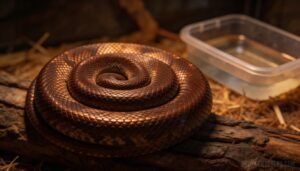
Defensive behavior doesn’t come out of nowhere — something in the snake’s environment or routine is almost always driving it. Ball pythons are remarkably consistent creatures, so when they go defensive, a specific trigger is usually responsible.
Here are the most common stress triggers worth checking first.
Missing Hides and Feeling Overexposed
Without at least two properly sized hides, your ball python can’t satisfy its thigmotaxis comfort needs — that instinct to press against solid surfaces on all sides. Overexposure symptoms show up fast: constant wall-rubbing, corner-wedging, and refusal to eat.
Hide placement strategy matters too. One on each end, tight enough to count.
Visual barriers and enclosure privacy aren’t optional — they’re foundational to calm behavior.
Incorrect Temperature and Humidity Levels
Temperature gradient imbalance hits harder than most keepers expect.
When the warm side drops below 88°F or climbs past 92°F, you’ll see tighter coiling, longer hiding, and increased defensive posturing.
Low humidity shedding problems compound the stress fast — stuck shed means discomfort.
Excessive moisture risks push respiratory issues.
Thermostat failure effects show immediately in behavior.
Overheating symptoms include pressing against glass and frantic repositioning.
Handling Too Soon or Too Often
Even after nailing temperature and humidity, handling frequency trips up many keepers.
Respect the Initial Acclimation Period — two weeks minimum before first contact. Ignore it, and you’ll see:
- Tight defensive balling every session
- Early stress signals like rapid tongue-flicking and rigid posture
- Defensive striking from a snake that never settles
The Post-Meal Handling Window matters too. Wait 48 hours after feeding.
New Enclosure Acclimation Stress
Moving ball python into a new home triggers immediate defensive responses — this is normal. Unfamiliar scent transfer, sudden changes in enclosure layout, ambient noise, and lighting schedule all register as threat cues.
| Acclimation Factor | What to Do |
|---|---|
| Acclimation Duration | Allow 5–7 days minimum |
| Enclosure Parameters | Maintain 80–85°F warm side |
| Scent Transfer | Use familiar substrate if possible |
| Early Stress Signals | Expect tight coiling, hiding |
| Stress Escalation Ladder | Skip handling entirely at first |
Shedding-related Defensiveness
When your ball python enters the Blue Phase, its Vision clouds over and defensive behavior in snakes spikes fast. Pre-shed Hiding increases, Handling Restrictions apply — don’t reach in.
Shedding cycle and mood changes go hand in hand; Humidity Management directly affects outcome.
Poor levels risk Retained Shed, which extends discomfort and escalating stress signals. Watch the ball python body language — behavioral change here is temporary, not character.
Feeding-day Sensitivity and Prey Anticipation
Feeding day rewires your snake’s focus completely. A Tongue Flick Surge, faster head tracking, and an S-shaped neck are all behavioral cues for feeding response — not aggression. Prey Cue Conditioning means your snake learns the routine.
- Skip handling 24–48 hours post-feeding
- Maintain Feeding Routine Consistency
- Watch for early stress signals during Handling Timing
- Let Post-Meal Calm reset before interaction
Safe Responses to Defensive Postures
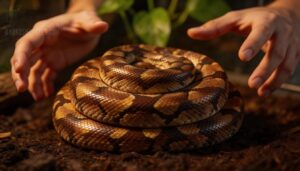
knowing when to back off is just as important as knowing how to hold your snake. Once you spot defensive postures, your next moves matter more than you might think.
Here’s exactly what to do — and watch for — when your ball python signals it’s had enough.
When to Stop Handling Immediately
Some signals aren’t suggestions — they’re emergency stops.
| Signal | What It Means | Your Move |
|---|---|---|
| Tight ball, head tucked | Peak defensive stress | Set down immediately |
| S-curve neck, raised head | Behavioral escalation, strike-ready | Stop all movement |
| Hissing + mucus discharge | Possible respiratory distress | End session, monitor closely |
Recognizing ball python body language and stress signals early protects both owner safety and your snake’s trust.
How to Return a Stressed Ball Python Calmly
The return is just as important as the handling session itself.
- Use the Gentle Return technique: angle your forearm toward the hide entrance and let the snake drift in rather than dropping it.
- Grip Support matters — keep both hands under the mid-body until it’s fully inside.
- Dim Lighting reduces visual exposure and helps a stressed snake settle faster.
- Slow Pacing during reentry keeps it in exploration mode, not flight mode.
- Quiet After Return is non-negotiable — close the enclosure and step back for 15–30 minutes.
Understanding ball python body language and stress signals guides every step here.
Ways to Reduce Defensive Body Language Over Time
real fix. Low-stress handling techniques — short sessions, slow movements, predictable timing — build trust gradually.
consistent feeding schedule removes uncertainty, and calm ambient noise keeps the environment from feeling unpredictable.
Minimal enclosure vibration and proper enclosure and environmental management for ball pythons matter more than people expect.
Understanding ball python body language helps you recognize when your approach is actually working.
Signs The Snake is Settling Back Down
Once those low-stress habits take hold, the changes in ball python body language become readable.
Relaxed muscle tone replaces that tight, coiled-into-a-ball defensiveness. The head moves outside the coils. Slow tongue flicking and smooth movement return. Steady breathing settles in.
When your snake holds a normal resting posture without flinching at your approach, that’s real progress.
When Defensive Behavior May Signal Illness
Sometimes defensiveness isn’t just fear — it’s pain talking.
If your snake stays tight and reactive even after enclosure conditions check out, look closer. Illness often hides behind body language:
- Wheezing or open-mouth breathing signals Respiratory Distress
- Swollen gums or discharge points to Mouth Rot Indicators
- Darkened belly scales suggest Scale Rot Symptoms
- Gradual thinning reveals Weight Loss Correlation with internal Parasite Stress
Red Flags That Warrant a Reptile Vet Visit
Some signs go beyond stress — they’re emergencies.
Get to a reptile vet same day if you see open-mouth breathing or wheezing (Respiratory Distress), repeated meal regurgitation (Gastrointestinal Emergencies), star-gazing or rolling (Neurological Issues), blistered or ulcerated scales (Skin Eye Infections), or sudden weight loss despite normal care.
Severe Trauma, bloody discharge, or any behavioral signs of illness that worsen overnight don’t wait.
Top 9 Ball Python Care Products
Good care starts with the right tools in your corner. Whether you’re just getting started or fine-tuning your setup, these resources cover behavior, husbandry, and enrichment from every angle.
Here are nine products worth having on your radar.
1. Designer Ball Python Morph Breeding Guide

The Designer Ball Python Morph Breeding Guide is built for keepers who want to move beyond basic care into the genetics behind their animals.
At $14, it covers dominant, recessive, and co-dominant morph mechanics in plain terms — so you actually understand why pairing two Pastels produces Super Pastels, or why certain combos risk neurological issues like wobble.
It connects breeding decisions to real outcomes, including female weight thresholds, incubation settings, and hatchling selection.
Practical, direct, and worth having on the shelf.
| Best For | Ball python keepers who are ready to move past basic care and start breeding intentionally — especially those who want to understand the genetics behind their morphs. |
|---|---|
| Product Type | Book/Guide |
| Price | $14.00 |
| Ball Python Use | Yes |
| Experience Level | Intermediate/Advanced |
| Language | English |
| Format | Paperback |
| Additional Features |
|
- Breaks down morph genetics (dominant, recessive, co-dominant) in plain, easy-to-follow language
- Covers the full breeding process, from female weight thresholds to incubation and hatchling selection
- A lot of practical value for only $14
- Not ideal for total beginners — you’ll get more out of it if you already have some reptile experience
- Focused entirely on ball pythons, so it won’t help if you keep other species
- How useful it is depends a lot on whether you can actually apply what you read
2. New Keeper’s Guide to Ball Pythons

The New Keeper’s Guide to Ball Pythons is built for exactly where you’re right now — at the beginning, with more questions than answers.
At $21.99, it walks you through enclosure setup, heat gradients, feeding schedules, and basic body language in plain, step-by-step terms.
What makes it useful isn’t just the information — it’s the order. Everything is sequenced the way a new keeper actually needs it.
Start here before anything else.
| Best For | New snake owners who want a straightforward, no-fluff guide to getting their ball python set up and thriving from day one. |
|---|---|
| Product Type | Book/Guide |
| Price | $21.99 |
| Ball Python Use | Yes |
| Experience Level | Beginner |
| Language | English |
| Format | Paperback |
| Additional Features |
|
- Written from a beginner’s perspective, so it actually speaks your language
- Covers the essentials — enclosures, heat, feeding — in a logical order that makes sense
- At $21.99, it’s a low-cost way to avoid expensive rookie mistakes
- Not much value if you’ve already got experience with ball pythons
- Only covers ball pythons, so it won’t help if you’re keeping other species
- Some folks might hesitate at the price for a guide they can only use once
3. Ball Python Manual CompanionHouse Guide
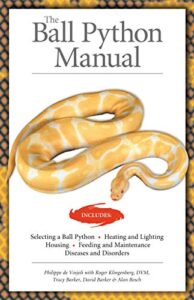
The Ball Python Manual by Philippe de Vosjoli is one of the most recognized starter references in reptile keeping. At 88 pages, it’s compact enough to finish in a sitting, covering selection, acclimation, housing, health care, and breeding.
It won’t overwhelm you with theory — it gets straight to what you need. Worth noting: some keepers find it light on behavioral detail and shedding guidance.
Use it as your foundation, then layer in more specific resources as your experience grows.
| Best For | Beginners who are just getting into ball python ownership and want a quick, no-fluff starting point. |
|---|---|
| Product Type | Book/Guide |
| Price | Not listed |
| Ball Python Use | Yes |
| Experience Level | Beginner |
| Language | English |
| Format | Paperback |
| Additional Features |
|
- Written by respected herpetologists, so the info is legit
- Covers all the basics in one slim, easy read — housing, feeding, health, and breeding
- Great launching pad before diving into more advanced resources
- Pretty thin on behavioral detail, which matters more than you’d think
- Zero coverage of shedding — a gap that’ll leave new owners Googling anyway
- Too surface-level for anyone with more than a few months of experience
4. Ball Python Care Guide for Beginners

If you’re just starting out, this one earns its spot on the shelf. The Ball Python Care Guide for Beginners covers exactly what new keepers need most — housing setup, feeding, behavior, and health — in 109 pages that don’t waste your time.
At $13.99, it’s an easy yes. You’ll find practical guidance on temperature ranges, hide placement, and reading your snake’s signals before problems escalate.
It won’t replace hands-on experience, but it gives you a solid foundation to build from.
| Best For | New snake owners who want a straightforward, no-fluff starting point for ball python care. |
|---|---|
| Product Type | Book/Guide |
| Price | $13.99 |
| Ball Python Use | Yes |
| Experience Level | All Levels |
| Language | English |
| Format | Paperback |
| Additional Features |
|
- Covers all the essentials — housing, feeding, behavior, and health — in one place
- At $13.99, it’s a low-risk buy that punches above its price
- Short enough (109 pages) that you’ll actually finish it
- Too surface-level for experienced keepers looking for advanced care info
- Published April 2025, so some research or practices may already be dated
- Doesn’t replace the learning that only comes from hands-on time with your snake
5. Ball Python Care Handbook

Step-by-step is the right approach when you’re still figuring out what your snake is actually telling you. Ball Python Care Handbook is built for that stage.
It walks through habitat setup, temperature zones, humidity, and defensive body language in plain language across 105 pages. You’ll find a practical handling protocol, a care log template, and a clear breakdown of when defensive behavior is normal versus when it’s a red flag.
At under a quarter-inch thick, it’s an easy enclosure-side reference.
| Best For | New ball python owners who want a clear, practical guide to setting up their snake’s home and learning how to read its behavior. |
|---|---|
| Product Type | Book/Guide |
| Price | Not listed |
| Ball Python Use | Yes |
| Experience Level | All Levels |
| Language | English |
| Format | Paperback |
| Additional Features |
|
- Covers all the essentials—habitat, temperature, humidity, feeding, and handling—in one slim, easy-to-reference book
- Practical tools like a care log template and handling protocol make it genuinely useful day-to-day
- Plain language makes it approachable even if you’re still early in your reptile-keeping journey
- Focuses only on ball pythons, so it won’t help if you keep or plan to keep other snake species
- At 105 pages, it may feel too surface-level for experienced keepers looking for advanced or specialized guidance
- Some basic familiarity with reptile care is assumed, which could leave total beginners with unanswered questions
6. Ball Python Keeper Handbook

Keeping a ball python means reading signals most people miss at first. The Ball Python Keeper Handbook covers exactly that — body language, defensive postures, enclosure setup, feeding, and handling — all in one focused reference.
It’s built for keepers who want clear answers without digging through scattered sources. The handling protocols alone are worth it, especially if you’re working with a defensive snake.
At 90 pages and $15.00, it gives you practical, actionable guidance without the overwhelm.
| Best For | New reptile owners and experienced keepers who want a clear, practical guide to ball python care without digging through forums or scattered resources. |
|---|---|
| Product Type | Book/Guide |
| Price | $15.00 |
| Ball Python Use | Yes |
| Experience Level | All Levels |
| Language | English |
| Format | Paperback |
| Additional Features |
|
- Covers the full picture — setup, feeding, handling, breeding, and hatchling care all in one place
- At $15 and 90 pages, it’s easy to pick up and actually finish
- Practical enough to help with a defensive snake, not just the easy stuff
- 90 pages won’t cut it if you’re chasing advanced or niche topics
- You’ll likely need extra resources for complex health issues or specific morph genetics
- Doesn’t promise to cover every curveball ball pythons can throw at you
7. Ball Python Care Logbook

Patterns tell you more than single moments ever will. Ball Python Care Logbook gives you 120 pages to track feeding outcomes, weight shifts, shed quality, and enclosure temperatures — all in one place.
When your snake refuses food twice in a row or drops weight three months running, you’ll have the data to act on. It covers medications, vet visits, and daily care checklists too.
At 6×9 inches, it’s practical, not bulky. Consistent records turn guesswork into informed decisions.
| Best For | Ball python owners who want to stay on top of their snake’s health and build a real record over time — especially those new to reptile care. |
|---|---|
| Product Type | Logbook |
| Price | Not listed |
| Ball Python Use | Yes |
| Experience Level | All Levels |
| Language | English |
| Format | Paperback |
| Additional Features |
|
- Covers everything in one spot — feeding, weight, sheds, meds, vet visits, and daily care
- Small enough (6×9) to keep on a shelf without taking up much space
- Works for any experience level, whether you’ve had snakes for years or just got your first one
- 120 pages will run out eventually, so long-term owners may need multiple copies
- No care tips or guidance included — it’s a logbook, not a care guide
- English only, and paper-based, so it won’t suit everyone’s workflow
8. Quilax White Snake Climbing Toy
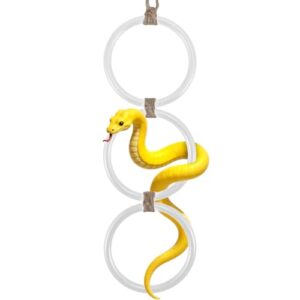
Good records keep your snake healthy — but stimulating enclosure keeps it behaviorally balanced. The Quilax White Snake Climbing Toy adds exactly that.
At 17.1 by 3.5 inches, its linked ring structure fits inside most standard tanks without crowding the floor space. Ball pythons and corn snakes both benefit from the added vertical surfaces and curved grip points.
It cleans easily and installs without tools, though zip ties help secure it. A simple addition that actively reduces stress-driven inactivity.
| Best For | Snake owners who want to give their ball python or corn snake more to explore without overhauling the whole tank setup. |
|---|---|
| Product Type | Enclosure Accessory |
| Price | Not listed |
| Ball Python Use | Yes |
| Experience Level | All Levels |
| Language | English |
| Format | Physical Product |
| Additional Features |
|
- Fits most standard tanks at 17.1 x 3.5 inches without eating up floor space
- Easy to clean and installs without any tools
- Gives climbing reptiles real vertical enrichment, which helps cut down on stress-driven inactivity
- Might be too small for larger ball pythons
- Plastic material isn’t everyone’s preference for a natural-feeling enclosure
- Needs zip ties to stay secure, which aren’t included
9. Horsmiyala DIY Snake Climbing Ring Set

If you want something your snake can actually interact with differently each session, the Horsmiyala DIY Snake Climbing Ring Set earns its $6.99 price.
Three black rings — each 12.75 inches long — connect via hemp ropes in seven-plus configurations. That variability matters.
A static enclosure stops stimulating curiosity quickly. Reconfigure the layout weekly, and your ball python keeps exploring rather than hiding out of boredom.
Rounded edges protect scales, and the lightweight build won’t stress your tank’s screen top.
| Best For | Snake owners who want an affordable, customizable enrichment setup for ball pythons or corn snakes that enjoy climbing and exploring. |
|---|---|
| Product Type | Enclosure Accessory |
| Price | $6.99 |
| Ball Python Use | Yes |
| Experience Level | All Levels |
| Language | English |
| Format | Physical Product |
| Additional Features |
|
- Super cheap at $6.99 — easy to try without much risk
- Seven-plus configurations keep the setup fresh and your snake curious
- Rounded edges are gentle on scales, and it’s light enough for most tank tops
- Needs assembly, so it’s not a drop-it-in-and-done situation
- May be too bulky for smaller or younger snakes
- Hemp ropes can trap waste, so regular cleaning is a must
Frequently Asked Questions (FAQs)
How to tell if a ball python is defensive?
A tight ball with the head buried, rock-hard muscle tension, hissing, or an S-shaped neck all point to a defensive snake. Trust those signals — they’re deliberate warnings, not random behavior.
How to tell if ball python likes you?
A relaxed ball python moves slowly, keeps a loose body, and stays on your hand without pulling away.
Those calm cues — settled head, steady tongue flicks, no tension — mean it trusts you.
How to calm a defensive snake?
Stop handling the moment defensive signals appear. Place the snake back gently, move slowly, and give it time alone. Most ball pythons settle within minutes once the pressure is removed.
How to tell a ball python’s mood?
Your ball python’s posture tells you everything. Loose coils, slow movement, and calm tongue-flicking mean it’s comfortable. Tight balling, stiff muscles, or an elevated S-curved neck signal stress or defensiveness.
Can defensive behavior differ between ball python morphs?
Yes, morphs like Spider ball pythons carry neurological quirks that can make them appear more defensive or erratic. Always factor in morph-specific traits before assuming a behavior is purely stress-driven.
Do ball pythons recognize their owners scent over time?
Yes — your ball python does recognize your scent over time. Repeated exposure builds a scent memory through their Jacobson’s organ, making your presence feel predictable and safe rather than threatening.
Conclusion
Reading a ball python’s tension is like learning a silent vocabulary—where stillness speaks louder than strikes. When you recognize the predictable sequence of defensive ball python body language, you step ahead of stress.
This knowledge turns potential bites into avoided misunderstandings, handling sessions into calm interactions. Observe the coils, the head posture, the retreat cues.
Respond with space, warmth, and patience. Your snake isn’t aggressive—it’s communicating. Listen. Their comfort begins with your understanding.
- https://d0ct0rjaysrept0l0gy.com/pages/beginner-s-guide-to-understanding-ball-python-behavior
- https://en.wikipedia.org/wiki/Ball_python
- https://animals.mom.com/way-heat-snake-cage-10113.html
- https://www.lopehare.com/ball-python-body-language-how-to-read-your-snakes-mood-and-needs/
- https://www.xyzreptiles.com/what-are-the-signs-of-a-healthy-ball-python/