This site is supported by our readers. We may earn a commission, at no cost to you, if you purchase through links.
Most reptile keepers obsess over basking spot temperatures—and completely miss what’s happening in the rest of the enclosure. A bearded dragon can sit under a 110°F lamp and still develop metabolic disorders if the surrounding air stays too cold. That’s the gap between ambient and surface temperature, and it’s where most husbandry mistakes live.
Surface heat drives digestion and behavioral warming. Ambient heat sets the thermal baseline that keeps every biological process running. Get one wrong, and the other can’t compensate.
Understanding the difference between ambient and surface temperature in reptiles isn’t a technicality—it’s the foundation of an enclosure that actually works.
Table Of Contents
- Key Takeaways
- Ambient Temperature in Reptile Enclosures
- Surface Temperature and Its Importance
- Key Differences Between Ambient and Surface Temperatures
- Measuring and Managing Temperatures Effectively
- Health Impacts and Safety Considerations
- Frequently Asked Questions (FAQs)
- What is the difference between ambient temperature and surface temperature?
- What is the ambient 30 rule?
- Is 72 too cold for ball python?
- Is 40C ambient temperature?
- Can reptiles overheat even with proper ambient temperatures?
- How does humidity interact with enclosure temperatures?
- How often should heating equipment be replaced or checked?
- Can seasonal changes affect your reptiles temperature needs?
- Conclusion
Key Takeaways
- Ambient temperature sets the biological baseline for your reptile’s metabolism, immunity, and digestion — getting it wrong can’t be fixed by a perfect basking spot alone.
- Surface heat works through direct contact conduction, raising gut motility by roughly 40% when it hits 35–42°C, making it the primary driver of successful digestion.
- Both temperature types require separate tools — digital probe thermometers for ambient readings, infrared guns for surface checks — because a misplaced sensor gives you false confidence, not real data.
- Humidity silently distorts your thermal environment: at 32°C and 80% humidity, your reptile feels roughly 5°C hotter than your thermometer shows.
Ambient Temperature in Reptile Enclosures
Ambient temperature is the steady background warmth filling your enclosure — and it’s doing more work than most keepers realize.
It works alongside basking temperature to regulate digestion, immunity, and activity — and understanding how ambient and basking temperatures differ helps you get that balance right.
It sets the baseline for everything from your snake’s metabolism to its daily movement patterns. Here’s what you need to know to get it right.
Definition and Role for Reptile Health
Ambient temperature is the air climate your enclosure maintains away from any direct heat source — measured mid-height, never under a lamp. It forms the baseline for reptile thermoregulation, keeping organs and enzymes within functional range. Get it wrong, and temperature regulation breaks down fast.
Stable temperature gradients support reptile metabolism, reduce heat stress, and shape how actively your animal moves, eats, and behaves daily. Properly managing heat sources is vital to prevent thermal burn risks.
How Ambient Temperature Supports Thermoregulation
Think of the air inside the enclosure as a temperature menu — your reptile browses it constantly. A proper thermal gradient lets them move between warmer and cooler zones, which is how reptile thermoregulation actually works. Without that range, reptile metabolism stalls, digestion slows, and heat stress prevention becomes impossible. Maintaining the right temperature is vital for reptile care, and understanding temperature control methods is essential for their well-being.
Here’s what a solid ambient monitoring setup facilitates:
- Self-regulated temperature regulation throughout the day
- Active thermoregulation without keeper intervention
- Stable enzyme function tied directly to ambient temperature
- A usable cool retreat that prevents dangerous overheating
Ideal Ambient Temperature Ranges by Species
Every species draws its own thermal gradient line. Ball pythons need warm-side ambient air around 88–92°F, with the cool side holding at 75–80°F. Bearded dragons push higher — upper 90s°F warm, low 70s°F cool. Leopard geckos stay in the 75–85°F range.
Temperature Research confirms these species variations aren’t flexible; reptile metabolism and ambient controls must match each animal’s specific thermoregulation requirements.
Creating an Ambient Temperature Gradient
Once you’ve matched species-specific ranges, the next step is building that thermal gradient into your enclosure design. Position your heat source at one end only — never centered. This single move creates the warm-to-cool ambient control your reptile needs for natural thermal cycling.
Adding a hide at each end lets your reptile thermoregulate privately — check out these reptile hides for beginners to set both zones up right.
Aim for a 5–10°C difference across zones, then monitor both ends daily for stable temperature gradient creation and reliable reptile temperature management.
Surface Temperature and Its Importance

Surface temperature is the heat your snake actually feels when its belly meets the ground — and it does very different work than the air around it.
From kickstarting digestion to driving moment-to-moment behavior, this contact heat matters more than most keepers realize.
Here’s what you need to know about how it works, why it counts, and where it comes from.
What is Surface Temperature?
Surface temperature is the heat your reptile actually feels — not the air around it, but the surface beneath its belly or feet. It’s conductive heating in action: direct heat transfer from a warm substrate or basking spot into the animal’s body. Surface temperatures under basking spots routinely run 10–30°F hotter than ambient temperature.
Key surface temperature facts to know:
- Infrared thermometers measure surface heat accurately from 12 inches away
- Basking spots can reach 100–115°F — far above ambient air readings
- Surface thermal gradients differ markedly from air thermal gradients
- Conductive heating drives core body temperature more efficiently than ambient warmth alone
Role of Surface Heat in Digestion and Behavior
Belly heat is everything for digestion. When surface temperatures hit 35–42°C, gut motility increases by roughly 40% — enzymes activate, proteins break down faster, and your reptile clears meals in a fraction of the time. That’s postprandial thermophily at work.
Without adequate surface heating, digestion processes stall, behavioral patterns shift toward lethargy, and impaction risk climbs. Proper thermal gradients protect reptile health directly.
Common Heat Sources for Surface Warmth
Not all heat sources deliver surface temperatures the same way. Basking lamps — especially halogen flood bulbs like Arcadia’s GoldenSun — drive surface temperatures to 95°F with precise IR-A penetration. Ceramic heat emitters and infrared heaters hold overnight warmth without disrupting light cycles. Radiant panels and heat mats offer gentler conduction.
Each tool fulfills a purpose — match the heat source to your species’ specific needs.
Key Differences Between Ambient and Surface Temperatures
Ambient and surface temperatures aren’t the same thing — and that distinction matters more than most keepers realize. Each one affects your reptile differently, from how it digests food to how it moves through the day.
Here’s where those differences really show up.
Air Vs. Contact Heat Explained

Air and surface temperatures work through entirely different heat transfer methods. Ambient temperature rises via convection — warm air circulating slowly through the enclosure.
Surface temperatures operate through conduction, delivering direct contact heat the moment your snake touches a warm substrate.
Radiant heating from overhead lamps adds infrared emission, penetrating tissue before the air even responds. Together, they build the thermal gradient your reptile depends on for temperature regulation.
Effects on Reptile Physiology and Activity

Temperature isn’t just comfort — it’s the engine driving reptile physiology. Metabolic rates roughly double with every 10°C rise, directly controlling digestion speed, locomotion patterns, and immune response.
At 20°C, protein assimilation drops to 60–70%; at preferred temperatures, it climbs to 80–90%. That thermal gradient isn’t optional — it’s the difference between a thriving ectotherm and one quietly declining.
Without the right thermal gradient, a reptile doesn’t just struggle — it quietly declines
Why Both Temperatures Matter in Enclosure Design

Think of your enclosure design as a thermal map — every zone fulfills a purpose. Ambient temperature sets the baseline your reptile navigates daily, while surface temperatures drive digestion and behavioral cues.
Without proper thermal gradients, temperature control breaks down fast. Heat distribution must span 24°C on the cool end to 38°C on warm surfaces.
Both layers working together define reptile behavior and genuine enclosure health.
Measuring and Managing Temperatures Effectively
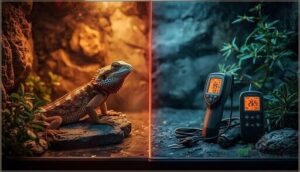
Getting temperatures right comes down to having the right tools and knowing how to use them. A thermometer in the wrong spot or a heat gun aimed at the wrong surface can give you a false sense of security.
Here’s what you need to monitor and manage both ambient and surface temperatures with confidence.
Tools for Monitoring Ambient and Surface Temperatures
For accurate temperature measurement, you’ll need at least two tools: digital probe thermometers for ambient readings and infrared guns for surface checks. A digital thermometer confirms your gradient; an infrared thermometer verifies basking spots instantly.
Smart sensors and data loggers track 24-hour shifts automatically. Add a thermostat control to regulate heat sources, and you’ve got a reliable, complete monitoring system.
Proper Placement of Thermometers and Heat Sensors
Good tools mean nothing if placement is wrong. Fix your digital probe on the basking surface itself — that’s where contact heat actually matters. Keep the cool-side probe at substrate level, away from direct heat sources. Never rest a sensor against bare glass.
A misplaced heat sensor skews every reading, and your thermostat control reacts to bad data just as willingly as good.
Maintaining Safe and Stable Temperature Gradients
Stable temperature gradients don’t maintain themselves — your enclosure design does the heavy lifting. Keep a 10°C spread between warm and cool zones, and use a dimming thermostat for precision within 1°C. Thermal monitoring catches drift before your snake does.
- Insulate three sides with foam board to cut fluctuations by 5°C
- Set thermostat probes at mid-height for enclosure-wide ambient temperature accuracy
- Run timer-controlled night drops of 2–4°C to support natural metabolic rest
Health Impacts and Safety Considerations

Getting temperatures right isn’t just about comfort—it’s about preventing real harm. Your choices in heating can make or break your snake’s health.
Here’s what you need to know before picking an enclosure setup.
Risks of Incorrect Temperatures
How quickly can Temperature Stress unravel your reptile’s health? Chronic low ambient temperature leads to Thermoregulation Failure, slow digestion, and Metabolic Issues—while high heat triggers Heat Stroke, rapid Dehydration Risks, and organ damage. Without proper temperature regulation techniques and thermal gradient creation, even brief exposure can threaten survival.
| Issue | Cause | Consequence |
|---|---|---|
| Heat Stroke | Excessive warmth | Organ failure |
| Dehydration Risks | High ambient temps | Lethargy, sunken eyes |
| Metabolic Issues | Poor gradients | Weak bones, stunting |
Preventing Burns and Heat Stress
Vigilance is your main defense against burn risk factors. Never let your reptile rest directly on exposed heat elements—always use substrate barriers and guards.
Thermoregulation tips start with thermal gradient management: maintain safe temperature ranges by checking basking spots with an infrared thermometer.
For heat stress prevention, guarantee cool retreats are always available, and monitor ambient temperature closely to support effective temperature regulation and thermal gradient creation.
Adjusting Heating Equipment for Reptile Safety
Match your thermostat type to your heat source — dimming or pulse-proportional thermostats handle high-wattage ceramics better than simple on/off units. Choosing heater wattage correctly means undersized bulbs won’t hold target surface temperatures, while oversized ones spike ambient temperature dangerously.
Seasonal setting adjustments keep gradients stable year-round. Redundant safety systems and routine equipment inspections catch failures early, giving you real reptile environmental control before problems escalate.
Frequently Asked Questions (FAQs)
What is the difference between ambient temperature and surface temperature?
Ambient temperature is the background air warmth filling your enclosure. Surface temperature is the contact heat at localized basking zones.
These two heat transfer pathways drive distinct body heating patterns — together shaping your reptile’s entire thermal environment.
What is the ambient 30 rule?
The ambient 30 rule caps your enclosure’s cool-side air at 30°C. It’s a husbandry code standard ensuring reptiles always have a genuine thermal retreat — preventing chronic overheating and supporting natural thermoregulation.
Is 72 too cold for ball python?
Yes, 72°F is too cold for a ball python as a steady daytime ambient. It slows digestion, suppresses appetite, and weakens immunity. Aim for 80–88°F warm side, 75–80°F cool side.
Is 40C ambient temperature?
No — 40°C is a basking surface temperature, not ambient. Safe ambient tops out around 29–32°C for most reptiles. Pushing air that high eliminates gradient loss risks and triggers dangerous heat stress fast.
Can reptiles overheat even with proper ambient temperatures?
Absolutely — like a pressure cooker with a cool lid, the interior can still scorch. Hot substrate alone triggers heat stress, even when ambient temperatures read perfectly safe.
How does humidity interact with enclosure temperatures?
Humidity quietly warps your entire thermal environment. At 32°C with 80% humidity, reptiles experience an effective temperature 5°C higher — pushing heat stress risk even when your ambient temperature and surface temperatures read correctly.
How often should heating equipment be replaced or checked?
Check heat mats weekly, bulbs monthly. Replace mats every 2–3 years, bulbs every 3–6 months. Calibrate thermostats every 3–6 months. Routine heating audits catch failures before your reptile pays the price.
Can seasonal changes affect your reptiles temperature needs?
Seasonal changes absolutely affect your reptile’s needs. Winter demands stronger heating strategies to maintain safe ambient temperatures, while summer requires cooling adjustments.
Seasonal thermoregulation shifts influence brumation cues, breeding triggers, and how you manage surface temperatures year-round.
Conclusion
Like a thermostat that only reads one room, an enclosure measured at the basking spot alone tells half the story. Mastering the difference between ambient and surface temperature in reptiles means understanding that your animal lives in the whole enclosure—not just under the lamp.
Surface heat drives digestion. Ambient heat sustains every system underneath. When both are dialed in correctly, you’re not just heating an enclosure—you’re building an environment where your reptile can genuinely thrive.
- https://coldeye.com/blogs/blogs/why-is-measuring-air-and-surface-temperature-important-for-exotic-pets
- https://wheremyscalesslither.weebly.com/measuring-temperatures.html
- https://academic.oup.com/biohorizons/article/1/2/136/269082
- https://animal-pedia.org/lizard/desert-iguana/
- https://reptifiles.com/red-eared-slider-care/red-eared-slider-basking-temperatures-heat/