This site is supported by our readers. We may earn a commission, at no cost to you, if you purchase through links.

Most people picture pythons or ball snakes when they think about keeping a boa, but dwarf boa species sit in a different category entirely—compact, calm, and built for life in a living‑room enclosure rather than a dedicated reptile room.
Some stay under 3 feet for their whole lives, yet carry the same slow, deliberate presence you’d expect from a much larger snake.
With lifespans pushing 20 to 30 years, choosing one isn’t a casual decision.
Getting the housing, feeding schedule, and health monitoring right from day one shapes everything that follows.
Table Of Contents
- Key Takeaways
- Dwarf Boa Species Overview
- Ideal Enclosure Setup for Dwarf Boas
- Feeding and Nutrition for Dwarf Boas
- Health and Wellness Considerations
- Top 10 Dwarf Boa Accessories
- 1. Hot Pink Turkey Feather Boa
- 2. Colorful Feather Boas Party Costume Pack
- 3. Red Turkey Feather Boa Decoration
- 4. White Feather Boa Party Decoration
- 5. Fluffy Feather Boas Party Sunglasses Set
- 6. Colored Feather Boas Sunglasses Party Set
- 7. Black Turkey Feather Boa Craft
- 8. Light Pink Turkey Feather Boa
- 9. Black Feather Boa Party Decoration
- 10. Pink Rose Feather Boa Set
- Frequently Asked Questions (FAQs)
- Are boas hard to take care of?
- What is the temperament of a dwarf boa?
- What size tank should a boa be in?
- Are dwarf boas good pets?
- What size tank does a dwarf boa need?
- How hard are boas to take care of?
- What is the lifespan of a dwarf boa?
- Are dwarf boas aggressive?
- How often should dwarf boas shed their skin?
- What breeding age is ideal for dwarf boas?
- Conclusion
Key Takeaways
- Dwarf boas stay under 3–5 feet and live 20–30 years, so they’re a genuine long‑term commitment that rewards consistent, detail-oriented care.
- A proper enclosure runs a temperature gradient from 75°F to 87°F, holds 60–70% humidity, and includes snug hides on both ends—get these right and your boa’s behavior and health follow.
- Feed prey no wider than your boa’s midsection, adjust frequency by age (every 5–7 days for neonates, every 14–21 days for adults), and always wait 48 hours after meals before handling.
- Most health problems—respiratory infections, mites, stuck shed, mouth rot—are preventable through stable temps, quarantine protocols, and fecal checks every 6–12 months.
Dwarf Boa Species Overview
Dwarf boas are compact, even-tempered snakes that fit comfortably into most living spaces without demanding a lot from you.
Their smaller stature is a big part of the appeal — see how boa locality size differences play into choosing the right fit for your setup.
They’re non-venomous, generally calm to handle, and can live 20 to 30 years with the right care. Here’s what you need to know about their core traits, common varieties, and what to expect as they grow.
Key Characteristics and Temperament
Dwarf boas pack a lot of personality into a compact body size — most species stay under 3 feet, making them genuinely manageable for home keepers. Young snakes often show defensive behaviors like coiling tightly or musking when handled, but don’t let that discourage you.
With patient, consistent handling, their docile temperament comes through.
They’re also fascinating from a reptile behavior and psychology standpoint — nocturnal activity, subtle color shifting between day and night, and cautious curiosity make dwarf boa care endlessly rewarding for attentive owners.
Cuba hosts the greatest Tropidophis diversity among dwarf boas.
Popular Dwarf Boa Varieties
Several locality-specific varieties stand out for keepers interested in dwarf boa constrictor care. Geographic distribution and size variations play a big role in what makes each unique:
- Hog Island Boa – 5–6 feet, hypomelanistic tan/gray coloration with pink tail hues
- Caulker Cay Boa – 3–4 feet, light gray with 22–24 dark saddles
- Tarahumara Boa – under 4 feet, chainlink dorsal pattern with crimson tail blotches
- Crawl Cay Boa – up to 5 feet, heavy black speckling on gray
These color morphs and habitat preferences reflect each island or regional population’s distinct evolutionary path.
Lifespan and Growth Expectations
Once you’ve picked a variety, it helps to know what you’re committing to long‑term.
Most dwarf boas reach 3.5 to 5 feet over four to five years, with growth rate closely tied to feeding schedule — conservative meals every 10–14 days keep size and health in balance.
Longevity factors like habitat stability, diet, and low stress directly shape lifespan; well‑managed individuals often live 20 to 30 years.
Age at maturity generally falls between 3 and 5 years.
The Panama dwarf boa lifespan([https://www.worldlifeexpectancy.com/reptile-life-expectancy-panama-dwarf-boa) is about 14 years.
Ideal Enclosure Setup for Dwarf Boas
Getting enclosure right is one of the most important things you can do for a dwarf boa.
A well-built setup covers everything from size and airflow to temperature, substrate, and hiding spots.
Here’s what to focus on when putting it all together.
Minimum Tank Size and Dimensions
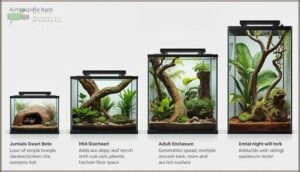
Getting the floor space right is the foundation of good enclosure design. Most adult dwarf boas do well in a 120 cm × 60 cm habitat — that’s your baseline length-width ratio. As your boa approaches 150 cm, upgrade timing matters:
- Start juveniles in a 75 cm × 30 cm tank
- Move to 90 cm × 45 cm mid‑growth
- Target 120 cm × 60 cm for adults
- Add height — 45–60 cm minimum
Ventilation and Security Requirements
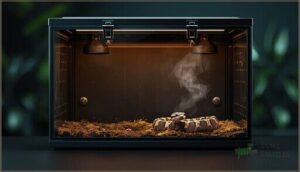
Balanced airflow and a secure enclosure go hand in hand. For humidity-balanced airflow, side vent placement low on the warm side and higher on the cool side creates natural convection without drying things out.
| Feature | Best Practice | Why It Matters |
|---|---|---|
| Mesh-top vs solid | Solid top preferred | Retains heat and humidity |
| Escape-proof lids | Latches on two sides | Prevents nose‑wedging |
| Lockable hinge design | Recessed key or twist lock | Child and pet safety |
| Vent hole size | 6–10 mm diameter | Limits humidity loss |
| Side vent placement | 10–15 cm spacing | Even, draft‑free airflow |
Enclosure design should also account for your boa’s surprising strength — multi‑latch systems stop them from muscling panels open.
Substrate and Furnishing Choices
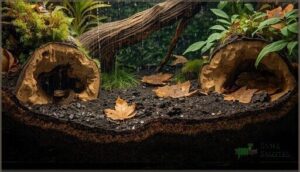
Choosing the right substrate sets the foundation for a thriving Dwarf Boa Habitat and Environment.
A Coconut Fiber Mix — usually 40% topsoil, 40% coco fiber, and 20% play sand — creates naturalistic, Humidity Retaining Layers while supporting natural Burrowing Substrate Depth of two to three inches. Cypress mulch works equally well.
Think of furnishings as your snake’s furniture: cork bark hides on both ends, sturdy Naturalistic Branch Design for climbing, and smooth Escape‑Proof Flooring beneath it all.
Good Reptile Husbandry starts here.
Temperature and Humidity Guidelines

Temperature control is the backbone of solid Reptile Husbandry, and getting it right doesn’t have to be complicated.
A proper Thermal Gradient Design runs from about 75°F on the cool side up to an Ideal Basking Spot of 85–87°F.
That Temperature Gradient lets your boa self-regulate throughout the day.
- Keep daytime ambient temps between 80–85°F and nighttime lows around 74–78°F
- Use ceramic emitters for Seasonal Temperature Adjustments if your room dips below 68°F
- Apply Humidity Regulation Techniques to maintain 60–70% daily, boosting to 75–85% during shedding
For accurate readings, Monitoring Equipment Calibration matters — place digital probes at both enclosure ends to protect your Dwarf Boa Habitat and Environment.
Importance of Hides and Climbing Structures
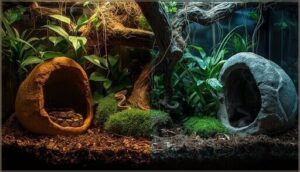
Think of hides as your dwarf boa’s personal off-switch for stress. Place one on each end of the Temperature Gradient — warm side for Thermoregulation Zones, cool side for retreat — and you’ll notice calmer behavior almost immediately. Snug, cling-fit hides work best for Stress Reduction.
Add branches for Climbing Enrichment, using Safety Anchoring to prevent rolling or shifting. This layered Snake Habitat approach facilitates natural behavior, steadier feeding, and genuine Reptile Care at every Humidity Level.
Feeding and Nutrition for Dwarf Boas
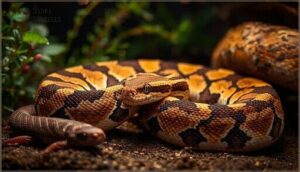
Feeding a dwarf boa isn’t complicated, but getting it right makes a real difference in their health and longevity.
What you feed them, how often, and how you handle the occasional picky eater all matter more than most new keepers expect.
Here’s what you need to know to keep your boa well-fed and thriving.
Appropriate Prey Types and Sizing
Getting prey size right is one of the most important things you’ll do for your boa’s health.
For neonate prey, start with pinky mice weighing 2–4 grams, then graduate to fuzzies as your snake grows.
Juvenile mouse sizes step up gradually alongside body weight.
Adult rat guidelines suggest staying under 10% of the snake’s total weight.
Always match prey width to your boa’s thickest point, and choose frozen-thawed options to keep feeding safe.
Feeding Frequency by Age
Age drives everything regarding feeding frequency in dwarf boa care and habitat management.
Neonates need a reliable neonate schedule of every 5–7 days — their fast metabolism demands it. As your snake hits the juvenile interval stage (3–12 months), every 7–10 days works well. Adult timing settles around every 14–21 days, preventing obesity without sacrificing health.
Key seasonal changes and senior adjustments to track:
- Neonates: Single pinky every 6 days helps steady growth
- Juveniles: Fuzzies every 8 days balances nutrition and digestion
- Adults/Seniors: Every 18–28 days; senior females may need 25–30 day intervals to avoid fatty liver disease
Tips for Handling Feeding Issues
Even with the right feeding and nutrition for dwarf boas dialed in, refusals happen. Stress reduction is your first move — give your boa one to two quiet weeks after any change, and stick to a consistent handling window between meals.
Warming thawed prey improves scent cues, and gentle prey presentation with tongs can trigger a reluctant strike. For persistent refusals, a bait-switch technique or a vet check rules out underlying health issues.
Safe Feeding Practices
Safe feeding starts with rubber-coated tongs — rubber-coated tongs keep your hands clear and mimic natural prey movement, so your boa strikes confidently. Thaw frozen rodents overnight, then warm them to around 98–100°F before feeding. Match prey width to your boa’s midsection, and never rush handling afterward.
Wait 24–48 hours post‑feeding so digestion completes undisturbed. A separate feeding enclosure also helps prevent defensive responses over time.
Health and Wellness Considerations
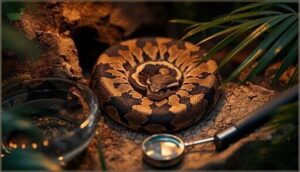
Keeping a dwarf boa healthy long-term comes down to knowing what to watch for before small issues become big ones. From shedding problems to respiratory infections, a few key areas deserve your regular attention.
Here’s what you need to stay on top of.
Common Health Problems and Prevention
Keeping your dwarf boa healthy comes down to staying ahead of problems before they take hold. Respiratory infections, mouth rot, regurgitation, parasite infestations, and incomplete shedding are the five issues you’ll encounter most often — and all are largely preventable with consistent habitat maintenance and smart feeding habits.
Dwarf boa health is won before problems start, not after they appear
Here’s what to stay on top of:
- Respiratory Infections — Keep temperatures at 80–85°F and humidity at 60–70%; cold, damp air breeds bacteria fast
- Mouth Rot — Use tongs and pre‑killed prey to avoid mouth injuries during feeding
- Regurgitation — Wait 48 hours after meals before handling, and never offer oversized prey
- Parasite Infestations — Quarantine new snakes for 60 days and disinfect all second‑hand gear thoroughly
- Incomplete Shedding — Monitor the shedding cycle closely and boost humidity to 70 % when eyes turn blue‑gray
Routine veterinary care — fecal exams every 6–12 months — catches what daily observation might miss.
Recognizing Signs of Illness
Prevention sets the foundation, but knowing what to look for keeps your dwarf boa alive and thriving. Watch for these five red flags:
- Appetite Changes — skipping 2–3 consecutive feeding cycles, or sudden weight loss signals parasites or systemic illness.
- Respiratory Sounds — wheezing, clicking, or bubbles near the nostrils point to infection.
- Skin Discoloration — red splotches or rough patches often mean scale rot or mites.
- Behavioral Lethargy — a boa that stops moving and stays coiled in one corner may be in pain.
- Mouth Inflammation — swollen gums or cheesy discharge indicate stomatitis.
Prompt veterinary care makes all the difference.
Shedding Cycles and Proper Care
Shedding is your dwarf boa’s built-in reset button — and reading the signs early makes all the difference.
| Stage | What to Do |
|---|---|
| Pre-shed Signs | Boost Humidity Adjustment to 80–90% |
| Active shed | Add damp moss, mist daily |
| Post-shed Recovery | Check for Skin Retention Issues; soak if needed |
Spot cloudy eyes or dull scales? That’s your cue. Soak techniques—shallow lukewarm water for two hours—resolve most stuck shed. Appetite returns within 48 hours after a clean shed.
Importance of Veterinary Check-Ups
Annual vet visits aren’t a luxury — they’re the foundation of real pet health for your dwarf boa. Each check-up covers four essentials:
- Early Disease Detection through physical exam and blood work
- Parasite Screening via fecal tests every 6–12 months
- Personalized Husbandry feedback on your dwarf boa habitat setup
- Weight Monitoring and emergency planning protocols
That’s veterinary medicine and care working proactively for reptile health and wellness.
Top 10 Dwarf Boa Accessories
Setting up the right environment for your dwarf boa goes beyond just the basics.
A few well-chosen accessories can make a real difference in their comfort, security, and overall health.
Here are ten options worth considering for your setup.
1. Hot Pink Turkey Feather Boa
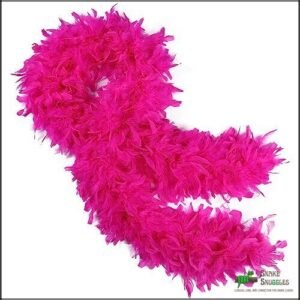
Bold and fun, the Hot Pink Turkey Feather Boa is a surprisingly practical pick for themed events, photo shoots, or costume parties centered around your dwarf boa setup.
Weighing just 40 grams over 2 yards, it’s genuinely lightweight — easy to style without weighing down any look. The natural turkey feathers are dyed a saturated hot pink that photographs beautifully under event lighting, which matters when you’re capturing memories.
Before your first use, give it a good shake and hang it for a few hours. This reduces the initial shedding that’s common with new feather boas. Store it somewhere cool and dry between uses to keep the color vivid and the feathers intact.
It’s reusable, adaptable, and works just as well for Mardi Gras as it does for a Barbie-themed birthday bash.
| Feature | Details |
|---|---|
| Material | Natural turkey feathers |
| Length | 2 yards |
| Weight | 40 grams |
| Color | Hot pink |
| Reusable | Yes |
| Best For | Anyone who needs a fun, eye-catching accessory for parties, photo shoots, stage performances, or costume events. |
|---|---|
| Material | Natural turkey feathers |
| Length | 2 yards |
| Reusable | Yes |
| Shedding | High |
| Primary Use | Costume/events |
| Color Options | Hot pink |
| Additional Features |
|
- Lightweight at just 40 grams, so it’s comfortable to wear or style for hours
- A bold hot pink color that pops in photos and under event lighting
- Reusable and versatile — works for everything from weddings to Mardi Gras
- Feathers tend to shed, especially right out of the package
- Needs shaking and hanging before use to look its best
- Some buyers have found the boa to be sparse or inconsistent in quality
2. Colorful Feather Boas Party Costume Pack
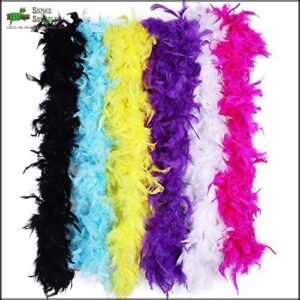
Six boas for $24.99 — that’s the kind of deal that makes group events a lot less stressful to plan.
The Colorful Feather Boas Party Costume Pack includes six 2-meter (6.56 ft) boas, each made from natural feathers and dyed in bright, distinct colors. You get enough variety to outfit a full group without doubling up on shades, which is genuinely useful for themed photo shoots or costume parties.
Before you use them, shake each boa outside to cut down on loose feathers. They’re eco‑friendly and non‑toxic, so they’re safe around kids and guests.
| Feature | Details |
|---|---|
| Length | 2 meters (6.56 ft) |
| Pieces | 6 boas per pack |
| Material | Natural feathers |
| Price | $24.99 |
| Shedding | Moderate to high |
| Best For | Anyone planning a group costume party, photo shoot, or themed event who wants an affordable way to outfit a whole crew at once. |
|---|---|
| Material | Natural feathers |
| Length | 2 meters (6.56 ft) |
| Reusable | Limited |
| Shedding | High |
| Primary Use | Group parties |
| Color Options | 6 mixed colors |
| Additional Features |
|
- Six boas for under $25 is a solid deal — great value if you’re dressing a group
- Each boa is 2 meters long, so there’s plenty to work with for dramatic looks
- Bright, distinct colors mean no two people have to match unless they want to
- Shedding is a real issue — expect feathers on clothes, food, and pretty much everything else
- Some buyers found them thinner and less fluffy than expected
- Not built to last — more of a one-event item than something you’d reuse season after season
3. Red Turkey Feather Boa Decoration
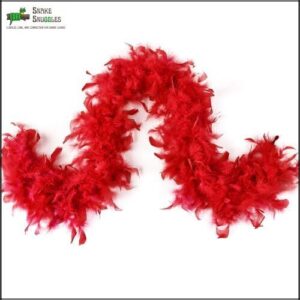
sweep of deep red — and this turkey feather boa delivers exactly that.
Measuring 2 yards long and weighing around 150 grams, it drapes with real presence across table edges, chair backs, and entrance arches. Real turkey feathers hold their shape better than fluffier synthetic alternatives, so you won’t end up with a sagging, sparse-looking decoration by the end of the night.
It’s available in 23 color options, but red usually is the top pick for weddings, Gatsby-themed parties, and holiday setups. After the event, shake it out and hand wash gently in cold water. Keep it away from direct sunlight during storage, and it’ll hold up across multiple uses without losing much of its volume.
| Feature | Details |
|---|---|
| Length | 2 yards (150 cm) |
| Weight | 150 grams |
| Material | Turkey feathers |
| Colors Available | 23 |
| Reusable | Yes |
| Shedding | Moderate |
| Best For | Anyone who needs a bold, eye-catching decoration for weddings, themed parties, holiday events, or stage performances. |
|---|---|
| Material | Turkey feathers |
| Length | 2 yards |
| Reusable | Yes |
| Shedding | Moderate |
| Primary Use | Event décor |
| Color Options | 23 colors |
| Additional Features |
|
- Made from real turkey feathers in 23 vibrant colors, so you get a rich, natural look that synthetics can’t quite match
- Lightweight at just 30g and 150cm long — easy to drape over chairs, tables, or archways without any fuss
- Reusable and handcrafted, making it a solid value for repeat events or craft projects
- Feathers can shed over time, and some boas may arrive looking sparse or flimsy
- May carry a chemical smell out of the box — needs 24 to 48 hours of hanging to fluff up and air out
- Quality can be inconsistent, so what you get might not always match what you see in the photos
4. White Feather Boa Party Decoration
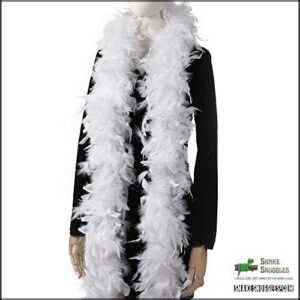
White has a way of making everything feel more intentional, and this turkey feather boa earns its place in any event setup.
At 2 yards long and just 45 grams, it is light enough to drape across chair backs, frame a photo booth, or accent a wedding arch without looking overdone. It comes vacuum-packed, so do not worry if it looks flat right out of the bag — hang it for 48 to 72 hours and it will fluff back to full volume on its own.
One thing to keep in mind: the dye can transfer onto skin or light clothing, so handle it carefully near delicate fabrics. Keep it away from open flames and moisture, and it will hold up across multiple events.
| Feature | Details |
|---|---|
| Length | 2 yards |
| Weight | 45 grams |
| Material | Turkey feathers |
| Color | White |
| Reusable | Yes |
| Shedding | Moderate |
| Storage | Vacuum-packed |
| Best For | Party planners, brides, and event decorators who want an easy, lightweight accent for weddings, photo booths, or festive gatherings. |
|---|---|
| Material | Turkey feathers |
| Length | 2 yards |
| Reusable | Yes |
| Shedding | Moderate |
| Primary Use | Event décor |
| Color Options | White |
| Additional Features |
|
- Two full yards gives you plenty of length to drape, wrap, or style across arches, chairs, or tables
- Comes vacuum-packed for easy storage and ships without bulk
- Works across a wide range of events — weddings, concerts, Carnival, holiday parties, you name it
- Dye can transfer onto skin or light-colored clothing, so handle with care
- Tends to shed, especially right out of the packaging
- May look thinner than expected and can lose its shape with heavy use
5. Fluffy Feather Boas Party Sunglasses Set
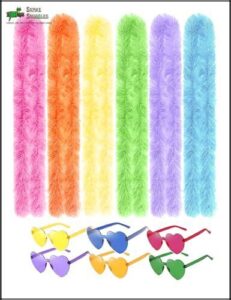
If you’re hosting a group event, this set takes the guesswork out of coordinating.
You get 6 polyester feather boas and 6 matching heart-shaped sunglasses — think hot pink, purple, and other bold tones — each boa running 6.6 feet long for a full, eye‑catching drape.
The synthetic construction keeps everything lightweight and reusable, which matters when you’re outfitting a whole crew.
One practical note: pull the boas out of packaging about 8 hours before your event so they have time to fluff back to full volume.
The sunglasses are decorative‑grade plastic, so they’re better suited for a photo booth moment than all‑night wear.
For Mardi Gras, bachelorette parties, or New Year’s Eve, though, this set delivers exactly what you need.
| Best For | Anyone hosting a group event like a bachelorette party, Mardi Gras bash, or New Year’s Eve who wants matching accessories without the hassle of hunting down individual pieces. |
|---|---|
| Material | Synthetic polyester |
| Length | 6.6 feet |
| Reusable | Yes |
| Shedding | Low |
| Primary Use | Group parties |
| Color Options | Hot pink/purple mix |
| Additional Features |
|
- You get 6 boas and 6 pairs of sunglasses in one shot — no mixing and matching required
- Each boa runs 6.6 feet long, so there’s plenty of fluff to go around
- Lightweight and reusable, so you can pack them away and pull them out again next time
- The boas need about 8 hours out of the packaging to fully fluff up, so plan ahead
- The sunglasses are basic plastic — fine for photos, not great for wearing all night
- Some buyers noticed a strong smell straight out of the bag
6. Colored Feather Boas Sunglasses Party Set
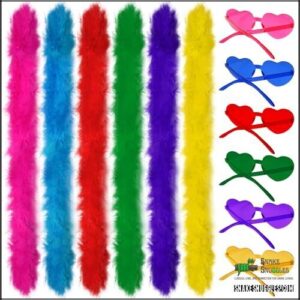
Want coordinated looks without the planning headache? This set hands you exactly that. You get 6 turkey feather boas and 6 matching heart-shaped sunglasses — each boa stretching 6.56 feet — in six vibrant, coordinating colors that photograph beautifully together.
The PC-frame sunglasses hold their shape through a full event, and the turkey feather construction drapes naturally over the shoulders. With 12 total pieces and a coordinating color scheme, outfitting your group takes about two minutes. One thing worth knowing: these boas run on the lighter side for fullness, so they’re best suited for casual parties, themed events, or photo ops rather than elaborate stage work.
Pull them out of packaging a few hours early so the feathers settle and fluff back up before your guests arrive.
| Best For | Party planners and group hosts who want coordinated, colorful looks for themed events, photo ops, or casual celebrations without spending hours coordinating outfits. |
|---|---|
| Material | Turkey feathers |
| Length | 6.56 feet |
| Reusable | Yes |
| Shedding | Moderate |
| Primary Use | Group parties |
| Color Options | 6 coordinating colors |
| Additional Features |
|
- Comes with 6 boas and 6 matching sunglasses — enough to outfit a whole group right out of the box
- Six vibrant coordinating colors look great in photos and on stage
- Lightweight and easy to wear all night without feeling weighed down
- Boas run thin and aren’t very full, so don’t expect a big, dramatic look
- Some customers reported feathers falling off with regular use
- Not the best pick if you need something heavy-duty for professional stage performances
7. Black Turkey Feather Boa Craft
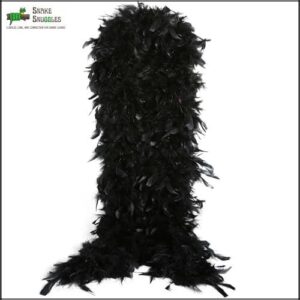
If you’re more into making things than wearing them, the Black Turkey Feather Boa Craft is worth a close look. At roughly 2 yards long and 55 grams, it’s a manageable size for real project work — think wreath forms, mask edging, costume trims, or photo booth backdrops.
The turkey feathers take black dye evenly, so you don’t end up with patchy color across the strand. That consistency matters when you’re cutting sections and placing them across different parts of a project.
When attaching it, stitch along the core rope rather than through the feathers themselves — your attachment points will hold cleaner and last longer. It does shed moderately, so lay down paper or a drop cloth when you’re cutting. Shake it out before you start, and you’re ready to work.
| Best For | Crafters and DIYers who need a reliable, consistent black feather boa for projects like wreaths, costume trims, mask edging, or photo booth décor. |
|---|---|
| Material | Turkey feathers |
| Length | 2 yards |
| Reusable | Yes |
| Shedding | Moderate |
| Primary Use | Crafting |
| Color Options | Black |
| Additional Features |
|
- Two yards of evenly dyed turkey feathers gives you plenty to work with across multiple craft projects
- Lightweight at 55 grams, so it’s easy to handle, layer, and attach without adding bulk
- At $9.99, it’s a low-risk buy for experimenting with new project ideas
- Sheds moderately, especially when cut or handled — messy workspace guaranteed if you’re not prepared
- Some users report a noticeable chemical smell straight out of the package
- May come thinner or less fluffy than expected, which could affect how it looks on finished projects
8. Light Pink Turkey Feather Boa
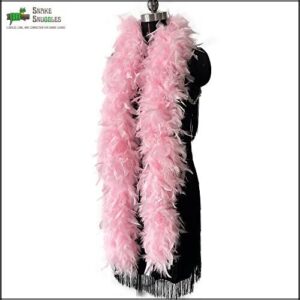
From the craft table to the celebration venue, the Light Pink Turkey Feather Boa shifts the energy — softer, fuller, and built for festive wear. At 5.9 feet and 80 grams, it drapes comfortably around your neck with enough length for a little drama.
The pastel pink comes from real turkey feathers that have gone through heat and UV disinfection, so you’re not wearing anything questionable against your skin. That matters, especially for kids’ dress‑up or close‑contact party wear.
It sheds — no getting around that — so wear it over darker clothing and give it a good shake before your event. For bachelorette parties, bridal showers, or costume boxes, it’s a reliable, affordable pick that actually delivers on the fun.
| Best For | Bachelorette parties, bridal showers, costume events, dress‑up |
| Material | Turkey feathers |
| Length | 5.9 feet |
| Color | Light pink |
| Weight | 80 grams |
| Shedding | High |
| Reusable | Yes |
Best For: Anyone who loves a little drama — great for bachelorette parties, costume events, dress-up, and bridal showers.
| Material | Turkey feathers |
|---|---|
| Length | 5.9 feet |
| Reusable | Yes |
| Shedding | High |
| Primary Use | Costume/parties |
| Color Options | Light pink |
| Additional Features |
|
- Real turkey feathers that are heat and UV disinfected, so it’s safe for kids and adults alike
- A solid 5.9 feet long, which gives you plenty of length to drape and style
- Lightweight at 80 grams, so it’s comfortable to wear all night
- Sheds constantly, so light-colored outfits are a no-go
- Some boas arrive thinner or less full than expected
- Feathers can start falling off right out of the packaging
9. Black Feather Boa Party Decoration
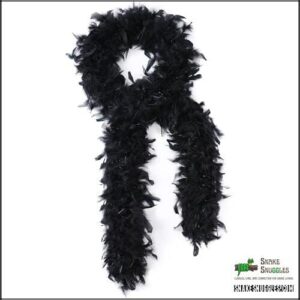
Black has staying power for a reason. Whether you’re decorating an event space or pulling together a bold costume look, this turkey feather boa earns its place in the lineup.
At 35 grams, it’s lighter than it looks, and the handcrafted construction gives it a full, dense silhouette that holds up well in photos and under stage lighting. You can drape it along a table edge, wind it around a centerpiece, or wear it — it covers roughly 4 to 5 feet of visual space either way. It comes in three distinct styles with over 20 color options if you want to branch out from black.
One thing to keep in mind: feather fallout is real, so avoid pairing it with light-colored fabrics. Otherwise, it’s reusable, adaptable, and genuinely delivers the drama you’re going for.
| Best For | Carnival, weddings, concerts, stage performances, event décor |
| Material | Turkey feathers |
| Length | 4–5 feet |
| Color | Black |
| Weight | 35 grams |
| Reusable | Yes |
| Shedding | Moderate |
| Style Options | 3 variations, 20+ colors |
Best For: Anyone who wants to add instant drama to a party, concert, wedding, stage performance, or themed event — whether worn or used as décor.
| Material | Turkey feathers |
|---|---|
| Length | 4–5 feet |
| Reusable | Yes |
| Shedding | Moderate |
| Primary Use | Costume/décor |
| Color Options | Black (20+ colors) |
| Additional Features |
|
- Full and fluffy look thanks to handpicked turkey feathers and solid 35-gram construction
- Versatile enough to wear or use as decoration — tables, centerpieces, photo booths, you name it
- Comes in 20 colors and three styles, so it’s easy to match any theme or vibe
- Sheds feathers, especially with movement — keep it away from light-colored outfits
- Quality can vary between batches, with some experiencing more fallout than expected
- Needs a gentle shake to fluff back up after being stored or packed away
10. Pink Rose Feather Boa Set
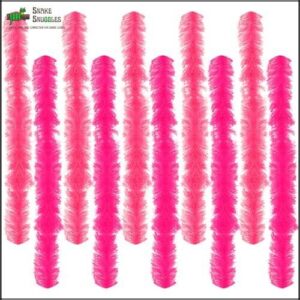
Ten matching boas in one pack — that’s the practical appeal of this pink rose set. Each piece runs about 5 feet long and is made from synthetic polyester, which means shedding stays minimal even when you’re outfitting a full group at a bachelorette party, themed birthday, or photo booth event.
The pink and rose tones are closely matched, so your group looks coordinated without looking identical. Tassels are securely attached, and the uniform feather construction holds its shape well enough for photos and light wear.
One honest note: a few users find the texture on the thinner side, so don’t expect the same density as a premium single boa. Store them somewhere cool and dry, and they’ll hold up for multiple uses.
| Best For | Bachelorette parties, themed birthdays, group photo booths |
| Material | Synthetic polyester |
| Length | 5 feet per boa |
| Colors | Pink and rose |
| Quantity | 10 pieces |
| Reusable | Yes |
| Shedding | Minimal |
| Notable Feature | Budget-friendly multi-piece set with secure tassels |
Best For: Anyone outfitting a whole group — think bachelorette parties, themed birthdays, or photo booth setups where you need matching accessories without spending a fortune.
| Material | Synthetic polyester |
|---|---|
| Length | 5 feet |
| Reusable | Yes |
| Shedding | Minimal |
| Primary Use | Costume/parties |
| Color Options | Pink and rose |
| Additional Features |
|
- You get 10 boas in one pack, so no scrambling to buy extras last minute
- Minimal shedding keeps the mess down, even with a crowd wearing them all night
- Pink and rose tones are close enough to look coordinated without being totally identical
- Some users found them thinner than expected — not the fluffy, dramatic look you might picture
- Synthetic polyester means they won’t feel or look like real feathers up close
- Packaging can feel small or misleading given the quantity inside
Frequently Asked Questions (FAQs)
Are boas hard to take care of?
Like owning a pet that outlives your decade-old car, boas aren’t hard — they’re just long. Dial in temps, spot clean daily, refresh water, and respect the 20-to-30-year commitment ahead.
What is the temperament of a dwarf boa?
Dwarf boas are generally calm and docile, especially once settled and handled regularly. Babies can be nippy, but most adults become predictable, slow-moving snakes that tolerate interaction well.
What size tank should a boa be in?
For most adult dwarf boas, a 4-foot by 2-foot by 2-foot enclosure works well.
Juveniles under 2 feet can start in a 2-foot tank, but plan to upgrade within a few years.
Are dwarf boas good pets?
Yes, dwarf boas make genuinely rewarding pets for patient, committed keepers. They stay manageable in size, grow calmer with regular handling, and can thrive alongside you for 20 to 30 years.
What size tank does a dwarf boa need?
Most adult dwarf boas do best in a 4×2×2 foot enclosure. A good rule of thumb: the tank length should at least match your snake’s full adult body length.
How hard are boas to take care of?
Think of boa care like tending a slow-burning fire — not intense, but it demands steady attention.
Most keepers rank them intermediate pets, needing precise temperatures, humidity control, and secure housing to truly thrive.
What is the lifespan of a dwarf boa?
Most dwarf boas live 20 to 30 years in captivity — that’s a serious, decades-long commitment. With excellent husbandry, some individuals push past 30 years, outlasting many other popular pet reptiles.
Are dwarf boas aggressive?
Most dwarf boas aren’t looking for a fight — they’re just easily startled. Babies may hiss or bluff-strike, but consistent, calm handling turns that wariness into genuine docility within weeks.
How often should dwarf boas shed their skin?
Young dwarf boas shed every 4 to 6 weeks, while adults slow to once every 2 to 3 months — roughly 4 to 8 sheds per year depending on age, diet, and conditions.
What breeding age is ideal for dwarf boas?
Timing is everything with breeding.
Females do best at 5–4 years old, when their bodies are fully developed.
Males are ready closer to 2–3 years, once they’re feeding consistently and holding weight well.
Conclusion
The theory that small snakes demand less commitment doesn’t hold up under scrutiny—dwarf boa species care information proves the opposite is true. Compact size never means casual responsibility.
These snakes live for decades, and every detail you control—temperatures, prey sizing, humidity, hide placement—shapes the quality of those years. Get the fundamentals right from the start, and what you’ll have isn’t just a well‑kept snake. You’ll have a relationship built on consistency and trust.