This site is supported by our readers. We may earn a commission, at no cost to you, if you purchase through links.
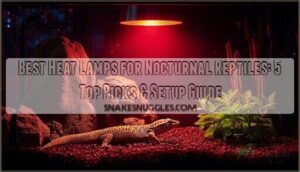
Most nocturnal geckos and snakes won’t bask under bright bulbs. They need warmth without glare that disrupts their night-active biology. Standard daytime heat lamps fail here.
They flood enclosures with visible light that suppresses natural behavior and prevents proper sleep cycles. Heat lamps for nocturnal reptiles solve this with infrared technology—delivering thermal energy through wavelengths your animals can’t see but their bodies absorb.
True red glass bulbs maintain heat output for months without coating flake-off. Spot reflectors concentrate warmth into precise zones. Pairing the right bulb with proper placement creates the thermal gradient your gecko or python needs to thermoregulate after dark.
Table Of Contents
Key Takeaways
- Nocturnal reptiles need infrared heat lamps with true red glass instead of painted coatings because the embedded color won’t flake off and maintains consistent warmth without disrupting sleep cycles or natural behavior.
- Position your heat lamp 12 to 18 inches above the basking spot to create proper temperature gradients, and always pair it with a thermostat to prevent dangerous overheating or underheating that disrupts digestion and metabolism.
- Replace infrared bulbs every 6 to 12 months even if they still glow, because heat output degrades long before visible failure and compromises your reptile’s ability to thermoregulate properly.
- Stable nighttime warmth from infrared sources supports healthy sleep cycles, improves digestion above 78°F, and reduces stress-driven behaviors like pacing and tail whipping when paired with consistent day-night cycles.
Best Heat Lamps for Nocturnal Reptiles
Nocturnal reptiles need heat without the glare that disrupts their sleep cycles. The right infrared lamp provides warmth while keeping your enclosure dark enough for natural behavior.
If you’re unsure whether your snake benefits more from overhead heat or ground warmth, check out this guide on the difference between heat pads and heat lamps for snakes to match the right heat source to your species.
Here are five heat lamps designed specifically for nighttime heating.
1. Repti Home Infrared Heat Lamp Bulb
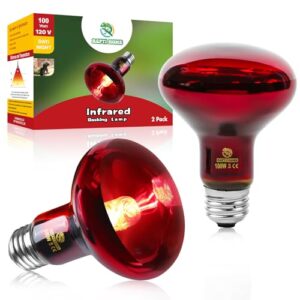
The Repti Home Infrared Heat Lamp Bulb delivers consistent overnight warmth through red infrared glass. It fits standard E26 sockets in most terrarium fixtures.
The bulb provides targeted heat to basking zones without visible light, ensuring it doesn’t disrupt nocturnal sleep cycles. It emits infrared energy rather than bright illumination, making it ideal for species requiring steady warmth after dark.
Available in multiple wattages, this bulb works across different enclosure sizes. Pair it with a thermostat for accurate temperature control throughout the night.
| Best For | Reptile and amphibian owners who need a reliable heat source that won’t disturb their pets’ day-night cycles. |
|---|---|
| Wattage | 100W |
| Bulb Base | E26 |
| Light Type | Infrared |
| Brand | REPTI HOME |
| Target Animals | Reptiles & Amphibians |
| Socket Type | Standard E26 |
| Additional Features |
|
- Emits infrared heat without visible light, so it won’t mess with your pet’s sleep schedule
- Fits standard E26 sockets, making it easy to install in most terrariums
- Works for multiple species including bearded dragons, tortoises, snakes, and even chickens
- Durability can be hit or miss—some bulbs burn out after just a few months
- Vulnerable to power surges that can cause sudden failure
- The casing may crack or break with regular use
2. Mclanzoo Reptile Heat Lamp Bulb
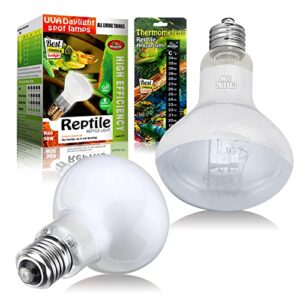
If you want UVA alongside infrared warmth, the Mclanzoo Reptile Heat Lamp Bulb combines both in one E26 fixture. It uses thickened explosion-proof glass and emits warm light that stimulates appetite and digestion in nocturnal species.
Available in 100 watts, this bulb creates basking zones while providing minimal visible light disruption. Pair it with a digital thermometer to monitor enclosure temperatures. Note that bulb life may not exceed two months with continuous use, and warranty coverage is limited to 30 days.
| Best For | Reptile owners who need a dual-purpose heat and UVA light source for smaller enclosures with species like bearded dragons, turtles, or lizards. |
|---|---|
| Wattage | 100W |
| Bulb Base | E26 |
| Light Type | Incandescent |
| Brand | MCLANZOO |
| Target Animals | Reptiles & Amphibians |
| Socket Type | Standard E26 |
| Additional Features |
|
- Combines UVA light with infrared heat in one bulb, which can help stimulate appetite and digestion
- Uses explosion-proof glass construction for added safety in humid terrarium environments
- Fits standard E26 sockets and includes a digital thermometer for easy temperature monitoring
- Short lifespan with bulbs often burning out in under two months during continuous use
- Limited 30-day warranty doesn’t cover the typical usage period for most reptile keepers
- May not generate enough heat for larger enclosures or particularly cold rooms
3. Repti Zoo Infrared Heat Lamp
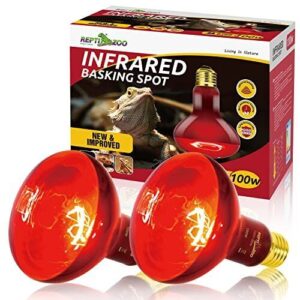
The Repti Zoo infrared heat lamp uses true infrared emission with red glass housing for nocturnal heating without bright light. It fits standard E26 sockets and runs continuously up to 3000 hours. The internal reflector concentrates heat to boost surface temperatures while maintaining ambient warmth across your enclosure.
Available in 100 watts, this bulb works with basic thermostats for adjustable nighttime heating. Quality control can be inconsistent—some units lose heat output quickly or suffer from brittle glue securing the glass element to the base.
| Best For | Reptile owners who need affordable nighttime heating without visible light disrupting their pet’s sleep cycle. |
|---|---|
| Wattage | 100W |
| Bulb Base | E26 |
| Light Type | Infrared |
| Brand | REPTI ZOO |
| Target Animals | Reptiles & Amphibians |
| Socket Type | Standard E26 |
| Additional Features |
|
- True infrared emission provides heat without bright light, perfect for maintaining proper nighttime temperatures
- Long 3000-hour lifespan and standard E26 socket make it economical and easy to replace
- Internal reflector design concentrates heat effectively for smaller to medium-sized enclosures
- Inconsistent quality control means some bulbs fail prematurely or lose heat output quickly
- Brittle adhesive can cause the glass element to detach from the base if bumped or handled roughly
- May not generate sufficient heat for larger terrariums or enclosures
4. Briignite Reptile Heat Lamp Bulb
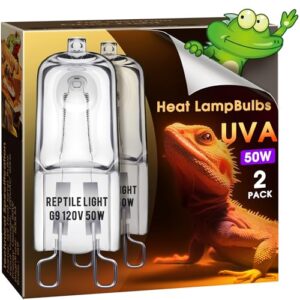
Briignite’s 50-watt halogen bulb offers adjustable heat through its dimming function—a feature most fixed-wattage lamps lack. The G9 base installs quickly in compatible fixtures, and the warm white light doubles as both a basking source and gentle nighttime viewing option for geckos, snakes, and chameleons.
Pair it with a ceramic fixture for nighttime warmth, or explore ball python heat source options to find the right balance of ambient and basking heat.
Quality control remains a concern. Multiple users report premature burnout within weeks or units arriving broken. The bulb runs extremely hot, so you’ll need protective guards to prevent burns and a thermostat to avoid dangerous temperature spikes.
| Best For | Reptile owners who need adjustable heat control and want a bright basking spot for common species like bearded dragons, geckos, and chameleons. |
|---|---|
| Wattage | 50W |
| Bulb Base | G9 |
| Light Type | UVA |
| Brand | Briignite |
| Target Animals | Reptiles & Amphibians |
| Socket Type | G9 2-pin |
| Additional Features |
|
- Dimmable function lets you fine-tune temperature without swapping bulbs
- Quick G9 installation fits most standard fixtures
- Bright warm light works for daytime basking and low-level night observation
- Frequent reports of bulbs dying within weeks or arriving broken
- Runs extremely hot and requires safety guards plus a thermostat
- Inconsistent quality control makes reliability a gamble
5. Fluker Reptile Heat Lamp Bulb
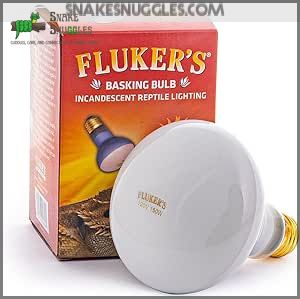
Fluker’s Deep Thermal Lamp uses carbon fiber filament technology to deliver steady infrared heat with minimal visible light—ideal for nocturnal species like ball pythons and leopard geckos. The parabolic reflector focuses warmth on your basking zone without flooding the entire enclosure.
Available in 75W and 100W options, you can match the output to your tank size. The bulb emits zero UVB and runs quietly in standard UL-approved fixtures.
Pair it with a rheostat for precise temperature control, especially in smaller enclosures where overheating risks climb fast.
| Best For | Reptile owners seeking a focused heat source for basking spots in smaller to medium-sized enclosures, especially those keeping nocturnal species that need warmth without excessive light. |
|---|---|
| Wattage | 75W |
| Bulb Base | E26 |
| Light Type | Infrared |
| Brand | REPTI ZOO |
| Target Animals | Reptiles |
| Socket Type | Standard E26 |
| Additional Features |
|
- Directs radiant heat exactly where your reptile needs it, creating a proper basking zone without overheating the whole tank
- Easy setup—just screw it into any standard reptile lamp fixture and you’re good to go
- Helps keep your reptile healthy by maintaining the right temperature range to prevent infections and support digestion
- Shorter lifespan than expected, with some bulbs burning out after just 2-3 months of use
- Can be too bright for nighttime use, even though it’s marketed for low-light situations
- Quality control issues—some customers received damaged or previously used bulbs
Key Features of Nocturnal Reptile Heat Lamps
Not all heat lamps work the same way when you’re caring for nocturnal reptiles. You need features that deliver warmth without wrecking their sleep patterns or stressing them out with too much light.
Let’s look at what separates a good nocturnal heat lamp from one that’ll cause problems down the road.
True Red Glass Vs. Painted Coatings
You’ll find two main approaches to red bulbs for reptile heat lamps: true red glass and painted coatings. True red glass embeds color in the material itself for better glass color stability and heat resistance. Painted coatings sit on the surface and may degrade under infrared heat.
Consider these durability factors for your nocturnal infrared heat lamp:
- Color consistency – True red glass maintains its red hue variations without fading during nighttime viewing
- Coating durability – Paint chips or peels with repeated heating cycles
- Long-term performance – Embedded color outlasts surface treatments
Infrared Heat and Minimal Visible Light
Infrared heat lamps deliver thermal balance through electromagnetic energy beyond visible wavelengths. You get efficient heat transfer without the bright glare that disrupts nocturnal infrared heat lamp cycles.
Most models emit wavelengths in the red light spectrum—just enough for nighttime viewing and observation without disturbing your animal’s night vision optimization. That minimal infrared emission warms basking zones while preserving the darkness nocturnal species need for natural infrared heating patterns.
Spot Reflectors for Targeted Heating
Spot reflectors transform a basic heat lamp into a precision tool. Parabolic reflector materials concentrate infrared heat lamps into tight beam angles—usually 10 to 30 degrees—so you direct thermal energy exactly where your nocturnal reptile needs it most.
- Aluminized steel surfaces enhance thermal efficiency while reducing wasted energy
- Low profile designs fit compact enclosures without blocking sight lines
- Adjustable mounting options let you tilt and rotate basking lamps for ideal coverage
- Heat resistant coatings prevent degradation under prolonged high temperature exposure
- Polished finishes focus heat patterns into narrow zones for targeted warming
For further insight into the benefits and design of, explore the range of heat reflector technologies used in infrared heating systems.
Compatibility With Thermostats and Rheostats
Pairing your heat lamp with control devices unlocks a level of precision you can’t achieve by hand. Thermostats cycle power on and off to hold setpoints within ±1°F, while rheostat controls dim output by adjusting resistance—perfect for gentle overnight heat regulation.
| Feature | Thermostat Settings | Rheostat Controls |
|---|---|---|
| Accuracy | ±1°F digital precision | Variable, no exact setpoint |
| Response | Fast on/off cycling | Gradual dimming adjustment |
| Best Use | Exact temperature feedback | Smoothing heat curves |
Most reptile heating solutions need wattage ratings that exceed your lamp to prevent overheating the control unit itself.
For a deeper understanding of how resistance influences current flow, see this rheostat operation overview.
Setting Up Heat Lamps in Nocturnal Enclosures
Getting the setup right matters just as much as choosing the right bulb. Where you place the lamp, how you secure it, and what you pair it with all affect your reptile’s health.
Here’s what you need to know about positioning and installing heat lamps in nocturnal enclosures.
Proper Lamp Placement and Positioning
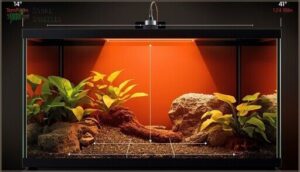
You can’t just screw in a bulb and call it done. Heat gradients need planning, not guesswork. Position your infrared heat lamps 12 to 18 inches above basking spots, then adjust based on real temperatures. Lamp angles direct heat where your reptile needs it, creating thermal zones from warm to cool. Distance adjustment controls intensity without swapping bulbs. Measure at multiple points to confirm your setup works.
Four placement essentials:
- Target the basking area – Aim the beam directly at the reptile’s preferred warming spot
- Maintain safe clearance – Keep at least 6 inches between bulb and reptile to prevent burns
- Create temperature zones – Place the lamp at one end to establish a natural gradient
- Avoid water dishes – Position heat sources away from moisture to prevent condensation issues
Using Protective Guards and Fixtures
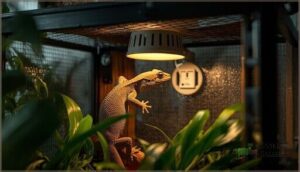
Hot bulbs need barriers. Protective barrier designs prevent burns when your reptile climbs or when you reach in for maintenance. Fixed guards attach to fixtures with screws while mesh designs allow airflow. Heat lamp mounting determines stability—clamps work for screen tops, screw plates for wood frames.
| Guard Material Options | Fixture Compatibility | Safety Interlocks |
|---|---|---|
| Steel with powder coat resists humidity | Standard sockets fit most reptile heat lamps | Automatic shutoff when opened |
| Polycarbonate stays transparent | Universal plates retrofit various brands | Presence sensors detect approaching limbs |
| Stainless steel accommodates saltwater setups | Clearance specs prevent heat transfer to housing | Microcontrollers log access events |
Ceramic heat emitters require guards rated for higher temperatures than standard reptile heating and lighting. Check monthly for cracks or loose fittings in reptile enclosures and habitats.
Combining With Other Heat Sources
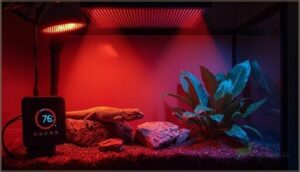
A single fixture won’t always cut it. Multi heating pairs infrared bulbs with ceramic heat emitters or panels for better ambient temperature control. Thermostat control prevents one heat source from overcompensating while the other runs wild.
Sequencing strategies work like this:
- Set baseline warmth with your secondary heater
- Add the reptile heat lamp for localized hotspots
- Monitor both zones independently for proper thermoregulation and lighting
Adjusting for Different Enclosure Sizes
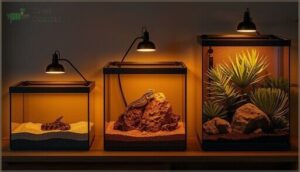
Enclosure size dictates your wattage selection and heat distribution strategy. Small tanks under 20 gallons reach target temperatures fast with 50w bulbs, while 40-gallon setups often need 100w for proper temperature gradients.
Larger enclosures demand higher wattage or multiple reptile heat lamps to maintain thermoregulation and lighting balance. Scaling reflectors with tank dimensions prevents edge hotspots that compromise temperature control and regulation across your reptile enclosures.
Ensuring Safety and Optimal Temperature
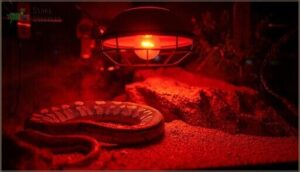
Getting the temperature right isn’t just about comfort—it’s about keeping your reptile alive. Too hot and you risk burns or organ stress.
Too cold and digestion shuts down. Here’s how to nail the balance and avoid the dangers that come with infrared heating.
Avoiding Overheating and Underheating
Temperature control sits at the heart of keeping nocturnal reptiles healthy. You can’t afford to guess when both overheating and underheating disrupt digestion, metabolism, and overall vitality.
Thermal regulation demands precision:
- Set nighttime ambient air within species-specific ranges – target ±2°C of ideal to prevent thermal stress
- Create thermal gradients of 2–5°C between warm and cool zones for natural thermoregulation
- Use thermostats, not just rheostats – maintain ±1–2°C control in the basking zone
- Position multiple lower-wattage reptile heat lamps for even heat distribution across the enclosure
- Monitor nightly with calibrated thermometers – track 14-day trends to catch drift early
Nighttime monitoring paired with proper heat lamp and lighting solutions keeps your setup stable and your animals thriving.
Choosing Heat-Resistant Materials
Your fixture materials matter as much as the bulb itself. Ceramic durability in sockets and heat resistance in domes prevent meltdowns when reptile heat lamps run nonstop.
Choose ceramic heat emitters paired with refractory metals like Inconel for lamp housings—they tolerate 1400°C without warping. Material selection drives thermal regulation safety.
Thermal insulation around wiring guards against shorts. Heat-resistant construction keeps your reptile heating system reliable year after year.
Regular Maintenance and Lamp Replacement
Replace reptile heat lamps every 6 to 12 months, even if they still glow. Heat output degrades long before bulbs burn out, compromising your animal’s thermoregulation.
Inspect bulbs monthly for cracks or dimming that signals early failure. Wipe surfaces with dry microfiber cloth to preserve infrared efficiency.
Track installation dates on maintenance schedules. Consistent lamp replacement prevents temperature drift better than reactive fixes.
Monitoring With Reliable Thermometers
Accuracy matters when heat lamps run all night. Use digital infrared thermometers at basking and cool zones to verify gradients within ±0.5°C.
Calibrate sensors monthly against ice water at 0°C. Data logging catches thermostat failures before reptile heating systems fail.
Position probes 2 to 4 inches below substrate, away from drafts. Choose enclosure-rated housings that resist humidity and guarantee environmental durability for reliable temperature monitoring.
Benefits for Nocturnal Reptile Health and Behavior
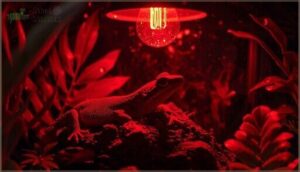
Infrared heat lamps do more than just warm your enclosure. They actually protect your reptile’s natural rhythms and long-term health.
Here’s how the right nighttime heat source promotes everything from sleep quality to digestion.
Supporting Natural Sleep Cycles
Nocturnal reptiles need a stable dark period at night to regulate their sleep cycles and maintain healthy circadian rhythm maintenance. Here’s how proper nocturnal habitat design facilitates rest.
- Infrared heat lamps deliver warmth with almost no visible light to preserve darkness.
- Ceramic heat emitters maintain thermal gradient management without disturbing sleep patterns.
- Timers enforce a consistent 10 to 12 hour dark photoperiod.
- Temperature drops at night signal resting phases between activity.
Nighttime Viewing Without Disturbance
Red infrared technology lets you watch your reptiles without spilling visible light into their dark-adapted world. Red light therapy keeps disruption below twenty percent of daytime brightness—the sweet spot for nocturnal observation. Install cameras with infrared capability to monitor behavior while your animal stays undisturbed in genuine darkness.
| Viewing Method | Impact on Reptile Behavior |
|---|---|
| Infrared cameras | Zero visible glow, no stress response |
| Dim red basking lamps | Minimal disruption to sleep cycle |
| White room lighting | Startles animals, disrupts activity |
| Night heat lamp (infrared) | Heat without behavioral interference |
Promoting Healthy Digestion and Activity
Stable warm zones from heat lamps keep enzymatic digestion humming along at ideal speed. You’ll notice improved appetite when thermal gradients let your reptile self-regulate body temperature.
Pair infrared heat with UVB lamps during brief dawn periods to support calcium metabolism. Consistent feeding schedules work best when you maintain nighttime warmth that prevents digestion-friendly diet from stalling mid-gut—fiber-rich insects digest faster above 78°F.
Reducing Stress and Behavioral Issues
Minimizing abrupt light changes with infrared heat lamps prevents stress-driven pacing and tail whipping—behaviors you’ll notice drop sharply when consistent nocturnal warmth meets stable day-night cycles.
Pair heat lamps with secure hides and low ambient noise to curb aggressive postures during feeding. Proper environmental balance promotes reptile health and wellness, reducing frequent darting that signals chronic distress and improving overall behavioral health through targeted nocturnal enrichment strategies.
Frequently Asked Questions (FAQs)
What wattage is best for different reptile species?
You’ll find wattage needs depend on species requirements and enclosure variables.
Bearded dragons bask around 100-110°F, often needing 75-100 watt bulbs in standard setups, while nocturnal species prefer moderate heat ranges.
Do nocturnal reptiles need UVB lighting at night?
You don’t need UVB lights at night for your reptile. Nocturnal species get calcium from diet and supplements, not nighttime UVB exposure.
Red light benefits and heat lamps provide warmth without disrupting sleep cycles.
How long do infrared heat bulbs typically last?
Most infrared heat bulbs last 5,000 to 12,000 hours depending on wattage and construction.
Higher-wattage models experience greater thermal stress, reducing lamp durability.
Proper heat management and thermostat use extend bulb lifespan considerably.
Conclusion
Your gecko won’t sleep under white light. Your snake won’t hunt under daylight glare. Your thermoregulation won’t work without proper infrared.
Heat lamps for nocturnal reptiles fix all three problems with true red glass that delivers warmth after dark. Pair the right wattage with spot reflectors and thermostats. Monitor basking zones with digital thermometers. Replace bulbs every six months.
Your animals will thermoregulate naturally, digest properly, and maintain the nocturnal rhythms they evolved to follow.
- https://eb2fe470.delivery.rocketcdn.me/wp-content/uploads/Reptile-Lamp-Chart.jpg
- https://www.zillarules.com/articles/how-to-create-a-proper-day-and-night-cycle-in-your-terrarium
- https://zoomed.com/nocturnal-infrared-heat-lamp/
- https://pmc.ncbi.nlm.nih.gov/articles/PMC4311741/
- https://www.frontiersin.org/journals/ecology-and-evolution/articles/10.3389/fevo.2022.821335/full