This site is supported by our readers. We may earn a commission, at no cost to you, if you purchase through links.

Most snake deaths in captivity trace back to one thing: guesswork. A tank that’s too dry, a thermostat left unchecked, a feeding schedule based on habit instead of biology. These aren’t rare mistakes. They’re the default outcome when owners rely on pet store advice instead of physiology.
Snakes don’t forgive sloppy setups the way dogs or cats might. Their bodies run on precise external cues, temperature, humidity, prey size, and small errors compound fast.
Knowing how to care for a pet snake properly means treating husbandry as a science, not a guess. Get the fundamentals right, and you’ll set your snake up for a long, healthy life.
Table Of Contents
- Key Takeaways
- How to Care for a Pet Snake
- Set Up a Safe Snake Habitat
- Control Temperature, Humidity, and Shedding
- Feed Your Pet Snake Safely
- Handle, Clean, and Monitor Health
- Frequently Asked Questions (FAQs)
- Are pet snakes hard to maintain?
- How to care for a pet snake for beginners?
- Can pet snakes get attached to you?
- Can I leave my snake alone for a week?
- Are snakes low-maintenance pets?
- How do you take care of a snake?
- What are the best pet snake care tips?
- Should you care for snakes as pets?
- What is a good pet snake?
- How do I choose a snake for my new pet?
- Conclusion
Key Takeaways
- Get your setup dialed in before you even buy your snake: choose a beginner-friendly, captive-bred, nonvenomous species and check local ownership laws first.
- Since snakes can’t regulate their own body heat, you need to build a precise thermal gradient (roughly 88-92°F warm side, 75-78°F cool side) with a reliable thermostat and independent temperature/humidity monitoring.
- Match feeding to biology, not habit—use frozen-thawed prey sized to your snake’s girth and follow an age-based schedule, since hatchlings, juveniles, and adults all eat at different rates.
- Stay alert for warning signs like stuck sheds, appetite loss, or unusual discharge, and back up your care with annual vet visits, since these steps catch problems before they become serious.
How to Care for a Pet Snake

Caring for a pet snake starts long before you set up a tank. Your choices at the very beginning determine how smooth the next twenty years will go. Here’s what you need to lock down first.
Since some species can be part of your life for two or three decades, it’s worth learning simple, proven taming techniques early on to build trust from day one.
Choose a Beginner-Friendly Species
Your first snake should forgive beginner mistakes, not punish them. Corn snakes top the list for good reason: calm temperament, easy handling, manageable 4–5 foot size.
If you’re weighing corn snakes against other beginner-friendly options, this guide to gentle pet snakes that won’t nip during handling breaks down how each stacks up.
- Corn snakes: quiet, docile, confidence-building
- Ball pythons: striking morphs, 3–4 feet
- King snakes: hardy, adaptable
- Rosy boas: compact, low-stress
Buy a Captive-Bred Snake
A calm species means little if its start in life was rough. Buy captive-bred, always.
These snakes acclimate faster, carry lower parasite loads, and come with lineage documentation. Reputable breeders back sales with health guarantees, quarantine recommendations, and real breeder support, so you’re not guessing about temperament or care needs on day one. Adopting captive-bred snakes also usually skips the permits required for wild-caught reptiles, simplifying the legal side of ownership.
Avoid Venomous Snake Species
Good breeding doesn’t erase bad biology. Stick to nonvenomous species like corn snakes, ball pythons, and king snakes.
Venomous snakes inject toxins through specialized fangs, and identification traits overlap enough that even experts get fooled. Rattlesnakes, copperheads, cottonmouths, and coral snakes are common U.S. natives.
- Skip anything requiring antivenom access
- Avoid wild-caught "mystery" snakes
- Never assume triangular heads mean safety
Check Local Ownership Laws
Choosing a nonvenomous species solves one legal risk, but ownership laws add another layer entirely. State wildlife regulations vary sharply: California requires breeder permits for common colubrids, Massachusetts bans all pythons and boas outright.
Run species ban verification before buying. Check municipal restriction checks too, since city ordinances often exceed state rules. Confirm captive-bred snakes meet documentation standards, and note any license renewal requirements before you commit.
Plan for Long-Term Costs
A snake can outlive a decade of birthdays, and your budget needs to plan that far ahead.
- Setup costs: $150–$300 enclosure, $40–$100 heating gear
- Annual vet budgeting: $50–$150 routine, $300–$1,500 emergencies
- Feeding frequency savings: bulk prey cuts costs 10–20%
Total annual expenses for snake ownership usually fall between $450 and $1,500.
Set Up a Safe Snake Habitat
Your snake’s enclosure is its entire world, so every detail matters. A poorly set-up habitat leads to stress, illness, or an escaped snake in your living room. Here’s exactly what you need to get right.
Enclosure needs vary by species, so it’s worth checking a detailed guide to caring for pet snake species before you buy tank size, heating, or substrate.
Choose The Correct Enclosure Size

Size dictates comfort. Hatchlings need 20-40 liter enclosures; adults require 60-120 liters, roughly two to three times body length.
| Snake Size | Enclosure Length |
|---|---|
| Under 2 ft | 24-40 in |
| 2-4 ft | 48-60 in |
| Over 4 ft | 60-180 gal |
| Arboreal | Taller units |
| Burrowing | Deeper substrate |
Vertical space should equal half the snake’s length for climbers.
Secure Every Escape Point
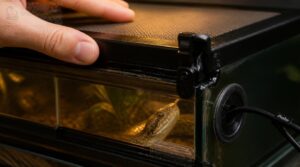
Never underestimate a snake’s nose for weak points.
Test latch integrity weekly, seal seams with silicone, and fit mesh under 0.25 inches for ventilation security. Add door sweeps, grommet cable entries, and inspect gaskets monthly.
Escapeproof materials matter more than terrarium size ever will, since even the roomiest enclosure fails if one seam gives.
Select Species-Appropriate Substrate

Bedding isn’t decoration, it’s a habitat function. Match substrate to species biology, not aesthetics.
- Aspen for dry-climate species
- Cypress mulch for tropical humidity
- Sand-clay mix for desert dwellers
- Coconut fiber for burrowers like king snakes
- Paper towels for quarantine setups
Moisture retention and burrowing behavior drive the choice. Bioactive substrates add complexity many beginners should skip initially.
Provide Warm and Cool Hides

A snake without a hide is a snake under stress. Give your pet two dedicated hides, one warm, one cool, sized to fit its coiled body snugly.
| Hide Type | Placement | Temp Range |
|---|---|---|
| Warm | Hot side | +6-12°F |
| Cool | Cool side | Ambient |
| Both | Opposite ends | Gradient |
Clean both weekly; damp bedding breeds mold fast.
Add Safe Enrichment Features

A bare tank breeds boredom, and bored snakes stress easier. Add live, non-toxic plants for humidity and cover, cork bark ramps for climbing, and rotate scents weekly to fight olfactory fatigue.
- Hidden leaf litter to explore
- Hollow logs for secure retreats
- Feeding puzzles behind obstacles
- Textured surfaces for shedding
- Dim, glare-free lighting
Control Temperature, Humidity, and Shedding

Your snake can’t regulate its own body heat, so your setup has to do it for them. Getting this wrong isn’t a minor mistake—it’s the leading cause of preventable health problems in captive snakes. Here’s what you need to get temperature, humidity, and shedding right.
Since snakes can’t regulate their own body heat, getting temperature and humidity wrong is the leading cause of preventable health problems in captivity
Create a Temperature Gradient
Because snakes can’t shiver or sweat, they rely entirely on you to build a thermal gradient. Place heat on one end only, keeping it 6 inches from walls.
| Zone | Surface Temp | Purpose |
|---|---|---|
| Warm | 88-92°F | Digestion |
| Cool | 75-78°F | Resting |
Block 75% of top screens to preserve airflow gradient control and monitor all zones with probe thermometers.
Install a Reliable Thermostat
A gradient means nothing without a reliable thermostat enforcing it. Run a wiring compatibility check first, most units need a C wire for constant power. Confirm sensor placement accuracy near the basking spot, away from vents.
- Verify wiring compatibility
- Secure C wire connection
- Test power source reliability
- Calibrate after installation
- Label wires before removal
Monitor Heat and Humidity
Calibration only proves the thermostat works. You still need independent verification through multi-point monitoring.
| Zone | Sensor Type | Placement |
|---|---|---|
| Basking | Temp probe | On surface |
| Cool side | Temp probe | Ground level |
| Humid hide | Hygrometer | Inside hide |
Add alert automation through Sensorpush or Inkbird apps for instant threshold notifications, catching failures before they harm your snake.
Match Species Humidity Needs
Every species carries its own humidity blueprint. Ball pythons need 50-60%, corn snakes hold at 40-55%, and Indian Sand Boas stay drier at 30-50%.
Match substrate moisture and gradient setup to that number specifically. During winter heating, push tropical species 10-15% higher than room air, and watch for fragmented sheds signaling humidity below 50%.
Prevent Problematic Sheds
A stuck shed rarely fixes itself. Set up a humid hide during the late shed phase, when skin starts lifting.
Inspect head and tail first, since shed sticks there most. If pieces resist gentle removal, run a lukewarm soak instead of pulling. Repeated stuck sheds mean your humidity levels or temperature gradient need adjusting, not more handling.
Feed Your Pet Snake Safely

Feeding mistakes cause more snake injuries than almost any other care error. Getting it right means paying attention to prey type, size, and timing, not just tossing in a meal. Here’s exactly what you need to know before feeding day arrives.
Choose The Right Prey Type
Your snake’s species dictates its menu. Constrictors like ball pythons thrive on frozen-thawed rodents, while garter snakes need fish, worms, or amphibians.
Live vs frozen prey isn’t a real debate: frozen-thawed wins on safety and retains over 95% of nutrients. Buy from reputable suppliers offering captive-bred, disease-free options, and always match feeding schedules to your species’ natural diet.
Measure The Correct Prey Size
Three numbers matter here: girth, weight, and width ratio. Measure your snake’s widest point with a flexible tape, then use prey width up to 1.25 times body girth. Ball pythons handle 1.25-inch prey at 2-inch girth comfortably.
For weight-based feeding, aim for 10-15% of body mass. Juvenile ball pythons need this checked every 2-4 weeks as girth increases.
Prepare Frozen-Thawed Prey
Thaw rodents in a sealed bag inside the fridge, never on the counter. Warm water speeds bacterial growth, so skip it.
Check texture and smell before feeding; discard anything off. Feed promptly, wash utensils and your hands after handling, and remove uneaten prey to stop disease transmission.
Follow an Age-Based Schedule
Your snake’s age drives its metabolism, and its schedule should follow suit. Hatchlings eat every 5-7 days; juveniles every 7-10 days, tracking 10-15% weekly weight gain; subadults stretch to 10-14 days.
- Weigh weekly (juveniles) or monthly (adults)
- Cap prey at 10% body weight
- Watch for winter fasting
- Adjust for breeding females
Recognize Feeding Readiness
Hunger shows up in behavior before it shows up in the food bowl. Watch for rapid tongue flicking, enclosure edge prowling, and head orientation toward prey scent.
A coiled, strike-ready posture or calm mouth-opening signals readiness. Offer prey sized 1–1.5 times body width, using proper two-handed handling, then monitor postfeeding behavior for normal digestion instead of regurgitation.
Handle, Clean, and Monitor Health
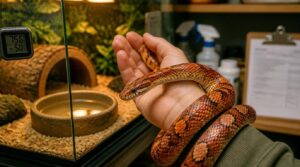
Feeding is only part of keeping your snake healthy. How you handle it and clean its space matters just as much, and small warning signs deserve your full attention. Here’s what to focus on to keep your snake thriving for years to come.
Handle Without Causing Stress
Pick up your snake using two-hand support along its full length, never by the head or tail alone. Start contact at the ventral side with a touch gradient, gliding hands continuously.
Handle in a quiet, low-traffic room for 10-15 minutes max. Supervise children closely, then wash hands for 20 seconds afterward.
Spot-Clean The Enclosure Daily
After handling, turn your attention back to the enclosure itself. Daily waste removal keeps bacteria from building up: scoop feces with a dedicated tool, spot-clean damp substrate, and wipe walls and water dish rims. Rinse decor and check corners for buildup.
This isn’t the same as monthly deep cleaning with a 10% bleach solution, that’s a separate task entirely.
Deep-Clean and Disinfect Safely
Monthly deep cleaning goes further than daily spot checks. Remove your snake, then scrub with a 10% bleach solution or reptile-safe cleaner, respecting disinfectant contact time on the label.
- Wear gloves and eye protection (PPE hand hygiene matters)
- Ventilate the room; open windows
- Rinse thoroughly, dry completely (rinse residue control)
Never mix chemicals, wash hands after.
Recognize Illness Warning Signs
A clean enclosure won’t stop illness from developing, so know the red flags. Watch for wheezing or mouth-open breathing, cottage cheese-like mouth discharge, swollen jaws, cloudy eyes, visible mites, star-gazing posture, or discolored belly patches.
Loss of appetite signals sickness in over 75% of cases. Any failure to eat, thrive, or move normally warrants immediate attention.
Schedule Reptile Veterinary Care
Your snake needs a wellness appointment with a qualified exotic animal vet every year, no exceptions.
Juveniles require checkups every 3-6 months; seniors past age seven need biannual visits. Exams include weight checks, oral and eye assessment, blood panels, and fecal parasite testing.
Exotic veterinary care runs $80-$120 per visit. Cheap insurance against costly, serious disease.
Frequently Asked Questions (FAQs)
Are pet snakes hard to maintain?
Not if you master the basics. Temperature gradients, feeding schedules, and enclosure cleaning routines demand consistency, not expertise. Budget time for annual veterinary care and proper handling techniques, and most beginner species stay manageable for decades.
How to care for a pet snake for beginners?
Slither into this the right way: pick a beginner-friendly species, buy captive-bred, set correct terrarium size and temperature gradients, follow age-based feeding schedules, handle gently, and plan for 20+ years of committed care.
Can pet snakes get attached to you?
Yes, but not like a dog. Snakes recognize human scent familiarity and calm during handling, showing trust through slow movement rather than affection. That relaxed response is comfort, not emotional attachment.
Can I leave my snake alone for a week?
For most healthy adults, absence makes the heart grow fonder, not the snake go hungry. Corn snakes and ball pythons tolerate a week fine, but arrange water access, temperature stability, and a caregiver check every 2-3 days regardless.
Are snakes low-maintenance pets?
That reputation is misleading. Snakes demand precise temperature regulation, humidity control, feeding schedules every 1-2 weeks, and routine health checks. Habitat setup and cost planning require real effort, so treat them as genuinely hands-on pets, not display animals.
How do you take care of a snake?
What does daily snake care actually involve? It comes down to five habits: temperature regulation, humidity control, a secure enclosure setup, correctly sized feeding, and watching closely for early health warning signs.
What are the best pet snake care tips?
Master the basics: build a 78–88°F gradient, offer warm and cool hides, feed frozen-thawed prey on an age-based schedule, handle gently with full-body support, and keep annual vet checkups on the calendar.
Should you care for snakes as pets?
Slow and steady wins the race, and snakes reward patience. Yes, with proper research they make excellent pets: quiet, low-maintenance, easy to clean. But they demand decades-long commitment, careful species selection, and legal checks first.
What is a good pet snake?
Good starter snakes share docile temperaments and non-venomous safety. Corn snakes, ball pythons, king snakes, rosy boas, and garter snakes all offer manageable size and forgiving care, making them ideal beginner-friendly species for new owners.
How do I choose a snake for my new pet?
Match the snake to your experience, not the other way around. Corn snakes and ball pythons suit beginners best: docile, manageable size, forgiving care. Check adult length, temperament, and local vet access before committing.
Conclusion
A healthy snake is like a well-tuned instrument, precise, responsive, and unforgiving of neglect. Learning how to care for a pet snake isn’t about grand gestures.
It’s about consistent daily discipline: stable temperatures, correct humidity, clean enclosures, and feeding schedules matched to biology. Skip the guesswork, and you remove most of the risk.
Your snake can’t tell you when something’s wrong, so your vigilance becomes its safety net. Master the fundamentals, and a long, thriving life follows naturally.
Knowing your snake’s species deepens that vigilance—traits like scale texture and head shape reveal behavioral tendencies, as explored in this guide to identifying snake species and their unique physical characteristics.