This site is supported by our readers. We may earn a commission, at no cost to you, if you purchase through links.

Pick up a Dasypeltis, and you’ll wait for a bite that never comes. These snakes carry only tiny, nonfunctional teeth, too small to break skin, so their whole strategy revolves around swallowing eggs whole and crushing the shells with bony spines in their throat. That trade-off makes them some of the calmest, safest snakes you can keep.
Among the best pet snakes with no teeth, three Dasypeltis species stand out for beginners and seasoned keepers alike, each with its own size, habitat, and quirks worth knowing before you buy an enclosure.
Table Of Contents
- Key Takeaways
- Best Pet Snakes With No Functional Teeth
- Which Toothless Snake is Best?
- Do Egg-Eating Snakes Really Have No Teeth?
- Toothless Pet Snake Care Requirements
- What to Know Before Choosing One
- Frequently Asked Questions (FAQs)
- What pet snakes don’t have teeth?
- What are the best pet snakes that don’t bite?
- What is the friendliest snake to have as a pet?
- What is the best snake to keep as a pet for a beginner?
- What is the average lifespan of a toothless pet snake?
- Can egg-eating snakes be housed together in pairs?
- Do egg-eating snakes need UVB lighting?
- What causes an egg-eating snake to regurgitate?
- Are egg-eating snakes legal to own everywhere?
- Can egg-eating snakes bond or recognize their keepers?
- Conclusion
Key Takeaways
- Dasypeltis snakes (African, Forest, and East African egg-eaters) only have tiny, nonfunctional teeth, so they crush eggs with bony spines in their throat instead of biting.
- These calm, easygoing snakes make great beginner pets, needing just a small 24x18x12 inch enclosure and weekly egg feedings instead of live rodents.
- Since they can’t bite, egg-eaters bluff predators by rubbing their serrated scales together in a hissing "saw-scaling" display that mimics venomous vipers.
- With proper care—matching egg size to head width, keeping humidity between 40-60%, and choosing captive-bred over wild-caught snakes—these pets can live 10 to 15 years or more.
Best Pet Snakes With No Functional Teeth
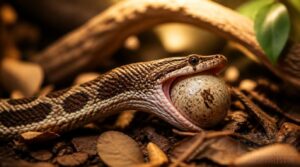
If you’re after a pet snake without a single tooth to worry about, egg-eaters are your answer. A handful of Dasypeltis species show up in the pet trade, each with its own look and personality. Here’s a rundown of the three you’re most likely to find.
Beyond their toothless bite, egg-eaters fit right in with other low-maintenance snake species that reward simple setups with easygoing temperaments.
African Egg-Eating Snake
A gentle climber with a taste for camouflage, the African egg-eating snake (Dasypeltis scabra) tops the toothless list. Native to sub-Saharan savannas and grasslands, adults reach 24-30 inches, with females often slightly larger. Their smooth, muted scales match beautifully into leaf litter while exploring branches for nests, since egg predation adaptation drives nearly every part of their behavior and daily routine.
Despite lacking teeth, its jaw features bony protrusions for crushing eggs, allowing it to swallow prey whole before regurgitating the empty shell.
Forest Egg-Eating Snake
If the African species feels like a savanna specialist, its cousin heads for the trees. The Forest Egg-Eating Snake haunts sub-Saharan woodlands and riverine edges, hunting nests by scent among leaf litter.
Its shell cracking mechanism works the same trick, though gape size shifts with local nests:
- Passerine eggs
- Waterfowl eggs
- Ground-nest clutches
- Canopy nests
East African Egg-Eating Snake
Slimmer and drier-country than its forest cousin, Dasypeltis medici runs 60 to 100 cm with smooth scales built for savanna scrub.
| Trait | East African Egg-Eater |
|---|---|
| Length | 60-100 cm |
| Diet | Bird eggs only |
Its specialized feeding morphology relies on ventral shell projections, not teeth, cracking shells smoothly as the egg slides down.
Species Comparison
Line up all three side by side and the family resemblance in the genus Dasypeltis is clear, even with different color patterns and habitat leanings.
- Size range: 60-150 cm across species
- Scale texture: smooth, non-keeled bodies
- Body shape: slender, built for swallowing eggs whole
Each toothless snake favors a slightly different habitat preference, from savanna to forest edge, but none resembles the Indian Egg-Eating Snake in build.
Which Toothless Snake is Best?

So which egg-eater actually fits your life? It really comes down to a few practical things, like how much handling you want and how big a snake you’re okay with. Here’s what to weigh before picking your new toothless friend.
Since egg size should match head width rather than overall length, this guide to choosing an egg-eating snake as a pet breaks down which species handle small versus extra-large eggs best.
Beginner Suitability
New to snakes? An egg-eating snake might be your easiest start. These nonbiting snakes need a small setup, just 24x18x12 inches, and skip the whole live-rodent hassle entirely.
The East African species even accepts store-bought eggs every 5 to 7 days as a youngster. That’s a beginner pet that’s forgiving on husbandry and light on daily fuss.
Temperament and Handling
Pick up any egg eating snake and you’ll notice something right away: no drama. These are calm, gentle snakes that move slowly and settle into your hands within seconds.
Watch for coiling or quick tongue flicks, those are mild stress signals. Support the body fully, keep sessions short, and trust builds fast with nonbiting snakes like these.
Adult Size
Size matters more than folks expect with these toothless snakes. African egg eating snakes reach 1.0 to 1.6 meters, Forest types stay around 0.9 to 1.3 meters, and East African cousins land near 1.0 to 1.4 meters.
- African: stout, 1.0-1.6m
- Forest: slender, 0.9-1.3m
- East African: broad, 1.0-1.4m
- Maturity: 2-3 years
- Habitat shapes final length
Richer habitats grow bigger adults; captive snakes without fangs often surpass wild ones.
Pet Trade Availability
Finding a toothless snake for sale isn’t hard if you live in North America or Europe, where retail networks stock them regularly. African egg eating snakes dominate local breeder shelves year round, while the Indian egg-eating snake and rarer morphs show up seasonally.
Just remember, cross border sales require legal import permits under CITES. Online marketplaces widen your options, but always vet sellers first.
Captive-Bred Versus Wild-Caught
Here’s the honest truth: most egg eating snakes on the market are still wild-caught, since captive breeding remains uncommon.
That matters for parasite risk and temperament differences, as wild-caught snakes often carry higher parasite loads and stress more easily.
Captive-bred toothless snakes acclimate faster and offer better genetic diversity tracking.
Ethical sourcing favors captive-bred whenever you can find it.
Do Egg-Eating Snakes Really Have No Teeth?
It’s a fair question, and the honest answer is a little more interesting than a flat yes or no. These snakes aren’t completely toothless, but what they do have won’t ever bother you. Here’s what’s really going on inside that mouth.
Reduced Nonfunctional Teeth
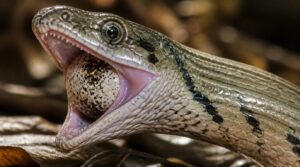
Toothless" isn’t quite accurate. Egg-eating snakes keep tiny vestigial teeth, smooth remnants too small for biting. These nonfunctional tooth retentions sit mostly up front, blunt and nerve-poor, more leftover than tool.
Despite the toothless appearance, oral mucosal protection still guards the mouth. So while an Indian egg-eating snake looks fang-free, it’s really running on reduced dentition, not a true absence of teeth.
Toothless Feeding Adaptations
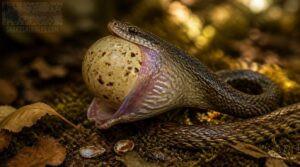
So how does an eggeating snake actually eat without teeth? The trick is jaw flexibility, letting the mouth stretch wide around the egg. Saliva softens the membrane, then bony spurs inside the throat handle shell puncture.
This swallowing process, shared by African egg eating snakes and the Indian EggEating Snake, ends with stomach acid finishing digestion.
No Fangs or Venom
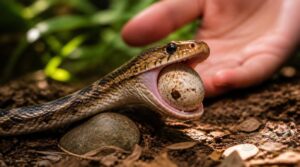
Once that shell-cracking machinery does its job, there’s no fangs left to worry about anyway. African egg eating snakes and the Indian EggEating Snake carry venom absent naturally, making them genuinely harmless to humans.
- Toothless mouth structure
- Non-venomous defense
- Safe for handling
- No medical risk from bites
That’s why toothless snakes suit nervous first-time keepers so well.
Defensive Saw-Scaling
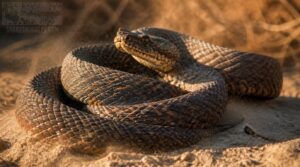
No fangs doesn’t mean no bluff. When cornered, these snakes coil into tight loops and rub their serrated keeled scales together, producing a rasping hiss called saw-scaling.
With no fangs to bare, a cornered egg-eater bluffs by rasping its serrated scales into a hissing, viper-like warning
It’s pure mimicry, copying venomous vipers to scare off predators. Add a little body inflation and head flattening, and you’ve got a harmless snake putting on quite a show.
Bite Risk
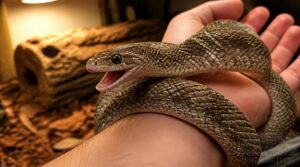
That saw-scaling bluff rarely turns into a real bite. Reduced teeth mean minor nips at most, more startle than harm.
Risk climbs with rough handling or enclosure stress like overheating. Stick to safe handling techniques: support the body, skip the head, use tongs for feeding. Watch bite response after meals, and clean any nip promptly.
Toothless Pet Snake Care Requirements
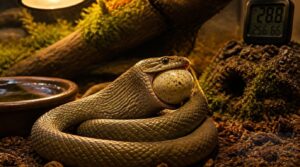
Once you know your snake has no real teeth, the next step is setting up a home that fits its unique needs. Toothless doesn’t mean low-maintenance, though—these snakes still need the right eggs, the right temperatures, and gentle handling to thrive.
Here’s what actually matters when you’re building their care routine.
Suitable Bird Egg Sizes
Size matters more than most new keepers expect.
Egg size compatibility depends on your snake’s head width, so quail eggs and finch eggs are your safest bets for most adults.
Best egg dimensions stay well below chicken egg size (53-60mm), since that’s simply too large for a snake’s flexible but limited jaw stretch.
Feeding Frequency
How often should you feed your snake? It depends on age. Hatchlings thrive on a weekly feeding schedule, while juveniles slow to every 7-10 days.
Adults settle into eating 1-2 eggs weekly, adjusting portions based on body condition. Surprisingly, wild snakes fast seasonally for months, but captive-born ones adapt well to consistent, predictable schedules year-round.
Enclosure Size and Setup
A good home matters as much as good food. Aim for a 24x18x12 inch enclosure minimum, with secure locking lids and mesh venting.
Add climbing branches, dual hides, and a shallow water dish.
- Five times body girth for width
- 20% free floor space
- Two-year growth margin
- Feeding area away from water
- Aspen or cypress substrate
Temperature and Humidity
Keep nighttime temps above 60°F, with a warm side near 85°F for a proper thermal gradient.
Humidity should sit between 40-60%, since warm air holds more moisture than cool air. Watch for shedding trouble, a sign your humidity control needs adjusting. A hygrometer and thermometer make temperature monitoring simple and worry-free.
Safe Handling Practices
No fangs, no venom, but egg-eating snakes still deserve gentle handling. Scoop from below, never grab the tail, and support the whole body evenly.
Wait 24-48 hours after feeding before touching them again. Watch body language: relaxed coils mean comfort, tight coils or hissing mean back off. Keep sessions short in a quiet, stress-free environment for safe, trust-building handling every time.
What to Know Before Choosing One
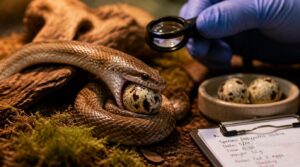
Bringing home a toothless snake sounds simple, but a few practical questions deserve honest answers first. Where you’ll get eggs, how you’ll handle health checks, and who you’re buying from all matter more than people expect. Here’s what to think through before you commit.
Reliable Egg Sourcing
Finding good eggs is half the battle. Look for certified egg suppliers with traceability and pathogen testing records.
- HACCP/ISO 22000 certification
- Salmonella testing before shipment
- Organic label compliance
- Sustainable farm practices
Small quail or finch eggs suit most eggeating snakes and support their balanced diet, natural egg cracking behavior, and dietary requirements.
Parasite Screening
A sourced egg is only half the safety picture.
Schedule fecal sample collection soon after purchase, ideally before any medication starts, since antibiotics skew results.
Your vet matches test type to the parasite in question, then interprets findings alongside your snake’s history.
Regular parasite screening at veterinary checkups catches problems early, even when your toothless snake looks perfectly healthy.
Feeding Refusal
Your snake stops eating and your mind jumps to worst-case scenarios. Take a breath first.
Temperature fluctuations cause 85% of feeding refusals, so check your thermometer before panicking. Watery whites or floating eggs matter too. Stress, poor egg presentation, and low humidity below 60% can all trigger fasting in toothless snakes. Rule out the simple stuff first.
Lifespan and Veterinary Care
Once feeding issues sort themselves out, think long-term. With good care, toothless snakes reach 10 to 15 years, sometimes 22.
Book annual vet checkups with fecal testing and weekly weighing to catch trouble early. Watch for weight loss, wheezing, or straining, these signal dystocia or infection. Quick action on emergency care, especially egg binding, makes all the difference.
Ethical Breeder Selection
Good vet care means little if the snake started out stressed or inbred. Look for health testing certificates, genetically diverse bloodlines, and clean facilities. Ask about lineage records and lifetime support.
Ethical breeder selection favors captive breeding over wild-caught toothless snakes, giving your egg-eating species a calmer temperament and a genuinely healthier start.
Frequently Asked Questions (FAQs)
What pet snakes don’t have teeth?
Picture a snake that could swallow a hundred quail eggs and never once flash a fang. That’s Dasypeltis, the toothless snake genus covering African, forest, and East African egg-eating species built entirely for a shell-only diet.
What are the best pet snakes that don’t bite?
For beginners wanting truly bite-free pets, corn snakes, ball pythons, ball pythons, and rosy boas top the list, alongside toothless egg-eaters. Each stays calm with gentle handling, though egg-eaters skip biting entirely since they physically can’t, relying on saw-scaling instead.
What is the friendliest snake to have as a pet?
Ever wonder what makes a snake truly friendly? Corn snakes often top the list for docile temperament and easy handling, but among toothless snakes, the African egg-eater’s calm nature and gentle handling make it a beginner-friendly favorite too.
What is the best snake to keep as a pet for a beginner?
Corn snakes usually top the list, thanks to calm temperament and easy handling. If you want a beginner-friendly snake with simpler diet needs, though, egg-eating species offer gentle care, docile handling, and manageable size for newcomers.
A safe, beginner-friendly snake water dish with a drowning-prevention ramp and smooth interior makes daily care even easier for first-time owners.
What is the average lifespan of a toothless pet snake?
With attentive care, egg-eating species usually reach 12 to 15 years, sometimes stretching to Wild snakes rarely see 10, facing predators and scarce meals, so your steady feeding schedule genuinely rewards them with a longer, healthier life.
Can egg-eating snakes be housed together in pairs?
No. These toothless snakes do best with solitary housing, since pairs often show stress, appetite drops, and even competition over food, and cohabiting raises disease transmission risk plus real breeding complications you’d rather avoid.
Do egg-eating snakes need UVB lighting?
Yes, a little goes a long way. Moderate UVB output aids vitamin D synthesis and calcium metabolism, especially in breeding females producing eggs. Place tubes 9 to 18 inches above basking spots, on a gradient, so your snake can choose sun or shade.
What causes an egg-eating snake to regurgitate?
Picture picking up your snake right after it swallows an egg, that’s a common regurgitation trigger. Handling post-feeding, oversized prey, sudden temperature shifts, humidity changes, and chronic dehydration all disrupt the digestive period, causing egg-eaters to bring meals back up.
Are egg-eating snakes legal to own everywhere?
Not quite. Legality is legal by state, and sometimes by city or country. Check whether a permit is needed, watch for local restrictions, and confirm the species isn’t a protected species under trade regulations before buying.
Can egg-eating snakes bond or recognize their keepers?
Not the way mammals do. Egg-eating snakes build scent recognition and keeper familiarity through repeated calm handling sessions, showing lower stress indicators and better handling tolerance over time, a behavioral adaptation reflecting routine and trust building rather than true emotional attachment.
Conclusion
Don’t judge a book by its cover, and don’t judge a snake by its teeth. These egg eaters prove that safety and personality can coexist beautifully in one calm, curious animal.
Among the best pet snakes with no teeth, you get low risk, easy care, and genuine charm rolled into one scaly package. Choose your species based on size and temperament, source eggs reliably, and you’ll have a companion that rewards patience for years to come.