This site is supported by our readers. We may earn a commission, at no cost to you, if you purchase through links.
Your snake’s body tells a silent language long before it strikes, hides, or retreats. Most keepers miss these subtle signals—the slight muscle tension along the spine, the frequency of tongue flicks, the angle of a raised head—until a defensive bite reminds them that interpretation matters.
Snakes communicate through precise physical cues shaped by millions of years of survival instinct, and once you understand this silent language, fear transforms into fascination. A tightly coiled ball doesn’t always mean aggression; sometimes it signals insecurity or temperature regulation.
That distinctive S-curve? It’s not always a threat display—it might indicate your snake is simply shifting from rest mode to active exploration. Learning to read these nuanced postures and movements gives you the insight to respond appropriately, whether your snake needs space, feels stressed by environmental factors, or is genuinely relaxed in your presence.
Table Of Contents
- Key Takeaways
- Key Snake Body Language Signals
- Recognizing Signs of Stress and Fear
- Identifying Relaxed and Content Snakes
- Environmental Factors Affecting Body Language
- Building Trust Through Positive Interaction
- Frequently Asked Questions (FAQs)
- How to read a snakes body language?
- What does it mean when a snake stops flicking its tongue?
- Do snakes recognize their owners over time?
- Can snakes feel pain or discomfort?
- Why does my snake refuse food suddenly?
- How long does it take snakes to adjust?
- What sounds or vibrations do snakes detect?
- Can snakes recognize individual people over time?
- Do different snake species communicate differently?
- How does shedding affect snake behavior patterns?
- Conclusion
Key Takeaways
- Snakes communicate stress and fear through body language—rapid tongue flicking, tight coiling, S-curves, hissing, and head flattening signal defensive states, while loose coils, slow movements, and gentle tongue flicks indicate relaxation and security.
- Environmental factors like temperature fluctuations, cramped enclosures, poor humidity, and sudden habitat changes directly trigger stress responses visible in your snake’s posture and behavior, making proper setup essential for calm body language.
- Building trust requires recognizing and respecting boundaries by stopping handling when you see defensive signals (S-postures, flattening, hissing), supporting the body evenly during brief sessions, and maintaining consistent routines that reduce stress over time.
- Most snakes adjust to new environments within two to four weeks and can recognize individual handlers through scent memory, associating familiar people with safety rather than forming emotional bonds like mammals do.
Key Snake Body Language Signals
Understanding what your snake is trying to tell you starts with recognizing the physical signals they display through their body. Snakes can’t vocalize emotions the way mammals do, so you’ll need to read their posture, muscle tension, and behavioral cues to interpret their current state.
If you notice signs like escape attempts, rapid breathing, or unusual color shifts, check out how to handle a stressed snake to help them calm down before things escalate.
The following signals represent the most common and important body language patterns you’ll encounter when observing or handling snakes.
Coiling Patterns and Muscle Tension
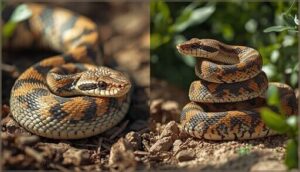
Coil formation reveals volumes about your snake’s emotional state. When muscle relaxation defines loosely arranged coils, you’re observing contentment and rest—your reptile feels secure.
Conversely, tight, stacked loops signal tension release as defensive postures emerge. Observing body alignment and flexibility training during coiling into S shape helps you decode defensive behaviors in reptile body language, distinguishing calm exploration from genuine threat perception.
S-Shaped Postures and Raised Heads

S-shaped snake curvature appears when your snake transitions from rest to motion or surveying mode.
Head elevation—raising the skull above shoulder level—sharpens its visual field and signals heightened awareness.
These posture signals often reflect environmental influence: warmer zones trigger more surveying, while obstacles prompt tighter curves.
Reading these movement patterns in snake body language helps you distinguish curiosity from defensive postures in reptile behavior.
Hissing, Puffing, and Defensive Displays
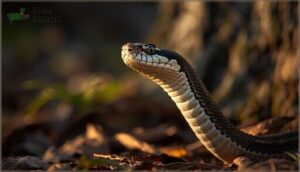
When your snake raises its head and forcefully expels air through the glottis—that sharp, sustained hiss—it’s deploying one of nature’s clearest warning signals in defensive mechanisms.
Puffing follows: the body arches, ribs expand, and diameter increases to make the animal look larger and more formidable. These threat displays in snake body language aren’t aggressive attacks; they’re fear responses asking you to back off before agonistic behavior escalates.
When a snake puffs up and arches its body, it’s issuing a clear warning: back off before fear turns into aggression
Notably, research has shown that such snake defensive behaviors are evolutionarily conserved across many species.
Tongue Flicking Speed and Frequency

Beyond those defensive behaviors, you can read emotional states by watching flick mechanics. Rapid, frequent tongue flicking reveals heightened arousal—your snake is actively odor sampling to assess threat or locate prey. Slower, deliberate flicks signal calm exploration.
Species variation matters: garter snakes usually flick faster than pythons, but any sudden increase in your individual’s rate acts as a stress indicator worth investigating. Apparently, recent research into context-correlated tongue-flick parameters in snakes and lizards highlights how different flick types reveal information about behavioral context and emotional state.
Head Flattening and Neck Expansion

When a snake perceives danger, it performs one of the most striking defensive postures: the head presses downward while cervical muscles contract, pushing the neck outward into a funnel-like silhouette.
This threat display creates visual signals that say “back off” without requiring actual contact. Neck expansion mechanics vary by species—larger snakes show broader profiles—but the message in snake body language remains universal: respect my space.
Recognizing Signs of Stress and Fear
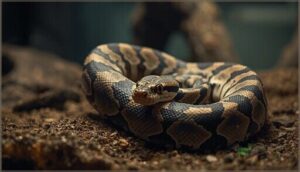
When your snake feels threatened or overwhelmed, its body language shifts into high alert—and recognizing these signals early can prevent both stress for your snake and potential defensive reactions.
Common signs include hissing, coiling tightly, flattening their body, or rapid tongue flicking—learn how to read your pet snake’s body language and trust signals to better understand their comfort level.
A stressed snake doesn’t always hiss or strike; sometimes the signs are subtler, like unusual stillness or frantic movement that seems out of character. Understanding these fear responses helps you adjust handling, environmental conditions, or your approach before the situation escalates.
Fast, Frantic Movements and Escape Attempts
When you see your snake darting wildly in zigzag patterns or repeatedly testing enclosure edges, you’re witnessing classic flight responses driven by fear or stress.
These frantic movements—often exceeding 1.5 body lengths per second—represent urgent escape strategies, particularly common in juveniles. Rapid retreats, lateral weaving, and erratic routing aren’t aggression; they’re defensive behaviors signaling your snake feels cornered and desperately seeks safety.
Freezing and Rigid Body Posture
A motionless snake with a stiff, straight backbone is evaluating whether you’re a genuine threat. This freeze response—often sustained for up to a minute—relies on rigid axial posture and minimal lateral bending to conserve energy during confrontations.
Unlike relaxed body language, this defensive mechanism reveals heightened stress signals: your snake is bracing for a potential strike, not simply resting.
Avoiding Eye Contact and Sudden Retreat
When your serpent turns its head sharply away and darts toward cover, it’s employing a primary fear response rather than showing disinterest. This snake avoidance behavior—sudden retreat paired with head redirection—signals acute stress, especially during handling or close approach.
Because most species detect movement better than fixed objects, breaking visual contact by shifting body orientation reduces perceived threat. Recognizing these visual cues and defensive postures helps you distinguish genuine alarm from calm exploration, allowing you to respect boundaries and reduce fear responses before they escalate into more intense animal body language.
Strike-Ready and Defensive Stances
A defensive snake doesn’t always attack—it’s showing you combat readiness, hoping you’ll back off. When threat response kicks in, your snake adopts strike preparation postures that demand immediate respect.
- S-curved neck coiled tight with head raised and angled toward you
- Body flattened to appear larger and more intimidating
- Mouth open with hissing sounds serving as audible warnings
- Eyes locked on your movement, tracking every shift
Identifying Relaxed and Content Snakes

A relaxed snake looks entirely different from one that’s stressed or afraid—the contrast is like night and day.
When your snake feels safe and comfortable, its body language shifts to calm, unhurried movements that signal everything’s right in its world. Here are the telltale signs that your snake is genuinely content.
Smooth, Fluid Movements
When your snake glides with deliberate pure contentment, you’re witnessing fluid postures that signal contentment. Relaxed snakes exhibit loose body posture and remarkable snake flexibility, allowing motion control that appears almost effortless and becomes smooth.
These slow movements reflect proper body alignment—each muscle working in harmony rather than tensed for defense. By recognizing relaxed snakes through these movement patterns and understanding snake body language, you’ll know your companion feels safe and secure.
Loosely Coiled or Resting Positions
Beyond fluid motion, your relaxed snake often settles into loosely coiled or resting postures that reveal genuine comfort. These coil variations feature multiple soft loops with minimal muscle tension, allowing proper body alignment and thermal regulation.
When recognizing relaxed snakes, look for loose body posture where the head rests gently above the coil—your companion’s way of saying it feels safe enough to truly unwind.
Gentle, Slow Tongue Flicks
Your companion’s gentle, slow tongue flicks—steady and unhurried—serve as one of the clearest calm behavior signs you’ll observe. These measured tongue flick patterns allow snakes to sample environmental enrichment through snake olfaction without stress-driven urgency.
- Flicks occur at shallow angles with smooth, unbroken movement
- Duration stays under half a second per sampling event
- The tongue travels in short, deliberate arcs rather than frantic passes
- Rhythmic patterns align with exploratory pauses near objects
- Relaxed posture accompanies this gentle handling-ready body language
Slow sampling reflects curiosity, not hunger or fear, revealing your snake’s comfortable emotional state while recognizing reptile body language and interpreting snake behavior accurately.
Calm Exploration Versus Hiding
When your snake glides forward with measured intent rather than darting into hiding, you’re witnessing genuine calm movement. Environmental comfort—proper heat, secure shelter, and predictable routines—fuels this snake curiosity, allowing exploration patterns that reveal relaxed snake behavior.
Recognizing emotional states means noting the difference between deliberate investigation and the sudden retreat typical of defensive postures when body language signals discomfort.
| Calm Exploration | Hiding Behavior |
|---|---|
| Smooth, measured movements | Rapid retreat to cover |
| Forward-facing head position | Tucked, defensive postures |
| Intermittent tongue flicking | Minimal scent sampling |
| Loose muscle tone | Tense, rigid body |
| Investigates new objects | Avoids open spaces |
Environmental Factors Affecting Body Language

Your snake’s body language doesn’t exist in a vacuum—it’s deeply influenced by the environment you provide.
Temperature swings, cramped quarters, and sudden habitat changes can all trigger stress responses that show up in your snake’s behavior.
Understanding these environmental triggers helps you distinguish between a snake that’s naturally defensive and one that’s simply uncomfortable with its setup.
Impact of Temperature and Humidity
Temperature and humidity aren’t just comfort factors—they’re the invisible conductors of snake behavior and body language.
Thermal regulation drives metabolic rate: warmer enclosures (75–85°F) fuel active exploration, while cooler zones slow movement and trigger extended basking. Humidity control around 50–60% preserves skin pliability and eases respiration, directly influencing stress signals like rapid tongue flicking and recognizing emotional states in your reptile.
Effects of Enclosure Size and Enrichment
Inside every enclosure, Space Utilization and Environmental Enrichment dictate your snake’s daily comfort and stress levels. Cramped Enclosure Design forces repetitive pacing, flattened postures, and frantic escape attempts—clear reptile behavior and body language red flags signaling poor animal welfare.
- Larger habitats allow full stretching and reduce collision-driven stress
- Vertical branches and hides promote natural exploration and calm body language
- Rotated enrichment items sustain curiosity without triggering defensive displays
Spatial Complexity transforms snake behavior, supporting ideal snake care and welfare.
Stress From Handling or Habitat Changes
Routine Disruptions trigger immediate stress signals, revealing how profoundly handling and habitat changes affect snake behavior and body language.
When you introduce new substrates or shift hiding spots, rapid tongue flicking and increased hissing mark the animal’s heightened environmental adaptation efforts.
Gentle, consistent handling techniques paired with gradual habitat enrichment reduce defensive postures within 24 hours, promoting long-term snake comfort and improved reptile behavior.
Signs of Discomfort Due to Poor Setup
Enclosure Design flaws trigger unmistakable stress signals—you’ll notice increased hissing, tight coiling against unstable furniture, and frequent rubbing along rough surfaces.
Setup Failures like inadequate temperature gradients or cramped hides cause persistent defensive snakes posturing, shallow breathing, and escape attempts.
Poor Habitat Quality directly shapes reptile behavior and body language, making Environmental Stress visible through the snake’s constant repositioning and reduced exploratory movement.
Building Trust Through Positive Interaction
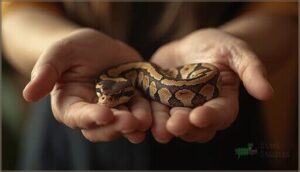
Building a trusting relationship with your snake doesn’t happen overnight—it requires patience, consistency, and a genuine understanding of what makes your animal feel secure.
The way you handle your snake, the environment you provide, and your ability to read and respect its signals all play critical roles in fostering calm, positive interactions. Let’s explore the key strategies that help you create a bond built on trust rather than fear.
Adjusting Handling Techniques for Comfort
Think of gentle handling as the bridge between observation and connection—when you support your snake with cupped hands under the chest and rear third, you’re not just lifting, you’re building trust.
- Support evenly across the body to avoid reflex contractions
- Move slowly in straight lines, pausing if hissing occurs
- Keep sessions short, gradually increasing as the snake relaxes
- Mirror enclosure temperature in your handling space
- Stop immediately when persistent coiling or flattening appears
Reducing Stress to Encourage Calm Behavior
Stress reduction begins with understanding that your snake’s wellness depends on consistent, predictable routines—feeding schedules, light cycles, and minimal disruption create security. Calming techniques like environmental enrichment and gentle handling transform anxious reptile behavior into relaxed snake demeanor, while recognizing stress in snakes through body language allows you to adjust before defensive displays escalate.
| Stress Trigger | Calming Solution |
|---|---|
| Temperature fluctuations | Maintain stable 72–78°F basking zones |
| Frequent habitat changes | Rotate enrichment weekly, not daily |
| Overstimulation from handling | Limit sessions to 2–5 minutes initially |
| Bright lights and loud noise | Provide dim, quiet spaces during rest |
| Lack of hiding options | Add multiple secure, species-appropriate hides |
Recognizing and Respecting Snake Boundaries
Boundary setting transforms defensive snakes into relaxed companions—but only if you respect their clear signals. Observing reptile body language during gentle handling helps you recognize when your snake’s had enough, reducing stress and building trust through enclosure design and patient snake socialization.
Three Essential Boundary Rules:
- Stop immediately if you see S-shaped posturing, head flattening, or rapid tongue flicks during handling
- Never corner your snake; always provide an escape route to prevent defensiveness
- Limit sessions to brief interactions, watching for tensed muscles that signal discomfort
Recognizing relaxed snakes versus stressed individuals ensures snake safety while strengthening your bond.
Strengthening The Human-Snake Bond
Regular gentle handling sessions paired with calm environments form the backbone of snake socialization and trust building.
You’ll notice your relaxed snake exploring your hands with slow tongue flicks rather than freezing—that’s bonding techniques in action.
Understanding snake behavior through consistent routines transforms reptile behavior and body language from defensive to curious, strengthening your connection one predictable interaction at a time.
Frequently Asked Questions (FAQs)
How to read a snakes body language?
Understanding reptile body language requires sharp observation skills and attention to contextual cues.
Watch movement speed, coiling patterns, tongue flicking frequency, and muscle tension—these physiological indicators reveal whether your snake feels threatened or relaxed.
What does it mean when a snake stops flicking its tongue?
When your snake stops flicking its tongue, it may signal heightened alertness to a nearby threat, momentary sensory processing, or defensive preparation—though context matters, as pauses also occur during calm, energy-conserving exploration.
Do snakes recognize their owners over time?
Over time, your pet snake can distinguish your scent and associate you with positive experiences like feeding and gentle handling, leading to calmer behavior and increased trust during routine interactions with familiar handlers.
Can snakes feel pain or discomfort?
Yes—snakes possess nociceptors and functional nerve pathways that detect harmful stimuli like heat and pressure.
Behavioral responses, hormonal stress patterns, and veterinary analgesia protocols confirm reptilian pain perception, sensory processing, and animal sentience warrant serious welfare standards.
Why does my snake refuse food suddenly?
Sudden feeding refusal often signals environmental stress, health issues, or seasonal shifts.
Temperature fluctuations, recent handling, respiratory infections, or breeding cycles can suppress your snake’s appetite, requiring careful observation and habitat adjustments.
How long does it take snakes to adjust?
Rome wasn’t built in a day—and your snake won’t settle overnight. Most species show acclimation periods of two to four weeks, though adjustment times vary by age, species, and environmental adaptation quality affecting stress reduction.
What sounds or vibrations do snakes detect?
Snakes detect airborne vibrations through skull resonance transmitted to their inner ear function, while groundborne sounds travel through their body.
This vibration localization helps them sense prey, predators, and environmental changes without external ears.
Can snakes recognize individual people over time?
Many keepers notice their ball python remains calm during routine handling yet tenses with visitors—your snake recognizes you through scent memory and human association, linking your odor with safety rather than forming emotional bonds.
Do different snake species communicate differently?
Yes—different snake species rely on unique vocalizations, pheromone communication, and species visual signals. Rattlesnakes warn with tail rattles, while others hiss softly or remain silent, reflecting diverse reptile behavior and body language across ethology studies.
How does shedding affect snake behavior patterns?
Think of shedding as a temporary fog—vision clouds, appetite drops, and your snake retreats into hiding.
Molting behavior shifts dramatically: reduced foraging, increased rubbing, heightened defensiveness. Humidity effects and skin renewal drive these predictable reptile behavior changes.
Conclusion
Picture yourself holding a snake that remains loose in your grip, tongue flicking slowly, muscles relaxed—you’ve unlocked a language few truly master. Interpreting common snake body language transforms uncertainty into confident caregiving, replacing guesswork with observation-backed understanding.
Every coil, hiss, and head angle carries meaning shaped by ancient instinct. When you respond to these signals appropriately, you don’t just avoid bites—you build genuine trust with a creature that communicates entirely through movement, posture, and presence.
- https://www.wilbanksreptiles.com/blogs/ball-python/ball-python-body-language-and-mood-guide
- https://reptilesmagazine.com/snake-yawning-or-gaping/
- https://envirobug.com.au/blogs/envirobug-blog/understanding-snake-body-language-how-to-read-their-signals
- https://theconversation.com/explainer-why-do-snakes-flick-their-tongues-29935
- https://www.dreamstime.com/intense-action-shot-crotalus-durissus-south-american-rattlesnake-defensive-posture-its-hood-raised-rattle-shaking-image355352334