This site is supported by our readers. We may earn a commission, at no cost to you, if you purchase through links.
Your ball python won’t move from its hide for three days, your corn snake suddenly refuses food, and your boa has started trembling during handling—without understanding reading pet snake behavior, these situations trigger unnecessary panic or, worse, cause you to miss genuine warning signs. Unlike mammals with expressive faces and obvious vocalizations, snakes communicate entirely through subtle body language, requiring you to observe patterns in posture, movement quality, and environmental responses to distinguish between a relaxed animal settling into routine and one experiencing stress, fear, or illness.
The difference between loose, draped coiling and tight defensive spirals, between steady exploration and frantic escape attempts, between normal pre-shed cloudiness and concerning lethargy often determines whether you’re providing ideal care or inadvertently creating chronic stress. Once you learn to recognize the specific signals—the S-curve that precedes a defensive strike, the focused tongue-flicking of hunting mode, the balled-up posture of overwhelming fear—you’ll respond appropriately to your snake’s actual needs rather than projecting human emotions onto reptilian behavior.
Table Of Contents
Key Takeaways
- Snakes communicate entirely through body language—loose coiling, slow movements, and steady breathing (6-16 breaths per minute) signal relaxation, while tight S-curves, raised heads, hissing, and flattening displays warn of defensive posture that precedes a strike.
- Stress manifests through balling up, rapid escape attempts, trembling, and frantic glass surfing, often triggered by inadequate hides, poor temperature gradients, or handling that exceeds the snake’s tolerance and provokes corticosterone release.
- Pre-shed behavioral changes include milky blue eyes that impair vision for three to seven days, increased hiding due to vulnerability, and heightened defensive reactions—all normal responses requiring adjusted handling and care during this sensitive period.
- Proper enclosure design with dual hides on warm and cool zones, appropriate temperature gradients, species-specific humidity control, and enrichment items like climbing branches prevents most behavioral problems by allowing natural thermoregulation, security, and exploration.
Recognizing Relaxed Snake Behavior
A relaxed snake tells you through its body that everything is okay, and learning to read these physical cues helps you understand when your pet feels safe and comfortable in its environment.
By watching how your snake moves and positions itself, you can develop a clear sense of interpreting common snake body language and respond more effectively to its comfort levels.
When you recognize the difference between calm behavior and stress, you can respond to your snake’s needs more effectively and build a better relationship over time. Here are the key physical cues that indicate your snake is at ease.
Body Posture and Movement Cues
Your snake’s body language reveals whether it feels safe or on edge. A relaxed snake drapes in gentle S curves across branches or hides, with muscles loose rather than tensed for action.
During calm exploration, you’ll notice smooth lateral undulation as the body follows the head in even, unhurried waves—no jerky stops or rigid angles that signal tension.
- Loose coiling: The body rests in gentle loops, not tight, defensive spirals
- Supported posture: Most of the snake’s weight settles on surfaces instead of lifting upright
- Steady movement: Flowing curves replace stiff, angular shifts when your snake patrols its enclosure
- Natural draping: The spine follows branch contours without rigid straightness
Research into postural stability mechanisms uncovers how snakes control their muscles to achieve both relaxed and upright stances.
Breathing Patterns of Calm Snakes
Beyond posture, watch your pet snake’s flanks to measure its comfort level—calm breathing unfolds at just 6 to 16 breaths per minute, with gentle rib expansion and no sound. A relaxed snake maintains steady exhales while draping quietly across your hands, mouth closed, body soft.
| Calm Posture Sign | What You’ll Observe |
|---|---|
| Breathing Rates | 6–16 slow inhales per minute |
| Chest Movement | Subtle flank rise, few millimeters |
| Sound Pattern | Silent—no clicks or wheezing |
| Mouth Position | Fully closed, lips aligned |
| Body Tension | Soft ribs, relaxed movement |
Rapid, labored breaths signal stress, not security.
Confident Head and Tail Positions
Once breathing settles, check your relaxed snake’s head alignment—it should rest in a straight line with the neck, not pulled into a tight S or jutting sharply from coils.
Confident movement includes slow, smooth head arcs during exploration and a tail that drapes loosely instead of anchoring stiff against surfaces.
Calm signals like these, free from defensive posturing, confirm your pet snake feels secure in its environment and comfortable with you. Noticing these subtle cues is part of understanding relaxed body language in snakes.
Signs of Contentment During Handling
When you lift your pet snake from its hide, watch for steady tongue flicks paired with relaxed snake movements—both signal trust during handling. A content snake shows these calm indicators:
Pairing these observations with consistent handling techniques helps your snake associate human interaction with positive experiences.
- Loose draping over your hands without hard squeezing
- Smooth, flowing transitions between palms instead of jerky lunges
- Pauses to explore new scents, showing curiosity rather than escape-driven body language
These contentment signs confirm gentle interaction works.
Identifying Defensive Postures
When your snake feels threatened, its body language shifts dramatically, signaling that it’s prepared to defend itself rather than tolerate further interaction.
These defensive postures, which include characteristic coiling, head positioning, and visual or auditory displays, serve as clear warnings that you should back off and reassess the situation. Understanding these signals helps you recognize when your snake needs space, allowing you to avoid stress for both you and your pet while maintaining a safer handling relationship.
S-shaped Coiling and Raised Body
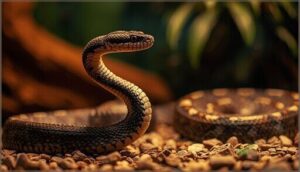
When your pet forms that classic S-curve with its front third elevated and muscles pulled tight, you’re witnessing defensive posturing at its most textbook—a strike posture built for rapid deployment if the animal feels cornered.
This coiling mechanism, distinct from neutral coiling where the body drapes loosely, signals strike readiness through visible body tension, so recognizing relaxed snake behavior versus true defensive body language becomes essential for safe handling.
Head Positioning as a Warning Sign

Your snake’s head angle telegraphs its threat response long before a strike, offering you critical warning signs if you know where to look. When defensive posture escalates, these stress indicators in reptile body language become unmistakable.
- A sudden lock-on stare, head frozen and aimed directly at your hand, signals high alert
- Quick backward jerks when you approach show the animal feels unsafe
- Head elevated and rigid rather than smoothly sweeping means tension, not curiosity
- Tilting the nose upward to track your movement indicates strike posture preparation
- Freezing mid-crawl with a stiffened neck reveals immediate unease during handling
Hissing, Puffing, and Flattening Displays
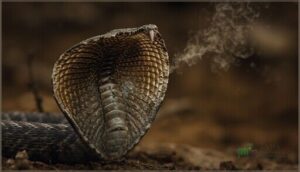
When your snake forcefully expels air through its glottis, you’re hearing a defensive warning—hissing—that tells you to back off before the animal escalates to a strike posture.
Many species pair this threat display with exaggerated puffing mechanics, inflating and deflating their lungs to intensify the sound, while simultaneously flattening their ribs outward for visual intimidation, creating a broader, more imposing profile that carries real energy costs.
Environmental Triggers for Defensive Behavior

Your captive environment shapes defensive posturing more than most keepers realize, because body language directly reflects enclosure setup stress.
Hide shortages force constant vigilance—snakes lacking secure retreats on both thermal zones escalate handling responses when they can’t escape perceived threats.
Enclosure exposure through transparent walls, combined with noise disturbances, bright light, and vibration from foot traffic, keeps your animal chronically alert and primed to strike.
Spotting Stress and Fear Signals

When your snake feels threatened or overwhelmed, its body language shifts dramatically from the relaxed behaviors you’ve learned to recognize, sending clear distress signals that demand your immediate attention and understanding.
These stress responses often appear suddenly during handling, environmental changes, or exposure to perceived threats, ranging from subtle tension in the muscles to frantic escape behaviors that can startle even experienced keepers. Recognizing these signals early helps you adjust your approach, minimize anxiety, and create a safer interaction for both you and your snake.
Balling Up and Tight Coiling
When your ball python curls into a ball and tucks its head deep inside, it’s using protective balling, a passive defensive posturing that shows fear rather than aggression. This Reptile Body Language reveals emotional triggers at work, and understanding snake behavior through these cues helps you adjust your approach.
- Tight coiling tension feels firm, almost rock-hard, as muscles lock to shield vulnerable areas
- Handling triggers include sudden movements, bright overhead lights, or being grabbed too quickly from above
- Young or new arrivals often display this curling into a ball behavior more frequently until they settle in
- Respecting this “I need space” signal and returning your pet to its hide builds trust over repeated sessions
Rapid Movements and Escape Attempts
When your snake suddenly launches into Fast Slithering with side-to-side waves or tries Glass Surfing up enclosure walls, that Rapid Darting signals serious discomfort—Escape Attempts often mean something’s wrong with temperature, humidity, or hiding options.
This Bolt Behavior, where body language shows tense muscles pushing against surfaces, reflects stressed Reptile Behavior rather than casual exploration, so check your setup immediately before Animal Communication escalates to defensive posturing.
Trembling, Tail Twitching, and Staring
Illness Tremors that persist even at rest, plus wheezing or limp muscle tone, warn you of systemic problems requiring veterinary care, while stress-linked trembling usually stops once your snake returns to its enclosure.
Tail Functions vary—defensive vibrations paired with a raised, tense body signal an imminent strike, whereas slower movements aid balance or distraction, and Staring Cues with fixed gaze and stillness reflect high-alert body language in reptile behavior and animal communication.
Handling-induced Stress Responses
While twitching and staring reveal immediate discomfort, your grip itself can trigger deeper physiological responses. Handling provokes stress hormones like corticosterone because firm restraint mimics predation—your snake’s body braces for escape, sometimes ending in regurgitation patterns, musk release, or frantic pushing against your hands, all warning signs that current handling techniques exceed its tolerance and demand post handling recovery.
Your grip can trigger stress hormones that make your snake’s body brace for escape, signaling your handling has exceeded its tolerance
The following behaviors are indicative of this stress:
- Regurgitating meals within 48 hours of being picked up
- Releasing foul-smelling cloacal musk when restrained
- Freezing rigid or thrashing violently to break free
- Hiding longer and refusing food after sessions
- Conditioning retreat behavior at every enclosure opening
Interpreting Feeding and Shedding Behaviors
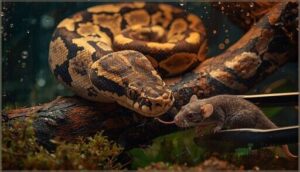
Your snake’s eating habits and shedding cycles reveal a lot about its overall health and comfort, but these behaviors can look strange or even concerning if you don’t know what’s normal.
A healthy snake shows consistent interest in food and follows predictable patterns before a shed, while changes in appetite or skin appearance often point to stress, illness, or simply natural biological rhythms. Understanding these signals helps you distinguish between routine behavior and situations that need your attention.
Normal Feeding Cues and Appetite
A ready-to-eat snake shows hunger through increased activity, focused tracking of your movement near the glass, and rapid tongue flicking that samples air for prey scent, which tells you its appetite is strong and it’s prepared to strike within seconds of prey presentation.
| Feeding Sign | What You’ll Observe | What It Means |
|---|---|---|
| Active prowling | Pacing enclosure edges, especially near feeding time | Strong appetite signals readiness to eat |
| Focused tracking | Eyes follow your hand or nearby motion closely | Hunting instinct activated, meal anticipated |
| Rapid tongue flicking | Frequent sampling of air and surfaces | Searching for prey scent cues |
| Quick strike response | Grabs offered prey within seconds, coils tightly | Healthy feeding response, normal digestion patterns |
| Post-meal retreat | Returns to hide after swallowing, rests calmly | Content snake digesting without stress |
Healthy eating involves prompt acceptance when you offer appropriately sized prey on your regular feeding schedules—adult ball pythons every one to two weeks, corn snakes every seven to ten days—and snakes that maintain smooth body contours without visible spine ridges or sunken sides demonstrate good appetite signals and proper pet snake care, while those showing consistent digestion patterns without regurgitation reflect stable feeding responses and sound snake care and maintenance practices rooted in understanding snake behavior and respecting individual food preferences across species.
Signs of Pre-shed Behavioral Changes
You’ll notice your snake entering shedding preparation when its eyes turn milky blue from fluid buildup between skin layers, which impairs vision for three to seven days and triggers increased hiding behavior as the snake feels vulnerable.
Skin dullness follows, fading to grayish tones across the body, while defensive reactions spike during this cloudy-eye stage—these pre shed signs reflect normal reptile behavior and body language during snake molting, requiring adjusted pet snake care.
Refusal to Eat and Potential Causes
When your snake ignores prey for multiple feedings, you’re witnessing snake behavior shaped by environmental factors, health issues, feeding practices, natural cycles, or stress triggers—all revealing pet snake behavior and psychology that demands attention.
Understanding reptile behavior and animal behavior through these refusal patterns protects snake health:
- Incorrect temperatures below 80°F slow digestion, making meals feel unsafe
- New environment stress keeps recently acquired snakes hiding instead of hunting
- Respiratory infections pair refusal with wheezing and weight loss requiring veterinary care
- Prey size problems occur when food items exceed the snake’s widest body point
- Seasonal breeding cycles naturally suppress appetite for weeks in healthy adult males
Enhancing Your Snake’s Environment

Your snake’s behavior reflects its environment just as clearly as it signals stress or comfort, which means a well-designed enclosure can prevent many behavioral issues before they start.
The physical setup—from hiding spots to temperature zones—shapes how your snake moves, feeds, and rests throughout its daily routine. Let’s look at the key environmental factors that directly influence your pet’s behavior and overall wellbeing.
Importance of Proper Enclosure Setup
Your enclosure design sets the foundation for everything your pet snake does each day, because without the right space, thermal gradients, and humidity control, even calm species show chronic stress behaviors. Proper reptile enclosure design and setup must balance size, ventilation systems, and lighting options so your snake can thermoregulate naturally and explore without fear.
| Enclosure Element | Why It Matters | What Happens If Wrong |
|---|---|---|
| Temperature Gradient | Snakes move between warm and cool zones to regulate body heat through the day | No gradient means the snake can’t thermoregulate, leading to lethargy or frantic pacing |
| Humidity Control | Species-appropriate moisture facilitates smooth sheds and respiratory health | Too dry causes stuck shed; too damp creates respiratory issues and hiding behavior |
| Ventilation Systems | Fresh airflow prevents stale, humid conditions and promotes active basking | Poor air quality makes snakes avoid certain areas or breathe with open mouths |
Creating Safe Hiding and Basking Spots
Your snake needs both shelter and warmth, which means placing at least two hides—one on each end of the temperature gradient—so it can thermoregulate without sacrificing security.
Basking safety depends on sturdy platforms with textured surfaces that keep heating equipment out of reach. Use smooth plastic, PVC, or chemical-free cork bark to support natural enrichment while maintaining proper humidity control throughout your reptile enclosure design and setup.
Temperature and Humidity’s Effect on Behavior
Temperature and humidity act like invisible puppet strings—pull one, and your snake’s activity levels shift immediately.
When the warm side drops below ideal, reptile care demands you watch for brumation state behavior: long periods hiding with minimal movement.
Heat stress triggers restlessness and open-mouth breathing, while low humidity causes shedding issues with stuck skin.
Understanding this animal behavior helps you read your snake’s body language and adjust enclosure setup before discomfort sets in.
Using Enrichment to Support Positive Behaviors
Enrichment transforms passive captives into active problem solvers, and you’ll see the difference in their body language. Foraging techniques like hiding prey under decor trigger natural hunting, while sensory stimulation through novel object introduction—rotating hides, textured surfaces, climbing branches—keeps exploration strategies sharp.
Environmental variety fosters positive reptile behavior and psychology, reducing stress-related pacing and promoting the relaxed, confident movements that signal proper pet care and management.
Frequently Asked Questions (FAQs)
How do snakes communicate with each other?
Chemical signals dominate reptile behavior and psychology—you’ll see tongue flicking constantly as they sample pheromones left by others.
Body language displays, tactile cues during combat, vibrational alerts, and sound communications like hissing complete their animal communication toolkit.
Can snakes recognize their owners over time?
You might say snakes don’t “know” you from Adam, but they learn your scent signature through sensory recognition, developing owner familiarity via the habituation process that shapes snake behavior and reptile behavior and psychology over time.
What does frequent yawning or gaping mean?
Frequent yawning or gaping in your snake can signal jaw realignment after feeding.
Respiratory issues like infection, shedding process skin loosening, environmental stress from poor conditions, or normal sensory exploration through scent sampling can also be indicated.
Do snakes sleep, and how can you tell?
Yes, snakes sleep roughly 16 hours daily with eyes open, showing reduced responsiveness, no tongue flicking, relaxed body posture, and slower breathing rates—key resting cues that reveal their sleep patterns and overall snake wellbeing.
Why does my snake soak in water often?
Soaking often signals shedding aid, humidity needs, overheating risk, or parasite irritation—your pet snake’s behavior reveals whether enclosure conditions match its species requirements.
So checking temperature gradients and moisture levels promotes snake health and wellness through proper reptile enrichment and stimulation.
Conclusion
A single misread signal can mean the difference between a thriving partnership and chronic stress cycles that shorten your snake’s lifespan—reading pet snake behavior transforms you from a passive keeper into an interpreter who anticipates needs before problems escalate.
Watch the coil patterns, decode the tongue-flicks, respect the defensive postures, and you’ll build trust that makes every interaction safer, every husbandry decision smarter, and every year with your snake richer than the last.
- https://www.allanglescreatures.com/blogs/news/ball-python-behavior-what-every-owner-needs-to-know
- https://eamc.vet/recognising-signs-of-stress-in-reptiles/
- https://www.redwoodpetclinic.com/2019/09/15/marin-county-ca-vet-signs-of-illness-snakes/
- https://a-z-animals.com/blog/why-snakes-yawn/
- https://softmath.seas.harvard.edu/publication/postural-control-in-an-upright-snake/