This site is supported by our readers. We may earn a commission, at no cost to you, if you purchase through links.

Keeping a reptile warm in an apartment comes with real constraints—limited outlets, thin walls, nosy landlords, and not an inch to waste.
A heat mat that works fine in a garage setup can become a fire hazard or an energy drain when crammed into a studio.
Getting the temperature gradient right matters more than most new keepers realize; too cold and your reptile stops digesting, too hot and you’ve got a crisis at 2 a.m.
The right reptile heat mats for apartment setups balance wattage, safety, and size without turning your living space into a liability.
These ten options do exactly that.
Table Of Contents
- Key Takeaways
- Best Reptile Heat Mats for Apartments
- 1. Exo Terra Heat Mat 16W
- 2. iPower 24W Reptile Heat Mat with LCD Thermometer
- 3. REPTI ZOO Reptile Heat Mat with Thermostat
- 4. Zoo Med Reptitherm Undertank Heater
- 5. iPower 8×12 Reptile Heat Mat
- 6. Aiicioo Reptile Heat Mat Thermostat
- 7. REPTI ZOO Adjustable Reptile Heat Pad
- 8. iPower Reptile Heat Mat with Adjustable Controller
- 9. BN LINK Reptile Heat Pad 6×8 8W
- 10. Pawfly 5W Reptile Heat Pad
- Key Factors When Choosing a Heat Mat
- Temperature Control and Safety Essentials
- Installation Tips for Apartment Terrariums
- Common Mistakes and How to Avoid Them
- Frequently Asked Questions (FAQs)
- Where to put a reptile heating pad?
- Do reptile heating pads use a lot of electricity?
- Can you leave a heat mat on 24/7?
- Can heat mats affect apartment humidity levels?
- How do heat mats impact monthly electricity bills?
- Do landlords restrict reptile heating equipment use?
- Can heat mats work during seasonal temperature changes?
- Conclusion
Key Takeaways
- A thermostat isn’t optional — without one, your heat mat runs unchecked and becomes a real fire and health risk.
- Match your mat’s size to one-third or half the tank floor so your reptile can move between warm and cool zones freely.
- Keep substrate under one inch above the mat, or surface temps drop 15–20°F while the mat quietly overheats underneath.
- Most heat mats draw under 24 watts and cost less than 3 euros a month, making them a safe, budget-friendly choice for apartment setups.
Best Reptile Heat Mats for Apartments
Finding the right heat mat for your apartment setup doesn’t have to be overwhelming.
A quick look at reptile heat mats sized for small terrariums can help you narrow down exactly what works for your space and species.
The options below cover a range of sizes, wattages, and built-in features — so there’s something for almost every reptile and every space. Here are ten of the best heat mats worth considering in 2026.
1. Exo Terra Heat Mat 16W
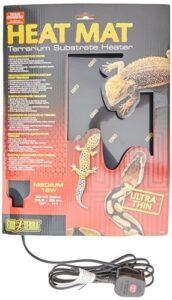
The Exo Terra Heat Mat 16W is a solid pick if you’re working with a 30–40 gallon tank. It measures 26.5 x 28 cm and sits just 0.5 cm thin under your glass terrarium.
The silicone build spreads heat evenly — no hot spots, no guesswork. It’ll run steadily for 24 hours without fuss.
One thing to know: you’ll need a separate thermostat. Without one, overheating becomes a real risk. Pair it with an Exo Terra thermostat and you’re set.
| Best For | Small reptile owners — especially those keeping geckos, snakes, or amphibians in a 30–40 gallon tank who want steady, reliable under-tank heat. |
|---|---|
| Power | 16W |
| Size | 15 x 11.8 in |
| Material | Silicone |
| Adhesive Backing | Yes |
| Thermostat Support | Required |
| Voltage | 120V |
| Additional Features |
|
- Heats evenly with no hot spots, thanks to the silicone build
- Slim and low-profile — slides right under a glass terrarium without any hassle
- Works around the clock without needing to babysit it
- You’ll need to buy a thermostat separately — it’s not optional, it’s a must
- Slower to heat up compared to some other brands on the market
- Once it’s stuck down, pulling it off can damage the mat — so placement matters from day one
2. iPower 24W Reptile Heat Mat with LCD Thermometer
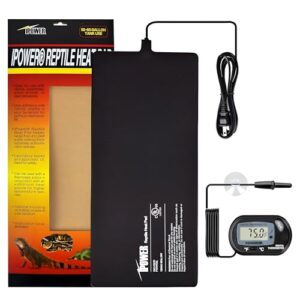
If your setup needs more real estate, the iPower 24W Heat Mat steps up nicely. At 8×18 inches, it’s built for 50–60 gallon tanks — a solid upgrade in coverage.
It runs at 24 watts using PTC material, which spreads heat evenly without burning hot spots. The included LCD thermometer tracks both temperature and humidity, so you’re never guessing. It also logs highs and lows, which is genuinely useful.
One heads-up: mount it properly. The adhesive can slip, and loose placement is a fire risk.
| Best For | Reptile and amphibian owners with larger tanks (50–60 gallons) who want reliable, even heat and built-in temperature monitoring. |
|---|---|
| Power | 24W |
| Size | 8 x 18 in |
| Material | PTC Heating |
| Adhesive Backing | 3M Adhesive |
| Thermostat Support | Not Included |
| Voltage | 120V |
| Additional Features |
|
- Big 8×18″ coverage area works well for larger terrariums
- PTC heating spreads warmth evenly — no hot spots
- LCD thermometer tracks temp, humidity, and logs highs and lows
- Adhesive can slip if not mounted carefully
- Loose placement is a real fire risk
- 24W may be overkill for smaller setups
3. REPTI ZOO Reptile Heat Mat with Thermostat

Want built-in thermostat control without buying extra gear? The REPTI ZOO Heat Mat manages that in one package. It covers 8×12 inches at 23 watts — right for 30–40 gallon tanks. The smart chip cuts power if surface temperatures hit 122°F, which matters when you’re sharing a bedroom with your reptile. The digital display shows set and actual temperatures side by side.
Setup is straightforward: stick it on, place the probe inside the tank, and you’re done.
| Best For | Reptile owners with 30–40 gallon tanks who want heat and thermostat control in one simple setup — no extra hardware needed. |
|---|---|
| Power | 23W |
| Size | 8 x 12 in |
| Material | Carbon Film |
| Adhesive Backing | 3M Adhesive |
| Thermostat Support | Built-in |
| Voltage | 120V |
| Additional Features |
|
- Built-in smart chip cuts power if temps hit 122°F, so you’re not babysitting it all day
- Digital display shows set and actual temps side by side — no guessing
- Easy install with 3M adhesive; probe goes inside, and you’re done
- Only fits 30–40 gallon tanks, so bigger setups need a different solution
- Adhesive mounting makes repositioning tricky once it’s stuck
- No wireless or app control — just the 3-button interface
4. Zoo Med Reptitherm Undertank Heater
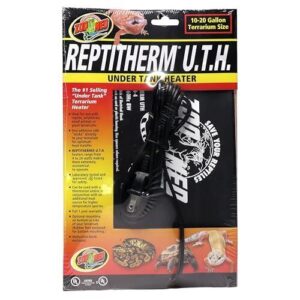
Zoo Med’s Reptitherm keeps things refreshingly simple. No smart chips or digital displays — just a reliable nichrome heating element that’s been trusted for decades.
The 6×8‑inch, 8‑watt model works well for 10–20 gallon setups, which fits most apartment starter tanks perfectly.
It’s UL and cUL certified, so you’re not gambling on safety.
One thing to note: you’ll need a separate thermostat. Without one, this mat can run hot and stay hot.
| Best For | Beginner reptile owners with 10–20 gallon tanks who want a simple, no-fuss heat source for snakes, lizards, or turtles. |
|---|---|
| Power | 8W |
| Size | 6 x 8 in |
| Material | Standard |
| Adhesive Backing | Yes |
| Thermostat Support | Required |
| Voltage | 120V |
| Additional Features |
|
- Simple setup — just peel, stick, and plug in
- UL and cUL certified, so safety is covered
- Affordable and reliable for small to mid-size enclosures
- Needs a separate thermostat or it can overheat
- Adhesive backing doesn’t always stick well to every surface
- No temperature control built in, so you’re flying blind without extra gear
5. iPower 8×12 Reptile Heat Mat
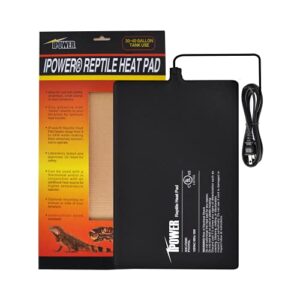
The iPower 8×12 is a solid mid-size option for apartments with 10–20 gallon tanks. It covers 96 square inches at 16 watts — enough warmth without spiking your electric bill. The PTC heating material self-regulates, so hot spots aren’t really a concern.
For best results, place it under the tank’s cool-to-warm side — a setup that mirrors the under-tank heat distribution principles ball python owners swear by.
Installation is straightforward: peel, stick, done. That 3M adhesive holds firm even during tank cleanings.
You’ll still need a separate thermostat, but paired with one, this mat performs reliably and quietly night after night.
| Best For | Reptile and small animal owners with 10–20 gallon tanks who want an affordable, energy-efficient heating solution. |
|---|---|
| Power | 16W |
| Size | 8 x 12 in |
| Material | PTC Heating |
| Adhesive Backing | 3M Adhesive |
| Thermostat Support | Optional |
| Voltage | 120V |
| Additional Features |
|
- PTC heating material self-regulates, so no worrying about dangerous hot spots
- 3M adhesive sticks well and holds up through regular tank cleanings
- At 16 watts, it keeps energy costs low without skimping on warmth
- No built-in thermostat — you’ll need to buy one separately for safe temperature control
- Adhesive can struggle to bond with glass or wood surfaces
- Improper setup (like blocking heat escape underneath) can create a fire risk
6. Aiicioo Reptile Heat Mat Thermostat
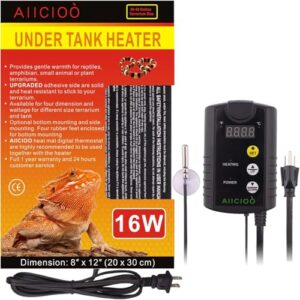
The Aiicioo combo takes the guesswork out of heat mat setups. It bundles an 8×12 inch, 16-watt heating pad with a digital thermostat — no hunting for compatible accessories. You get a control range of 68 to 108°F, an LCD display that stays readable in low light, and a heating indicator that shows exactly when the mat is working.
Cords run about 6 feet, so placement is flexible. Just keep it off plastic or acrylic tanks.
| Best For | Reptile owners who want a simple, all-in-one heating solution for lizards, hermit crabs, or other small reptiles without fussing over compatibility. |
|---|---|
| Power | 16W |
| Size | 8 x 12 in |
| Material | Plastic |
| Adhesive Backing | Yes |
| Thermostat Support | Built-in |
| Voltage | 120V |
| Additional Features |
|
- Comes with a built-in digital thermostat, so you’re not buying pieces separately
- Easy to mount on the bottom or side of the tank, with rubber feet to let heat escape safely
- Works for more than just reptiles — great for seedlings or other heat-sensitive setups
- Not compatible with plastic, acrylic, or water tanks, which limits where you can use it
- The thermostat makes a clicking noise that some people find irritating over time
- May not put out enough heat for larger enclosures or species that need higher temperatures
7. REPTI ZOO Adjustable Reptile Heat Pad
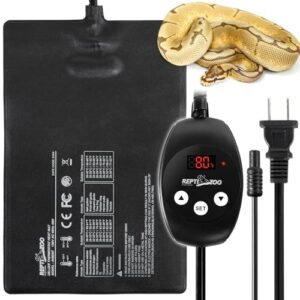
The REPTI ZOO Adjustable Heat Pad gives you real control — not just a dial that guesses. You can set temperatures anywhere from 68 to 122°F, and a built-in smart chip keeps the surface from crossing that upper limit.
The 8×12 inch, 24-watt version manages 30 to 40 gallon tanks well.
Carbon fiber heating spreads warmth evenly and warms up fast.
It runs silently, emits no light, and draws minimal power — a solid fit for any apartment setup.
| Best For | Reptile owners who want precise temperature control for mid-size tanks housing geckos, bearded dragons, snakes, or turtles. |
|---|---|
| Power | 24W |
| Size | 12 x 8 in |
| Material | Carbon Fiber |
| Adhesive Backing | Yes |
| Thermostat Support | Built-in |
| Voltage | 120V |
| Additional Features |
|
- Heats up fast and spreads warmth evenly thanks to carbon fiber technology
- Runs 24/7 with no light or noise — won’t stress your animals or your sleep
- Works beyond reptiles too: seed germination, fermentation, even brooding boxes for quail chicks
- Some users have reported the thermostat running hotter than set, which means you’ll want a separate thermometer to double-check
- The adhesive backing can lose its grip over time, so placement might need extra help
- Temperature needs consistent monitoring to avoid overheating — not quite a set-it-and-forget-it situation
8. iPower Reptile Heat Mat with Adjustable Controller
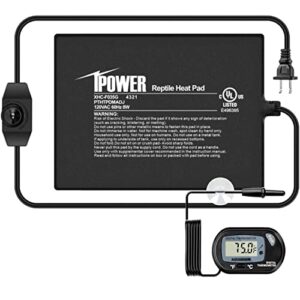
Sometimes simpler is exactly right. The iPower Reptile Heat Mat with adjustable controller skips the digital complexity and gives you a straightforward knob that works.
The 6×8 inch mat runs at 8 watts — enough warmth for 10 to 20 gallon tanks without spiking your electricity bill.
PTC heating material distributes heat evenly, so there are no hot spots your gecko might stumble onto.
The 6-foot cord keeps things tidy, and the waterproof build manages humidity without fuss.
| Best For | Budget-conscious reptile and small animal owners who want reliable, no-fuss heating without dealing with digital controls or complex setups. |
|---|---|
| Power | 8W |
| Size | 6 x 8 in |
| Material | PTC Heating |
| Adhesive Backing | 3M Adhesive |
| Thermostat Support | Knob Controller |
| Voltage | 120V |
| Additional Features |
|
- The adjustable knob keeps things simple — just dial in the heat and you’re done
- PTC heating spreads warmth evenly, so no hot spots for your animals to accidentally burn themselves on
- Comes with an LCD thermometer included, so you’re not buying accessories separately
- Too small for larger tanks — if you’ve got anything bigger than a 20 gallon, this probably won’t cut it
- The 3M adhesive is seriously sticky, so think carefully before you stick it down because repositioning is a hassle
- No digital display on the controller, so you’re relying on the included thermometer to know your actual temp
9. BN LINK Reptile Heat Pad 6×8 8W
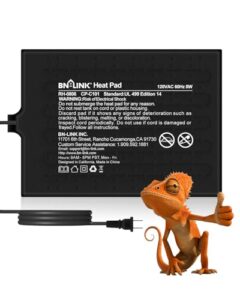
The BN LINK 6×8 heat pad punches above its weight for apartment setups. At 8 watts and 120 volts, it draws almost nothing from your outlet while keeping small tanks in the 10–20 gallon range comfortably warm.
The built‑in adjustable knob lets you dial between 104°F and 122°F without extra gear. Its flexible, water‑resistant build and strong adhesive grip, glass cleanly. Pair it with a thermostat, though — this pad gets serious if left unchecked.
| Best For | Reptile and small animal owners who need an affordable, low-energy heat source for tanks in the 10–20 gallon range. |
|---|---|
| Power | 8W |
| Size | 6 x 8 in |
| Material | Standard |
| Adhesive Backing | Yes |
| Thermostat Support | Required |
| Voltage | 120V |
| Additional Features |
|
- Flexible and waterproof build makes it easy to install and clean
- Energy-efficient at just 8 watts — barely touches your electric bill
- Works for more than just reptiles — great for seed starting, bread proofing, and yogurt making
- You’ll need a separate thermostat, or it can get dangerously hot
- Adhesive grip has let some users down over time
- Not a great fit for larger tanks or setups needing temps outside the 104–122°F range
10. Pawfly 5W Reptile Heat Pad
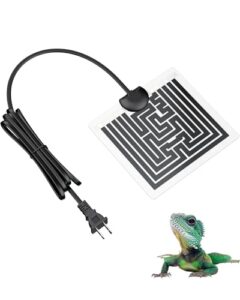
The Pawfly 5W heat pad is the quietest option on this list — and sometimes that’s exactly what you need. Its graphene heating element spreads warmth evenly across a 6×5.5‑inch surface, topping out safely at 122°F.
At just 5 watts, it’s ideal for small tanks housing geckos, frogs, or hermit crabs. It won’t run up your electric bill either. Just pair it with a thermostat — it’s not included — and keep the substrate thin so heat can actually reach your pet.
| Best For | Small reptile and amphibian owners who want a safe, low-cost heat source for compact tanks housing geckos, frogs, hermit crabs, or similar pets. |
|---|---|
| Power | 5W |
| Size | 6 x 5.5 in |
| Material | Graphene |
| Adhesive Backing | No |
| Thermostat Support | Compatible |
| Voltage | 120V |
| Additional Features |
|
- Graphene heating element spreads warmth evenly and caps out at a safe 122°F
- Super energy-efficient at just 5W — barely a blip on your electric bill
- Lightweight and easy to set up, with a non-adhesive design and long power cord
- Won’t cut it for larger enclosures — it’s strictly a small-tank solution
- Thermostat not included, but you’ll definitely want one to keep temps in check
- Some users have reported occasional manufacturing defects out of the box
Key Factors When Choosing a Heat Mat
Not every heat mat works for every setup — and in an apartment, the wrong choice can mean wasted space, wasted energy, or a stressed-out reptile.
Before you pick one, a few key factors are worth thinking through. Here’s what to keep in mind as you browse the options.
Apartment Size and Space Limitations
Living in an apartment doesn’t mean you can’t keep reptiles well. It just means you need to think smarter about your heat mat setup.
- Keep your floor footprint small with vertical shelving or rack systems
- Choose compact design mats around 14–15 cm for nano tanks
- Use compact power strips mounted to walls or racks
- Make sure proper clearance spacing between stacked enclosures
- Prioritize noise‑friendly placement away from sleeping areas
Tank Size and Heat Coverage
Once your space is sorted, mat-tank sizing becomes your next puzzle. Aim for ideal coverage of one-third to one-half of the tank floor — enough for gradient design without eliminating cool zones.
For a 40-gallon breeder, an 11×17-inch mat hits that sweet spot. Smart heat mat placement and heat distribution guarantee that temperature management stays consistent without turning your reptile’s home into an oven.
Wattage and Energy Efficiency
Wattage scaling matters more than most people realize. A small 4–8W mat suits a single hide; a 16–20W manages standard tanks. That’s real power consumption control — a 16W mat running all day uses less than 0.4 kWh.
- Energy savings: Pair any mat with a thermostat for efficiency
- Heat distribution: Even wattage beats hot spots every time
- Power rating: Match wattage to tank volume, not guesswork
Compatibility With Different Substrates
under your reptile matters as much as what’s above.
Paper towel benefits are hard to beat — direct contact means maximum heat transfer, no guesswork.
Aspen bedding use works well too, raising surface temps 2–8°F with safe penetration.
Tile heat conduction takes longer but hits steady basking temps.
Avoid thick coconut coir — it blocks substrate heating almost entirely.
Cypress mulch pairing strikes a solid middle ground.
Species-specific Heating Requirements
Your reptile species calls the shots on heat mat setup. Species-specific heating requirements vary more than most keepers expect:
- Desert Species Heat — Leopard geckos need 88–92°F warm sides, low humidity.
- Tropical Species Heat — Ball pythons want 88–96°F with 50–60% humidity for Heat Humidity Balance.
- Nocturnal Heating Needs — Belly heat matters most; no light required.
- Terrestrial vs. Arboreal — Floor mats handle terrestrial thermoregulation; arboreal species need overhead heat for a proper thermal gradient.
Temperature Control and Safety Essentials
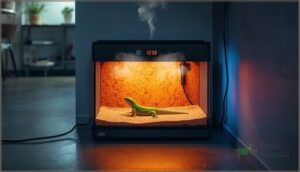
Getting the temperature right isn’t just about comfort — it’s about keeping your reptile alive. A good heat mat means nothing without proper controls and smart placement.
Here’s what you need to know before anything goes wrong.
Importance of Thermostats and Controllers
A good thermostat is the difference between a thriving reptile and a sick one. Without temperature regulation, your heat mat runs unchecked — stressing your animal and draining your wallet.
| Feature | Why It Matters |
|---|---|
| Pulse Proportional Control | Delivers smoother, steadier heat |
| Multi‑Channel Management | Controls several tanks at once |
| Memory Backup Function | Restores settings after power cuts |
| Alarm Notification Systems | Alerts you to dangerous temp swings |
Energy saving modes and a reliable temperature controller make apartment keeping genuinely manageable.
Preventing Overheating and Fire Risks
Overheating isn’t just bad for your reptile — it’s a genuine fire risk in a small apartment.
circuit load management in mind: older buildings often run 10–16 amps per circuit, so don’t stack mats on one outlet.
Always leave ventilation clearance under tanks.
Schedule regular infrared checks monthly.
Pair every mat with a calibrated thermostat, and stick to fire-resistant materials near your setup.
Placement for Optimal Safety
Where you place your heat mat matters as much as which one you buy. A smart heat mat setup starts with a non‑flammable base — wood, tile, or metal only. Raise your terrarium slightly for airflow underneath. Keep warm zone coverage to one‑third or half the tank floor, and always pair your thermostat with proper surface clearance.
- Non‑flammable Base – Never place mats on carpet or fabric.
- Raise Terrarium – Use plastic feet for under‑mat ventilation.
- Warm Zone Coverage – Cover only 33–50% of the tank footprint.
- Substrate Depth – Keep it thin (under 1 cm) above the heated glass.
Monitoring Temperature Gradients
Two thermometers beat one every time. Place one probe directly over the heat mat’s warm zone and a second on the cool end — that’s your temperature gradient in real time.
Use an infrared spot-check to confirm surface temps where your animal actually rests.
Enable smart alerts for nighttime drift monitoring, and keep a gradient logging habit for a week after setup.
Your thermostat manages thermal control, but your eyes catch what it misses.
Installation Tips for Apartment Terrariums
Getting your heat mat set up right makes a bigger difference than most people expect.
A few small decisions — where you place it, how you secure it, and how you run the cords — can mean the difference between a thriving enclosure and a headache. Here’s what to know before you plug anything in.
Under-tank Versus Side Placement
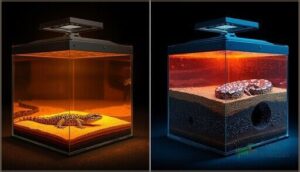
Where you place your reptile heat mat changes everything about how heat moves through the tank. Under-tank installation drives conductive warmth up through the substrate — ideal for leopard geckos and ball pythons that crave belly heat. Side placement shifts the gradient patterns horizontally, reducing burn risk for burrowers.
- Under-tank: best heat transfer for terrestrial reptile behavior
- Side-mounted: safer substrate setup for deep-burrowing species
- Under-tank creates steep vertical gradients
- Side placement suits arboreal climbers better
- Both heat mat setups require a thermostat
Secure Attachment Methods
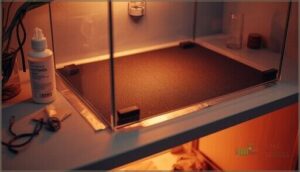
Once your mat is placed, keeping it there matters. heat mat installation starts with adhesive preparation — clean the glass with isopropyl alcohol first. Self-adhesive mats bond best on spotless surfaces.
| Method | Best For |
|---|---|
| Built-in adhesive | Glass tank bottoms |
| Aluminum foil tape | Plastic enclosure edges |
| Rubber feet placement | Elevating tanks for airflow |
Edge sealing techniques finish the job — tape every border so nothing shifts.
Managing Cords and Electrical Safety
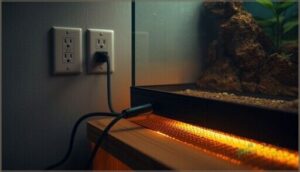
Once your heat mat is locked in place, cords become your next focus.
- Route cords along enclosure edges, away from substrate.
- Plug into GFCI outlets for built‑in overheating protection.
- Add surge protection rated 1000+ joules.
- Inspect weekly for fraying or chew damage.
Smart outlet selection and damage prevention habits make heat mat installation and safety simple.
Adjusting for Multi-enclosure Setups

Running multiple enclosures changes everything.
Multi-channel control is your best friend here — Herpstat 6 lets you manage six heat sources independently, each with its own individual probe tucked under the mat.
rack system heating for vertical stacks, and always practice wattage balancing so you don’t overload circuits.
Independent channel adjustments mean your ball pythons and leopard geckos get exactly what they need.
Common Mistakes and How to Avoid Them
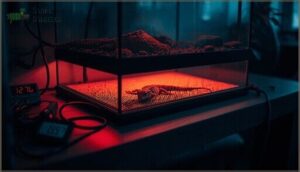
Even experienced keepers slip up sometimes, and a few of these mistakes are surprisingly common.
The good news is they’re all easy to fix once you know what to watch for. Here are the five mistakes most likely to cause problems in your setup.
Skipping Temperature Monitoring
Skipping temperature monitoring is one of the fastest ways to harm your reptile without realizing it. Undetected heat burns, reptile health decline, and even fire safety neglect can all trace back to a missing thermometer.
- Overheating glass past 45°C causes belly burns
- Excess energy consumption raises your electric bill
- Thermostat drift goes unnoticed without backup checks
- Landlord insurance issues follow electrical incidents
Neglecting Cool Zones
Forgetting cool zones is a setup mistake that snowballs fast. Without a proper temperature gradient, your reptile can’t regulate its body temperature at all — that’s thermoregulation failure in practice.
Chronic overheating follows quickly, triggering stress behaviors, digestion issues, and immune suppression.
Even with a thermostat handling terrarium temperature control, reptile thermoregulation only works when there’s somewhere cooler to retreat.
Using Heat Mats With Deep Substrate
Deep substrate is a silent saboteur of your heat mat setup. Beyond one inch, substrate and heat transfer become enemies — surface temps drop 15–20°F, leaving your reptile cold while the mat dangerously overheats below.
Deep substrate silently sabotages heat mats, dropping surface temps 15–20°F while the mat dangerously overheats below
Watch for these Heat Penetration Limits and Overheating Risks:
- Keep substrate under 1 inch over mats
- Use thin reptile carpet or tiles instead
- Explore Alternative Heating Methods like ceramic emitters
- Apply smart Placement Strategies — mat under warm hide only
- Make Species Adjustments for burrowers; switch to overhead heat
Overlooking Regular Maintenance
Neglecting reptile heat mat maintenance and longevity is one of the fastest ways to lose a mat — and endanger your reptile.
A quick Visual Inspection Routine in the first few days catches problems early. After that, stay consistent.
| Task | Frequency |
|---|---|
| Visual Inspection Routine | Daily (first 3–5 days), then weekly |
| Dust Accumulation wipe-down | Weekly |
| Cord Inspection for frays | Monthly |
| Thermostat Calibration check | Monthly |
| Mat Replacement Timing review | Every 1–2 years |
Most mats last 1–2 years — but only with proper care and safety precautions.
Using Low-quality or Incompatible Equipment
Cheap gear is the silent killer of reptile setups. Poor reptile heat mat selection leads to real consequences, fast:
- Electrical faults and overheating from uncertified mats without proper safety features
- Thermostat failure and material damage when mismatched controllers run mats past safe limits
- Substrate burns threatening reptile health through hidden hot spots under deep bedding
Invest right upfront—troubleshooting common heat mat issues caused by early equipment failure costs far more later.
Frequently Asked Questions (FAQs)
Where to put a reptile heating pad?
Mount the mat on the side of your glass tank, never behind foam walls.
Side placement creates a natural under‑tank gradient, improves heat mat setup safety, and keeps terrarium heating steady without blocking warmth.
Do reptile heating pads use a lot of electricity?
Not really. Most heat mats pull just 4–24 watts. With a thermostat managing the duty cycle, real daily energy consumption often stays under 5 kWh — less than leaving a light bulb on.
Can you leave a heat mat on 24/7?
Yes — and for most reptiles, you should. With a thermostat cycling power and proper safety cutoffs, running a heat mat 24/7 provides species nighttime needs without spiking energy cost.
Can heat mats affect apartment humidity levels?
Heat mats don’t add moisture to your air — they raise evaporation rates and reduce air moisture capacity, causing subtle humidity reduction.
Watch substrate drying closely and use a hygrometer to stay in control.
How do heat mats impact monthly electricity bills?
Most mats cost under 3 euros monthly. A 16W mat runs about 07 euros with thermostat savings cutting duty cycle costs nearly in half — making energy efficient heating options surprisingly budget-friendly.
Do landlords restrict reptile heating equipment use?
Many landlords restrict reptile heating equipment. Fire risk bans and lease clause impact are real concerns. Always check your lease first and get written approval before setting up any heating gear.
heat mats can scorch surfaces and pose fire hazards.
Can heat mats work during seasonal temperature changes?
Absolutely — but they need a little help in winter.
When room temps dip below 68°F, pair your mat with a pulse thermostat to handle ambient swing mitigation and prevent energy usage spikes.
Remember to monitor humidity levels for ideal reptile health.
Conclusion
Reptile keepers who obsess over temperature gradients aren’t being paranoid—they’re being smart. A stable warm zone means your animal actually digests, moves, and thrives instead of just surviving.
The best reptile heat mats for apartment setups don’t just fit your space; they work quietly and safely without demanding attention.
Match the wattage to your tank, add a thermostat, and check temps weekly. Your reptile’s health lives in those details.
- https://www.lawinsider.com/clause/heating-and-cooling
- https://www.steadily.com/blog/pet-laws-regulations-rental-properties-washington
- https://insektenliebe.com/en/news-en/keeping-terrarium-animals-in-rented-accommodation-what-you-need-to-know-as-a-tenant/
- https://eichenglobal.com/en/blog/haustiere-in-mietwohnungen/
- https://theindependentlandlord.com/pet-friendly-landlord/