
This site is supported by our readers. We may earn a commission, at no cost to you, if you purchase through links.

corn snake basking under a heat lamp is one thing—but a heat mat hidden beneath a substrate? That’s where classroom reptile keeping gets tricky.
Most overheating incidents happen not from obvious equipment failures, but from a heat mat running unchecked overnight because no one set the thermostat correctly.
Thirty students, a live animal, and malfunctioning heating equipment are a combination worth taking seriously.
Choosing the right reptile heat mats for classroom environments means balancing animal welfare, student safety, and practical day‑to‑day management.
The six options below cut through the noise.
Table Of Contents
Key Takeaways
- A thermostat isn’t optional—running a heat mat without one means full, unregulated heat that can burn your reptile’s belly and create a serious safety risk in a classroom setting.
- Cover only 25–50% of the tank floor with the heat mat so your reptile always has a cooler zone to move to, mimicking the natural temperature range it needs to stay healthy.
- Match your mat size to your enclosure’s actual floor dimensions—not the gallon rating—and use 10–20W for smaller tanks, scaling up to 16–24W for 20–40 gallon setups.
- Leopard geckos and corn snakes are your best classroom picks because they’re small, calm to handle, easy to feed, and don’t demand the complex heating setups that bearded dragons or ball pythons do.
Best Reptile Heat Mats for Classrooms
Picking the right heat mat for a classroom reptile setup comes down to a few things — reliability, safety, and ease of use for both you and your students.
A reptile heat mat guide for small terrariums can help you choose a safe, reliable option that’s easy for students to monitor and maintain.
The six options below cover a solid range of sizes, wattages, and thermostat features to fit different species and enclosure setups.
Here’s what made the cut.
1. iPower Reptile Heat Mat Digital Thermostat Combo
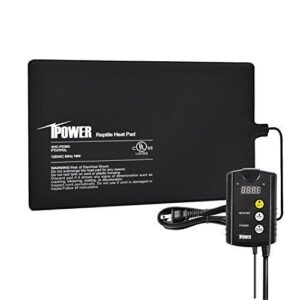
The iPower Reptile Heat Mat Digital Thermostat Combo is a smart pick for classroom enclosures. The 8×12 mat runs at 16 watts and pairs with a digital thermostat that controls temperatures between 40°F and 108°F — plenty of range for most common classroom reptiles.
Setup is straightforward: plug it in, place the probe correctly, and use the three-button interface to dial in your target temperature.
The 3M adhesive backing keeps it firmly in place, and the PTC heating film warms up fast.
| Best For | Teachers, hobbyists, or home growers who need a reliable, easy-to-use heat mat for reptile enclosures, plant germination, or small fermentation projects. |
|---|---|
| Wattage | 16W |
| Material | PTC heating material |
| Color | Black |
| Mounting Style | Adhesive (3M) |
| Reptile Compatible | Yes |
| Max Temperature | 108°F |
| Additional Features |
|
- Heats up fast and holds a steady temp thanks to the PTC heating film and digital thermostat
- Wide temperature range (40°F–108°F) covers most reptiles, plants, and fermentation setups
- Simple plug-and-play setup with clear LED indicators and a secure 3M adhesive backing
- Some users have noticed the thermostat makes a clicking sound during use
- Temperature accuracy depends heavily on where you place the probe — easy to get wrong
- Not the best fit if you need temps consistently above 75°F
2. Fluker’s Reptile Heat Mat 11×11
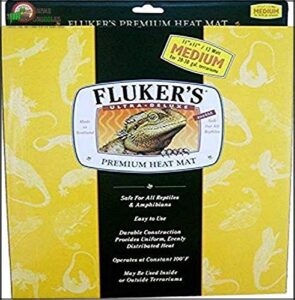
Fluker’s 11×11 heat mat is worth a look if you want something simpler and just as reliable.
It covers 20–30 gallon tanks perfectly — the square shape fits standard classroom terrarium bottoms without any awkward overhang.
It runs at 12 watts, so it won’t stress a classroom power strip, and the uniform heat distribution means no cold spots your reptile might try to avoid.
No adhesive means you can reposition it easily between school years.
Pair it with a thermostat, since it runs at a steady 100°F.
| Best For | Teachers or reptile owners who need a simple, reusable heat mat for small-to-medium enclosures like 20–30 gallon tanks. |
|---|---|
| Wattage | Not specified |
| Material | Chloroprene |
| Color | Black |
| Mounting Style | No adhesive |
| Reptile Compatible | Yes |
| Max Temperature | Not specified |
| Additional Features |
|
- No adhesive means you can reposition or reuse it without any hassle
- Works with a thermostat to keep temps consistent and safe
- Fits standard tank bottoms cleanly with even heat distribution
- Won’t cut it for larger enclosures — the heat output is pretty limited
- Needs a solid surface to work, so wire cages are out
- The listed dimensions are for the product overall, not the actual heating pad, which is smaller
3. Zilla Terrarium Heat Mat Large
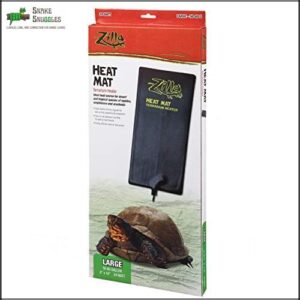
If you need something a bit bigger, the Zilla Terrarium Heat Mat Large steps up nicely. It’s built for 50–60 gallon tanks — the kind of roomy setup a classroom corn snake or blue‑tongued skink would love.
At 24 watts, it self‑regulates up to 113°F and uses carbon fiber technology to spread heat evenly, so there are no hot spots your reptile might accidentally linger on too long. Rubber spacers keep it safely off the glass, which is a smart design detail worth appreciating.
| Best For | Owners of larger reptiles — snakes, lizards, turtles, or even hedgehogs — who need steady, even warmth across a 50–60 gallon tank. |
|---|---|
| Wattage | 24W |
| Material | Carbon fiber |
| Color | Not specified |
| Mounting Style | Adhesive |
| Reptile Compatible | Yes |
| Max Temperature | 113°F |
| Additional Features |
|
- Carbon fiber heating means no hot spots, so your reptile can bask without risk of overheating in one patch
- Energy-efficient at 24 watts — does the job without running up your electricity bill
- Simple adhesive install and works for a wide range of species beyond just reptiles
- The adhesive can struggle to hold on the underside of a tank, so you may need tiles or extra support to keep it in place
- Not plug-and-play for UK users — you’ll need a transformer to use it safely
- At 113°F max, it may not be enough on its own for species that need higher belly heat
4. Zoo Med Repti Therm Heater
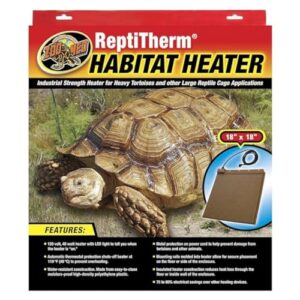
The Zoo Med Repti Therm Heater is a solid pick when your classroom budget is tight but reliability still matters. It runs at 40 watts, with a built-in automatic shutoff at 119°F — that’s your safety net if things run warm.
For apartment classrooms where space and safety codes are both a concern, this reptile heat mat guide for apartment setups breaks down exactly how to use a heater like this one without running into landlord or ventilation issues.
The moisture-proof plastic wipes clean easily, which any teacher dealing with substrate mess will appreciate. One thing to note: you’ll want an external thermostat for precise control, since heat output isn’t adjustable on its own.
| Best For | Teachers and reptile owners who need a reliable, budget-friendly heat pad for tortoises or large reptiles without a lot of fuss. |
|---|---|
| Wattage | 40W |
| Material | Polyethylene plastic |
| Color | Black |
| Mounting Style | Flat surface |
| Reptile Compatible | Yes |
| Max Temperature | 119°F |
| Additional Features |
|
- Moisture-proof plastic makes cleanup quick and easy after messy feeding days
- Built-in auto shutoff at 119°F gives you peace of mind if temps creep up
- Runs 24/7 when paired with an external thermostat, so your reptile stays warm around the clock
- Heat isn’t adjustable on its own — you’ll need to buy a separate thermostat for real control
- Not built for large, heavy tortoises over 200 pounds, so bigger animals could damage it
- Won’t cut it for large terrariums or rooms that need serious heat coverage
5. iPower Reptile Heat Pad
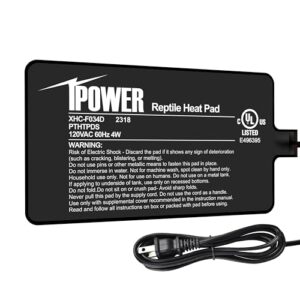
Budget pick that actually delivers. The iPower Reptile Heat Pad comes in four sizes — from a compact 4×7 inches at 4 watts for 1-5 gallon tanks up to 8×18 inches at 24 watts for 50-60 gallon setups.
That flexibility matters when your classroom has multiple enclosures.
The PTC heating film spreads warmth evenly, hitting around 86°F at room temperature without hot spots.
It’s waterproof, mounts with 3M adhesive, and includes a 6-foot cord.
Just pair it with an external thermostat for full control.
| Best For | Budget-conscious reptile owners or educators managing small terrariums up to 5 gallons who want reliable, even heat without spending a lot. |
|---|---|
| Wattage | 4W |
| Material | PTC heating material |
| Color | Not specified |
| Mounting Style | Adhesive (3M) |
| Reptile Compatible | Yes |
| Max Temperature | Not specified |
| Additional Features |
|
- PTC heating film spreads warmth evenly with no hot spots — great for heat-sensitive reptiles
- Waterproof build with strong 3M adhesive makes installation clean and hassle-free
- Energy-efficient at just 4 watts, so it won’t spike your electricity bill
- No built-in thermostat, so you’ll need to buy one separately for safe temperature control
- Only suited for small tanks — anything over 5 gallons and you’ll need a bigger option
- Placement matters a lot; trap the heat wrong and you risk overheating your enclosure
6. Zilla Terrarium Heat Mat Medium 16 Watt
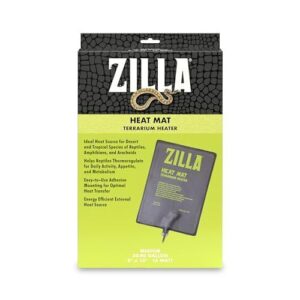
Solid middle-ground option.
The Zilla Terrarium Heat Mat Medium runs at 16 watts and fits standard 30–40 gallon glass tanks — the size most classrooms actually use.
Carbon fiber heating technology spreads warmth evenly with no hot spots, maxes out at a safe 113°F.
It mounts outside the tank with adhesive backing, so the interior stays open for hides and student observation.
Silent operation is a real bonus during lessons.
Just add a thermostat — that part isn’t included.
| Best For | Teachers and classroom setups using standard 30–40 gallon tanks who need a safe, even heat source for reptiles, amphibians, or arachnids. |
|---|---|
| Wattage | 16W |
| Material | Carbon fiber |
| Color | Black |
| Mounting Style | Adhesive |
| Reptile Compatible | Yes |
| Max Temperature | 113°F |
| Additional Features |
|
- Carbon fiber tech spreads heat evenly — no hot spots, no guesswork
- Mounts outside the tank, so the inside stays clean and open for observation
- Quiet, energy-efficient, and caps at a safe 113°F
- Thermostat not included, which you’ll really want for precise temperature control
- Adhesive mounting can be tricky to reposition once it’s set
- Only works well for desert and tropical species — not a fit for every reptile setup
Key Features to Consider in Heat Mats
Not all heat mats are created equal, and the wrong one in a classroom can mean stressed animals or a safety headache you really don’t want.
Before picking one off the shelf, it helps to know what actually matters. Here are the four features worth paying attention to.
Sizing for Classroom Enclosures
Getting heat mat sizing wrong is the most common classroom mistake. Match the mat to your enclosure floor size, not the gallon rating — a tall 20‑gallon still needs a mat sized for its 30×12‑inch footprint.
- Floor Coverage Ratio: Cover 25–50% of the floor, leaving a clear cool zone
- Wattage Matching: Use 10–20W for smaller tanks, 16–24W for 20–40 gallon setups
- Future Growth Scaling: Size for your reptile’s adult needs, accounting for Species Heat Demand and Ambient Draft Impact near vents
Thermostat Integration and Controls
Thermostat isn’t optional — it’s the whole system. Without one, your heat mat runs full power constantly, which can burn your reptile’s belly.
A thermostat isn’t optional — without one, your heat mat runs full power and burns your reptile
Plug-in line thermostats make thermostat setup simple: mat plugs into thermostat, thermostat plugs into the wall. Choose a proportional thermostat for sensitive species — it adjusts power in small increments rather than cycling fully on and off, keeping temperatures rock‑steady.
Digital display readouts let students read current versus target temperatures at a glance, turning temperature monitoring into a live lesson. Use day/night scheduling to automatically drop temperatures 5–10°F after school hours. Lockout safety features prevent curious hands from accidentally changing your settings midday.
Always confirm probe placement accuracy by cross‑checking with an infrared thermometer — a buried probe reads cooler than actual surface temperatures, throwing off everything.
Waterproof and Safety Ratings
Water spills happen — especially with students nearby. IPX ratings matter.
An IPX4 or IPX5 rating means the mat manages splashes and light misting without risk.
UL certification, which confirms real electrical safety testing, puts you in solid shape.
Look for flame retardant materials in the outer film, moisture resistance on the surface, and GFCI compatibility for your classroom outlets.
The energy efficient heating pad provides steady warmth while keeping electricity costs low.
Energy Efficiency and Cost
Heat mats are surprisingly wallet‑friendly. A 16‑watt mat costs around $1.70 a month — less than a bag of chips. Compare that to a 75‑watt lamp at $4.05 per month, and the wattage comparison speaks for itself.
- Thermostat savings: Cut runtime to 12 hours and halve your bill instantly
- Scheduling strategies: Timer‑based 10‑hour weekday cycles reduce power consumption by 58%
- Power consumption metrics: Three mats together draw just 48 watts total
- Lifecycle cost analysis: Smart scheduling saves roughly $47 across a school year
Heat lamps generally use 50‑250 watts, making them less efficient than mats for heat lamp wattage range.
Safe Installation and Placement Tips
Getting the heat mat into your classroom setup correctly makes all the difference between a thriving reptile and a stressed one.
A few simple placement rules can prevent burns, overheating, and electrical headaches before they ever become a problem.
Here’s what you need to know to install your heat mat safely and confidently.
Proper Mat Positioning for Classrooms

Along an interior wall, away from windows and doors, is exactly where your heat mat enclosure belongs.
Keep it at least 75–90 cm off the floor for solid height clearance, and position it in low foot traffic zones — corners work great for this.
Use cord concealment strategies like cable clips along the counter edge, and post simple signage design near the tank, so students know hands off.
Preventing Overheating and Burns
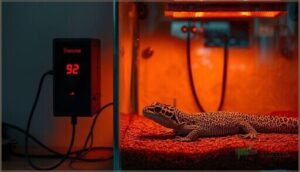
Once your mat is positioned, your thermostat setup becomes the real safety net. Set your thermostat alarm settings to cut power before surfaces hit 100°F — most geckos and corn snakes stay comfortable between 88–95°F.
Follow probe placement guidelines by taping the sensor directly above the mat.
Post student safety signage near the tank, run regular temperature audits daily, and know your emergency shutoff protocol if readings spike.
Substrate Compatibility and Thickness
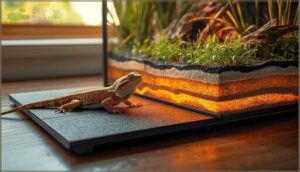
What you place over the mat matters just as much as the mat itself. Substrate conductivity directly affects how well belly heat reaches your reptile.
- Tile vs Paper — Ceramic tile conducts heat evenly; paper towels transfer warmth quickly for simple setups.
- Sand Depth Limits — Keep substrate less than 2″ thick; deep sand traps heat unevenly.
- Coconut Fiber Effects — It pulls moisture and heat away, reducing mat efficiency.
Granular substrate risks include hot pockets and uneven warming. Solid surface conductivity wins for reliability.
Electrical Safety in School Settings
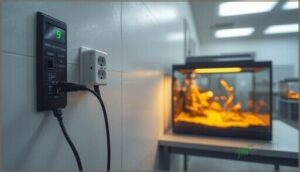
Substrate depth handled — now the electricity side needs equal attention. School outlets are rated 15–20 amps, so Circuit Load Management matters. Keep total wattage (heat mat + thermostat + lights) under 80% of that.
| Safety Area | What to Check | Why It Matters |
|---|---|---|
| Ground Fault Protection | GFCI outlets near sinks | Prevents shocks from spills |
| Power Strip Selection | UL/ETL-listed, circuit breaker included | Stops overloads safely |
| Emergency Shutoff Procedures | Labeled outlet, printed instructions posted | Fast response during emergencies |
Follow these guidelines: inspect outlets before use, never daisy‑chain strips, and make sure automatic shutoff on your thermostat activates correctly.
Managing Temperature and Thermal Gradients
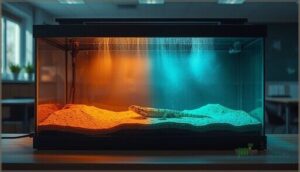
Getting the temperature right inside a reptile enclosure isn’t just about warmth — it’s about giving your animal a range of temperatures to move between, just like they would in the wild.
That balance between a warm side and a cool side is called a thermal gradient, and it matters more than most people realize.
Here’s what you need to know to set it up correctly.
Creating Effective Warm and Cool Zones
Think of your tank as a two-neighborhood system.
Cover one-third to one-half of the floor with your heat mat — that’s your Zone Placement Strategy. Keep the warm side between 88–95°F and the cool side 10–20°F lower.
Use Substrate Depth Variation — shallower over the mat, deeper on the cool end — to sharpen that thermal gradient.
Place hides on both ends for smart Hide Temperature Distribution.
Monitoring Temperature With Sensors
Keeping a close eye on good reptile care is where it really pays off. Use a digital probe thermometer for exact readings — probe placement matters, so tape the sensor right above the heat mat on the outside glass. For quick checks, IR sensors (infrared thermometry) read surface temperatures in seconds.
- Place probes on both warm and cool sides
- Use IR sensors from above with the lid open
- Enable alarm systems to catch dangerous swings
- Set up temperature data logging every 5–10 minutes
- Remote alerts keep you covered over weekends
Adjusting for Species-Specific Needs
Every reptile in your classroom has its own heating playbook.
A leopard gecko needs belly heat around 88–92°F, while a crested gecko does fine at 72–78°F.
Desert vs Tropical species, Nocturnal vs Diurnal habits, and Juvenile vs Adult age all shape your mat settings differently.
| Species | Warm Side Temp | Heat Mat Role |
|---|---|---|
| Leopard Gecko | 88–92°F | Primary heat source |
| Corn Snake | 84–88°F | Primary heat source |
| Crested Gecko | 72–78°F | Supplemental only |
| Bearded Dragon | 100–110°F basking | Low-level backup only |
Maintenance and Longevity in Educational Settings

A heat mat that works great on day one can cause problems six months later if you’re not checking on it.
In a classroom, where students are watching and learning, keeping your setup reliable matters even more.
Here’s what you need to know to keep things running smoothly all year long.
Cleaning and Inspecting Heat Mats
A clean heat mat is a safe one — and in a classroom, that matters more than ever. Build heat mat maintenance into your weekly routine:
- Weekly Wipe Routine — Dampen a soft cloth with warm water and mild dish soap.
- Disinfection Methods — 70% isopropyl alcohol dries in minutes and kills bacteria effectively.
- Physical Damage Signs — Check for cracks, blistering, or scorch marks during every cleaning.
- Electrical Cord Inspection — Feel for kinks or fraying, especially near the plug.
- Record Keeping — Log every cleaning date so nothing slips past a month.
Troubleshooting Common Issues
Even a well-maintained mat can act up. Most problems trace back to a few common mistakes: probe placement errors (always tape the probe near the mat, not hanging in air), power strip issues, cutting overnight heat, or GFCI trips near sinks.
For hot spot detection, press a digital thermometer directly onto the substrate above the mat. Thermostat failures often mean a mismatched load rating — check compatibility first.
Maximizing Heat Mat Lifespan
Think of a heat mat like a classroom projector — treat it right, and it runs for years. Label each mat with its install date and wattage for easy tracking.
Proper wattage matching, thermostat calibration, and airflow management all reduce strain on the heating element. Surge protection shields the electronics, while careful adhesive preservation prevents peeling. Small habits, big payoff.
Preparing for Power Outages
Power outages happen — your reptile can’t wait.
A 1000 VA UPS keeps a 15–20W heat mat running 8+ hours.
Wrap three sides of the tank with foam board for passive insulation, and stash emergency heat packs nearby.
Battery-powered thermometers let you track the drop in real time.
Post your monitoring protocols and safety procedures near the enclosure so any adult can respond fast.
Frequently Asked Questions (FAQs)
Do reptile heat mats work?
Yes, reptile heat mats genuinely work — but only for the right species.
They deliver reliable belly heat effectiveness, supporting thermoregulation in ectothermic animals like leopard geckos and corn snakes that need warm surfaces, not hot air.
Where to put a reptile heating pad?
Stick it under one end of the tank — never inside.
That under tank heater placement creates a natural temperature gradient, leaves a proper air gap, and keeps your heat mat installation safe and effective.
Which reptile species work best in classrooms?
Leopard geckos and corn snakes top the list.
Both score well on size constraints, temperature tolerance, feeding simplicity, and handling calmness — unlike bearded dragons, crested geckos, or ball pythons, which demand more planning.
How often should classroom reptile enclosures be replaced?
Most glass or PVC enclosures last 5–8 years in classrooms.
Wooden ones? Replace them every 3–5 years. Watch for hygiene triggers, growth capacity limits, and heavy classroom wear as your real replacement signals.
Are heat mats safe around water dispensers?
Heat mats aren’t waterproof — they’re moisture resistant at best.
Keep them away from water dispensers, use GFCI protection, add spill barriers, and route cords with drip loops to manage shock risk effectively.
What permits are needed for classroom reptiles?
You’ll need a state wildlife permit, an Educational Display License, and district approval before bringing any reptile into your classroom.
Health and safety regulations also apply, so check local guidelines first.
Conclusion
An ounce of prevention is worth a pound of cure—and nowhere is that truer than with reptile heat mats for classroom environments. The right mat, paired with a reliable thermostat and consistent temperature checks, turns a potential hazard into a genuine teaching tool.
Your students notice how you care for living things. Set up the enclosure correctly, inspect it regularly, and the corn snake under that heat lamp becomes the most memorable science lesson of the year.
- https://incubatorwarehouse.com/products/repti-warm-heat-mat
- https://www.geckonia.eu/en/p/reptile-systems-heating-mat
- https://flukerfarms.com/premium-heat-mat/
- https://docs.google.com/document/d/1w42651JfoxzOwCbzRKwxhpKNMW1rPyVTEismcad0QyU/mobilebasic
- https://www.reptiles.swelluk.com/vivexotic-glass-heat-mat-holder