This site is supported by our readers. We may earn a commission, at no cost to you, if you purchase through links.

Running a reptile room with a dozen tanks means one cold spot can throw off a ball python’s feeding response or push a leopard gecko into brumation you didn’t plan for. Temperature control isn’t background noise—it’s the whole game.
When you’re heating multiple enclosures at once, the right heating pad makes the difference between a stable setup and a constant troubleshooting cycle. The five options below cover the range of what actually works in multi-tank rooms, from budget-friendly basics to pads with built-in thermostats that pull real weight.
Table Of Contents
- Key Takeaways
- Best Reptile Heating Pads for Multi Tank Rooms
- Key Features to Consider in Heating Pads
- Installation Tips for Multi Tank Setups
- Energy Efficiency and Cost Savings
- Frequently Asked Questions (FAQs)
- How to keep a lizard tank warm at night?
- Do reptile heating pads use a lot of electricity?
- Can heating pads work for aquatic turtle tanks?
- How often should reptile heating pads be replaced?
- Are heating pads safe during power outages?
- Do heating pads work under wooden enclosures?
- Which reptiles should never use under-tank heating?
- Conclusion
Key Takeaways
- Match your heating pad wattage to tank size—4–8W for small tanks up to 20 gallons, 16W for 30–40 gallon setups, and 24W for anything larger—so every animal gets a proper thermal gradient.
- Built-in thermostats are a safety net, not real temperature control; pairing any heat mat with an external thermostat keeps temps accurate within 1–2°C and protects your animals from dangerous heat spikes.
- Heat mats use up to 80% less energy than traditional heat lamps, making them the smarter choice for running multiple enclosures without a punishing electricity bill.
- Always mount pads on the outside bottom of glass tanks, cover only one-third to half the floor, and raise the enclosure on rubber feet to prevent dangerous heat buildup underneath.
Best Reptile Heating Pads for Multi Tank Rooms
Running a multi-tank room means you need heating pads that actually pull their weight — reliable, efficient, and easy to manage across multiple enclosures. Not every pad manages that job well.
If you’re building out your setup, this guide to reptile heat mats for multiple snake enclosures breaks down exactly what to look for when wattage and coverage really start to matter.
Here are five that do.
1. Exo Terra Heat Mat 16W
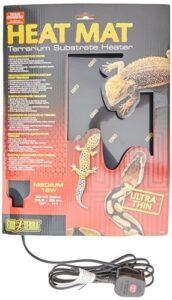
The Exo Terra Heat Mat 16W is a solid pick for medium enclosures — specifically tanks in the 30 to 40 gallon range. It measures 26.5 x 28 cm and delivers steady, even heat through the glass without any light disruption.
That makes it perfect for nocturnal species or 24-hour heating setups. At just 16 watts, it won’t spike your energy bill across multiple tanks.
One thing to note: you’ll need a separate thermostat to keep temperatures dialed in safely.
| Best For | Small reptile owners — geckos, snakes, or amphibians — who need reliable, low-key heat without messing with their pet’s light cycle. |
|---|---|
| Brand | Exo Terra |
| Power Output | 16W |
| Adhesive Backing | Yes |
| Waterproof Design | Not specified |
| Suitable Animals | Geckos, snakes, amphibians |
| Thermostat Required | Yes |
| Additional Features |
|
- Delivers steady, consistent heat right through the glass with zero light disruption
- Only 16W, so running multiple tanks won’t hurt your electricity bill
- Built from durable silicone and works great for both tropical and temperate setups
- You’ll need a separate thermostat — it doesn’t regulate temperature on its own
- Heats up a bit slower than some competing mats
- Once it’s stuck down, pulling it off can damage the mat and it likely won’t be reusable
2. iPower 24W Reptile Heat Mat with LCD Thermometer
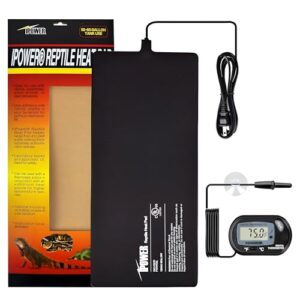
If you need a bit more muscle, the iPower 24W Heat Mat steps up nicely. It covers an 8 x 18 inch footprint — a solid match for 20 to 30 gallon tanks — and draws just 24 watts per enclosure. Scale that across ten tanks and you’re looking at roughly 240 watts total.
It also ships with an LCD thermometer, so you can verify hot spots right away. You’ll still want a separate thermostat for each enclosure, but that’s standard practice anyway.
| Best For | Reptile and small animal keepers managing multiple mid-sized tanks (20–30 gallons) who want solid heat coverage with a built-in thermometer. |
|---|---|
| Brand | iPower |
| Power Output | 24W |
| Adhesive Backing | 3M adhesive |
| Waterproof Design | Yes |
| Suitable Animals | Reptiles, lizards, amphibians |
| Thermostat Required | Recommended |
| Additional Features |
|
- Covers a generous 8 x 18 inch area, making it a great fit for 20–30 gallon enclosures
- Comes with an LCD thermometer so you can check temps right out of the box
- Advanced PTC heating material keeps warmth consistent and efficient
- The adhesive backing can be hit or miss — it may not stick reliably to all surfaces
- Improper mounting creates a fire risk, so placement really matters
- Still needs a separate thermostat per tank for proper temperature control
3. REPTI ZOO Reptile Heat Mat with Thermostat
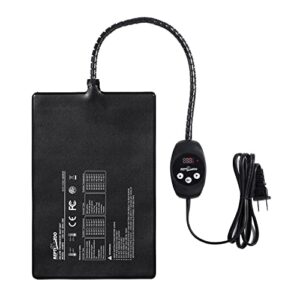
The REPTI ZOO Heat Mat takes things a step further by bundling the thermostat right into the unit. You get a digital inline controller with a three-button interface, and it reads in both Fahrenheit and Celsius.
That kind of built-in precision pairs perfectly with what you’d find in a guide to digital thermostats for corn snake enclosures, where steady temps within a degree can make a real difference.
The 8 x 12 inch mat runs at 23 watts — solid for 30 to 40 gallon tanks. A built-in smart chip holds your target temp automatically, and dual overheat protection keeps things safe.
For a multi-tank room, that’s one less separate device to buy and manage per enclosure.
| Best For | Reptile keepers who want an all-in-one heating solution for 30–40 gallon tanks without buying a separate thermostat. |
|---|---|
| Brand | REPTI ZOO |
| Power Output | 23W |
| Adhesive Backing | 3M adhesive |
| Waterproof Design | Not specified |
| Suitable Animals | Snakes, lizards, hermit crabs |
| Thermostat Required | Built-in controller |
| Additional Features |
|
- Thermostat is built right in — no extra controller to buy or wire up
- Digital display shows temps in both Fahrenheit and Celsius, making it easy to dial in the right range
- Dual overheat protection plus a smart chip gives you peace of mind that temps stay stable
- At 8 x 12 inches, it may be too small for larger enclosures over 40 gallons
- Built-in thermostat means if the controller fails, you’re replacing the whole unit
- Adhesive mounting makes repositioning tricky once it’s set in place
4. Zoo Med Reptitherm Undertank Heater
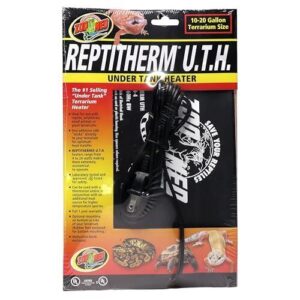
Zoo Med’s ReptiTherm keeps it simple — and that’s the point. The 6 x 8 inch, 8-watt pad is built for 10 to 20 gallon tanks, making it a solid pick for smaller enclosures in a stacked room.
It uses a nichrome heating element that delivers steady belly heat without light or noise. The adhesive backing bonds directly to glass, and rubber feet lift the tank just enough to let heat escape safely.
You’ll still want a thermostat — Zoo Med recommends one — but the pad itself is reliable and cheap to run.
| Best For | Reptile owners with smaller tanks (10–20 gallons) who want a simple, affordable way to keep their snakes, lizards, or turtles warm. |
|---|---|
| Brand | Zoo Med |
| Power Output | 8W |
| Adhesive Backing | Yes |
| Waterproof Design | Not specified |
| Suitable Animals | Snakes, lizards, turtles |
| Thermostat Required | Yes |
| Additional Features |
|
- Steady belly heat with no light or noise to stress your reptile
- Easy to install — just peel and stick right to the glass
- Cheap to run at only 8 watts
- Gets hot enough that you really do need a thermostat to avoid overheating
- The adhesive can struggle to bond on certain surfaces
- Only sized for smaller tanks, so it won’t cut it for larger enclosures
5. iPower Reptile Heat Pad
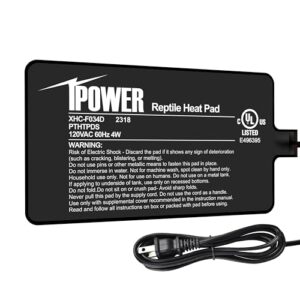
The iPower Reptile Heat Pad punches above its weight in a multi-tank room. It comes in four sizes — 4W up to 24W — so you can match the pad to each enclosure instead of guessing.
The PTC heating film spreads warmth evenly and self-regulates, which cuts down on hot spots. Strong 3M adhesive keeps it locked under glass, and the 6-foot cord reaches any power strip easily.
No thermostat is built in, so pair it with one for real control.
| Best For | Budget-conscious reptile keepers with small enclosures (1–5 gallons) who want a simple, no-fuss heat source for snakes, lizards, geckos, or frogs. |
|---|---|
| Brand | Unnamed |
| Power Output | 4W |
| Adhesive Backing | 3M adhesive |
| Waterproof Design | Yes |
| Suitable Animals | Turtles, snakes, lizards, geckos, frogs |
| Thermostat Required | No |
| Additional Features |
|
- PTC heating film spreads heat evenly and reduces hot spots for a more consistent temperature
- Strong 3M adhesive and waterproof build make it easy to mount securely and keep clean
- Energy-efficient 4W draw keeps running costs low for everyday use
- No built-in thermostat means you’ll need a separate temperature controller to avoid overheating
- Only suitable for small tanks up to 5 gallons, so it won’t work for larger setups
- Placement has to be careful — trapping heat against a surface can cause problems
Key Features to Consider in Heating Pads
Not all heating pads are built the same, and in a multi-tank room, the wrong choice can cause real headaches. A few key things will make or break how well a pad works for your setup. Here’s what to look at before you buy.
Wattage and Heat Distribution
Wattage drives everything in terrarium heating. Reptile heating mats come in 4W, 8W, 16W, and 24W options — each matched to a specific tank size for proper heat mat sizing and energy efficiency.
- 4–8W mats suit 1–20 gallon tanks
- 16W mats cover 30–40 gallon setups
- 24W mats handle 50–60 gallon enclosures
Good heat transfer and thermal gradients depend on firm contact and correct wattage. Proper terrarium heating requires a temperature control system for best results.
Built-in Vs. External Thermostats
Built-in thermal limiters cut power around 50°C — they’re a safety net, not real temperature control. For true thermostat accuracy and thermal regulation, external thermostats win every time. They hold temperatures within 1–2°C by reading the actual warm spot.
In a multi-tank room, one quality external thermostat can run several reptile heating pads safely, giving you centralized heat mat safety and reliable temperature control throughout. This is essential for maintaining proper temperature control systems in reptile enclosures.
Sizing for Multiple Tanks
Size your reptile heat mat to cover about one third of each tank floor — that’s the sweet spot for healthy thermal gradients.
For multi-tank layouts, match wattage to volume: 8W for 10–20 gallon tanks, 16W for 30–40 gallon, 24W for larger enclosures.
Getting tank size ratios right means every animal in your enclosure heating system can self-regulate properly.
Safety and Overheat Protection
One faulty pad in a multi-tank room can become a serious problem fast. That’s why thermal safety features aren’t optional — they’re essential.
Look for these safety protocols before buying:
- Thermal cutoffs that shut off around 50°C automatically
- Heat sensors that reset once the pad cools down
- Overheat alarms with audible or digital alerts
- Built-in overheat protection to prevent fire hazards
- Thermal regulation that keeps surfaces in safe ranges
Installation Tips for Multi Tank Setups
Getting your heating pads installed right makes all the difference in a multi-tank room. A few smart habits upfront can save you from cold spots, overheating, and stressed animals down the line.
Here’s what you need to know before you plug anything in.
Proper Placement and Attachment

Getting placement right is half the battle with reptile heating pads. Clean the glass first — isopropyl alcohol strips oils that kill adhesion. Then attach your reptile heat mat to the outside bottom, covering only one-third to half the tank.
| Step | Action | Why It Matters |
|---|---|---|
| Surface Cleaning | Wipe with isopropyl alcohol | Ensures strong adhesive bond |
| Bottom Placement | Cover 1/3 to 1/2 of base | Maintains proper heat gradient |
| Elevation | Add rubber feet (1/4 inch) | Prevents heat buildup underneath |
Temperature Monitoring and Adjustment

Once the mat is down, probe placement makes or breaks your temperature control. Tuck the thermostat probe between the mat and tank bottom to catch real glass surface heat — aim for 88–90°F. Proper probe placement prevents temperature fluctuations that stress your animals.
Use a digital thermostat for tight thermostat settings and dial in thermal gradients so thermoregulation actually works across every enclosure.
Avoiding Common Installation Mistakes
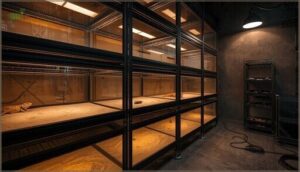
Even perfect probe placement won’t save you if the install itself is wrong. Pad placement errors cause most heating problems — and they’re easy to avoid.
- Cover only one-third to half the tank floor for terrarium temperature control
- Raise enclosures on bumpers for tank ventilation tips and airflow
- Never stack pads — heat mat safety depends on single-layer use
- Match substrate selection to your pad’s wattage to prevent hot spots
- Inspect wiring regularly for wiring hazards prevention
Energy Efficiency and Cost Savings

Running a multi-tank room doesn’t have to mean sky-high electricity bills. Swapping out high-wattage lamps for low-watt heating pads can make a real difference in your monthly costs.
Here’s how the math breaks down across three key areas.
Comparing Electricity Use: Pads Vs. Lamps
Heat mats win on energy consumption every time. A 20-watt pad runs all day for roughly $2.16 monthly. A 75-watt lamp? That’s $4.05 per enclosure. In a multi-tank room, that gap adds up fast.
Reptile heating pads deliver direct conductive thermal output with minimal waste, making heat efficiency and power savings genuinely measurable — not just marketing talk.
Reptile heating pads deliver measurable energy savings through direct conductive heat — no waste, no marketing spin
Managing Heat Across Multiple Enclosures
Running multiple tanks means thermal zoning isn’t optional — it’s your whole strategy. Each enclosure needs its own heat gradient, so reptile thermoregulation actually works.
Multi-probe temperature control systems like Herpstat or Inkbird IPT-2CH let you monitor enclosure heating systems independently.
Pair reptile heating pads with proper enclosure insulation, and your terrarium heating stays consistent without one tank robbing warmth from another.
Maintaining Humidity and Reducing Overhead Costs
Switching to reptile heating pads does double duty — it cuts your energy bill and helps with humidity control at the same time. Because pads don’t blast dry air like heat lamps do, moisture management becomes much easier.
A 20-watt pad uses about 80% less energy than a 100-watt bulb. That’s real energy savings, and better heat retention across every terrarium heating setup you’re running.
Frequently Asked Questions (FAQs)
How to keep a lizard tank warm at night?
A heat mat manages nighttime temperature drops without disturbing your lizard. It facilitates natural thermoregulation by keeping warm zones around 70–77°F, so your reptile stays comfortable all night long.
Do reptile heating pads use a lot of electricity?
No, reptile heating pads use very little electricity. Most reptile heat mats run between 4W and 24W, making energy efficiency in reptile keeping genuinely easy on your wallet compared to traditional heat lamps.
Can heating pads work for aquatic turtle tanks?
Not really. For aquatic turtle care, heat pads can’t reliably raise tank temperature into the 75–80°F range turtles need. A submersible water heater manages thermal regulation far better.
How often should reptile heating pads be replaced?
Plan for replacing your reptile heating pads every 3 to 5 years.
Run pad inspection annually, watch for uneven heat or scorch marks, and replace immediately if the pad fails to hold its target temperature.
Are heating pads safe during power outages?
Power outages stop heat pads instantly, and your tank cools within an hour. For reptile safety, keep chemical heat packs ready as backup solutions. Short outages under six hours rarely cause immediate harm.
Do heating pads work under wooden enclosures?
Not well. Wood blocks most of the heat, so mat placement matters a lot.
Side-mounting your heat mats inside the enclosure works far better for safe, effective thermal regulation than going under the bottom.
Which reptiles should never use under-tank heating?
Skip the reptile heat mat for tortoises, arboreal species, aquatic reptiles, burrowers, and bioactive setups. These animals either never touch the floor or face serious burns, electrical hazards, or digestive harm from belly heat.
Conclusion
Managing reptile heating pads for multi-tank reptile rooms is like tuning instruments in an orchestra — every pad needs to hit the right note or the whole setup falls flat. Choose pads that match your species’ needs, pair them with reliable thermostats, and monitor temps consistently.
A stable heat gradient isn’t a luxury; it’s the foundation your animals depend on daily. Get that right, and your entire room runs like it was built to.
- https://docs.google.com/document/d/1I40wqoz7l88_xM9iqRhfJ7crpgFJfxHEqfpNxnz9TPc/mobilebasic
- https://www.reptiles.swelluk.com/help-guides/which-reptile-thermostat-do-i-need/
- https://www.bn-link.com/products/bn-link-durable-reptile-heating-pad-with-digital-thermostat-under-tank-heater-terrarium-warmer-combo-set-for-turtles-lizards-frogs-and-other-reptiles-1
- https://www.xyzreptiles.com/how-to-use-a-heat-pad-for-reptiles/
- https://solartechonline.com/blog/how-much-electricity-does-heat-lamp-use/