
This site is supported by our readers. We may earn a commission, at no cost to you, if you purchase through links.
A corn snake that stops eating in November isn’t cold — it’s cold. Reptiles don’t generate their own body heat, so when your home cools down overnight, their metabolism follows. Digestion stalls. Immune function drops. A snake that ate fine on Monday can become lethargic and refuse food by Friday, purely from a 10-degree temperature swing you barely noticed.
Overnight drops hit hardest because there’s no one watching. The right heating pad holds that thermal floor steady while you sleep. Choosing one that matches your species, tank size, and setup makes the difference between a thriving animal and a chronically stressed one.
Table Of Contents
- Key Takeaways
- Why Reptiles Need Heating Pads Overnight
- Key Features of Effective Reptile Heating Pads
- Choosing The Right Heating Pad Size
- Safe Installation and Placement Tips
- Top 5 Reptile Heating Pads for Overnight Use
- Common Mistakes With Reptile Heating Pads
- Maintenance and Monitoring for Safe Overnight Heating
- Frequently Asked Questions (FAQs)
- Can I leave a heating pad on low overnight?
- Should I turn my geckos heat mat off at night?
- How to heat a reptile enclosure at night?
- Can heating pads work with ceramic heat emitters?
- How long do reptile heating pads typically last?
- Are heating pads safe for aquatic turtle tanks?
- Do heating pads raise electricity bills significantly?
- Can two heating pads run in one enclosure?
- Conclusion
Key Takeaways
- A 10-degree overnight temperature drop tanks your reptile’s metabolism by up to 50%, stalls digestion, and suppresses immunity — a heating pad isn’t a luxury, it’s what keeps the animal alive and functional while you sleep.
- Every heating pad needs a thermostat; without one, surface temps drift dangerously and can exceed 40°C, turning a basic overnight setup into a burn risk.
- Match your pad to one-third to one-half of the enclosure floor — anything more eliminates the cool zone your reptile depends on to self-regulate.
- Deep substrate over 10 mm blocks heat before it reaches your reptile’s belly, making substrate choice and depth just as critical as wattage selection.
Why Reptiles Need Heating Pads Overnight
Reptiles can’t generate their own body heat — when temps drop overnight, their whole system slows down. That’s not rest; that’s stress.
That’s why under-tank heating for reptiles isn’t optional — it’s the closest thing they have to a survival lifeline.
Here’s what you need to know about overnight heating before we get into the top picks.
Effects of Nighttime Temperature Drops on Reptiles
When nighttime temperatures drop below 20°C, your reptile’s metabolism slows substantially — cutting energy efficiency by up to 50%. Below 18°C, digestion stalls, behavioral stress spikes, and immune suppression sets in fast. Prolonged cold even triggers brumation.
Below 18°C, a reptile’s digestion stalls, immunity crashes, and the body edges toward brumation
A reliable heating pad isn’t optional; it’s how you maintain the thermal gradient your animal needs to stay healthy. Proper ambient temperature trigger is essential for safe brumation.
Ectothermic Physiology and Temperature Regulation
Your reptile isn’t being dramatic — it literally can’t self-regulate. Ectothermic physiology means metabolic rate scaling ties directly to ambient heat, doubling roughly every 10 °C gained. Without reptile heating pads maintaining a stable thermal gradient, neural thermoreceptor feedback fails to trigger normal thermoregulation.
Their cold-blooded energy efficiency helps them survive periods of scarce food. Watch for these heat retention postures and behaviors signaling temperature stress:
- Tight coiling against warm surfaces
- Body flattening against glass
- Repeated warm-to-cool shuttling
- Reduced nighttime movement
- Limbs tucked close to minimize heat loss
Species-Specific Temperature Requirements
Not every species shares the same overnight comfort zone. Bearded Dragon Night temps can dip to 55–65°F safely, while Ball Python Warm zones must stay above 75°F. That gap matters when choosing reptile heating pads and setting your thermostat.
| Species | Safe Night Range |
|---|---|
| Bearded Dragon | 55–75°F |
| Ball Python | 75–85°F |
| Leopard Gecko Gradient | 60–77°F |
| Crested Gecko Cool | 65–72°F |
| Corn Snake Night | ~75°F |
Match your thermal gradient to the species — not the other way around.
Key Features of Effective Reptile Heating Pads

Not every heating pad is worth your money — or your reptile’s safety.
The right one comes down to a few non-negotiable features that separate reliable overnight heat from a fire hazard waiting to happen.
Here’s what to look for before you buy.
Ultra-Thin Carbon Film Technology
Carbon film isn’t just thin — it’s engineered. At 0.4 mm, these films deliver even heat distribution across the entire pad surface, eliminating hotspots that can cook one side of your reptile’s belly while leaving the other cold. Here’s why it matters for overnight reptile heating solutions:
- Rapid heating response — pads reach target temps in under 5 minutes.
- Flexibility and durability — moisture-proof, kink-resistant, and built to last.
- Self-regulating safety — PTC technology caps surface heat at 55°C automatically.
Adjustable Wattage and Sizing Options
Most brands offer heat mat sizing in four steps — 4, 8, 16, and 25 watts — so you can match wattage control to your actual enclosure volume. A 16W pad suits a 10–20 gallon setup; a 25W accommodates 50–60 gallons.
Always pair these reptile heating solutions with a thermostat to maintain safe thermal gradients. Size variants exist precisely so your heat mats never overpower your space.
Manual Vs. Thermostat Temperature Control
Manual controls keep costs low — sometimes under $30 — but surface temps can drift 3–6°C when room temperatures shift overnight. A thermostat changes everything. It reads the probe, cycles power automatically, and holds your target within 1–2°C.
For species that need that 5–10°F overnight dip, a thermostat makes it easy to automate the drop without babysitting your setup — check out this snake terrarium heating options comparison to find the right controller for your budget.
For ball pythons needing 30–32°C belly heat, that precision matters. Better temperature accuracy means better digestion, better feeding response, and a healthier animal overall.
Safety Mechanisms and Overheat Protection
A good heating pad won’t just warm your enclosure — it’ll protect it.
Here’s what to look for:
- Thermal Cutoff switches that shut off automatically at 50°C
- PTC Self-Regulation that reduces power as temps rise, preventing hotspots
- CellSafe Micro-Heaters enforcing a hard 55°C ceiling across every cell
- UL Certification and a solid Waterproof Rating for 24/7 safe use
Choosing The Right Heating Pad Size

Size isn’t just a detail — it’s the whole game.
pad that’s too small leaves your reptile cold; one that’s too large creates a hot zone with no escape.
Here’s how to match the right heating pad to your specific setup.
Measuring Your Terrarium Base
Measure from the inside glass edge — not the outside. Glass thickness alone can steal 0.5–1 cm per side, throwing off your heat mat selection entirely.
Multiply interior length by width for your true floor area calculation. Stick to one unit system throughout your terrarium setup, whether metric or imperial. A 36 in × 18 in base gives you 648 square inches to work with.
Matching Pad Dimensions to Enclosure Size
Coverage Ratio Guidelines matter more than most keepers realize. Your reptile heating pad should cover one-third to one-half of the enclosure floor — never more.
Exceed 50% and you’ve eliminated the cool zones your animal depends on for thermoregulation. Species-Specific Sizing also plays a role: baby leopard geckos in a 60×30cm setup need only one-quarter coverage.
Match the heat mat to your enclosure design and management goals, not convenience.
Wattage Recommendations for Tank Sizes
Wattage isn’t one-size-fits-all. Match it to your tank size and species’ needs:
- 5–10 gallon tanks – A 4–7W reptile heating pad manages small setups without overwhelming heat distribution.
- 10–30 gallon tanks – Use 7–24W heat mats for effective terrarium heating and temperature control.
- 40+ gallon tanks – Step up to 24–32W, factoring in room temperature impact and heat loss factors.
Safe Installation and Placement Tips
Even the best heating pad won’t do its job if it’s stuck in the wrong spot. Placement and attachment might seem like small details, but they make a real difference in how well your reptile stays warm overnight.
Here’s what you need to know before you plug anything in.
Proper Attachment Methods
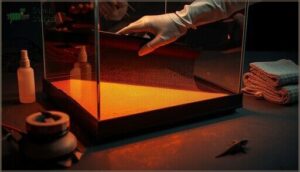
Start with glass cleaning — wipe the enclosure base with diluted isopropyl alcohol and let it dry completely.
Then peel the backing and roll the pad edge-first onto the glass for clean adhesive alignment with zero air bubbles.
Attach mounting feet to create a 5–6 mm air gap underneath.
Use heat-resistant tape for edge sealing only if grip loosens.
Creating a Thermal Gradient in The Enclosure
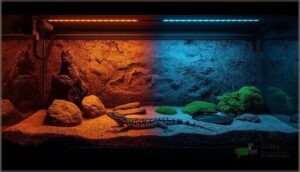
Place the pad under one end only — that single move creates a side-to-side gradient, your reptile can actually use.
Aim for 40–50% floor coverage. The warm zone manages basking zone placement; the uncovered side becomes your cool zone design.
A 5–10°C difference is all most species need for proper temperature regulation, especially during a nighttime temperature drop.
Substrate Considerations for Heat Distribution
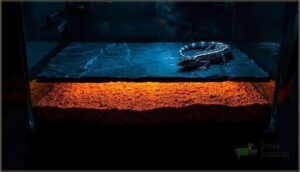
What sits between your heat mat and your reptile matters more than most keepers realize. Tile conductivity beats loose substrate every time — slate or ceramic spreads warmth evenly across the warm zone.
Keep substrate depth limits in mind: anything over 10 mm insulates the glass, forcing the pad to run dangerously hot underneath. Always maintain air gap ventilation beneath the tank, and recheck thermostat probe placement whenever you change substrate materials.
Top 5 Reptile Heating Pads for Overnight Use
Not all heating pads are built the same, and overnight use is where that difference really shows.
The five options below have earned their spot through consistent performance, solid safety features, and real-world reliability.
Here’s what’s worth your money.
1. Exo Terra Heat Mat 16W
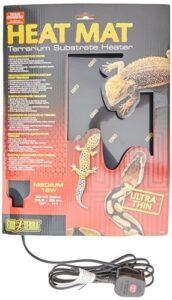
Exo Terra Heat Mat 16W punches well above its weight for smaller setups. At 10 × 11 inches and just 16 watts, it covers roughly one-third of a 30–40 gallon terrarium floor — exactly the footprint you want for a proper thermal gradient.
The ultra-thin silicone construction transfers heat evenly, mimicking sun‑warmed ground. It adheres permanently to glass, so there’s no shifting overnight. Pair it with an Exo Terra thermostat — this mat has no built‑in temperature control, and skipping that step is a gamble you don’t want to take.
| Best For | Small reptile owners — think geckos, small snakes, or amphibians — who need reliable, even undertank heat for a 30–40 gallon terrarium. |
|---|---|
| Brand | Exo Terra |
| Material | Silicone |
| Adhesive Backing | Yes |
| Waterproof | Yes |
| Power Output | 16W |
| Tank Suitability | Small tanks |
| Additional Features |
|
- Thin silicone design spreads heat evenly across the floor, mimicking natural sun-warmed ground
- Sticks firmly to glass so it stays put once you’ve set up your thermal gradient
- Works great for both tropical and temperate setups, giving you real versatility
- No built-in thermostat — you’ll need to buy one separately or risk overheating your reptile
- Once it’s adhered to the tank, pulling it off can damage the mat and it likely won’t be reusable
- Heats up a bit slower than some competing brands, so factor in some warm-up time
2. iPower 24W Reptile Heat Mat with LCD Thermometer
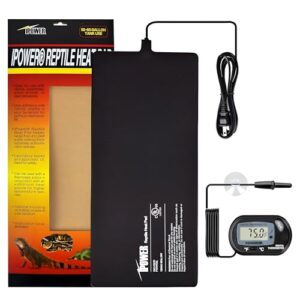
The iPower 24W heat mat steps up for medium to large setups — 50 to 60 gallon tanks where the 16W Exo Terra just won’t cut it. At 8 × 18 inches, it covers the right footprint without swallowing the entire floor.
The thin-film element spreads heat evenly, no hot spots.
It comes bundled with an LCD thermometer, which is a genuine bonus. You still need a separate thermostat, though. Don’t skip that.
The 3M adhesive bonds flat to glass and stays put overnight.
| Best For | Reptile and amphibian owners running medium to large terrariums (50–60 gallons) who need reliable, even bottom heat. |
|---|---|
| Brand | iPower |
| Material | PTC heating material |
| Adhesive Backing | 3M adhesive |
| Waterproof | Yes |
| Power Output | 24W |
| Tank Suitability | Medium-large tanks |
| Additional Features |
|
- At 8 × 18 inches and 24 watts, it’s got the size and power to actually warm a larger tank
- Comes with an LCD thermometer right out of the box — one less thing to buy
- Thin-film heating element spreads warmth evenly, so no hot spots cooking your animals
- You still need a separate thermostat — don’t run this uncontrolled
- The adhesive can be hit or miss depending on the surface
- Improper mounting is a real fire risk, so placement matters
3. REPTI ZOO Reptile Heat Mat with Thermostat
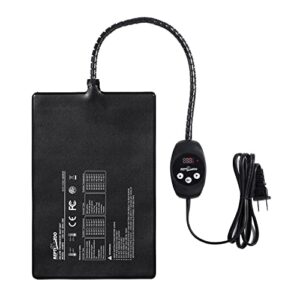
The REPTI ZOO 8×12 inch heat mat solves the problem most pads create — it includes its own built‑in thermostat. No extra controller to buy.
The smart chip holds temps between 68°F and 122°F with dual overheat protection cutting power automatically if anything goes wrong.
Carbon film heats fast and distributes evenly across the surface.
The 3‑button digital display lets you toggle between Fahrenheit and Celsius, and the 3M adhesive sticks firmly to glass.
Sized right for 30–40 gallon tanks at 23 watts.
| Best For | Reptile and amphibian owners who want a reliable heat mat without hunting down a separate thermostat. |
|---|---|
| Brand | REPTI ZOO |
| Material | Carbon film |
| Adhesive Backing | 3M adhesive |
| Waterproof | Yes |
| Power Output | 23W |
| Tank Suitability | 30-40 gal tanks |
| Additional Features |
|
- Built-in thermostat with dual overheat protection means you’re not flying blind on temps
- Carbon film heats up fast and spreads heat evenly — no hot spots
- 3M adhesive sticks flat to glass tanks, and setup takes minutes
- Only fits 30–40 gallon tanks, so larger setups need a different size
- At 23 watts, it may not be enough for colder rooms or species needing higher belly heat
- Adhesive placement is pretty permanent — repositioning can be a hassle
4. Zoo Med Reptitherm Undertank Heater
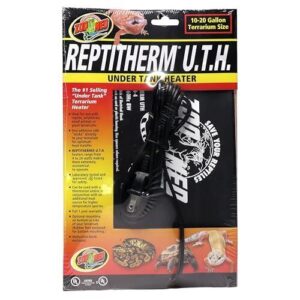
Zoo Med’s Reptitherm is the old reliable of the undertank heater world — and for good reason.
This 6″×8″, 8-watt mat uses a solid-state nichrome element sealed in durable vinyl, directing heat upward through the glass efficiently.
It’s UL/cUL approved and bonds permanently to the tank’s exterior.
One critical note: pair it with a thermostat. Without one, glass surface can get dangerously hot.
Cover roughly half the floor space on one side to maintain a proper thermal gradient overnight.
| Best For | Reptile owners who want a simple, reliable heat source for snakes, lizards, or turtles — especially in cooler environments where maintaining a consistent temperature overnight matters. |
|---|---|
| Brand | Zoo Med |
| Material | Resistive wire |
| Adhesive Backing | Yes |
| Waterproof | Yes |
| Power Output | 8W |
| Tank Suitability | Small-medium tanks |
| Additional Features |
|
- Straightforward to install — just peel and stick to the outside of the tank
- Energy-efficient at 8 watts, so it won’t run up your electric bill
- Directs heat upward through the glass evenly, helping your reptile thermoregulate naturally
- Gets seriously hot without a thermostat, which you’ll need to buy separately
- The adhesive can fail on certain surfaces, meaning you might need extra tape or glue to keep it in place
- At 6″×8″, it’s on the smaller side, so it may not cut it for larger enclosures
5. iPower Reptile Heat Pad
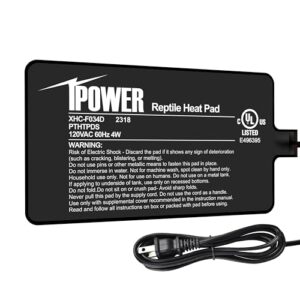
Budget-friendly doesn’t have to mean unreliable.
The iPower Reptile Heat Pad packs PTC heating material into a slim, waterproof mat that attaches firmly with 3M adhesive.
The 4×7 inch, 4-watt model suits 1 to 5 gallon tanks perfectly — small setup, no wasted energy.
It reaches working temp within minutes and holds steady through the night.
No built-in thermostat, so pair it with a separate controller.
Six-foot cord gives you enough slack to route it cleanly.
| Best For | Anyone on a budget setting up a small 1–5 gallon terrarium for reptiles, amphibians, or other tiny critters. |
|---|---|
| Brand | INKBIRD |
| Material | PTC heating material |
| Adhesive Backing | 3M adhesive |
| Waterproof | Yes |
| Power Output | 4W |
| Tank Suitability | 1-5 gal tanks |
| Additional Features |
|
- PTC heating material warms up fast and stays consistent without spiking
- 3M adhesive keeps it firmly in place, and the waterproof build means no stress about moisture
- Six-foot cord gives you plenty of room to set things up cleanly
- No built-in thermostat, so you’ll need to buy a separate temperature controller
- Only works for tanks up to 5 gallons — not an option if your setup is bigger
- Placement really matters; mount it wrong and you risk trapping heat where you don’t want it
Common Mistakes With Reptile Heating Pads
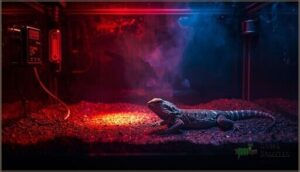
Even the best heating pad won’t save your reptile if you’re making a few common setup errors.
Most problems come down to skipping the basics — poor monitoring, wrong placement, or ignoring what your specific species actually needs.
Here are the four mistakes worth fixing before they cost you.
Lack of Temperature Monitoring
Flying blind with a heating pad is how thermal burns happen.
Poor temperature control isn’t just inconvenient — it’s a direct threat to your reptile’s health. Watch for these monitoring failures:
- Probe Placement Errors that read cool air instead of the actual surface your animal rests on
- Nighttime Data Gaps from skipping overnight checks, letting temps drop below safe ranges
- Overheat Alarm Absence meaning a runaway pad hits 40°C+ completely undetected
- Redundant Thermometers skipped in favor of one unreliable dial
- Behavioral Burn Indicators ignored — belly blisters and glass‑pressing signal heating pad safety failures already in progress
Inadequate Cool Zones
Heat that covers too much floor kills your thermal gradient. Cool hide placement matters: your reptile needs a true cool end — roughly 22 to 25°C — for nighttime cooling and digestion. Without it, temperature monitoring shows a flat, uniform range that stresses the animal constantly.
Ventilation strategies, humidity balance, and smart enclosure heating all depend on that cool zone existing in the first place.
Using Heat Pads With Deep Substrate
Deep substrate is the silent killer of effective heat distribution. Standard heat mats hit their heat penetration limits fast — anything beyond 1 inch of substrate blocks most warmth before it reaches your reptile’s belly.
Burrowing species risks multiply here:
- Surface thermostat probe placement misses scorching temperatures below
- Substrate moisture effects short out heating elements over time
- Thermal gradient collapses completely under thick organic mixes
Switch to overhead heat alternatives for deep enclosure heating setups.
Overlooking Species-Specific Needs
Every reptile isn’t just a different animal — it’s a different climate zone. Bearded dragons need nighttime heat drops to around 55–75°F; crested geckos prefer 65–72°F.
Species gradient design, humidity interaction, and age-based settings all shape how heat mats and thermostat settings affect thermoregulation. Skipping species research breaks reptile care and maintenance before it even starts. Health monitoring catches what guesswork misses.
Maintenance and Monitoring for Safe Overnight Heating
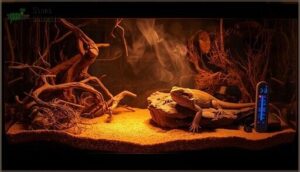
Getting your heating pad set up is only half the job — keeping it running safely overnight is the other half.
A little routine care goes a long way toward catching problems before your reptile feels them.
Here’s what you should be doing consistently to stay ahead of any issues.
Regular Cleaning of Heating Pads
Keeping your reptile heating pads clean isn’t optional — it’s part of heating pad safety and precautions that directly affects your animal’s health. Wipe the surface every 1–2 weeks with mild soap usage or a vinegar solution mixed 1 to 3 with distilled water.
Always unplug first, avoiding moisture near cord edges. Do a visual inspection each time for scorch marks or fraying.
Checking Thermostat and Temperature Probes
After cleaning, your next job is checking thermostat and probe placement accuracy. Don’t trust a single device—dual thermometer use catches missed spikes. Calibration frequency matters; compare readings monthly and recalibrate if needed.
Alarm settings and power fail‑safeguards are your backup plan. If your thermostat slips, temperature regulation goes out the window.
- Peace of mind when readings match
- Catching silent malfunctions
- Preventing overnight overheating
Observing Reptile Behavior for Signs of Stress
Watching your reptile overnight tells you more than any thermometer.
Lethargic posture, hyperactive pacing, or gaping breathing are red flags — not quirks.
Color darkening often signals thermal stress, while aggressive defensives appear when discomfort peaks.
These behaviors directly reflect reptile health and wellness.
Trust what you see, then adjust your heat mats and temperature control before problems escalate.
Frequently Asked Questions (FAQs)
Can I leave a heating pad on low overnight?
Yes — but only with a thermostat. A pad set on low without one can still exceed 40°C and burn your reptile overnight. Control it, and it’s safe to run 24/
Should I turn my geckos heat mat off at night?
It depends on your room temperature. If it stays above 67°F overnight, turning the heat mat off is fine. Below that, keep it on a low thermostat setting.
How to heat a reptile enclosure at night?
Keep a thermostat running overnight and set your warm side to 31–33°C. Lightless heat mats handle nighttime temperature drops without disrupting your reptile’s sleep cycle.
Can heating pads work with ceramic heat emitters?
Heating pads and ceramic heat emitters work great together. The pad manages belly heat while the emitter warms the air — a dual thermostat setup keeps both dialed in safely.
How long do reptile heating pads typically last?
Most reptile heating pads last 2 to 5 years with continuous use. Run one without a thermostat, and you’ll shorten that window fast. Proper temperature control is the difference.
Are heating pads safe for aquatic turtle tanks?
No. Standard reptile heating pads aren’t waterproof heaters — moisture triggers electrical shock hazards. Use submersible aquarium heaters and a basking lamp instead.
Glass stress risk is real if pads overheat beneath filled tanks.
Do heating pads raise electricity bills significantly?
Drop in the bucket. A 16W heat mat adds roughly $30 to your monthly bill. Thermostat efficiency and duty cycle savings cut that further. Even multiple pads won’t break the bank.
Can two heating pads run in one enclosure?
Yes, but carefully.
Two heat mats combine wattage — a 16W and 24W mat deliver 40W total.
Without proper thermostat zoning and wattage balancing, you’ll cook the enclosure instead of warming it.
Conclusion
Your reptile doesn’t ask for much — steady warmth overnight is almost the whole job. The right reptile heating pads for overnight temperature drops eliminate the guesswork, protect digestion, and keep immune function from quietly tanking while you sleep.
Match the pad to your species, run it through a thermostat, and check that probe weekly. Do those three things consistently, and your animal stays in the thermal sweet spot every single night.