This site is supported by our readers. We may earn a commission, at no cost to you, if you purchase through links.
A leopard gecko pressed against cold glass isn’t just uncomfortable—it’s shutting down metabolically. Reptiles can’t generate body heat, so they depend entirely on external sources to maintain the physiological processes that keep them alive.
Without adequate belly heat, digestion slows, immune function drops, and your animal becomes vulnerable to infections and metabolic disorders. Reptile heating pads for terrariums solve this by delivering consistent ground-level warmth that mimics sun-heated rocks and sand.
But not all pads heat evenly, and the wrong setup can create dangerous hot spots or fail to reach target temperatures. The right pad matched with proper controls keeps your reptile thriving.
Table Of Contents
- Key Features of Reptile Heating Pads
- Choosing The Right Heating Pad Size
- Importance of Temperature Control
- Materials and Durability Considerations
- Top 5 Reptile Heating Pads for Terrariums
- Safe Installation and Placement Tips
- Maintenance and Energy Efficiency
- Frequently Asked Questions (FAQs)
- How to heat a reptile terrarium?
- Can you use a reptile heat mat for plants?
- How to keep a reptile enclosure warm at night?
- Can heating pads be used with screen-bottom tanks?
- Do heating pads work with bioactive substrate setups?
- How long do reptile heating pads typically last?
- Are heating pads safe to use with hatchlings?
- Can multiple heating pads be used in one terrarium?
- Conclusion
Key Features of Reptile Heating Pads
Not all reptile heating pads are built the same. The best ones share a handful of features that make them safer, more reliable, and easier to use with your terrarium.
Understanding the difference between heat pads and heat lamps for snakes can help you choose the heating method that best mimics your snake’s natural environment.
Let’s look at what separates a solid heating pad from one that’ll cause you headaches down the road.
Ultra-Thin Carbon Film Technology
Ultra-thin carbon film heaters slide under glass with almost no profile—usually under a millimeter thick. That slim design gives you even heat distribution across the pad instead of hot wires bunched in stripes.
Carbon materials emit far infrared warmth, which penetrates your reptile’s belly tissue like sun-warmed rock. Film efficiency tops 98 percent, so these reptile heating mats reach thermostat set points fast without wasting power.
For more information on energy-efficient heating technology, see how carbon fiber heat mats improve safety and uniform warmth.
Adhesive Backing and Secure Attachment
Most reptile heating mats come with 3M adhesive that bonds permanently to glass bottoms for secure tank stabilization. That direct contact maximizes heat transfer from pad to terrarium, which improves reptile thermoregulation.
Before you peel and stick, clean the glass thoroughly—grease or dust weakens adhesive strength. If original backing fails, aluminum foil tape offers a reliable reptile heating solution without damaging the carbon film.
An example of this type of heater is the belly heat pad for reptiles, designed to encourage digestion and offer a comfortable environment.
Adjustable Wattage and Sizing Options
Once your adhesive is locked down, you need the right heat output for your setup. Most terrarium heat mats come in fixed wattages—4 to 8 watts for small tanks, 16 watts for medium enclosures, and 24 watts for longer reptile housing.
Matching power density to your tank volume helps you build safe temperature gradients without overheating. Wattage control paired with proper heat mat sizing creates stable zones your animal can use for thermoregulation.
Manual Vs. Thermostat Temperature Control
Power management divides into two camps: plug straight into the wall or use a thermostat. Manual control costs nothing extra but demands daily checks with a temp gun, since your mat runs at full power nonstop.
Thermostat settings solve this by reading a probe and cycling power to hold your target range, usually 30 to 32 °C:
- Probe placement directly above the pad captures accurate floor temperatures for temperature regulation
- On-off thermostats cut power at your set point, creating narrow thermal gradients with 1–2 °C swings
- Dimming models adjust voltage smoothly, improving heat distribution and safety features without extreme spikes
Temperature control for reptiles shifts from guesswork to automated precision, preventing burns while you’re at work.
Choosing The Right Heating Pad Size

Getting the size right isn’t complicated, but it matters more than you might think. A pad that’s too small won’t create an adequate warm zone, while one that’s too large can overheat your entire terrarium.
Let’s walk through how to measure your tank, match the right pad dimensions, and choose appropriate wattage for your setup.
Measuring Your Terrarium Base
Before you can choose the right heating pad, you need accurate base measurements of your enclosure. Grab a rigid tape and measure the full exterior footprint—length and width—from outer edge to outer edge.
Don’t guess by gallon rating; tank footprints vary between brands. Record these dimensions so you can match pad size, guarantee proper heat distribution, and plan ventilation gaps for safe terrarium heating.
Matching Pad Dimensions to Enclosure
Once you’ve measured your terrarium, aim for a heating pad that covers roughly one-quarter to one-third of the floor. This enclosure sizing creates a proper thermal gradient—a warm zone under the pad and a cooler retreat elsewhere—so your reptile can thermoregulate naturally.
Covering more than half the base risks overheating; pad placement on just one side ensures safe heat distribution across your terrarium design.
Wattage Recommendations by Tank Size
Most 10-gallon tanks run well on 8–16 watts, while 20-gallon enclosures usually need 16–24 watts. Larger 40-gallon tanks often use 24–32 watts for proper heat distribution.
A general rule: budget 2–4 watts per gallon, adjusting for room temperature and reptile species needs. Cold basements may push you toward higher wattage, and energy efficiency improves when you pair any reptile heating pad with a thermostat.
Importance of Temperature Control
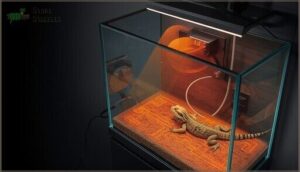
Temperature control isn’t optional when you’re using heating pads—it’s the difference between a healthy reptile and a medical emergency.
Temperature control separates healthy reptiles from medical emergencies when using heating pads
Without proper temperature regulation, even a quality heat mat can create dangerous hot spots or overheating that leads to burns.
Here’s how to keep your setup safe and your temperatures exactly where they need to be.
Using Thermostats for Precision
A thermostat transforms your heat mat from a guessing game into precision heating. Here’s how to dial it in:
- Place temperature probes directly on the warm floor above the mat—external readings often run several degrees cooler than what your reptile actually feels.
- Verify accuracy with an independent thermometer at the probe spot; adjust your setpoint up or down if readings don’t match.
- Choose proportional controllers over on-off models to minimize temperature swings and hot spots on the glass surface.
Regular thermostat calibration and monitoring through thermostat alarms keep adjustable thermostat systems reliable for your terrarium heating options.
Built-in Overheat Protection
Many reptile heating pads include thermal cutoff devices and fuse protection that permanently disable the unit if internal temperatures hit 105 to 115 degrees Celsius. These overheat sensors protect against fire risk, but they’re not a substitute for external temperature control.
Look for heat limiters with safety certifications—UL-listed pads meet independent standards for reptile care and maintenance. Still, pair any heat sources for reptiles with a dedicated thermostat for reliable terrarium heating options.
Avoiding Hot Spots and Burns
A single miscalibrated probe can turn your heat mat into a thermal minefield. Burn prevention starts with smart heat distribution—even reptile heating pads rated for temperature control create dangerous hot spots without proper setup.
- Place your thermostat probe directly over the warmest section of the heat mat surface for accurate thermal safety readings.
- Use a thin, even substrate layer across terrarium heat mats to spread warmth and prevent bare-glass contact burns.
- Limit pad coverage to one-third of your tank floor, giving your animal a genuine cool zone for reptile welfare.
- Spot-check surfaces weekly with an infrared gun—thermostat displays don’t always reflect real contact temperatures in reptile care and maintenance.
Materials and Durability Considerations

Not all heating pad materials are created equal, and the wrong choice can put your reptile at risk. Vinyl might be cheap, but it’s also prone to overheating and cracking.
Here’s what you need to know about the materials that actually hold up over time.
Vinyl, Cloth, Ceramic, and Rubber Options
You’ll find reptile heating pads wrapped in vinyl, cloth, ceramic tiles, or rubber. Each material comparison reveals trade-offs: vinyl pads slip easily under glass terrariums, while cloth covers add a soft barrier you can wash. Ceramic benefits include even heat distribution when placed over mats, and rubber durability accommodates heavy tortoises.
Understanding how these materials interact with your reptile enclosure heating helps you pick the safest option.
| Material | Key Advantage |
|---|---|
| Vinyl | Flexible, UL-listed safety |
| Cloth | Washable, diffuses hot spots |
| Ceramic | Rigid surface, easy disinfection |
| Rubber | Impact-resistant, outdoor use |
Waterproof and Moisture-Resistant Designs
Beyond surface materials, look for sealed enclosures that lock out spilled water and substrate moisture. Modern terrarium heat mats often carry ingress protection ratings like IP67—dust-tight construction with sealed seams that handle splashes during misting. These waterproof heating pads let you maintain humid environments for tropical species without risking short circuits.
Three moisture-safety must-haves:
- Welded or heat-sealed edges that prevent condensation from wicking into internal wiring over time.
- Molded cord connections with strain relief that shield junctions from drips and terrarium condensation.
- PVC outer jackets you can wipe clean after spills, so mineral deposits won’t corrode your reptile enclosure heating setup.
Damp setup maintenance becomes straightforward when your heating mat resists repeated contact with humid glass.
Fire Safety and Non-Toxic Materials
Once moisture protection is in place, fire safety becomes your next priority. Quality heating pads for reptiles use flame retardant insulation and heat resistance materials rated for sustained contact with glass tanks—look for UL or CSA electrical safety marks.
Non toxic coatings and toxic free construction prevent harmful off-gassing when your terrarium heat mats run fourteen hours daily, keeping both your reptile heating solutions and your animals safe.
Top 5 Reptile Heating Pads for Terrariums
You’ve covered materials, sizing, and safety features—now it’s time to see which pads actually deliver.
The five options below represent the most reliable models available, each tested across different terrarium setups and species requirements. Here’s what works and why it matters for your specific setup.
1. Exo Terra Reptile Heat Mat
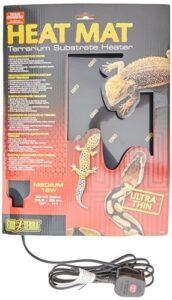
Exo Terra’s Heat Mat stands out in the 16-watt lineup for glass terrariums. This ultra-thin pad measures 15 by 11.8 inches and uses self-regulating PTC technology to prevent dangerous hot spots.
You’ll get consistent belly heat that mimics sun-warmed surfaces—critical for proper thermoregulation in tropical and temperate species. The self-adhesive backing bonds permanently to exterior glass, but here’s the catch: you need a separate thermostat for precise control. Once stuck, don’t peel it off—you’ll damage the heating elements permanently.
| Best For | Reptile owners who need reliable under-tank heating for small to medium terrariums, especially for species that require belly warmth like leopard geckos, corn snakes, and bearded dragons. |
|---|---|
| Power | 16W |
| Material | Silicone |
| Color | Black |
| Waterproof | No |
| Adhesive Backing | Yes |
| Cord Length | Standard |
| Additional Features |
|
- Self-regulating PTC technology prevents overheating and dangerous hot spots automatically
- Ultra-thin design (1.5 inches) fits easily under glass terrariums without taking up space
- Permanent adhesive backing ensures secure placement and consistent heat transfer
- Requires a separate thermostat purchase for proper temperature control
- Cannot be repositioned once adhered to the tank without damaging the heating elements
- Takes longer to reach target temperature compared to higher-wattage options
2. iPower Reptile Heat Mat
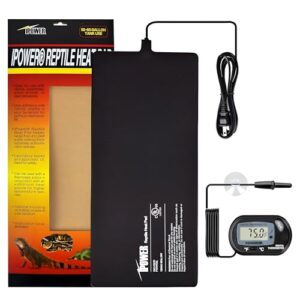
iPower’s flexible pad delivers solid belly heat across four size options—from a compact 4-watt model for 5-gallon quarantine setups to a 24-watt unit covering 50-gallon tanks. The thin heating film reaches operating temperature in under ten minutes, climbing to about 80–90°F at room temperature without a controller.
You’ll notice the 3M adhesive holds firm against glass, though some keepers report weak bonding on textured plastic. The included dial controller helps, but don’t skip an independent thermostat—relying solely on that knob risks thermal burns in species requiring precise gradient control.
| Best For | Reptile keepers looking for an affordable under-tank heater with adjustable temperature control for small to medium enclosures. |
|---|---|
| Power | 24W |
| Material | PTC heating material |
| Color | Black |
| Waterproof | Yes |
| Adhesive Backing | Yes (3M) |
| Cord Length | 6 feet |
| Additional Features |
|
- Heats up quickly in under ten minutes and includes a dial controller for basic temperature adjustment
- Strong 3M adhesive bonds well to glass surfaces for secure mounting
- Available in four sizes to fit everything from 5-gallon quarantine tanks to 50-gallon setups
- Adhesive struggles on textured plastic and may not stick reliably to all surfaces
- Lacks an automatic cutoff feature, requiring a separate thermostat to prevent overheating and burns
- Limited temperature precision with the included dial controller, making it risky for species needing exact heat gradients
3. Repti Zoo Reptile Heat Mat Thermostat

Precision matters when you’re safeguarding a reptile’s comfort zone, and the Repti Zoo Reptile Heat Mat Thermostat meets that challenge by combining a digital controller right into the mat. You set the exact temperature—between 68–122°F—on its external display, so there’s no guesswork or wild swings.
Dual safety features, including an internal cutoff, help prevent dangerous overheating. The PVC-sealed carbon film spreads heat evenly, which makes it an excellent choice for sensitive species or anyone who wants reliable, steady warmth control.
| Best For | Reptile owners who want precise temperature control and built-in safety features to maintain a stable environment for their pets. |
|---|---|
| Power | 23W |
| Material | Carbon film |
| Color | Black |
| Waterproof | No |
| Adhesive Backing | Yes |
| Cord Length | Standard |
| Additional Features |
|
- Built-in digital thermostat lets you set exact temperatures between 68–122°F without buying separate equipment
- Dual safety protections and even heat distribution from carbon film material reduce overheating risks
- Simple 3-button setup with a clear display makes adjustments quick and straightforward
- Some users report the temperature display becomes unreliable or stops working after extended use
- May not last beyond a year based on customer feedback about durability issues
- Adhesive backing doesn’t stick well to all surfaces, which can make mounting tricky
4. Zoo Med Reptile Undertank Heater
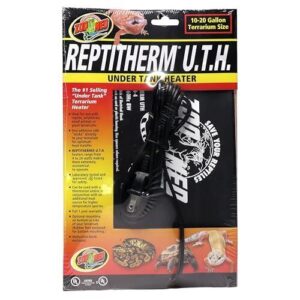
The Zoo Med ReptiTherm uses a nichrome heating element that permanently bonds to the exterior glass of your terrarium, delivering steady warmth without built-in controls. You’ll need a separate thermostat to dial in the right temperature.
It comes in four sizes—4 watts for tiny setups up to 24 watts for sixty-gallon tanks—and includes rubber feet to raise the enclosure slightly. That airflow prevents overheating. It’s UL-approved and runs continuously for pennies, making it a reliable 24-hour heat source for temperate species.
| Best For | Reptile owners with glass terrariums who need a reliable, low-cost heat source and are willing to use a separate thermostat for temperature control. |
|---|---|
| Power | 8W |
| Material | Active heating element |
| Color | Black |
| Waterproof | No |
| Adhesive Backing | Yes |
| Cord Length | Standard |
| Additional Features |
|
- Provides steady, continuous warmth for just pennies per day with UL-approved safety
- Includes rubber feet that lift the enclosure for proper airflow and prevent overheating
- Available in four sizes (4W to 24W) to match different terrarium dimensions
- Requires a separate thermostat purchase since there’s no built-in temperature control
- Adhesive may not stick well to all surfaces and might need extra securing
- Can overheat pets if not properly monitored with a thermostat
5. iPower Reptile Heat Pad
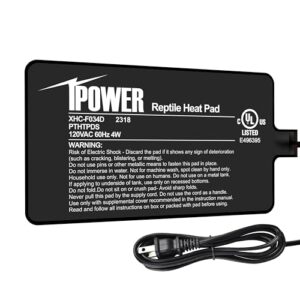
For small enclosures up to five gallons, the iPower Heat Pad delivers 4 watts through a thin heating film with 3M adhesive backing. Its surface reaches about 80°F at room temperature—mild belly heat for geckos and small snakes.
The waterproof construction protects against spills, but you’ll need a separate thermostat since there’s no built-in control. The adhesive holds well initially but can fail after several months. Expect roughly seven months of reliable service before re-mounting or replacement becomes necessary.
| Best For | Small reptile owners with enclosures up to 5 gallons who need gentle belly heat for species like geckos and small snakes. |
|---|---|
| Power | 4W |
| Material | PTC heating material |
| Color | Black |
| Waterproof | Yes |
| Adhesive Backing | Yes (3M) |
| Cord Length | 6 feet |
| Additional Features |
|
- Waterproof design protects against terrarium spills and humidity
- Strong 3M adhesive ensures secure mounting to glass or plastic
- Energy-efficient 4W output reaches target temperature quickly
- No built-in thermostat means you’ll need to buy one separately
- Adhesive weakens over time, typically failing after about seven months
- Low 4W output won’t work for larger tanks or heat-demanding species
Safe Installation and Placement Tips
Setting up your heating pad correctly makes all the difference between a safe setup and a potential disaster. Where you place it, how you secure it, and what you do with that power cord all matter more than most keepers realize.
Let’s walk through the three placement rules that keep your reptile comfortable and your terrarium risk-free.
External Vs. Internal Mounting

Most reptile heating pads work best when fixed outside the terrarium, usually on the bottom or back panel. This keeps your animal away from direct contact while pushing warmth through glass or plastic. Internal mounting—sticking the pad inside the enclosure wall—can boost thermal efficiency, but you’ll need stronger safeguards against burns and material compatibility issues.
External mounting delivers:
- Lower safety risks by keeping electrical parts outside where curious reptiles can’t reach them
- Simple thermostat probe placement between the mat and enclosure base for accurate readings
- Better heat distribution through side or back panels when deep substrate blocks bottom warmth
- Fire prevention by allowing airflow beneath the pad instead of trapping heat against wood
Raising The Tank for Heat Dispersion

Lifting your enclosure a quarter-inch off the surface might sound minor, but that air gap importance changes everything for heat dispersion methods.
When heat mats sit flush against carpet or wood, trapped warmth can melt finishes or shorten the pad’s life.
Tank raising techniques using rubber feet or furniture risers create ventilation strategies that let excess heat escape, maintaining thermal balance while your reptile heat pad runs safely for years.
Protecting Power Cords and Connections
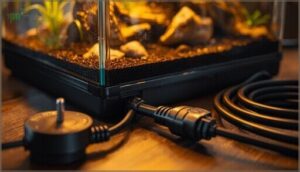
Once the tank stands raised, turn your attention to cord protection—heat mat cables flexing against glass edges fray fast. Route power cords straight to the wall, never under the enclosure where pinching damages electrical insulation.
Cable management sleeves or rigid conduit stop curious reptiles from chewing through to live wiring. Always check outlet security and avoid damaged plugs; waterproof thermostats need dry connections to cycle your adjustable thermostat safely.
Maintenance and Energy Efficiency
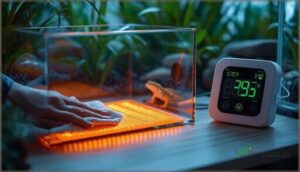
A heating pad won’t do its job if you don’t keep it clean and running right. You also want to know what it’s costing you each month—these devices run for hours every day, and the math matters.
Here’s how to maintain your pad and keep energy use under control.
Regular Cleaning and Inspection
Weekly surface sanitizing and damage checks keep your heating pad safe and functional. Unplug the unit before you begin—cooling the surface prevents burns and protects electronics during cleaning. Wipe away dust and shed skin with a soft cloth, then inspect for cracks, discoloration, or frayed cords.
- Debris Removal: Gentle wiping prevents hot spots under stuck substrate
- Electrical Tests: Check plug integrity and cord routing before reconnecting
- Visual Scans: Look for bubbling, melting, or lifted adhesive
- Maintenance Scheduling: Monthly deep inspections during full enclosure cleanouts
Proper terrarium setup and maintenance extends pad life and ensures reptile health and wellness.
Monitoring Temperature and Humidity
Once your heating pad is clean and secure, environmental monitoring becomes your daily health check. You need both temperature probes and humidity sensors to verify your terrarium heating setup delivers the right conditions. Heat mapping across your enclosure confirms your adjustable thermostat settings create a proper gradient—warm basking zones and cooler retreats for thermal regulation and control.
| Device Type | Primary Function | Placement Strategy |
|---|---|---|
| Digital Thermometer | Tracks warm-side temps | Near heating pad surface |
| Thermostat Probe | Controls heat output | Directly above pad |
| Hygrometer Sensor | Measures humidity levels | Mid-height, away from mist |
| Combo Monitor | Logs both metrics | Cool side for gradient check |
Ball pythons need 50–60 percent humidity, while bearded dragons thrive at 20–35 percent—precise reptile heating solutions depend on accurate readings. Temperature control isn’t guesswork; smart monitors with app alerts catch dangerous spikes before your animal suffers.
Calculating Power Consumption and Costs
Monitoring temps isn’t free—you’re paying for every hour that pad runs. Most small reptile heating pads draw 5 to 15 watts, so a 15-watt mat running 14 hours daily uses about 0.21 kilowatt-hours.
At 15 cents per kilowatt-hour, that’s roughly 95 cents monthly. Thermostat settings cut costs by cycling heat on and off, making energy efficiency and cost estimation straightforward once you check your pad’s wattage.
Frequently Asked Questions (FAQs)
How to heat a reptile terrarium?
Most keepers pair under-tank heat mats with overhead basking lamps to create warm zones that match their species’ needs.
This dual approach gives reptiles proper belly heat and behavioral basking spots simultaneously.
Can you use a reptile heat mat for plants?
Many gardeners repurpose reptile heat mats for seed starting and root temperature control.
These low-wattage pads provide gentle soil warming that improves plant germination rates, though you’ll need a thermostat to prevent overheating.
How to keep a reptile enclosure warm at night?
You’ll want to maintain nighttime temperature with ceramic heat emitters or under-tank heat pads paired with thermostat settings.
Most species need gentle warmth from safe heating practices, not intense heat source options, to guarantee reptile comfort overnight.
Can heating pads be used with screen-bottom tanks?
Screen-bottom tanks and heating pads make a terrible match—mesh bleeds heat into the room instead of warming your reptile.
Mount the pad on a solid side panel or switch to overhead heat sources.
Do heating pads work with bioactive substrate setups?
Heat transfer through deep substrate layers poses real challenges. Thick bioactive soil insulates warmth near the glass, often failing to create usable surface temperatures while risking root health and microfauna impact below.
How long do reptile heating pads typically last?
Properly placed pads persist three to five years with daily use.
Thermostat-controlled heating pads for reptiles extend heat mat durability by preventing constant maximum output. Replace your reptile heat pad when thermal efficiency drops or adhesive fails.
Are heating pads safe to use with hatchlings?
Yes, heating pads are safe for hatchlings when you use a thermostat to maintain proper temperatures and provide adequate substrate depth over the heated zone, preventing direct contact burns on delicate belly skin.
Can multiple heating pads be used in one terrarium?
You can run multiple heat pads on one terrarium if the total wattage suits your tank size.
Each pad needs its own thermostat, and together they can’t cover more than one-third of the floor.
Conclusion
Think of your terrarium as a miniature ecosystem where every degree matters. The right reptile heating pads for terrariums don’t just warm glass—they power digestion, immunity, and survival itself.
Match pad size to your enclosure, pair it with a reliable thermostat, and verify temperatures with a probe thermometer. Your gecko won’t thank you verbally, but its steady appetite and alert behavior will tell the story.
Temperature control isn’t optional—it’s foundational.
- https://zoomed.com/reptitherm-under-tank-heater-u-t-h/
- https://www.instructables.com/Reptile-tank-heating-and-lighting-guide/
- https://www.thebiodude.com/blogs/reptile-and-amphibian-lighting-faqs-and-help/here-s-why-you-shouldn-t-be-using-a-heat-mat-for-your-reptile
- https://www.xyzreptiles.com/correctly-using-reptile-heating-pad/
- https://thewebinarvet.com/blog/proper-environmental-conditions-for-common-pet-reptiles