This site is supported by our readers. We may earn a commission, at no cost to you, if you purchase through links.
Your bearded dragon stops eating. Your chameleon’s bones feel soft. Your gecko moves slowly even when you handle it. These aren’t random problems. They’re signs of lighting failure in your reptile habitat.
Most keepers don’t realize that reptiles can’t produce vitamin D3 without the right UVB wavelengths. They also can’t regulate their body temperature without proper heat zones. A single bad bulb choice affects digestion, bone growth, and immune function.
The good news is that modern reptile lighting solutions fix these issues with dual fixtures, precise UVB output, and adjustable heat control. You just need to know which systems match your species and enclosure.
Table Of Contents
- Key Takeaways
- Top 9 Reptile Lighting Solutions Reviewed
- 1. Reptile Dual Light Fixture System
- 2. Reptile Dual Light Fixture Combo
- 3. Reptile Heat Lamp Fixtures Set
- 4. Reptile Deep Dome Heat Lamp Fixture
- 5. Reptile Uvb Light Fixture Kit
- 6. Dual Reptile Heat Lamp Fixture
- 7. Reptile Clamp Lamp Fixture
- 8. Reptile Aluminum Heat Lamp Fixture
- 9. Reptile Heat Lamp Fixture Thermostat
- Essential Lighting Types for Reptile Habitats
- Key Lighting Parameters for Reptile Health
- Choosing The Right Lighting System
- Wholesale Opportunities for Reptile Lighting
- Frequently Asked Questions (FAQs)
- Conclusion
Key Takeaways
- Reptiles can’t produce vitamin D3 or regulate body temperature without proper UVB wavelengths (290–315 nm) and dedicated heat sources, making lighting failures a direct cause of metabolic bone disease and digestive problems.
- Replace UVB bulbs every 6–12 months even if they look bright, since output drops 20–40% over time and household LED bulbs lack the UVB spectrum reptiles need for calcium absorption.
- Set basking zones at 32–45°C with cooler areas 5–8°C lower, positioning heat lamps 10–15 cm above the basking spot to create temperature gradients that support natural thermoregulation.
- Match your fixture type and UVB intensity to your species and enclosure size—desert reptiles need 10% UVB output while tropical species thrive at 5–8%, and small terrariums under 20 gallons require compact fixtures to avoid crowding.
Top 9 Reptile Lighting Solutions Reviewed
You need lighting that promotes your reptile’s health without guesswork. The right fixture provides proper UVB exposure, maintains temperature gradients, and fits your enclosure setup.
Here are nine reliable lighting solutions that cover heat lamps, UVB kits, and dual-function systems for different species and tank sizes.
1. Reptile Dual Light Fixture System
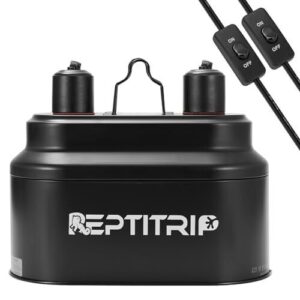
You need integrated spectral control for your reptile habitat lighting, and a dual lighting fixture design delivers exactly that. These systems combine UVB lights and heat lights in one housing, simplifying your setup while targeting basking zones with precision.
UVB outputs generally range from 5% to 10% of total intensity, supporting healthy calcium metabolism. Most domes and fixtures accommodate enclosures from 18 to 36 inches wide, letting you adjust positioning to match your animal’s natural behavior.
This approach streamlines your equipment and keeps your pet thriving.
| Best For | Reptile keepers who want a streamlined setup that combines UVB and basking heat in one fixture without juggling multiple components. |
|---|---|
| Maximum Wattage | 160W per socket |
| Material | Metal |
| Weight | 1.7 pounds |
| Color | Black |
| Switch Type | Independent switches |
| Heat Dissipation | Ventilation holes |
| Additional Features |
|
- Combines UVB and heat in a single housing, cutting down on clutter and simplifying your enclosure setup.
- Adjustable positioning works with tanks from 18 to 36 inches, so you can dial in the right basking zone for your specific reptile.
- UVB output in the 5–10% range supports proper calcium absorption and keeps your pet healthy.
- Bulbs aren’t included, so you’ll need to buy those separately and factor in the extra cost.
- Some users report durability problems, with fixtures failing after just a few months of use.
- Light distribution isn’t always ideal—these fixtures may not direct light downward as effectively as dedicated basking domes.
2. Reptile Dual Light Fixture Combo
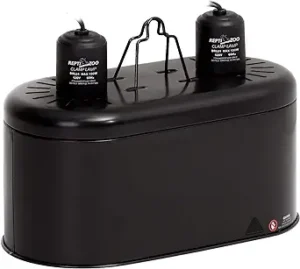
A combo fixture pairs two independent switches with solid ceramic lamp caps, so you control UVB lights and heat lights separately. The REPTI ZOO design holds up to 150 watts per socket and includes radiating holes for heat management, keeping your domes and fixtures cool during long basking cycles. ETL certification confirms lamp safety standards.
This setup works well for bearded dragons, geckos, and chameleons. You hang it above your reptile habitat lighting zone or rest it on a screen top, matching your animal’s natural thermoregulation needs without extra clutter.
| Best For | Reptile owners who need flexible control over heat and UVB lighting in small-to-mid-sized enclosures for species like bearded dragons, geckos, and chameleons. |
|---|---|
| Maximum Wattage | 150W per lamp |
| Material | Metal |
| Weight | 1 pound |
| Color | Black |
| Switch Type | Two independent switches |
| Heat Dissipation | Radiating holes |
| Additional Features |
|
- Two independent switches let you control heat and UVB lights separately, making it easy to adjust basking zones and photoperiods without unplugging anything.
- Ceramic sockets handle up to 150 watts each and include ventilation holes to prevent overheating, which helps extend bulb life and keeps the fixture safe during long daily cycles.
- ETL-certified design with a compact, hang-or-mount setup that works on screen tops or suspended above enclosures without taking up extra space.
- Some buyers report receiving dented or bent fixtures on arrival, so you’ll want to inspect the product carefully before installing it.
- A few users experienced buzzing noises, loose sockets, or switch failures within the first few months, suggesting quality control inconsistencies.
- May not provide enough coverage or wattage for very large enclosures or high-output basking requirements for desert species in bigger habitats.
3. Reptile Heat Lamp Fixtures Set
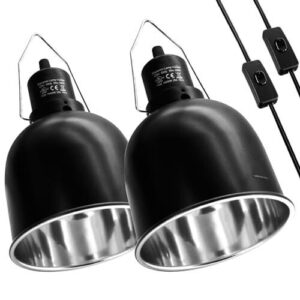
The MECESOR set delivers independent switches for each socket, letting you run UVB and ceramic heat emitters on separate schedules. Its dimmable aluminum housing with 1 mm lamp walls reflects heat efficiently, while ventilation holes prevent overheating.
Standard 60-watt bulbs generate basking temperatures around 120–140°F at six to twelve inches, and ceramic heat emitters hold steady infrared warmth with minimal fluctuation. The E26 base accepts halogen, UVA, and UVB bulbs up to 160 watts.
Integrated reflectors boost lamp efficiency by 10–25 percent, lowering power draw without sacrificing thermal outputs.
| Best For | Reptile keepers who need flexible control over separate heating and lighting schedules in glass terrariums. |
|---|---|
| Maximum Wattage | 160W |
| Material | Aluminum |
| Weight | Not specified |
| Color | Not specified |
| Switch Type | Separate switches |
| Heat Dissipation | Multiple ventilation holes |
| Additional Features |
|
- Independent switches let you run heat and UVB on different timers without extra hardware
- Aluminum reflector boosts efficiency by 10–25%, cutting power costs while maintaining basking temps
- E26 base accepts multiple bulb types up to 160 watts—halogen, ceramic, UVA, and UVB
- No built-in thermostat means you’ll need a separate controller for precise temperature management
- 160-watt ceiling limits options for larger enclosures or high-heat species
- Not rated as waterproof, so moisture from misters or high-humidity setups could be a concern
4. Reptile Deep Dome Heat Lamp Fixture
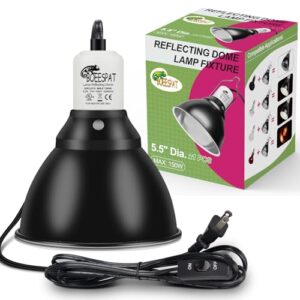
Deep dome fixtures concentrate radiant heat into a tight basking zone, reducing lateral light spill by over 30 percent compared to shallow clamps. The 5.5-inch aluminum dome accommodates E26 bulbs up to 150 watts and delivers surface temperatures of 32–40°C at 20–30 cm.
Ceramic sockets withstand continuous use above 200°C, while top ventilation holes prevent overheating. Parabolic reflector designs boost visible and infrared output, sharpening temperature gradients essential for thermoregulation.
Independent switches and strain-relief grommets add control and durability for long-term reptile care.
| Best For | Reptile owners who need a reliable, high-output heat source that delivers focused basking temperatures and supports bulbs up to 150 watts for small to medium terrestrial species. |
|---|---|
| Maximum Wattage | 150W |
| Material | Aluminum alloy |
| Weight | 11.7 ounces |
| Color | White |
| Switch Type | Independent switch |
| Heat Dissipation | Top ventilation holes |
| Additional Features |
|
- Deep parabolic reflector concentrates heat into a defined basking zone, reducing wasted light by over 30% and creating sharp temperature gradients that help reptiles regulate their body temperature naturally.
- Ceramic socket handles continuous operation above 200°C without cracking or deforming, making it safe for 24-hour use with high-wattage heat bulbs and ceramic emitters.
- Built-in switch and 67-inch cord with strain relief offer convenient on/off control and reduce the risk of electrical shorts in humid terrarium environments.
- Multiple users report loose or faulty on/off switches that fail within months, requiring bulb removal or outlet control as a workaround.
- Quality control issues are common—some units arrive dented, non-functional, or with inconsistent wattage ratings listed in product specs versus packaging.
- Durability concerns over long-term use, with reports of socket failures and fixture malfunctions that may require replacement sooner than the typical 3–5 year lifespan.
5. Reptile Uvb Light Fixture Kit
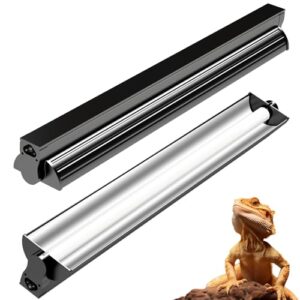
T5 HO kits pair electronic ballasts with 10% UVB bulbs to deliver 2,000–5,000 μW/cm² of UVB radiation at the basking site, supporting vitamin D3 synthesis and calcium absorption.
The 12-inch aluminum fixture weighs 9.6 ounces and houses a replaceable UVB 10.0 lamp that maintains output for six to twelve months. Minimal heat emission and a built-in reflective layer optimize UVB output without overheating.
You’ll install this reptile lighting solution above mesh screens at 10–30 cm to match species-specific exposure guidelines and protect your animal’s health.
| Best For | Reptile owners who need a compact, low-heat UVB solution for desert species like bearded dragons or other animals requiring 10% UVB output in smaller enclosures. |
|---|---|
| Maximum Wattage | 8W |
| Material | Aluminum |
| Weight | 9.6 ounces |
| Color | Not specified |
| Switch Type | Not specified |
| Heat Dissipation | Minimal heat emission |
| Additional Features |
|
- Delivers 10% UVB and 30% UVA with an alloy reflector that maximizes output for vitamin D3 synthesis and calcium absorption
- Replaceable bulb design saves money over time, and the electronic ballast maintains consistent performance for 6–12 months per bulb
- Minimal heat emission prevents overheating while still providing adequate UVB coverage for 12-inch setups
- Multiple user reports of receiving broken or defective units on arrival
- 12-inch fixture may not provide sufficient coverage for larger or multi-animal enclosures
- Requires careful distance monitoring (10–30 cm) and regular bulb replacement to avoid underexposure or metabolic bone disease
6. Dual Reptile Heat Lamp Fixture
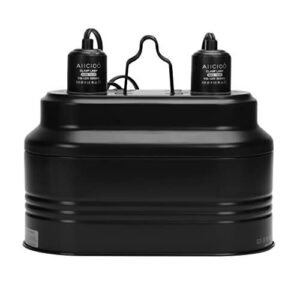
The Aiicioo dual reptile heat lamp fixture accommodates up to 160 watts across two independently switched bulbs, letting you control basking zones and UVB lighting for reptiles separately. Metal construction with top ventilation dissipates heat safely, though some users report overheating issues with sustained high-wattage use.
You’ll mount it 15–30 cm above your basking area to create temperature gradients of 8–12°C—essential for reptile thermoregulation.
Always pair heat lamps with a separate thermostat to maintain basking temperatures within 29–34°C and guarantee fixture durability while protecting your animal from burns.
| Best For | Reptile owners who need flexible dual-zone temperature control and want to run separate UVB and heat bulbs in a single fixture above small to mid-sized terrariums. |
|---|---|
| Maximum Wattage | 160W |
| Material | Metal |
| Weight | 1.96 pounds |
| Color | Black |
| Switch Type | Two ON/OFF switches |
| Heat Dissipation | Top ventilation holes |
| Additional Features |
|
- Individual switches let you control each 80W bulb independently, so you can adjust basking heat and UVB lighting separately throughout the day.
- Top ventilation holes and metal construction help dissipate heat safely when you stay within the 160W total limit and mount it properly.
- Hanging hook design makes installation straightforward, and the compact 11.42 × 6.1 × 5.79-inch size fits most standard enclosures without taking up extra space.
- Some users report overheating, melting, or early bulb burnout when running high-wattage bulbs continuously without a separate thermostat.
- Cords are shorter than many owners prefer, which can limit placement options depending on your enclosure setup.
- Lightweight metal construction can dent or warp easily if mishandled, and the fixture may not hold up as well as heavier-duty alternatives over time.
7. Reptile Clamp Lamp Fixture
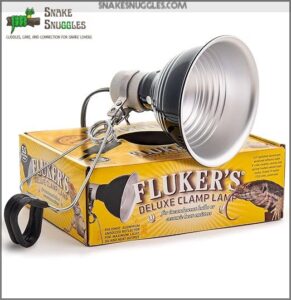
Clamp lamp fixtures are a cornerstone of reptile lighting solutions, giving you flexible heat distribution and secure mounting. The Fluker’s model uses heavy gauge aluminum for durability and a ceramic socket for lamp safety. Its clamp design fits most terrarium edges, so you can set up basking strategies for reptiles of many sizes.
Use UVB lighting for reptiles or heat lamps to match your species’ needs. For reptile care and maintenance, check fixture materials and always monitor temperature to prevent overheating.
| Best For | Reptile owners who need a flexible, budget-friendly clamp light that securely attaches to standard terrariums and works with various bulb types for basking and heating. |
|---|---|
| Maximum Wattage | 75W |
| Material | Aluminum and plastic |
| Weight | 1 pound |
| Color | Not specified |
| Switch Type | On/off switch |
| Heat Dissipation | Not specified |
| Additional Features |
|
- Heavy-duty aluminum construction with a ceramic socket handles up to 75 watts and works with incandescent bulbs, ceramic heat emitters, and compact fluorescents
- Safety clamp provides secure attachment to most terrarium edges, and the on/off switch makes daily lighting control convenient
- Affordable price point with UL/CUL safety approval gives you reliable performance without breaking the bank
- Can get very hot with high-wattage bulbs, so you need to be careful about placement and monitor temperatures closely
- Not ideal for deep or large terrariums since the 5.5-inch dome may not provide adequate heat coverage for bigger setups
- Some users report bulb blowouts or product defects, so quality control may be inconsistent across units
8. Reptile Aluminum Heat Lamp Fixture
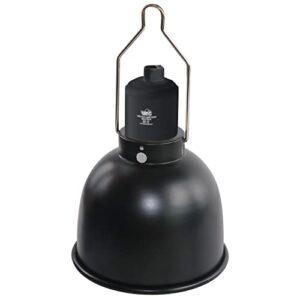
Aluminum fixtures offer enhanced thermal efficiency compared to steel housings, transferring heat 15–25% more effectively to your basking zones. These heat sources for reptiles support lamp safety with radiating vents that stabilize surface temperatures between 60–90°C.
You can use them with basking lamps or ceramic heat emitters rated up to 150 W, depending on your enclosure size. Aluminum’s corrosion resistance improves fixture durability in humid environments.
For reptile health, position the fixture 10–20 cm above the basking surface to create proper heat distribution and prevent overheating in your reptile lighting solutions.
| Best For | Reptile keepers who need reliable heat and UVB delivery in humid enclosures and want better thermal efficiency than standard steel fixtures. |
|---|---|
| Maximum Wattage | 150W per lamp |
| Material | Aluminum |
| Weight | 2.27 pounds |
| Color | Black |
| Switch Type | Separate switches |
| Heat Dissipation | Radiating holes |
| Additional Features |
|
- Aluminum construction transfers heat 15–25% more effectively than steel, creating more efficient basking zones while staying cooler to the touch
- Compatible with multiple bulb types up to 150W including UVB tubes, basking lamps, and ceramic heat emitters for flexible lighting setups
- Built-in ventilation holes and corrosion-resistant material handle humid reptile environments better than basic fixtures
- Customer reports mention units failing after a few months, with some experiencing sparking incidents that raise fire safety concerns
- Doesn’t include a bulb despite the price point, so you’ll need to budget separately for UVB tubes that require replacement every 6–12 months
- Screw quality issues reported by multiple users suggest inconsistent manufacturing standards across batches
9. Reptile Heat Lamp Fixture Thermostat
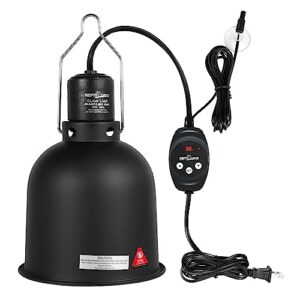
Ever wondered how you can master temperature control in your reptile habitat? A heat lamp fixture thermostat is your best tool. It keeps basking zones steady, reducing hot spots and cold drafts by up to 5°C.
Thermostat calibration ensures accuracy, while safety features like automatic shutoff guard against overheating. Use ceramic heat emitters or heat mats for stable heat distribution.
These systems boost energy efficiency and extend bulb life. For reptiles needing strict thermoregulation techniques, precise control means healthier, more active animals.
| Best For | Reptile owners who need reliable temperature control to maintain consistent basking zones and prevent dangerous temperature swings in their terrariums. |
|---|---|
| Maximum Wattage | 100W |
| Material | Aluminum alloy |
| Weight | 13.6 ounces |
| Color | Not specified |
| Switch Type | On/off switch |
| Heat Dissipation | Radiating holes |
| Additional Features |
|
- Reduces temperature fluctuations by 3.5–5°C and keeps basking zones within ±2°C of your target, which means healthier reptiles and fewer stress-related issues.
- Cuts down overheating incidents by 40–60% with automatic shutoff protection, plus it extends your bulb life by 10–30% through smarter on/off cycling.
- Works with day/night programming to support natural circadian rhythms, and can lower your annual electricity costs by 15–25%.
- Some users report the temperature control isn’t always consistent, and there are concerns about durability with units not lasting as long as expected.
- No built-in on/off switch means you have to unplug it or use a separate timer, which is less convenient for daily use.
- Mixed feedback on the dimming feature and heat output, plus some users mention the light blinks constantly, which can be annoying.
Essential Lighting Types for Reptile Habitats
Your reptile’s health depends on three main lighting types working together. Each type fulfills a specific biological function that you can’t skip or substitute.
Let’s break down what UVB, heat, and UVA lighting actually do for your animal.
UVB Lighting for Vitamin D3 Synthesis
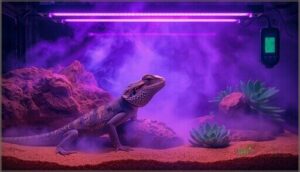
Your reptile’s body can’t produce vitamin D3 without proper UVB lighting—it’s that simple. UVB spectrum wavelengths around 290–315 nm trigger cutaneous synthesis, supporting calcium metabolism and preventing metabolic bone disease.
Proper UVB lighting at 290–315 nm is essential because your reptile cannot produce vitamin D3 or absorb calcium without it
You’ll need 5–12% UVB output at basking sites for most tropical species, with desert dwellers requiring higher intensities. Replace bulbs every 6–12 months, as UVB dosage drops by 20–40% over time, compromising reptile health.
Understanding the importance of research networks is essential for developing effective lighting solutions.
Heat Lamps for Thermoregulation
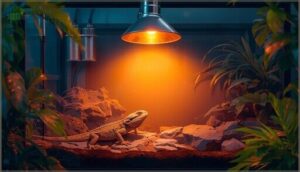
Your reptile can’t regulate body temperature without proper heat lamps—thermoregulation depends on external warmth. Heat mats and ceramic heat emitters offer consistent thermal efficiency, while incandescent bulbs create focused basking behaviors in your reptile enclosure design.
- 60–250 watts suits most small to medium enclosures for ideal heat distribution
- 30–40°C basking zones with 22–28°C ambient areas support natural thermoregulation
- Aluminum reflectors boost lamp safety and efficiency by 40%
- Replace bulbs every 6–12 months to maintain consistent thermal output
UVA Lighting and Behavioral Health
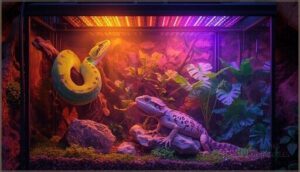
Beyond heat, UVA light (315–400 nm) shapes your reptile’s behavior—calm exploration, natural foraging, and proper circadian rhythms depend on it. Pair UVA with UVB in a 1:1 to 1:3 ratio for spectral balance that mimics sunlight. Dimmable fixtures with gradual dawn transitions improve reptile welfare and reduce stress behaviors. Understanding the main topic areas is essential for creating a suitable environment for your reptiles.
| UVA Effects | Behavioral Enrichment | Lighting Design |
|---|---|---|
| Visual signaling for mating | Higher basking duration | Gradient exposure zones |
| Circadian rhythm alignment | Active movement increase | 30–40 cm fixture distance |
| Reduced stress indicators | Perch hopping frequency | Dimmable timer controls |
| Foraging behavior support | Territory display activity | UV-transmitting panels |
| Exploration enhancement | Dawn/dusk activity peaks | Regular spectral checks |
Key Lighting Parameters for Reptile Health
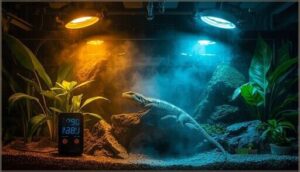
Getting the lighting right isn’t just about picking a bulb. You need to dial in specific parameters like UVB strength, temperature zones, and light cycles to keep your reptile healthy.
Here’s what matters most when you set up your enclosure.
UVB Intensity and Exposure Guidelines
Your reptile needs specific UVB radiation levels to produce vitamin D3 effectively. Aim for 2.0–5.0 watts per square meter at the basking spot for most species.
Provide 10–12 hours of UVB lighting daily. Position your fixtures 15–30 cm from the substrate to maintain proper intensity.
Remember that UVB exposure above safe limits can damage skin and eyes, so measure carefully.
Temperature Gradients and Basking Zones
Heat sources create temperature gradients that let your reptile choose its comfort level. Position heat lamps 10–15 cm above the basking spot to fine-tune heat transfer and prevent overheating.
Your basking zone should reach 32–45°C depending on species, while cooler areas remain 5–8°C lower. This gradient design aids natural thermoregulation and improves feeding response by roughly 18%.
Use thermometers at multiple heights for accurate thermal mapping.
Photoperiod Control for Circadian Rhythms
Consistent light cycles anchor circadian entrainment and regulate biological rhythms in captive reptiles. Set photoperiod management at 12:12 to 14:10 light:dark for most tropical and desert species, ensuring photoreceptors receive reliable cues.
Gradual 6–10 minute dawn transitions reduce stress and stabilize reptile behavior. Programmable timers paired with UVB lighting options maintain daily consistency, which boosts feeding routines and fosters healthy circadian rhythms.
Safety Considerations and Overexposure Risks
You must protect your reptile from UVB safety and heat risks that come with improper lighting solutions. Keep UVB lighting options at least 12–18 inches from basking zones to prevent reptile burns and avoid overexposure prevention failures.
Basking surfaces above 42°C trigger skin damage fast. UV radiation above 10,000 μW/cm² increases lighting hazards like cataracts and necrosis. Monitor output regularly to prevent reptile health issues.
Choosing The Right Lighting System
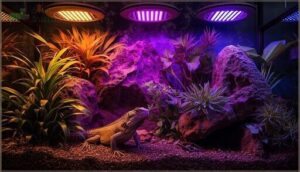
Picking the right lighting system starts with understanding your animal’s needs and your enclosure’s layout. You need to match fixture types and wattage to your species while keeping energy costs and safety in mind.
The following sections break down what to look for so you can set up a system that works.
Compatibility With Enclosure Size and Species
Your reptile’s lighting setup depends directly on enclosure sizing and species lighting needs. Small terrestrial habitats under 20 gallons need compact fixtures to avoid crowding, while larger setups allow flexible UVB dosage strategies. Thermal gradients shift with habitat design—tall terrariums spread heat differently than wide ones.
- Bearded dragons demand 6–8% UVB exposure in 40–55 gallon reptile habitats for proper vitamin D3 synthesis.
- Leopard geckos thrive on minimal UVB in 20–29 gallon animal enclosures to prevent eye irritation.
- Glass terrariums reduce UVB by 15%, requiring closer basking zones or higher wattage.
- Rack systems with clamp lamps cover 2–3 heating zones in reptile care setups 72% of the time.
Match terrarium lighting to your animal’s biology for peak reptile habitat performance.
Fixture Types and Bulb Wattage Selection
Choosing the right terrarium lighting starts with fixture type and wattage control. Mercury vapor bulbs deliver UVB and heat together in 125–275 W options, but ceramic heat emitters provide stable heat management without light. Compact fluorescent bulbs work for smaller setups, while LED light and halogen floods support reptile lighting design with limited UVB.
Match bulb selection to your species and always verify fixture safety before installation.
Energy Efficiency and Longevity
Your lighting choices shape both your utility bills and equipment lifespan. LED lighting for aquariums and terrariums cuts energy consumption by 50–70% compared to older fluorescent setups, while ceramic heat emitters maintain rated outputs within 5% after 10,000 hours of heat management—proving their durability.
Here’s what power optimization delivers:
- Energy efficient lighting reduces replacement frequency by 40–60% with LED UVB sources exceeding 25,000 hours.
- Energy savings reach 20–40% when switching from incandescent to ceramic or LED heat solutions.
- Longevity tests confirm ceramic heat emitters provide stable performance for years.
Safety Features and Installation Tips
UL-listed heat lamps with wire guards cut direct contact risk by 92%, making fire prevention essential when you install reptile lighting systems. Overheat protection drops burn incidents by 58%, while automatic shutoff thermostats hold basking zones within +/- 5°C.
Secure LED light and UVB fixtures 12–20 cm above basking sites, check wire management regularly, and use thermal monitoring for safe heat control.
Wholesale Opportunities for Reptile Lighting

If you run a pet shop or sell reptile supplies online, you can access wholesale pricing on quality lighting products. A wholesale account gives you better margins and helps you stock the right gear for your customers.
Here’s how to get started and what kind of support you’ll receive along the way.
Eligibility for Pet Shops and Online Retailers
You’ll need a business license and tax ID to qualify for wholesale accounts at most reptile lighting suppliers. About 82% of retailers require these documents.
Pet shops, online reptile websites, and active reptile stores are eligible for wholesale pricing. Many programs ask for proof of your storefront or e-commerce presence before account approval. Some require minimum purchase volumes or geographic verification.
Benefits of Wholesale Accounts
Once approved, you’ll access bulk discounts that drop unit costs by 20–40%. Wholesale pricing gives you access to net-30 or net-60 payment terms, which helps manage cash flow.
You’ll also get a dedicated account manager for technical support and product compatibility questions.
Many wholesale accounts include priority restock during peak season and exclusive promotional bundles that boost your retail partnerships and margins.
Application Process and Required Information
To apply, you’ll need to submit your business license and resale certificate or tax ID. About 57% of reptile lighting solutions wholesalers require these documents upfront. Most suppliers—68% on average—verify tax requirements before account approval, which usually takes 5–7 business days. You’ll also review contract terms covering minimum advertised price, return policies, and any annual purchase thresholds.
Here’s what to prepare:
- Valid business license or DBA registration
- Resale certificate or tax identification number
- Business contact and banking information
- Product categories you’ll carry (UVB, LED light, terrarium and vivarium lighting)
- Estimated annual order volume
Support and Partnerships for Resellers
Once approved, you gain access to reseller networks and wholesale pricing designed for pet industry partnerships. LYR Inc. offers account management and sales support to help reptile breeders and vendors succeed.
You’ll connect with wholesale distribution channels and tap into wholesale business opportunities across the pet industry. Partner benefits include promotional materials and direct technical assistance for your customers.
Frequently Asked Questions (FAQs)
How often should UVB bulbs be replaced?
Replace your UVB bulbs every 6 to 12 months. Even if they still look bright, UVB output drops over time.
This decline impacts vitamin D3 synthesis and overall reptile health, so stick to manufacturer guidelines.
Can I use household LED bulbs for reptiles?
Household LED bulbs lack the UVB spectrum reptiles need for vitamin D3 synthesis.
You must pair them with dedicated UVB lamps and heat sources to prevent metabolic bone disease and maintain proper thermoregulation.
Whats the difference between UVB and UVA?
Ever wonder why your reptile needs two types of UV? UVB (280–315 nm) drives vitamin D3 synthesis for calcium metabolism, while UVA (315–400 nm) influences behavior, feeding, and natural activity patterns.
Do nocturnal reptiles need daytime lighting?
Yes, nocturnal reptiles need daytime lighting to maintain their circadian rhythm and support calcium metabolism.
A 12-hour photoperiod with UVB promotes behavioral enrichment and improves overall reptile care and health outcomes.
How do I measure UVB output accurately?
Like reading a thermometer for fever, you need a calibrated UVB meter to test accurate UVB readings.
Position the sensor at your reptile’s basking zone to measure UV radiation levels directly.
Conclusion
Don’t leave your reptile in the dark. The right reptile lighting solutions transform your enclosure from a survival box into a thriving habitat.
Your bearded dragon’s bones grow stronger. Your chameleon’s colors brighten. Your gecko digests food properly. Each bulb you install powers biological functions that artificial light alone can’t replicate.
Choose fixtures that match your species’ needs. Set up heat gradients correctly. Your reptile depends on you to recreate what nature provides automatically.