This site is supported by our readers. We may earn a commission, at no cost to you, if you purchase through links.
Your burrowing snake just disappeared into its enclosure again, but this time something’s wrong. The substrate’s compacting into concrete-like clumps, or worse, it’s so dusty your snake’s developing respiratory issues.
Choosing reptile substrates for burrowing snakes isn’t just about giving them something to dig through—it’s about replicating the structural integrity and moisture balance of their natural tunneling environments. A hognose needs different particle density than a sand boa, and what works for a Kenyan sand boa will suffocate a rosy boa.
The wrong substrate creates collapsed tunnels, bacterial blooms, and stressed snakes that stop eating. Six substrate options consistently outperform the rest for species-specific burrowing needs, each with distinct advantages for moisture retention, tunnel stability, and long-term health.
Table Of Contents
- Key Takeaways
- Essential Features of Substrates for Burrowing Snakes
- Best Substrate Materials for Burrowing Snakes
- Matching Substrates to Snake Species and Habitats
- Maintenance and Hygiene of Burrowing Snake Substrates
- Top 6 Substrates for Burrowing Snakes (Product Reviews)
- Frequently Asked Questions (FAQs)
- Conclusion
Key Takeaways
- Match substrate particle density (0.1–0.3 g/cm³) and moisture retention to your snake’s native habitat—desert species need aspen or sand-soil blends below 40% humidity, while tropical burrowers thrive in coconut fiber or cypress mulch at 60–80% humidity.
- Provide 3–6 inches of substrate depth for most burrowing snakes and 6–12 inches for larger species, ensuring tunnels stay stable without collapsing during natural digging behavior.
- Avoid cedar, pine, and dusty substrates that release respiratory irritants, and choose digestible, non-toxic options like coconut fiber or aspen shavings to prevent impaction if accidentally ingested during feeding.
- Spot-clean waste daily and replace substrate every 6–12 weeks depending on species humidity needs, using digital hygrometers to monitor moisture levels and prevent mold growth or respiratory infections.
Essential Features of Substrates for Burrowing Snakes
Your burrowing snake needs a substrate that does more than just line the tank—it has to support natural behaviors while keeping your pet healthy. The right material balances moisture control, cleanliness, and tunneling capability without introducing hidden risks.
Let’s look at the four essential features that separate good substrates from poor ones.
Moisture Retention and Humidity Control
For burrowing snakes, moisture retention isn’t just about keeping things damp—it’s about maintaining stable humidity levels between 40–80% depending on species. Substrates like coconut fiber and cypress mulch excel at capillary action, holding water activity steady for 24–72 hours after misting.
Substrate density affects moisture balance directly: looser beds promote airflow while fiber-rich options stabilize humidity control without oversaturation. The importance of maintaining precise environmental conditions is akin to ensuring methodological rigor in scientific studies.
Odor Management and Cleanliness
Odor Control starts with your substrate’s absorbent capacity—coconut fiber and cypress mulch bind ammonia better than paper products. Spot-clean feces daily to minimize bacterial buildup, and run full substrate changes every 8 weeks.
For deeper guidance on pairing substrate types with your boa’s humidity needs, see our complete substrate comparison for boa constrictors.
Adequate ventilation prevents humidity spikes that intensify smells. Use ammonia test strips monthly to track air quality objectively, ensuring your cleaning schedule matches your snake’s actual waste production.
Regular dictionary searches can help you find terms related to reptile care and maintenance.
Substrate Density and Burrowing Ease
Once your substrate drains well and stays fresh, check its compaction—snakes tunnel fastest in media with bulk density around 0.1–0.3 g/cm³. That sweet spot lets burrows hold their shape without collapsing mid-dig.
- Coconut fiber offers ideal burrowability when lightly moistened
- Moderate compaction ensures tunnel geometry stays stable over weeks
- Uniform density prevents collapse zones during burrowing mechanics
- Moisture + density together control burrow stability for burrowing snakes
Safety Considerations and Health Risks
Beyond structure, your substrate must pass a safety screen—even natural materials pose hazards. Cedar and pine release aromatic phenols that trigger respiratory irritation in burrowing snakes, while dusty media send inhalable particles into delicate airways. Check labels for toxicity testing and avoid anything with pesticide residue. Choose nontoxic, digestible options that won’t cause impaction if swallowed.
A well-chosen base layer works hand-in-hand with proper terrarium size and ventilation to create a healthy environment your snake can thrive in.
Even natural substrates pose risks—cedar and pine oils irritate airways, while dusty materials harm respiratory health, so always choose nontoxic, digestible options
| Hazard Category | Risk Factor | Prevention Strategy |
|---|---|---|
| Respiratory Risks | Fine dust, aromatic oils | Select low-dust, nontoxic reptile substrate |
| Chemical Hazards | Pesticides, fertilizers | Source certified, pre-washed media |
| Bacterial Contamination | Damp organic matter | Maintain humidity control; spot-clean daily |
| Substrate Allergens | Mold spores, mycotoxins | Replace every 8 weeks; monitor moisture |
Best Substrate Materials for Burrowing Snakes
Now that you understand what makes a good burrowing substrate, let’s look at the specific materials that work best.
Options like coconut fiber and cypress mulch are popular choices that meet these needs, and you can explore substrate types and their impact on snake health to find what works best for your setup.
Each option offers different benefits for moisture retention, tunneling stability, and ease of maintenance. You’ll find the right match by considering your snake’s natural habitat and humidity requirements.
Start with beginner-friendly substrate options if you’re new to snake care, since they simplify cleaning routines while still supporting healthy humidity levels.
Cypress Mulch and Coconut Fiber
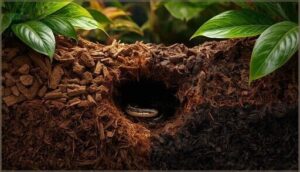
Two popular reptile substrate choices stand out for their natural qualities. Cypress mulch holds moisture without turning soggy, making humidity control manageable at 50–70%. Coconut fiber absorbs even more water and keeps burrow stability high because it doesn’t compact.
You can blend both for moisture management that suits tropical burrowing snakes. Choose untreated, pesticide-free products to protect your snake’s health.
Aspen Shavings for Dry Environments
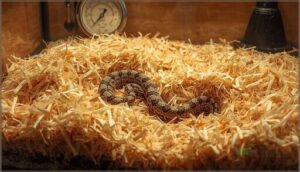
Lightweight aspen shavings work perfectly when you’re housing dry-environment burrowers like hognose snakes. This reptile substrate absorbs surface moisture while staying loose enough for natural burrowing behavior. You’ll maintain humidity control below 40% without risking respiratory issues.
- Choose kiln-dried, dust-free aspen shavings to protect snake health and minimize airborne irritants
- Layer substrate depth at 2–3 inches so your snake can dig comfortable tunnels
- Spot-clean daily and replace sections monthly to prevent odor buildup in snake tank substrates
- Monitor for mold in corners where ventilation drops—dry environments still need airflow
Bioactive Substrates With Topsoil and Coconut Coir
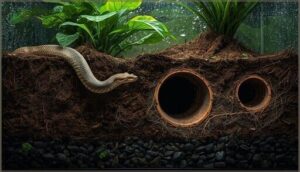
Building a living ecosystem starts with combining pesticide-free topsoil and coconut coir for your burrowing snakes. This bioactive substrate blend delivers excellent moisture retention while supporting a natural microbial balance in the enclosure.
Regular upkeep ensures your snake thrives—learn how to make your snake comfortable with consistent cleaning routines and proper habitat maintenance.
Topsoil quality matters—choose organic material free from fertilizers. Mix three parts topsoil with one part coconut coir, then add a drainage layer underneath.
You’ll create ideal burrowing dynamics that let your snake dig deep tunnels while beneficial bacteria handle waste naturally.
Sphagnum Moss and Its Applications
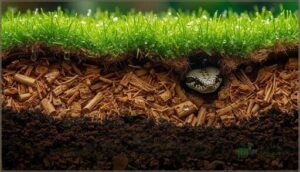
Sphagnum moss holds up to 18 times its weight in water, making it a powerful humidity control tool for burrowing snakes.
Layer 2–3 cm on top of cypress mulch or coconut fiber to slow evaporation and create stable moisture zones. This substrate mixing approach enhances burrow stability while its antimicrobial properties reduce odor.
Replace the moss layer every few months for proper moss maintenance.
Matching Substrates to Snake Species and Habitats
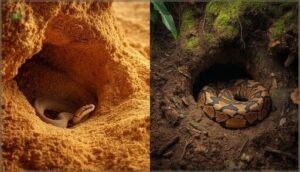
Your snake’s natural habitat should guide your substrate choice. Desert species need different materials than tropical burrowers, and using the wrong substrate can lead to health problems.
Let’s match common burrowing snakes with their ideal substrates based on humidity requirements and natural behaviors.
Desert-Dwelling Burrowers
Desert-dwelling burrowing snakes require substrates that support tunnel construction without collapsing, while also maintaining low humidity levels. A proven sand-soil blend consists of 30 percent play sand and 70 percent topsoil, effectively mimicking natural semi-arid habitats and facilitating stable burrow construction.
Key setup requirements for desert terrariums:
- Provide 12–18 inches of substrate depth for confident digging
- Maintain ambient humidity between 20–35 percent to prevent blister disease
- Use screen lids or vented enclosures to optimize airflow over substrates
- Create thermal gradients with basking zones over drier substrate areas
- Avoid calcium sand due to impaction risk; choose play sand instead
Tropical Burrowing Species
Tropical burrowing snakes thrive when you replicate humid forest conditions with moisture-retentive substrates. Coconut fiber and cypress mulch excel at maintaining 60–80 percent humidity levels while supporting stable burrow design. Your substrate depth should reach 8–14 inches to accommodate natural snake behavior.
| Substrate Component | Primary Function |
|---|---|
| Coconut Fiber | Moisture retention and tunneling structure |
| Cypress Mulch | Humidity control and odor management |
| Sphagnum Moss | Surface moisture zones for shedding |
| Bioactive Substrate | Waste breakdown and tropical plants support |
| Leaf Litter | Natural cover and foraging enrichment |
Monitor humidity daily using digital hygrometers—respiratory infections develop quickly in improper conditions.
Species With Moderate Humidity Needs
Many burrowing snakes need 40–60 percent humidity—that sweet spot between desert and rainforest conditions. You’ll achieve moisture balance by mixing coconut fiber with cypress mulch at a 2:1 ratio.
Substrate texture matters for burrow depth: medium-grain materials support tunnel stability without collapsing.
Monitor your snake’s shedding quality and activity patterns to confirm proper humidity control in their microhabitat.
Identifying Inappropriate Substrates for Burrowing Snakes
Getting substrate selection right starts with knowing what not to use. Avoid excessively dusty materials—they irritate airways and trigger mucus buildup in burrowing snakes. Skip fine, abrasive sands that damage snouts and eyes during digging.
Watch for substrate toxins in wood products releasing volatile compounds. Non-absorbent options create humidity extremes, while mite-prone materials harbor pathogens.
Your snake’s burrowing behavior reveals substrate hazards quickly.
Maintenance and Hygiene of Burrowing Snake Substrates
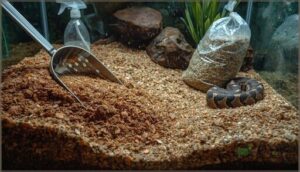
Keeping your substrate clean isn’t just about odor control—it’s about preventing respiratory infections, mites, and bacterial growth that can seriously harm your snake. Daily spot cleaning combined with regular full replacements creates a healthy environment where your burrowing snake can thrive.
Let’s break down the essential maintenance tasks that’ll keep your enclosure safe and your snake healthy.
Spot Cleaning and Daily Care
Every morning, check your burrowing snakes’ enclosure for feces and urates—waste removal can’t wait. Bacterial growth accelerates fast in warm substrate. Scoop out droppings immediately, inspect humidity levels with your hygrometer, and remove any uneaten prey within 24 hours.
This daily monitoring protects your snake from respiratory issues and Salmonella risk. Spot-clean soiled areas with reptile-safe disinfectant, then wash your hands thoroughly for at least 20 seconds.
Full Substrate Replacement Schedules
Beyond spot cleaning, you’ll need complete substrate replacement every 8–12 weeks for most burrowing snakes. Tropical species with higher humidity requirements often need rotation every 6–8 weeks.
Track replacement intervals in a maintenance log, noting odor intensity and humidity monitoring readings. If you spot mold, compaction, or persistent smell before your scheduled change, replace the reptile substrate immediately—health benchmarks always override your calendar.
Mite and Salmonella Prevention
When mite control methods matter most, substrate sterilization through freezing or heat treatment kills eggs before introduction.
Regular Salmonella testing of your bioactive substrate ensures pathogen reduction, especially for burrowing snakes in tropical setups.
Implement biosecurity measures like washing hands before enclosure access and quarantining new reptile substrate for 72 hours. These steps protect your reptile care and maintenance routine while supporting effective humidity control and management.
Managing Humidity to Prevent Respiratory Issues
Maintain relative humidity between 40% and 60% to prevent respiratory irritation in burrowing snakes. Use a digital hygrometer to track substrate moisture daily—your reptile substrate should clump lightly but crumble under pressure.
Excess humidity control failures promote mold growth that compromises air quality management and breathing.
Combine proper moisture retention with regular ventilation to support healthy burrowing behavior and respiratory health in your snake’s digestible natural environment.
Top 6 Substrates for Burrowing Snakes (Product Reviews)
You’ve covered the essentials of substrate maintenance, so now it’s time to look at specific products that work well for burrowing snakes.
Each substrate below offers different benefits depending on your snake’s species and humidity requirements.
Let’s go through six reliable options that make setting up a functional enclosure straightforward.
1. Bioactive Reptile Terrarium Soil Mix
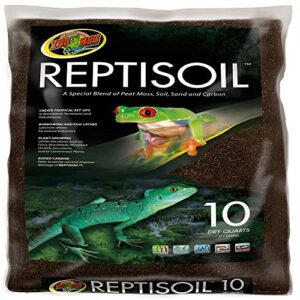
Bioactive soil mixes transform your terrarium into a living ecosystem where microfauna balance waste breakdown naturally. You’ll find coconut coir and topsoil blended with live isopods and springtails to maintain substrate health.
Proper burrowing depth runs 3 to 6 inches, letting your snake dig while supporting humidity levels around 60–70%. The substrate layering approach creates moisture gradients essential for tropical burrowing snakes.
Choose commercial bioactive substrates free of pesticides—they’re safer than DIY blends and support terrarium design that mimics natural habitats. Let’s go!
| Best For | Reptile keepers who want a low-maintenance, self-sustaining terrarium setup for tropical burrowing species like snakes, lizards, and amphibians. |
|---|---|
| Primary Material | Coconut fiber |
| Odor Control | Yes |
| Moisture Retention | High |
| Ease of Cleaning | Moderate |
| Natural Material | Yes |
| Burrowing Suitable | Yes |
| Additional Features |
|
- Creates a living ecosystem with beneficial bacteria that breaks down waste and reduces odors naturally
- Allows proper burrowing depth (3-6 inches) and maintains ideal humidity levels for tropical species
- Supports long-term plant growth and natural behaviors like digging and egg laying
- Can be dusty and may require rinsing hands after handling to avoid residue
- More expensive than basic substrate options available elsewhere
- May contain large wood chips or debris that need removal before use with smaller animals
2. Reptile Terrarium Liner Carpet
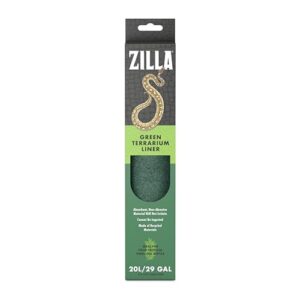
Reptile carpet offers a clean, low-maintenance alternative when you prioritize easy hygiene over deep burrowing behavior. This terrarium liner measures 2.6 x 13.3 x 2.5 inches, featuring enzyme-treated polyethylene that reduces odors while remaining non-abrasive.
You’ll notice limited humidity control compared to loose substrates, so pair it with moist hides for species needing moisture gradients. The material minimizes respiratory irritants through a dust-free terrarium design.
Substrate safety stays high—it’s non-ingestible and simple to spot-clean. Consider this bioactive substrate alternative for temporary setups or snakes with minimal burrowing instincts.
| Best For | Keepers who want a clean, no-fuss setup for snakes or lizards that don’t burrow much and need quick daily maintenance. |
|---|---|
| Primary Material | Polyethylene/Polypropylene |
| Odor Control | Yes |
| Moisture Retention | Low |
| Ease of Cleaning | Easy |
| Natural Material | No |
| Burrowing Suitable | No |
| Additional Features |
|
- Enzyme treatment cuts down on smell and keeps the terrarium fresher between cleanings
- Non-abrasive surface won’t irritate soft bellies, and it’s safe if your reptile tries to nibble it
- Dust-free design means fewer respiratory problems compared to loose substrates
- Doesn’t hold humidity well, so you’ll need to add moist hides for species that need it
- Reptiles can burrow underneath it if it’s not secured properly, creating messy gaps
- May shrink after washing and drying, which can mess up the fit in your tank
3. Natural Forest Floor Bedding Substrate
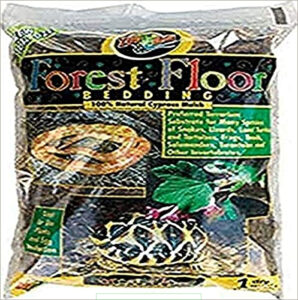
Zoo Med’s forest floor cypress mulch mimics natural habitats your burrowing snake would encounter in the wild. This substrate depth of roughly 3–4 inches encourages burrowing behavior while maintaining humidity levels through excellent moisture retention.
You’ll appreciate the natural enrichment it provides—your pet can tunnel and hide just like in leaf-covered woodlands. Combine cypress mulch with coconut fiber for ideal structure, or layer it over a bioactive substrate base.
Spot-clean waste easily, and replace the entire reptile substrate every 8–12 weeks to prevent mold.
| Best For | Snake owners seeking a natural substrate that supports burrowing behavior while maintaining consistent humidity levels in the enclosure. |
|---|---|
| Primary Material | Cypress mulch |
| Odor Control | Moderate |
| Moisture Retention | High |
| Ease of Cleaning | Easy |
| Natural Material | Yes |
| Burrowing Suitable | Yes |
| Additional Features |
|
- Retains moisture effectively to keep humidity stable without becoming waterlogged or developing mold
- Mimics natural forest floor conditions, encouraging instinctive digging and hiding behaviors
- Easy to spot-clean daily while maintaining the substrate structure between full replacements
- May contain large wood chunks that need removal before use to prevent injury or discomfort
- Dark color and texture make it harder to spot waste during daily cleaning checks
- Risk of pest contamination if not properly stored, with some reports of ant or bug infestations
4. Natural Reptile Bedding Alfalfa Meal
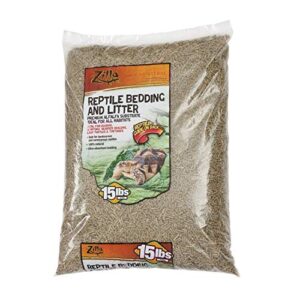
Zilla’s alfalfa meal bedding brings a different approach to snake tank substrates for burrowing species—it’s 100% digestible if accidentally ingested during feeding. This natural reptile bedding includes a bacteriostatic agent that keeps bacterial growth minimal while you provide burrowing snake care.
The pellet form offers decent humidity control for moderate-moisture environments, though burrowing performance suffers when wet. Mix it with cypress or coconut substrate rather than using it alone. Spot-clean daily and replace every 6–8 weeks to prevent the strong farm odor from building up.
| Best For | Snake keepers who want a digestible substrate option for burrowing species and don’t mind frequent maintenance to manage moisture and odor. |
|---|---|
| Primary Material | Alfalfa |
| Odor Control | Yes |
| Moisture Retention | Moderate |
| Ease of Cleaning | Easy |
| Natural Material | Yes |
| Burrowing Suitable | Yes |
| Additional Features |
|
- Safe if accidentally eaten during feeding thanks to 100% digestible alfalfa composition
- Bacteriostatic agent helps minimize harmful bacterial growth in the enclosure
- Works well as part of a mixed substrate setup when combined with cypress or coconut fiber
- Gets soggy and prone to mold when wet, requiring careful humidity management
- Strong farm smell can be unpleasant and builds up over time without regular cleaning
- Poor burrowing performance when used alone—needs to be mixed with other substrates
5. Natural Coconut Fiber Reptile Bedding
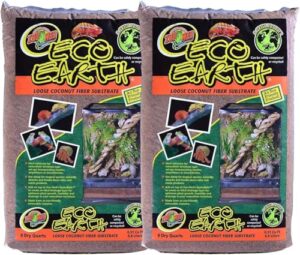
Zoo Med’s Eco Earth coconut fiber is one of my go-to reptile bedding options for tropical burrowing snake care. Its moisture retention properties support humidity control methods that help prevent dehydration. This natural reptile bedding holds tunnels well when dampened, creating a stable burrowing environment for your setup.
Mix it with topsoil for bioactive substrate benefits, or use it alone for simpler maintenance. Spot-clean waste daily and replace every 4–6 months.
The substrate maintenance tips here are straightforward: mist lightly to maintain a workable consistency, and ensure ventilation prevents mold growth in your enclosure.
| Best For | Keepers of tropical burrowing snakes and reptiles who need a natural substrate that maintains humidity while supporting stable tunnel formation. |
|---|---|
| Primary Material | Coconut fiber |
| Odor Control | Yes |
| Moisture Retention | High |
| Ease of Cleaning | Easy |
| Natural Material | Yes |
| Burrowing Suitable | Yes |
| Additional Features |
|
- Retains moisture well to help maintain humidity levels without becoming waterlogged or soggy
- Holds burrows effectively when dampened, giving burrowing species a stable digging environment
- Low dust content compared to wood-based options, which is better for respiratory health
- Requires regular misting and monitoring to maintain the right moisture level for your species
- Needs full replacement every 4–6 months and daily spot-cleaning to prevent odor buildup
- Some batches arrive too dry and need significant hydration before use
6. Natural Aspen Snake Bedding Supply
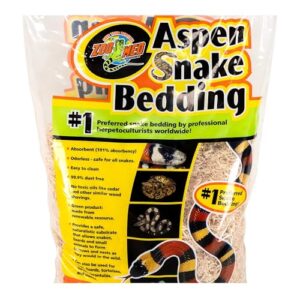
While coconut fiber suits tropical species, aspen shavings offer excellent benefits for snakes from arid climates. Zoo Med’s Aspen Snake Bedding Supply delivers 191% absorbency with zero toxic oils, making it ideal for burrowing snake care.
Your snake can tunnel freely through this dust-free reptile substrate without respiratory risks. Maintain substrate depth at 3–4 inches for best burrowing tips and humidity control.
Spot-clean waste daily to support snake hydration and prevent odor buildup. Replace every 3–6 months to keep your snake tank substrates fresh and healthy.
| Best For | Snake owners with burrowing species from arid climates who need a safe, absorbent substrate that supports natural digging behavior while keeping odors under control. |
|---|---|
| Primary Material | Aspen wood |
| Odor Control | Yes |
| Moisture Retention | Low |
| Ease of Cleaning | Easy |
| Natural Material | Yes |
| Burrowing Suitable | Yes |
| Additional Features |
|
- 191% absorbency rating keeps enclosures dry and manages moisture effectively for desert and semi-arid snake species
- Completely free of toxic oils like cedar, making it safe for snakes with no respiratory irritation from chemicals
- Lightweight and easy to spot-clean daily, with waste visible against the light-colored shavings for simple maintenance
- Mixed feedback on dust levels, with some users reporting it’s not completely dust-free despite the 99.9% claim
- Doesn’t handle moisture well after soaking, requiring careful humidity monitoring to prevent mold growth
- May need frequent full changes every 3–6 months depending on enclosure conditions, which can add up in cost over time
Frequently Asked Questions (FAQs)
Can I mix different substrates for my snake?
Measure twice, cut once: mixing substrates for snake tanks works if you match particle sizes and humidity needs. Layered bioactive substrate ratios support burrowing behavior while maintaining proper moisture control without compromising terrarium safety.
How deep should substrate be for burrowing snakes?
You’ll need at least 3–6 inches of substrate for most burrowing snakes. Larger species require 6–12 inches to support stable tunnel construction and promote natural snake behavior while ensuring burrow stability and tunnel safety throughout your enclosure design.
What substrates work best for hatchling burrowing snakes?
Hatchling burrowing snake care demands fine-textured substrates like coconut fiber or cypress mulch. These materials maintain humidity levels without waterlogging while supporting burrow stability.
Aspen shavings work well for dry-environment species, ensuring substrate safety and natural snake behavior.
Do burrowing snakes need substrate during winter brumation?
Yes, but choose carefully. During brumation, substrate maintains winter humidity and burrow stability for brumation safety.
Use moisture-retentive bioactive substrate or coconut coir to support snake hibernation without risking dehydration or respiratory issues.
How do I transition my snake to new substrate?
Your snake’s nose isn’t ready for an instant substrate flip—rushing it stresses their entire system.
Start substrate acclimation by layering 10–20% new material weekly over two weeks, allowing gradual olfactory adjustment while monitoring appetite and burrowing behavior closely.
Conclusion
The best substrate isn’t the one that looks most natural—it’s the one your snake actually uses. Proper substrate doesn’t just support burrowing—it unlocks natural behavior you’ve never seen before.
Your burrowing species will spend 80% of its life underground, making reptile substrates for burrowing snakes the single most critical investment in your setup. Match particle size to species requirements, monitor moisture levels weekly, and watch your snake transform from stressed surface-dweller to confident excavator.