This site is supported by our readers. We may earn a commission, at no cost to you, if you purchase through links.
Corn snakes are escape artists first and pets second. A loose corn snake doesn’t just disappear behind your couch—it squeezes into wall gaps, vents, and spaces you didn’t know existed.
The enclosure you choose determines whether your snake thrives or becomes a missing persons case. Beyond security, the right reptile terrarium for corn snakes controls heat gradients, humidity, and enrichment—everything that keeps a corn snake eating, shedding cleanly, and moving with purpose.
Get the setup right from the start, and daily care becomes straightforward.
Table Of Contents
- Key Takeaways
- Best Terrarium Types for Corn Snakes
- Choosing The Right Terrarium Size for Corn Snakes
- Essential Terrarium Features for Corn Snakes
- Top 6 Terrarium Accessories for Corn Snakes
- Setting Up a Naturalistic Corn Snake Habitat
- Frequently Asked Questions (FAQs)
- Can corn snakes live in a terrarium?
- What plants can I put in my corn snake terrarium?
- Do corn snakes like big enclosures?
- How often should I completely clean the terrarium?
- Can corn snakes live together in one enclosure?
- What humidity level do corn snakes need?
- How do I prevent mites in the terrarium?
- Should I use live or artificial plants?
- How often should corn snakes be fed?
- What prey size is right for juveniles?
- Conclusion
Key Takeaways
- Corn snakes are natural escape artists, so your enclosure needs a secure lid with locking mechanisms — no exceptions.
- Enclosure size matters at every life stage: hatchlings need at least 18×12×12 inches, while adults require a minimum of 60×20×20 inches to stay healthy and stress-free.
- A proper setup balances heat gradients, humidity (40–60%), and ventilation — neglect any one of them and your snake’s health starts to slip.
- Enrichment isn’t a bonus — hides, climbing structures, and burrowing substrate are core needs that directly affect your corn snake’s behavior and well-being.
Best Terrarium Types for Corn Snakes
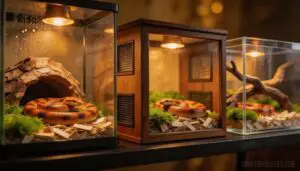
Picking the right terrarium is one of the first real decisions you’ll make as a corn snake owner, and it shapes everything that comes after. Each enclosure type has its own trade-offs, from heat retention to ease of access.
For a deeper look at how each material holds up in practice, this guide to corn snake environment setup walks you through the key trade-offs worth knowing before you buy.
Here are the main options worth knowing about.
Glass Vs. Plastic Enclosures
Both glass cages and plastic cages have real trade-offs worth knowing before you buy.
- Clarity & Visibility — Glass delivers 90–92% light transmission, keeping your corn snake sharp to observe
- Thermal Insulation — Plastic reptile enclosures seal tighter, holding heat and humidity more efficiently
- Durability & Impact — Polycarbonate plastic resists breakage; glass scratches less over time
UV Protection and Weight & Portability favor plastic when choosing cage material for your reptile enclosure.
Wooden Vivariums and Custom Builds
Wooden vivariums take things up a notch. A custom wooden terrarium uses kiln-dried hardwood with water-based sealant safety coatings — safe for your snake and easy to wipe down. You can add custom background panels, integrated cable management, and a modular panel system that grows with your snake.
A well‑planned enclosure design ensures a sustainable ecosystem and reduces maintenance.
| Feature | Benefit | Best For |
|---|---|---|
| Sound dampening design | Quieter pumps/fans | Living rooms |
| Wooden cabinet build | Vertical space gain | Adult corn snakes |
| Modular and expandable snake enclosures | No full replacement needed | Growing juveniles |
DIY reptile terrarium construction ideas and creative corn snake enclosure designs shine here.
Front-Opening Terrariums for Easy Access
Front-opening terrariums take daily care from annoying to easy.
Dual Door Access means you’re not awkwardly reaching over your corn snake every feeding. Each door opens independently — that’s one-handed opening while the other side stays sealed.
Reduced Glass Handling cuts maintenance stress by 40%, and Quick Spot Cleaning becomes routine.
Locking mechanisms also keep escape attempts where they belong: nowhere.
Pros and Cons of Each Enclosure Type
Each type has real trade-offs worth knowing.
Glass wins on Visibility & Aesthetics, and Cleaning Ease, but loses on Weight & Portability, and Heat Retention.
A Plastic Tub is cheap and light, but warps over time.
A Reused Fish Tank is a solid budget pick.
Double Floor Enclosures and Large Terrariums are your best Space-efficient snake housing solutions for long-term setups.
Choosing The Right Terrarium Size for Corn Snakes
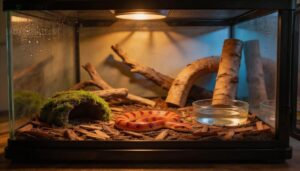
Getting the size right is one of the most important decisions you’ll make for your corn snake. Too small, and your snake will feel cramped, stressed, and more likely to get sick.
Here’s what you need to know about picking the right dimensions at every stage of your snake’s life.
Minimum Dimensions for Hatchlings and Juveniles
Start small, but not too small. The Hatchling Length Requirement is simple: at least 18 × 12 × 12 inches — that’s your absolute minimum corn snake enclosure size.
As they grow, follow a Size Increment Schedule, bumping juveniles into 24 × 12 × 12 inches. Enclosure Proportion Rules favor more floor area over height.
These minimum floor dimensions and housing requirements for juvenile corn snakes keep stress low and movement healthy.
Appropriate Size for Adult Corn Snakes
Once your corn snake hits adulthood, the rules change. You’re looking at a minimum of 60 × 20 × 20 inches — that’s your absolute minimum corn snake enclosure size for a full-grown snake.
Guidelines for housing adult corn snakes factor in floor space ratio, enclosure volume, and a growth buffer so your snake can actually move. A 40-gallon tank hits those minimum floor dimensions comfortably.
Importance of Length, Width, and Height
Three measurements define everything about your corn snake’s quality of life.
- Length Impacts Activity — ideal terrarium length lets your snake stretch and explore fully.
- Width Enhances Comfort — wider reptile enclosure dimensions allow natural coiling without touching walls.
- Height Encourages Climbing — vertical space accommodates branches and hammocks.
- Proportional Ratios — balanced corn snake terrarium size prevents hot spots.
- Space Utilization Efficiency — selecting appropriate vivarium size for corn snakes maximizes every inch.
Risks of Undersized Enclosures
A cramped enclosure doesn’t just look bad — it quietly chips away at your snake’s health every single day.
A cramped enclosure slowly destroys your snake’s health, one confined day at a time
| Risk | Cause | Effect |
|---|---|---|
| Muscle Atrophy | No room to stretch | Weak posture, stunted growth |
| Shedding Injuries | Tight corners, no humidity | Retained shed, skin damage |
| Thermal Instability | Poor gradient space | Stress, digestion issues |
| Humidity Imbalance | Limited air volume | Mold, respiratory problems |
| Behavioral Stress | Restricted exploration | Appetite loss, pacing |
minimum corn snake terrarium dimensions isn’t optional — it’s the foundation of reptile welfare guidelines, and balancing enclosure size and snake health long-term.
Essential Terrarium Features for Corn Snakes
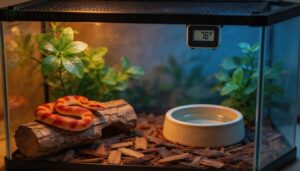
Getting the terrarium right goes beyond just picking the right size. There are a few key features that can make or break your corn snake’s comfort and safety.
Here’s what to look for before you buy or build.
Secure Lids and Escape-Proof Locking Mechanisms
Corn snakes are escape artists — don’t underestimate them. A secure lid isn’t optional; it’s your first line of defense.
Look for these features:
- Magnetic Latch Systems for quick, reliable closure
- Gasket Seal Integrity to hold humidity steady
- Reinforced Lid Hinges that won’t warp over time
- Multi-Point Lock Design to distribute pressure evenly
- Tamper Evident Indicators so you always know the enclosure security status
Ventilation and Airflow Management
Good ventilation isn’t glamorous, but it keeps your snake healthy.
Passive vent placement — high and low — drives a steady air exchange rate without blasting your snake with drafts. Mesh screen design on every opening blocks escapes and debris. Aim for 5–10% of enclosure volume in total vent openings for solid snout ventilation.
| Ventilation Factor | Target Range | Risk If Ignored |
|---|---|---|
| Air exchange rate | 2–4 changes/hour | Stale, stagnant air |
| Humidity vent balance | 40–60% humidity | Respiratory stress |
| Vent opening area | 5–10% of volume | Poor airflow management |
| Mechanical fan sizing | Low-speed, quiet | Drafts and temp swings |
| Mesh screen design | Fine, escape-proof | Escapes, debris buildup |
Humidity control matters too — too much airflow dries everything out fast.
Heating, Lighting, and Temperature Gradient Setup
Once airflow is sorted, heat is next. Set your under tank heater on one side only — that’s your thermal gradient starting point.
Ceramic Heat Emitters handle nighttime warmth without light disruption, and a Nighttime Temperature Setback of 2–6°C keeps things natural.
Pair LED lighting with a UVB Lighting Schedule of 12 hours on, 12 off.
Always use Thermostat Calibration to keep your Heat Mat Placement safe and stable.
Substrate Selection and Depth for Burrowing
Substrate matters more than most keepers realize. Aspen Bedding is a solid go-to — aspen shavings hold tunnel shapes well without compacting. A Coconut Fiber Blend or Play Sand Mix also works great for stable burrows.
Follow Burrow Depth Guidelines: 6 inches minimum for hatchlings, 8–12 for adults. Wall Stability Techniques, like layering finer substrate on top, prevent cave-ins.
- Aspen shavings tunnel walls that actually hold shape
- Coconut fiber that stays moist without getting soggy
- Deep substrate your snake disappears into completely
Top 6 Terrarium Accessories for Corn Snakes
A good setup goes beyond just the tank itself. The right accessories make your corn snake feel secure, active, and at home. Here are six worth adding to your enclosure.
1. Niteangel Reptile Hammock Lounger
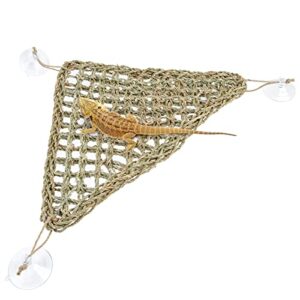
The Niteangel Reptile Hammock Lounger is a simple upgrade that punches above its $15.50 price tag. It’s hand-woven from natural seagrass, so it gives your snake a rough, textured surface — genuinely useful during shedding season.
The triangle shape (roughly 17″ × 12.5″) mounts with three suction cups and frees up floor space, your snake would otherwise ignore. It encourages mid-level climbing and adds a natural look without crowding the enclosure.
Just inspect it weekly for loose threads or slipping suction cups.
| Best For | Reptile owners with adult bearded dragons, geckos, snakes, or similar lizards who want to add a natural climbing and lounging spot without taking up floor space. |
|---|---|
| Material | Seaweed |
| Price | $15.50 |
| Weight | 6.53 oz |
| Installation | Suction cups & strings |
| Cleaning Method | Hand-wash or soak |
| Color | Tan |
| Additional Features |
|
- Natural seagrass texture genuinely helps with shedding — it’s not just decorative
- Mounts easily with suction cups and makes great use of vertical tank space
- Hard to beat at $15.50 for something that looks good and actually does a job
- No instructions in the box — you’ll probably end up watching a YouTube video to figure out the string setup
- Small toes or nails on juvenile reptiles can get snagged, so it’s better suited for adults
- Needs regular scrubbing to stay clean; skip maintenance and bacteria will move in fast
2. Prevue Bird Ladder Wood 7 Step 12 Inch
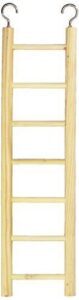
A bird ladder in a snake tank — sounds odd, but it works.
The Prevue Hendryx 7-step wooden ladder gives your corn snake a natural climbing surface without taking up floor space. It’s pre-sanded, so no splinters, and the hook-style mount lets you reposition it easily.
At roughly 12 inches tall, it fits most setups without crowding other décor. Wipe it down weekly, and replace it if your snake starts chewing through the rungs.
| Best For | Small bird owners looking for an affordable, easy-to-install climbing toy that fits snugly inside compact cages. |
|---|---|
| Material | Natural wood |
| Price | Not listed |
| Weight | Not listed |
| Installation | Cage bar hooks |
| Cleaning Method | Wipe or soak |
| Color | Natural wood |
| Additional Features |
|
- Pre-sanded wood means no rough edges to worry about — safe right out of the box.
- The hook-style mount makes it simple to reposition or swap out whenever you rearrange the cage.
- Works as more than just a ladder — birds use it as a perch, a nap spot, and even a beak file.
- Strong chewers like cockatiels can gnaw through the rungs in a matter of months.
- It’s on the small side, so larger birds won’t get much use out of it.
- The plain, colorless wood might not grab a bird’s attention the way a brighter, more colorful toy would.
3. JW Pet Hol Ee Roller Puzzle Ball
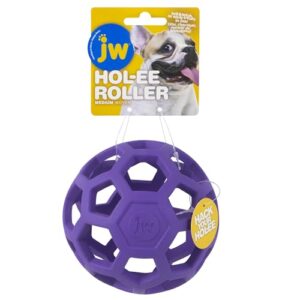
The JW Pet Hol-ee Roller isn’t just a dog toy — corn snakes actually love pushing it around the enclosure. The open rubber lattice lets you stuff treats or feeder scents inside, turning a lazy afternoon into a puzzle your snake has to solve.
It’s lightweight, easy to clean with warm soapy water, and gentle enough that it won’t damage your setup. Drop it on the cool side and watch your snake work for it.
| Best For | Small-to-medium dog owners looking for a versatile toy that keeps their pup mentally and physically engaged. |
|---|---|
| Material | Natural rubber |
| Price | $11.95 |
| Weight | 4.5 oz |
| Installation | Freestanding |
| Cleaning Method | Rinse and dry |
| Color | Not listed |
| Additional Features |
|
- Stuff it with treats and it becomes a puzzle that keeps dogs busy and mentally stimulated
- Soft natural rubber is gentle on gums, making it great for teething puppies
- Light enough for indoor play without worrying about broken lamps or scratched floors
- Not built for aggressive chewers — a determined dog can tear it up over time
- The holes can occasionally catch on a dog’s teeth, so you’ll want to keep an eye on playtime
- Only comes in one size, so larger breeds may need something bigger
4. Galápagos Green Mossy Cave Hide
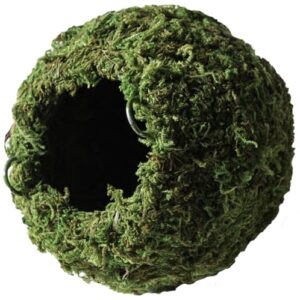
The Galápagos Green Mossy Cave Hide is one of those accessories that pulls double duty — it looks great and actually does something. The sphagnum moss exterior holds localized humidity, which helps during shedding, and the corner‑fit design slots neatly against tank walls.
You can place it flat on the substrate or hang it with the included chain for a climbing hideout. Just check the wire frame for sharp ends before putting it in.
At $15.93, it’s solid value.
| Best For | Reptile, amphibian, and invertebrate owners who want a hide that looks natural, works in multiple setups, and doubles as a humidity spot. |
|---|---|
| Material | Sphagnum moss |
| Price | $15.93 |
| Weight | 5.6 oz |
| Installation | Ground or hanging chain |
| Cleaning Method | Mist or soak |
| Color | Green |
| Additional Features |
|
- Versatile placement — use it on the ground or hang it with the included chain for climbers
- Sphagnum moss holds moisture, making it great for species that need a humid microclimate
- Blends naturally with cork bark and wood décor for a clean, realistic look
- Moss dries out fast and needs regular misting or weekly soaking to stay effective
- Wire frame can have sharp ends — always inspect it before dropping it in the enclosure
- At 4 inches, it may be too bulky for very small animals or tight tank setups
5. SuperMoss Fresh Green Hanging Bungalow Birdhouse
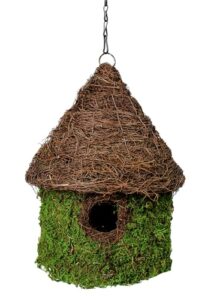
The SuperMoss Fresh Green Hanging Bungalow is technically made for birds, but corn snake keepers have found a solid use for it. Hand-woven from natural moss vine, it doubles as a lightweight hanging hide that blends right into a naturalistic setup. Hang it mid-tank using the included chain, and your snake gets an elevated retreat with real texture to rub against.
It measures about 10 × 14 inches, which fits a juvenile or small adult comfortably. At $43.20, it’s a decorative piece that actually earns its spot.
| Best For | Corn snake keepers who want a naturalistic, mid-tank hide that doubles as a decorative piece in a bioactive or naturalistic setup. |
|---|---|
| Material | Moss vines |
| Price | $43.20 |
| Weight | 1.68 lb |
| Installation | Hanging chain |
| Cleaning Method | Mist or water |
| Color | Fresh green |
| Additional Features |
|
- Hand-woven moss construction gives it a natural look and real texture — great for snakes that like to rub during a shed
- The included chain makes mid-tank hanging easy, adding vertical enrichment to the enclosure
- Works as a lightweight hide for juveniles or small adults without taking up precious floor space
- Moss sheds, so expect some cleanup and loose material in the tank over time
- At $43.20, it’s pricier than a basic plastic hide for what’s essentially a repurposed birdhouse
- The open top and transparent panel mean it offers less darkness and security than a traditional enclosed hide
6. Hand Woven Grass Hummingbird House
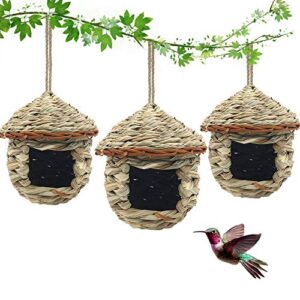
Another bird product that pulls double duty in a corn snake setup. The Hand Woven Grass Hummingbird House is small — roughly 6 × 6 inches — but that tight, natural weave makes it a great little hide for hatchlings or juveniles. The opening sits around 1.8 × 2.2 inches, just snug enough to make a young snake feel secure.
Hang it from a branch or vine inside the tank using the built-in hemp rope. It’s lightweight, biodegradable, and adds a naturalistic texture your snake will actually use.
| Best For | Hatchling and juvenile corn snakes that need a snug, natural-feeling hide inside their enclosure. |
|---|---|
| Material | Hibiscus grass |
| Price | Not listed |
| Weight | 7.76 oz |
| Installation | Hemp rope hanger |
| Cleaning Method | Difficult, coarse surface |
| Color | Natural grass tone |
| Additional Features |
|
- Tight grass weave creates a cozy, secure hide that small snakes actually seem to enjoy
- Built-in hemp rope makes it easy to hang from branches or vines inside the tank
- Lightweight and biodegradable — adds a naturalistic look without bulk
- Fragile construction can fray or splinter over time, which could be a concern around delicate hatchlings
- Very small opening limits use to the tiniest snakes; juveniles won’t fit for long
- Coarse material makes cleaning a real hassle, which matters a lot in a reptile enclosure
Setting Up a Naturalistic Corn Snake Habitat
Getting your corn snake’s habitat right goes beyond just picking a tank. A naturalistic setup means thinking about hides, plants, water, and humidity all working together.
Here’s how to bring each piece into place.
Creating Hides and Climbing Enrichment
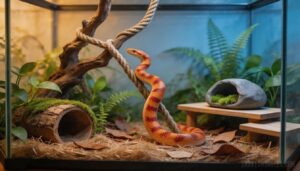
Good hides aren’t optional — they’re where your corn snake feels safe enough to thrive.
Mix a tunnel hide design near the warm side with moss lined caves on the cool end. Add elevated ground hides to prevent belly dampness.
| Feature | Purpose |
|---|---|
| Natural branch climbing | Builds muscle |
| Adjustable rope vines | Encourages exploration |
| Moss hide | Aids shedding |
| Vertical climbing materials | Uses full enclosure height |
Integrating Live Plants and Bioactive Elements
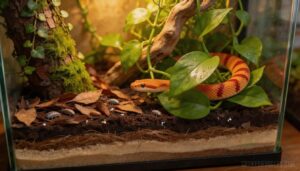
Live plants turn a plain enclosure into a self-sustaining ecosystem that your corn snake actually wants to explore. A proper bioactive setup uses soil layering techniques and microfauna management to handle waste naturally through nutrient cycling.
- Choose pothos, spider plant, or creeping fig
- Layer topsoil, coconut fiber, and sand for drainage
- Maintain moisture balance without oversaturating roots
- Add springtails and isopods for cleanup
- Meet plant light requirements with 12–14 hours of full-spectrum light
Water Bowl Placement, Size, and Hygiene
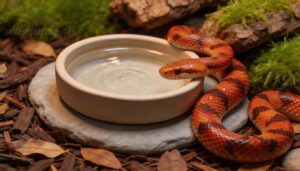
Your water bowl setup matters more than most people think. Bowl Positioning keeps things simple — place it at least 6 inches from the warm hide and away from basking lights. Bowl Elevation of 1–2 inches off the substrate prevents contamination. Use bottled spring water or tap water left standing for 24 hours.
| Water Provision | Guideline |
|---|---|
| Bowl Capacity (hatchling) | 100–200 ml |
| Bowl Capacity (adult) | 750–1,500 ml |
| Cleaning Routine | Daily wash, weekly disinfect |
| Material Selection | Ceramic or stainless steel |
| Bowl Elevation | 1–2 inches off substrate |
Enclosure cleaning stays easier when you drain standing water after each wash and replace bowls showing cracks.
Maintaining Humidity and Preventing Mold
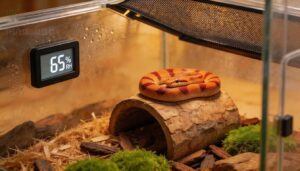
Keeping humidity between 40–60% is your goal — a hygrometer (humidity sensor) tells you exactly where you stand. Condensation on the glass means it’s too high.
If it keeps climbing, crack the screen top or run a small dehumidifier nearby. For bioactive setups with microfauna, substrate selection matters: soggy bedding feeds mold fast, so spot-clean damp patches before they spread.
Frequently Asked Questions (FAQs)
Can corn snakes live in a terrarium?
Yes, corn snakes thrive in a well-designed terrarium.
With proper reptile husbandry, the right thermal gradient, and species compatibility in mind, a snake habitat design that meets their behavioral adaptation needs promotes long-term health.
What plants can I put in my corn snake terrarium?
Safe live plants like pothos, spider plant, and Boston fern work great. They’re non-toxic, moisture-retaining, and low-maintenance — perfect natural decor for a bioactive terrarium without putting your snake at risk.
Do corn snakes like big enclosures?
The bigger the room, the bigger the life. Larger is always better."
Corn snakes thrive in a large terrarium — more space facilitates exploratory behavior, lowers stress levels, meets exercise needs, and encourages growth stimulation.
How often should I completely clean the terrarium?
Deep clean the terrarium every 3 to 6 months. Spot clean waste weekly. Your cleaning log routine keeps things on track, and consistent maintenance frequency prevents mold buildup before it starts.
Can corn snakes live together in one enclosure?
Corn snakes are solitary by nature.
Gender compatibility, size mismatch risks, feeding competition, and health risks make multi-snake housing solutions rarely worth it.
Separate enclosures are always the safer, stress-free choice.
What humidity level do corn snakes need?
Keep humidity levels at 40–60% normally. Bump that up to 65–75% during shedding. A hygrometer helps you track it, and moisture-retentive substrate manages most of the humidity maintenance automatically.
How do I prevent mites in the terrarium?
mite-resistant materials and thermal sterilization for new substrate. ventilation management and humidity control dry out damp spots fast.
springtails and isopods as your cleanup crew, and quarantine new items before introducing them.
Should I use live or artificial plants?
Live plants look great but come with mold risk and higher maintenance frequency. Fake plants win on cost comparison and light requirements.
For a bioactive setup, live plants earn their place — otherwise, artificial plants keep things simple.
How often should corn snakes be fed?
Feed on a clock that matches their growth stage. Hatchling feeding frequency starts every 5–7 days, juvenile feeding cadence shifts to every 7–10 days, and adult feeding interval settles at every 10–14 days.
What prey size is right for juveniles?
Match prey width to your juvenile’s thickest body section. Too large means regurgitation risk. Gradually increase size as they grow. Use feeding tongs every 5–7 days for safe, stress-free meals.
Conclusion
As you prepare to welcome your corn snake home, remember that a well-planned terrarium is the key to a happy, healthy pet. With the right reptile terrariums for corn snakes, you’ll create a thriving environment that meets their unique needs.
A secure, well-ventilated enclosure sets the stage for a lifelong friendship. By choosing wisely and setting up with care, you’ll enjoy a rewarding experience with your slithery companion for years to come, every day.
- https://reptifiles.com/corn-snake-care-guide/corn-snake-terrarium-size/
- https://www.petmd.com/reptile/corn-snake-care-sheet
- https://www.thebiodude.com/blogs/snake-caresheets/care-guidelines-for-corn-snakes
- https://www.zenhabitats.com/blogs/reptile-care-sheets-resources/corn-snake-complete-lighting-and-heating-guide
- https://www.happydragons.com/reptiles/corn-snake/care-guide/