This site is supported by our readers. We may earn a commission, at no cost to you, if you purchase through links.
Most apartment reptile keepers don’t realize their bearded dragon or leopard gecko is slowly starving—not for food, but for light.
Without adequate UVB exposure, reptiles can’t synthesize vitamin D3, which means calcium never reaches their bones, and metabolic bone disease sets in quietly before you notice anything wrong.
The frustrating part is that the sun streaming through your apartment window doesn’t help, because standard glass filters out nearly all UVB radiation before it ever reaches your pet.
Choosing the right reptile UVB lights for apartment living means working around space limits, lease restrictions, and energy constraints while still meeting your animal’s biological needs.
The nine options ahead cut through the noise and match real setups to real solutions.
Table Of Contents
- Key Takeaways
- Benefits of UVB Lighting for Apartment Reptiles
- Choosing UVB Lights for Small Living Spaces
- Top 9 UVB Lights for Apartment Reptiles
- 1. ReptiTrip LED UVB Lamp Adjustable
- 2. REPTITRIP LED UVB Light Controller
- 3. Cozwell 6W UVB UVA Reptile Light
- 4. REPTI ZOO Dimmable UVB Reptile Light
- 5. REPTIDLDB 39W T5 UVB 10.0 Reptile Light Fixture
- 6. Hygger Zoo T5 UVB Reptile Light Fixture
- 7. Hygger Zoo 24W T5 UVB Reptile Light
- 8. Reptispa T5 UVB Lighting Kit
- 9. REPTI HOME T5 UVB UVA Light Kit
- Installation and Maintenance in Apartments
- Tips for Safe and Effective UVB Use Indoors
- Frequently Asked Questions (FAQs)
- Do Reptiles need UV light?
- Can reptile lights keep a bearded dragon warm?
- What is UVB lighting?
- Can humans use reptile UVB lights?
- Do UVB bulbs use a lot of electricity?
- Can I get vitamin D from a reptile lamp?
- Can reptiles get UVB through the window?
- Can UVB lights affect neighboring apartment residents?
- How do landlords view reptile UVB setups?
- Are UVB lights safe around children and pets?
- Conclusion
Key Takeaways
- Window sunlight won’t protect your reptile — standard glass blocks nearly all UVB radiation, so a dedicated lamp isn’t optional, it’s the only thing standing between your pet and metabolic bone disease.
- Your reptile’s species determines how much UVB it actually needs, ranging from a UV Index of 0.5 for leopard geckos all the way up to 6.0 for bearded dragons, so matching bulb strength to Ferguson Zone is just as important as having a light at all.
- A glowing bulb doesn’t mean a working one — UVB output fades long before the light burns out, which means you need to replace fluorescent tubes every 10–12 months and use a UV meter to confirm your setup is actually doing its job.
- Apartment constraints like tight spaces and shared walls don’t have to compromise your reptile’s health, since compact, energy-efficient options like the 8W ReptiTrip or slim T5 fixtures deliver proper UVB without spiking your electric bill or bothering your neighbors.
Benefits of UVB Lighting for Apartment Reptiles
UVB lighting isn’t optional for reptiles — it’s the difference between a thriving pet and one slowly losing its health indoors.
If you’re just getting started, this guide to reptile UVB lights for beginners breaks down exactly what to look for before you buy.
Without it, your reptile can’t produce vitamin D3, which means their body can’t absorb calcium properly, and that leads straight to metabolic bone disease.
Here’s what you need to know about why UVB matters and how to match it to your specific reptile’s needs in an apartment setting.
Importance of UVB for Reptile Health
Without UVB radiation, your reptile can’t convert sunlight into vitamin D3 synthesis — and without that, calcium absorption basically falls apart.
UVB lighting triggers a natural chain reaction in your pet’s skin, supporting bone density, immune function, and organ health.
It even plays a role in reproductive success.
Think of it as the one thing your reptile genuinely can’t fake indoors.
Providing adequate UVB helps prevent metabolic bone disease.
Preventing Metabolic Bone Disease Indoors
Metabolic bone disease is what happens when calcium absorption breaks down — bones soften, limbs twist, and your reptile’s quality of life drops fast.
Indoors, poor UVB lighting is usually the trigger.
A working T5 UVB bulb, proper heat gradient management, and a balanced calcium-phosphorus ratio all work together.
Regular UVB testing and smart vitamin D3 supplementation keep your reptile’s skeleton strong year‑round.
Ensuring adequate calcium intake is key to prevent MBD.
UVB Needs by Species in Confined Spaces
Not every reptile needs the same UVB intensity — and getting this wrong can still lead to Metabolic Bone Disease even with a lamp running. Ferguson Zone ranges tell you exactly how much UV your species actually needs:
- Zone 1 (leopard geckos): UV Index 0.5–1.5
- Zone 2 (green anoles): UV Index up to 3.0
- Zone 3 (day geckos): UV Index up to 4.5
- Zone 4 (Bearded Dragons): UV Index 4–6
Species UV gradients, Habitat intensity, and a properly sized T5 UVB Bulb drive Vitamin D3 synthesis where it counts.
Choosing UVB Lights for Small Living Spaces
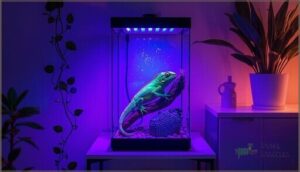
Picking the right UVB light for a small apartment setup isn’t just about wattage — it’s about finding something that fits your space, suits your specific reptile, and won’t run up your electric bill or annoy your neighbors.
The good news is that today’s options are smarter and more compact than ever, making it easier to give your reptile exactly what it needs without sacrificing half your living room.
Here are the top factors to keep in mind as you look through the best UVB lights available for apartment reptile keepers in 2026.
Space-saving UVB Lighting Options
Space is a premium in apartment reptile setups, so the right fixtures make all the difference.
Low profile fixtures, often just 1 to 1.5 inches tall, slide neatly onto racks without eating your vertical space.
LED strip bars and multi‑function bars combine UVB with visible light in one slim housing.
Clamp mounts, flat plug timers, and LED UVB lights with dimmer cycle timer and switchable modes keep your corner tidy and efficient.
Matching Bulb Strength to Reptile Species
Getting Ferguson Zone Matching right is the difference between a thriving reptile and a stressed one.
Bearded dragons need a basking UVI of 3.0–7.0, while crested geckos stay healthy under 1.0. UVB Lighting for Reptiles should always follow Species UVB Gradients:
- Use UVI Meter Calibration to confirm actual output
- Follow Bulb Distance Guidelines to prevent Metabolic Bone Disease
- Apply Albino UVB Adjustments for pigment-sensitive animals
Energy Efficiency and Noise Considerations
Living in an apartment means noise and power bills actually matter. A 20-watt UVB lamp running 12 hours daily costs roughly $0.03 per day, so Wattage Optimization adds up fast.
Choose a Flicker-Free Design with an A-rated Ballast Noise Rating to keep things quiet. LED UVB Light options last longer and run cooler, and Timer Automation manages Heat Management without any guesswork.
Top 9 UVB Lights for Apartment Reptiles
Finding the right UVB light for an apartment setup doesn’t have to be complicated. Each option below was chosen with small spaces, energy efficiency, and your reptile’s specific needs in mind. Here are the top nine UVB lights worth considering for 2026.
1. ReptiTrip LED UVB Lamp Adjustable
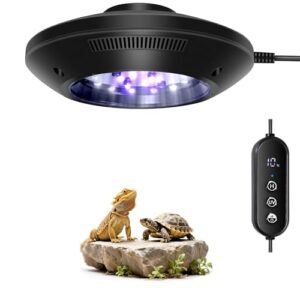
ReptiTrip LED UVB Lamp Adjustable is a solid pick if you’re working with a compact setup and don’t want to fuss with multiple devices. Its built-in timer runs from 1 to 24 hours, and you can dial UV intensity across Ferguson Zones 1–4 in 10% brightness increments — meaning one lamp works for a leopard gecko or a bearded dragon.
At just 8W, it won’t spike your electricity bill, and its slim aluminum housing fits neatly over most standard mesh lids.
| Best For | Reptile owners with small to medium enclosures who want one lamp that handles lighting, UV, and scheduling without buying separate gear. |
|---|---|
| UVB Type | LED UVB |
| Power | 8W |
| Material | Aluminum |
| Compatible Species | Bearded dragons, lizards, snakes |
| UVB Output | F1–F4 adjustable |
| Heat Emission | None |
| Additional Features |
|
- Covers Ferguson Zones 1–4, so it works for a wide range of species from leopard geckos to bearded dragons
- Built-in 1–24 hour timer with adjustable brightness means less manual work and more consistent care
- At 8W, it’s easy on your electricity bill and doesn’t add heat to the enclosure
- Lifespan tops out around 8,000 hours, so you’ll need to budget for replacements
- May fall short for larger enclosures or reptiles with more demanding lighting needs
- A few users reported early failures, and the return window can be tight if something goes wrong
2. REPTITRIP LED UVB Light Controller
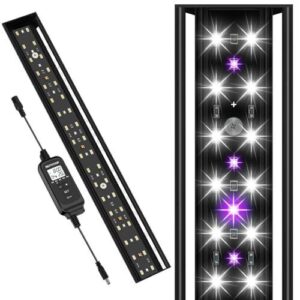
Think of the REPTITRIP LED UVB Light Controller as the brain behind the bulb. Built inline with the lamp cord, it gives you four automatic Ferguson Zone modes — M1 through M4 — so you can match UV output to your specific reptile without swapping fixtures.
The display shows current time and brightness percentage at a glance, and dimming runs from 0 to 100 percent in small steps.
At 14W with aluminum alloy construction, it’s efficient, quiet, and rated for 7,000‑plus hours.
| Best For | Reptile owners who want precise UV control for bearded dragons, geckos, turtles, or other reptiles that need dialed-in UVB exposure. |
|---|---|
| UVB Type | LED UVB |
| Power | 14W |
| Material | Aluminum |
| Compatible Species | Bearded dragons, geckos, turtles |
| UVB Output | 4 UVI modes |
| Heat Emission | Minimal |
| Additional Features |
|
- Four Ferguson Zone modes (M1–M4) let you match UV output to your specific reptile’s needs without swapping fixtures
- Full 0–100% dimming gives you fine-tuned control over light intensity
- Lightweight aluminum build runs efficiently at just 14W and is rated for 7,000 hours
- No memory function — you’ll have to reset your preferences every time the power cuts out
- Doesn’t produce heat, so you’ll still need a separate heat source for your enclosure
- Manual setup each time it’s unplugged can get old fast if you deal with frequent power interruptions
3. Cozwell 6W UVB UVA Reptile Light
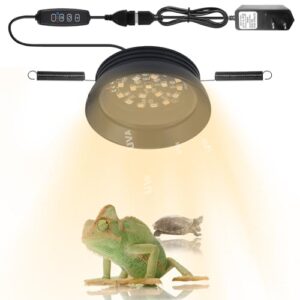
If you’re short on space and budget, the Cozwell 6W UVB UVA Reptile Light punches above its weight. It screws into a standard E26 base, so there’s no special fixture required — just drop it into a clamp lamp you likely already own.
At only 6 watts, it draws minimal power while still delivering both UVA and UVB wavelengths that your reptile needs for vitamin D3 production and natural behavior. It’s best suited for small geckos, tropical lizards, and amphibians in 10–20 gallon tanks.
| Best For | Reptile owners with smaller tanks and a tight budget who already have a clamp lamp setup and need a simple UVA/UVB solution for geckos, lizards, or amphibians. |
|---|---|
| UVB Type | LED UVB |
| Power | 6W |
| Material | Aluminum |
| Compatible Species | Bearded dragons, geckos, turtles |
| UVB Output | UVB 5.0 / 10.0 |
| Heat Emission | Minimal |
| Additional Features |
|
- Fits a standard E26 base, so no extra fixtures needed
- Only 6 watts, which keeps your energy bill low
- Adjustable brightness with 9 levels and built-in timer options for easy scheduling
- No clear way to tell which UV mode is active without a separate UV meter
- The timing function can be unreliable and may not work as expected
- Hooks don’t always grip screen covers securely, which can be a hassle
4. REPTI ZOO Dimmable UVB Reptile Light
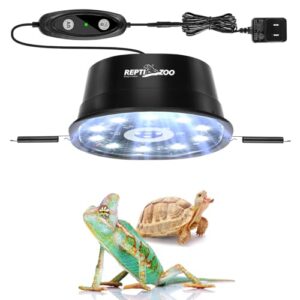
REPTI ZOO Dimmable UVB Reptile Light is a smart pick if you’re keeping multiple species in a small apartment. It offers two UVB modes — a 5.0 tropical setting and a 10.0 desert setting — so you’re not locked into one setup.
At just 6 watts, it runs cool and costs little to operate, while the external dimmer lets you adjust brightness without disturbing your reptile. That dimming feature also helps you create natural sunrise and sunset cycles, which genuinely reduces stress in confined enclosures.
| Best For | Reptile owners with multiple species who want one light that works across both tropical and desert setups. |
|---|---|
| UVB Type | LED UVB |
| Power | 6W |
| Material | ABS Plastic |
| Compatible Species | Bearded dragons, turtles, geckos |
| UVB Output | UVB 5.0 / 10.0 |
| Heat Emission | Minimal |
| Additional Features |
|
- Two UVB modes (5.0 and 10.0) give you flexibility for different reptile species without buying separate lights
- The dimmer lets you dial in brightness and mimic natural light cycles, which helps keep your reptile calm and comfortable
- At only 6 watts, it’s cheap to run and doesn’t heat up your enclosure
- May fall short for high-UVB reptiles like bearded dragons that need stronger, more consistent output
- Some users have run into durability issues within the first six months, which is frustrating for the price
- It’s on the pricier side for a compact bulb, especially if longevity turns out to be a concern
5. REPTIDLDB 39W T5 UVB 10.0 Reptile Light Fixture
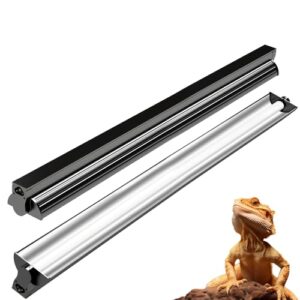
If your reptile needs serious UVB power, the REPTIDLDB 39W T5 UVB 10.0 Fixture steps up in a big way. It pumps out 10% UVB and 30% UVA — levels that bearded dragons and tortoises genuinely need to absorb calcium properly.
The polished curved reflector pushes light downward efficiently, covering roughly a 90 cm span that suits most apartment terrariums. It runs on standard European 220–240V power, includes an on/off switch, and the T5 tube swaps out tool‑free when annual replacement comes around.
| Best For | Bearded dragons, tortoises, and other desert reptiles that need strong UVB exposure for healthy bones and digestion. |
|---|---|
| UVB Type | T5 Fluorescent |
| Power | 39W |
| Material | Aluminum |
| Compatible Species | Bearded dragons, tortoises |
| UVB Output | UVB 10.0 |
| Heat Emission | Low |
| Additional Features |
|
- Puts out a solid 10% UVB and 30% UVA — exactly what desert reptiles need for calcium absorption and vitamin D3 synthesis
- The alloy reflective layer pushes light right where it needs to go, maximizing coverage across the enclosure
- Easy bulb replacement with a detachable cable and on/off switch built in — no fuss
- Some users have noticed the bulb holder peeling and crinkling over time, which is a bit concerning for longevity
- Doesn’t produce much heat, so you’ll likely need a separate heat source depending on your reptile’s needs
- Not a one-size-fits-all solution — tropical species would need the UVB 5.0 version instead
6. Hygger Zoo T5 UVB Reptile Light Fixture
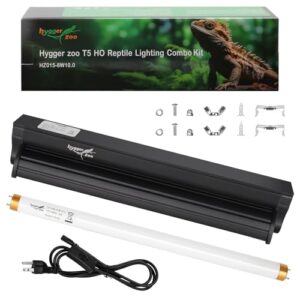
The Hygger Zoo T5 UVB Reptile Light Fixture is a smart step up if you’re housing bearded dragons, tortoises, or other desert species in a compact apartment setup. Its aluminum shell manages heat well, which matters a lot in smaller rooms where ventilation is already limited.
The curved, polished reflector pushes UVB downward more efficiently, and the 10% UVB, 30% UVA output facilitates real vitamin D3 synthesis. You can rest it on a mesh lid or mount it inside the tank — your call.
| Best For | Apartment dwellers keeping bearded dragons, tortoises, or other desert reptiles in compact enclosures who want efficient UVB delivery without a lot of extra heat buildup. |
|---|---|
| UVB Type | T5 Fluorescent |
| Power | 8W |
| Material | Aluminum |
| Compatible Species | Bearded dragons, turtles |
| UVB Output | UVB 10.0 |
| Heat Emission | Low |
| Additional Features |
|
- The curved, polished reflector pushes UVB rays downward efficiently, supporting real vitamin D3 synthesis and calcium absorption
- Aluminum build keeps heat dissipation in check and helps the light last longer
- Flexible setup — just rest it on a mesh lid or mount it inside the tank, whatever works for you
- Not a great fit for larger tanks like 120-gallon setups where you’d need more coverage
- Some users have flagged durability concerns, so longevity isn’t guaranteed
- The fixture can shift around and may not stay put inside the terrarium
7. Hygger Zoo 24W T5 UVB Reptile Light
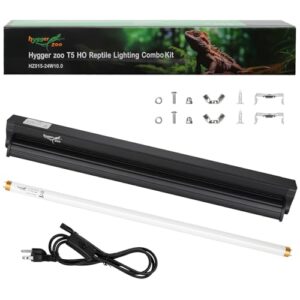
If you want a bit more reach, this 24W version gives you just that. It runs the same 10% UVB and 30% UVA ratio as its sibling, but the 22-inch tube spreads that output more evenly across longer tanks — think 20 to 40 gallons, which is the sweet spot for most apartment setups.
The polished curved reflector pushes light downward instead of letting it scatter, and the detachable cord with an on/off switch keeps things tidy without extra clutter.
| Best For | Desert reptile owners with 20–40 gallon tanks who want stronger, more even UVB coverage for bearded dragons, turtles, or snakes. |
|---|---|
| UVB Type | T5 Fluorescent |
| Power | 24W |
| Material | Aluminum |
| Compatible Species | Bearded dragons, turtles, snakes |
| UVB Output | UVB 10.0 |
| Heat Emission | Low |
| Additional Features |
|
- The polished curved reflector pushes UVB light right where it needs to go, so your reptile actually gets the benefit
- At 24W, it covers longer tanks more evenly than smaller bulbs — great for mid-sized setups
- The detachable cord and on/off switch make daily use genuinely convenient
- Won’t cut it for larger enclosures — anything around 120 gallons is too big for this light
- A few users have had durability concerns, so it may not be a forever purchase
- It can shift around if your reptile is active, which means you might need to reposition it more than you’d like
8. Reptispa T5 UVB Lighting Kit
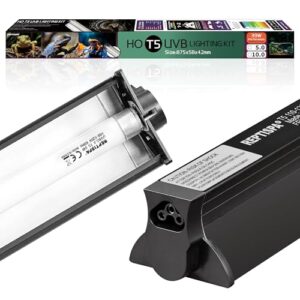
Stepping up from that 24W option, the Reptispa T5 UVB Lighting Kit is a solid plug-and-play choice for desert species like bearded dragons.
The 22-inch, 24W tube delivers a strong 10.0 UVB rating, meaning it facilitates vitamin D3 synthesis even when mounted above a mesh lid.
Its polished aluminum reflector pushes light directly into the basking zone rather than letting it scatter sideways, and the slim, lightweight housing sits cleanly on most apartment enclosures without taking over your shelf space.
| Best For | Desert reptile owners — especially bearded dragon keepers — who want a reliable, out-of-the-box UVB setup that’s easy to mount and won’t hog shelf space. |
|---|---|
| UVB Type | T5 Fluorescent |
| Power | 39W |
| Material | Aluminum |
| Compatible Species | Bearded dragons, desert species |
| UVB Output | UVB 10.0 |
| Heat Emission | Moderate |
| Additional Features |
|
- Strong 10.0 UVB output with an alloy reflector that channels light right into the basking zone instead of wasting it on the walls
- Slim, lightweight build that fits neatly on most enclosures without a hassle
- Promotes real health benefits — better appetite, digestion, and calcium absorption for your reptile
- The fixture runs hot, so placement and airflow actually matter
- UVB bulbs need replacing every 6–12 months, and swapping them out isn’t always straightforward
- Better suited for smaller tanks — larger setups may need something with more coverage
9. REPTI HOME T5 UVB UVA Light Kit
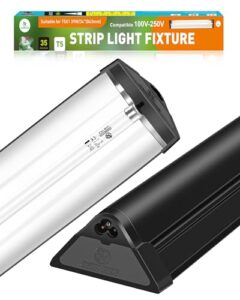
Rounding out this list, the REPTI HOME T5 UVB UVA Light Kit covers your bases if you’re keeping bearded dragons or tortoises in a mid-sized apartment enclosure.
The 39W T5 tube delivers around 10% UVB output, supporting vitamin D3 synthesis and calcium metabolism without needing a second lamp.
Its aluminum alloy reflector channels light directly downward, and the slim bar housing fits neatly on most mesh-top setups.
Just keep basking spots within 20 to 40 centimeters, and replace the bulb annually.
| Best For | Reptile owners keeping bearded dragons, tortoises, or turtles in a mid-sized enclosure who want a single light that handles both UVA and UVB without the hassle of running two separate lamps. |
|---|---|
| UVB Type | T5 Fluorescent |
| Power | 39W |
| Material | Aluminum Alloy |
| Compatible Species | Bearded dragons, tortoises, snakes |
| UVB Output | UVB 10.0 |
| Heat Emission | Low |
| Additional Features |
|
- The aluminum alloy reflector pushes light straight down, so your reptile actually gets the UV exposure it needs rather than losing it to the sides.
- Works across a wide voltage range (100V–250V), which is handy if you’re ever traveling or relocating with your setup.
- At 39W with solid UVB output, it supports vitamin D3 synthesis and calcium metabolism on its own—no extra lamp required.
- The bulb can be finicky—slight vibrations have been known to shut it off, which is frustrating if your home isn’t perfectly still.
- Some users have run into reliability issues over time, so the bulb may not always last as long as advertised.
- Assembly needs a careful hand—rushing it or mishandling the parts can damage the lamp or bulb before you even get started.
Installation and Maintenance in Apartments
Getting your UVB light installed correctly makes all the difference between a thriving reptile and one that is slowly missing out on what it needs.
In an apartment setup, the details matter even more — you’re working with tighter spaces, shared walls, and less room for error.
Here’s what you need to know about placement, safe installation, and keeping those bulbs working at their best.
Proper Placement for Optimal UVB Exposure
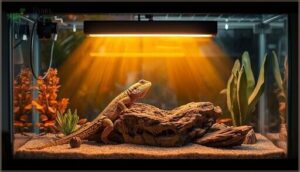
Placement makes or breaks your UVB lighting setup. For most basking species, position your lighting fixtures so the basking distance sits 12 to 18 inches below a T5 tube — measured from your reptile’s back.
UV gradient creation matters too: offset the lamp toward one side so UVB radiation tapers naturally.
Mesh screen effects can cut output by 30 to 35 percent, so lamp height adjustment and heat-UV alignment keep your reptile habitat setup working as intended.
Safe Installation in Compact Enclosures
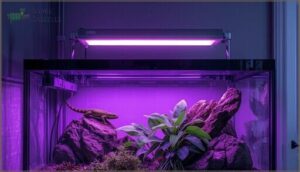
Installing compact UVB lighting safely starts with mounting brackets that hold fixtures flush to the enclosure ceiling, preventing wobbling when the tank gets bumped. Use internal brackets rather than resting gear on mesh.
Maintain clearance distances of 6 to 12 inches for compact UVB bulbs, add mesh guard use around hot lamps, and run cables with drip loops for solid cable management and heat shielding throughout your reptile habitat setup.
Replacing and Monitoring UVB Bulbs
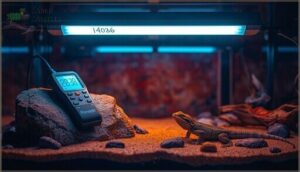
A bright bulb does not mean a working one — that’s the trap with UVB lighting for reptiles. UVB output drops long before the light burns out, so visual versus UV output is never a reliable guide.
A glowing UVB bulb is not a working one — output fades long before the light ever does
- Use UVB meters like the Solarmeter 6.5 for UV index metering at basking height
- Write install dates on bulbs for easy bulb lifespan tracking
- Replace fluorescent tubes every 10–12 months, compact bulbs around 6–8 months
Tips for Safe and Effective UVB Use Indoors
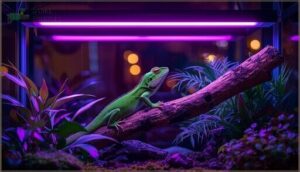
Getting UVB right isn’t just about buying a good bulb — it’s also about how you use it once it’s in the enclosure.
A few simple habits can make a real difference in how much UV your reptile actually receives each day. Here’s what to keep in mind for safe, effective indoor use.
Avoiding UVB Loss Through Glass or Plastic
Glass and plastic are silent UVB killers — standard window glass blocks nearly all UVB radiation before it reaches your reptile.
Always remove plastic covers from fixtures, choose enclosures with a Mesh Lid Design, and opt for UV-Transmitting Acrylic or Low-Iron Glass when solid panels are unavoidable.
Use UV meters for UV Meter Testing to confirm your UVB Lighting Solutions actually deliver.
| Barrier Type | UVB Blocked | Best Fix |
|---|---|---|
| Standard glass | ~100% | Plastic Cover Removal + mesh |
| Standard acrylic | 70–90% | UV-Transmitting Acrylic panels |
| Wire mesh screen | 30–50% | Coarser mesh or open strip |
Managing Heat and Ventilation
Heat buildup is sneaky — your UVB lighting and LED UVB light both add warmth, so Thermostat Integration matters more than you’d think.
Pair a digital thermostat with Heat Mat Placement under the cool side, and use Clip Fan Usage to pull stale air out. Screen Vent Optimization keeps airflow strong, while Temperature Gradient Design and smart Temperature Control maintain that essential 20°F spread across your enclosure.
Adjusting Light Height and Duration
Once you’ve sorted your ventilation, light height becomes your next dial to tune.
Mesh Lid Compensation is real — mesh can cut UVB output by roughly 35%, so raise your UVB Lighting closer to offset that loss.
Combine Perch Height Variation with UVI Gradient Tuning so your reptile self-selects exposure.
Keep Photoperiod Timing at 10–12 hours, and apply Seasonal Height Tweaks as light conditions shift indoors.
Frequently Asked Questions (FAQs)
Do Reptiles need UV light?
Yes, reptiles absolutely need UV light. Without UVB exposure, they can’t trigger Vitamin D3 synthesis, which means calcium absorption fails — and that leads straight to Metabolic Bone Disease.
Can reptile lights keep a bearded dragon warm?
UVB lighting alone won’t keep a bearded dragon warm — think of it as sunscreen without the sun.
You’ll need halogen bulbs to hit the 105–115°F basking temps your dragon actually needs.
What is UVB lighting?
Think of it as a slice of sunlight your reptile can’t live without.
UVB lighting emits UVB radiation between 290–320 nanometers, triggering vitamin D3 synthesis, so your reptile absorbs calcium and stays healthy.
Can humans use reptile UVB lights?
Technically, humans can absorb vitamin D3 from UVB lighting, but reptile lamps aren’t designed for human therapy.
They carry skin cancer risk and pose serious eye safety concerns without regulatory guidelines or controlled UVB spectrum dosing.
Do UVB bulbs use a lot of electricity?
Not really. A typical 24-watt T5 UVB bulb running 10 hours daily uses just 24 kWh, costing around 40 EUR monthly in Germany — less than leaving a phone charger plugged in.
Can I get vitamin D from a reptile lamp?
Yes, reptile lamps emit UVB in the 290–320nm range, which can trigger vitamin D3 synthesis in your skin — but sessions must stay short, and medical guidance is strongly recommended first.
Can reptiles get UVB through the window?
No, reptiles can’t get UVB through the window. Standard glass blocks nearly 100% of UVB radiation, making window UVB myths common. Dedicated UVB lighting remains essential for reptile health indoors.
Can UVB lights affect neighboring apartment residents?
Think of your apartment walls as a fortress — UVB leakage to neighbors is virtually impossible.
Wall barriers, glass, and distance stop UVB radiation cold, keeping neighbor exposure well within safe guidelines.
How do landlords view reptile UVB setups?
Most landlords view reptile UVB setups cautiously, weighing lease restrictions, fire safety, property damage, and tenant nuisance concerns.
Disclosing your setup and showing proper insurance liability coverage usually helps earn their approval.
Are UVB lights safe around children and pets?
When set up correctly, UVB lighting poses minimal risk to children and pets.
Keep fixtures at safe lamp height, monitor UVB levels regularly, and follow pet exposure guidelines to protect everyone nearby.
Conclusion
Apartment living doesn’t have to mean compromising your reptile’s health.
The right reptile UVB lights for apartment living fit compact enclosures, run quietly, and won’t spike your electric bill in ways your landlord notices.
Your bearded dragon or leopard gecko can’t tell you when their bones are weakening, but you can act before that silent damage starts.
Match the bulb strength to your species, replace it on schedule, and your animal thrives—square footage be damned.
- https://www.familyreptiles.com/post/what-are-the-differences-between-various-reptile-uvb-bulbs-and-which-one-is-best-for-my-species
- https://www.cttlight.com/post/the-ultimate-guide-to-choosing-the-right-uvb-led-light-for-your-reptile
- https://vcahospitals.com/know-your-pet/reptiles---proper-lighting
- https://reptilesmagazine.com/uvb-lighting-for-your-reptiles/
- https://talis-us.com/blogs/news/reptisun-uvb-led-bulb-the-best-lighting-solution-for-reptiles