This site is supported by our readers. We may earn a commission, at no cost to you, if you purchase through links.
Most corn snake owners spend hours debating enclosure size, substrate depth, and hide placement—then grab whatever cheap bulb fits the fixture without a second thought. That single shortcut can quietly unravel everything else you’ve built.
Without adequate UVB exposure, your corn snake can’t synthesize vitamin D3, which means calcium absorption breaks down and metabolic bone disease becomes a real threat—not a distant possibility. The right reptile UVB light for corn snake setups makes the difference between a snake that thrives and one that slowly deteriorates despite perfect temperatures and feeding schedules.
These ten options cover every enclosure size, budget, and setup style worth considering.
Table Of Contents
- Key Takeaways
- Why UVB Lighting Matters for Corn Snakes
- Choosing The Right UVB Light Type
- Factors to Consider When Selecting UVB Lights
- Top 10 UVB Lights for Corn Snake Setups
- 1. LckyY UVB 10.0 Reptile Light
- 2. REPTIDLDB T5 8W UVB Light
- 3. QZQ T5 UVB Reptile Light Fixture
- 4. REPTI ZOO UVB Reptile Light
- 5. Hygger Zoo 13W UVB Reptile Light
- 6. MRREPTILE 13W UVB Reptile Light
- 7. Hygger Zoo Adjustable UVB Reptile Light
- 8. REPTI ZOO Tropical UVB Light 15W
- 9. Hygger Zoo Dimmable UVB Reptile Light
- 10. EnchOrch LED UVB UVB Reptile Light
- Proper Setup and Maintenance of UVB Lighting
- Monitoring Health and Adjusting UVB Exposure
- Frequently Asked Questions (FAQs)
- Conclusion
Key Takeaways
- Without UVB lighting, your corn snake can’t produce vitamin D3, which breaks down calcium absorption and leads directly to metabolic bone disease — a painful, often irreversible condition.
- A 5.0 or 6% T5 HO tube hitting a UVI of 2.0 to 3.0 at the basking spot is the sweet spot for corn snakes, striking the right balance between effective exposure and avoiding overexposure damage.
- UVB bulbs degrade silently — T8s need replacing every 6 months and T5s every 10–12 months, regardless of whether they still appear to glow, so track install dates and verify output with a Solarmeter.
- Fixture placement matters as much as bulb choice — mount above mesh (never glass), keep the basking surface 7–13 inches below the bulb, and dust the tube every 2–4 weeks to prevent UV loss.
Why UVB Lighting Matters for Corn Snakes
UVB lighting isn’t optional for corn snakes — it’s the foundation of a healthy setup.
Pairing UVB with proper humidity makes a real difference — check out this guide to corn snake housing and humidity basics to get both right from the start.
Without it, your snake can’t produce vitamin D3, which means calcium absorption breaks down and serious health problems follow.
Here’s what you need to know about why it matters and how to choose the right light for your setup.
The Role of UVB in Reptile Health
UVB lighting does far more than mimic sunlight — it drives the biological systems that keep your corn snake thriving. Without it, reptile health deteriorates quickly.
Proper UVB exposure helps bone density, immune boost responses, hormonal regulation, and metabolic rate. It also promotes healthy skin shedding and prevents calcium deficiency.
Skipping UVB risks metabolic bone disease, a painful and often irreversible condition.
Adequate UVB also drives vitamin D3 synthesis, essential for calcium metabolism.
Vitamin D3 Synthesis and Calcium Absorption
When your corn snake basks, UVB lighting triggers skin previtamin conversion — UVB wavelengths around 295 nm hit epidermal cells, starting the thermal isomerization that body heat completes.
The liver then drives the calcidiol activation pathway, and kidneys finish converting it to active D3.
Intestinal calbindin transport moves calcium from food into the bloodstream, boosting absorption up to ten times.
Low plasma D3 levels mean calcium deficiency follows quickly.
Ensuring UVB lighting importance helps prevent metabolic bone disease.
Preventing Metabolic Bone Disease (MBD)
Without enough Vitamin D3, calcium never reaches the bones — and that’s when Metabolic Bone Disease sets in. MBD causes soft, deformed bones and muscle weakness in corn snakes.
Without Vitamin D3, calcium never reaches the bones, and Metabolic Bone Disease turns a corn snake’s skeleton soft and weak
Combining proper UVB Lighting with Calcium Supplementation and Diet Enrichment keeps plasma D3 levels stable.
Regular Vet Checks catch early warning signs.
Maintaining correct Habitat Humidity and Exercise Enrichment rounds out complete Corn Snake Care and Reptile Lighting success.
Choosing The Right UVB Light Type
Not all UVB lights are built the same, and picking the wrong one can make a real difference in your corn snake’s health. The type you choose — whether T5, T8, LED, or compact fluorescent — affects output, coverage, and how well your setup actually works.
Here’s a breakdown of your main options and what output level your corn snake actually needs.
T5 Vs T8 Fluorescent Bulbs
These two bulb types aren’t interchangeable — they have real differences that affect your snake’s care. T5 High Output bulbs push stronger UVB lighting deeper into the enclosure, reaching 12–18 inches, while T8 tubes work best under 18 inches. Fixture compatibility also differs since each needs its own ballast.
- UVB Output: T5 lights hit UVI 6–8; T8 stays at 4–5
- Penetration Distance: T5 reaches further, better for taller habitats
- Energy Efficiency: T5 delivers more lumens per watt
- Lifespan Comparison: Both need replacement every 6 months for reliable UV snake care
LED and Compact Fluorescent Options
Both LED lights and compact fluorescent options bring something different to your corn snake lighting setup. LEDs win on energy efficiency and heat output — consuming up to 80% less power while lasting 50,000 hours. CFLs fit standard sockets but drop 50% output within six months.
| Feature | LED UVB | UVB Compact Lamp |
|---|---|---|
| Energy Efficiency | Excellent | Moderate |
| Heat Output | Minimal | Low–Moderate |
| Spectrum Tunability | Adjustable | Fixed |
| Installation Flexibility | Panel/top mount | E27 socket |
| Cost Over Time | Lower | Higher |
For reptile care, LEDs give you more control long‑term.
Recommended UVB Output for Corn Snakes
Get this right, and your snake thrives.
For corn snakes, UVB lighting should stay within a UVI target range of 1.0 to 3.0 at the basking spot.
Bulb percentage selection matters here — stick to 5 to 6 percent T5 tubes.
Seasonal photoperiod adjustments, enclosure size scaling, and meter calibration all help prevent metabolic bone disease by ensuring consistent vitamin D3 synthesis.
Factors to Consider When Selecting UVB Lights
Not every UVB light is built the same, and the wrong one can quietly set your corn snake up for health problems down the road.
Before buying, there are a few key things worth thinking through — intensity, placement, and how long the bulb actually stays effective. Here’s what to weigh before making your pick.
Intensity and Spectrum Requirements
Corn snakes don’t need blazing desert-level UVB — they thrive with a UVI gradient design that peaks around 2.0 to 3.0 at the basking zone.
A 5 to 6 percent UVB rating hits that sweet spot without overshooting.
Focus on wavelength optimization in the 290 to 315 nanometer range for efficient vitamin D3 synthesis.
Matching spectral balance and the distance‑intensity curve keeps your UVB lighting dialed in perfectly.
Fixture Placement and Enclosure Size
UVB fixture makes or breaks your lighting setup.
For a 4x2x2 reptile enclosure, use a 22‑inch T5 HO tube and align it above the basking spot — that’s your gradient positioning strategy at work.
Mesh top mounting cuts UVB by about 30%, so drop the basking distance to 11–13 inches.
Enclosure dimensions matching and fixture length alignment guarantee your corn snake gets a proper UVI gradient, not a guessing game.
Lifespan, Maintenance, and Replacement Schedule
bulb that still glows isn’t necessarily still working. T5 HO UVB bulbs last 12 months before significant UVB degradation; the timeline drops output below safe levels — T8s need swapping every 6 months.
Build an annual bulb audit into your corn snake care and maintenance routine.
Wipe tubes monthly; dust accumulation effects can cut UVB by 50%.
Use a Solarmeter to verify your basking spot hits 2.0–3.0 UVI.
Top 10 UVB Lights for Corn Snake Setups
Finding the right UVB light for your corn snake doesn’t have to be overwhelming.
Each option below was chosen with corn snake-specific needs in mind — UVI range, bulb type, and practical fit for real setups.
Here are the top 10 UVB lights worth considering in 2026.
1. LckyY UVB 10.0 Reptile Light
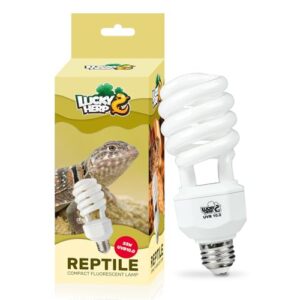
The LckyY UVB 10.0 is a compact fluorescent bulb built for reptiles that need strong UVB exposure. At 23W, it puts out 10% UVB and 30% UVA, supporting vitamin D3 synthesis and calcium metabolism in your corn snake.
It fits standard E26 bases, so no special fixtures are needed. The rated lifespan runs up to 12,000 hours, but plan to replace it every 6 to 12 months to keep UVB output effective and your snake’s health on track.
| Best For | Desert reptile owners — especially those keeping bearded dragons, lizards, or snakes — who need strong, reliable UVB and UVA output to keep their pets healthy. |
|---|---|
| UVB Type | 10.0 UVB |
| UVA Output | 30% UVA |
| Power (Watts) | 23W |
| Material | Glass |
| Reptile Suitability | Desert reptiles |
| Vitamin D3 Support | Yes |
| Additional Features |
|
- Puts out 10% UVB and 30% UVA, giving desert reptiles what they need to produce Vitamin D3 and absorb calcium properly
- Fits standard E26 bases, so you don’t need a special fixture to get it up and running
- High color rendering (90% CRI) means your reptile’s enclosure looks natural and bright
- UVB output degrades over time, so you’ll need to swap it out every 6–12 months even if it still lights up
- Some users ran into compatibility issues with certain lamp holders or voltage setups
- A handful of buyers reported flickering or bulbs that stopped working sooner than expected
2. REPTIDLDB T5 8W UVB Light
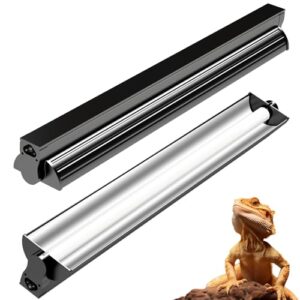
If you want something a bit slimmer and more fixture‑ready, the REPTIDLDB T5 8W is worth a look. It measures just 12 inches long and runs on only 8 watts, making it a natural fit for smaller corn snake enclosures.
Despite the low power draw, it delivers 10% UVB and 30% UVA output through an alloy reflective layer that pushes light where it counts. The built‑in T5 HO electronic ballast eliminates flickering, and the replaceable bulb design keeps long‑term maintenance simple.
| Best For | Small reptile owners — especially those with corn snakes or compact desert setups — who want solid UVB coverage without a bulky fixture. |
|---|---|
| UVB Type | 10.0 UVB |
| UVA Output | 30% UVA |
| Power (Watts) | 8W |
| Material | Aluminum |
| Reptile Suitability | Desert & tropical |
| Vitamin D3 Support | Yes |
| Additional Features |
|
- Puts out 10% UVB and 30% UVA despite only pulling 8 watts, so you’re not paying much on your energy bill
- The alloy reflective layer does a good job directing light into the enclosure instead of wasting it
- Replaceable bulb means you don’t have to toss the whole unit when it burns out
- Some users noticed the bulb holder starting to peel and crinkle over time, which isn’t a great sign for durability
- At 12 inches, it’s great for smaller tanks but won’t cut it for larger enclosures
- You’ll need to budget for replacement bulbs down the road since UVB output fades before the bulb fully dies
3. QZQ T5 UVB Reptile Light Fixture
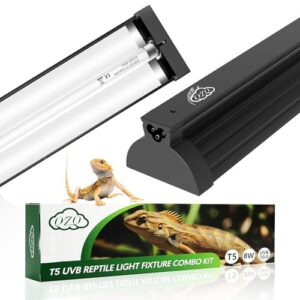
Another solid option in the same compact T5 category is the QZQ T5 UVB Reptile Light Fixture.
It runs on just 8 watts, weighs barely over a pound, and fits comfortably on most standard enclosures at 13.27 inches long.
The curved internal reflector pushes 10% UVB and 30% UVA directly down into the basking zone, which is exactly where your corn snake needs it.
Mounting is straightforward using the included clips, and the 5.9-foot detachable cord reaches most outlets without hassle.
| Best For | Reptile owners with bearded dragons, tortoises, or lizards who want an affordable, easy-to-install T5 UVB setup that doesn’t take up much space. |
|---|---|
| UVB Type | 10.0 UVB |
| UVA Output | 30% UVA |
| Power (Watts) | 8W |
| Material | Plastic |
| Reptile Suitability | Desert & tropical |
| Vitamin D3 Support | Yes |
| Additional Features |
|
- Strong UVB and UVA output (10% / 30%) with a curved reflector that directs light right where your reptile needs it
- Super lightweight at just over a pound, with a detachable 5.9ft cord that makes setup and repositioning easy
- Only draws 8 watts, so it won’t spike your electricity bill during long daily use
- Some users have reported the reflective coating peeling over time, which can reduce light efficiency
- Bulb lifespan can be hit or miss — don’t count on it lasting much beyond six months
- You’ll want to be careful removing the protective blue film during setup, as it’s easy to accidentally scratch or damage the reflector
4. REPTI ZOO UVB Reptile Light
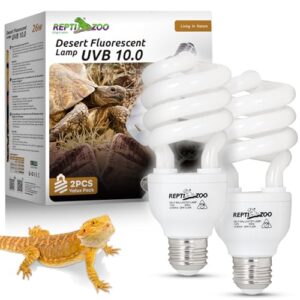
If you’re ready to scale up, the REPTI ZOO UVB Reptile Light delivers in a bigger package. It’s a T5 HO combo kit — meaning the hood, reflector, and tube come together as one plug-and-play unit. No separate ballast hunting is required.
The polished curved reflector pushes UVB directly down into the enclosure, and you can choose the 5.0 tube for corn snake‑appropriate UVB levels. Sizes run from 24W up to 54W, matching tanks from 24 to 48 inches.
| Best For | Reptile owners who keep tropical and subtropical species like bearded dragons, tortoises, or lizards and want a reliable dual-pack UVB bulb setup without overspending. |
|---|---|
| UVB Type | 10.0 UVB |
| UVA Output | 30% UVA |
| Power (Watts) | 26W |
| Material | ABS |
| Reptile Suitability | Tropical & subtropical |
| Vitamin D3 Support | Yes |
| Additional Features |
|
- Emits both 5% UVB and 30% UVA, giving your reptile the light it needs for healthy bones and natural behavior
- Easy to install — standard E26 socket means no special fixtures or adapters
- Comes as a two-pack, so you’ve got a spare ready when you need it
- The bulb length can be too long for some dome fixtures, which could create a tipping or safety hazard
- Durability is a bit of an unknown — the low price has some buyers wondering how long these will actually last
- Not universally compatible, so you’ll want to double-check your fixture before buying
5. Hygger Zoo 13W UVB Reptile Light
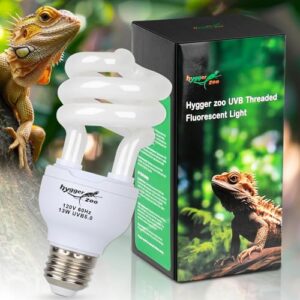
For smaller enclosures where a full T5 fixture feels like overkill, the Hygger Zoo 13W UVB Reptile Light fills that gap cleanly. This compact fluorescent screws into a standard E26 socket, so setup takes minutes.
It delivers 5% UVB and 30% UVA, which facilitates vitamin D3 synthesis without overwhelming a corn snake’s crepuscular preference for moderate light. Mount it 8 to 15 inches above the basking surface, and plan on replacing it every 6 to 12 months.
| Best For | Rainforest reptile owners with smaller enclosures who need a simple, socket-ready UVB bulb without the bulk of a full T5 setup. |
|---|---|
| UVB Type | 5.0 UVB |
| UVA Output | 30% UVA |
| Power (Watts) | 13W |
| Material | Quartz Glass |
| Reptile Suitability | Rainforest reptiles |
| Vitamin D3 Support | Yes |
| Additional Features |
|
- Easy E26 screw-in install — no special fixture needed
- Solid 5% UVB and 30% UVA output supports D3 synthesis and overall reptile health
- Compact size fits shallow domes where larger bulbs just won’t work
- Needs to be replaced at least once a year, which adds up over time
- Not a good fit for desert reptiles that need a stronger 10.0 UVB spectrum
- Some users have reported early burnout or premature malfunctions
6. MRREPTILE 13W UVB Reptile Light
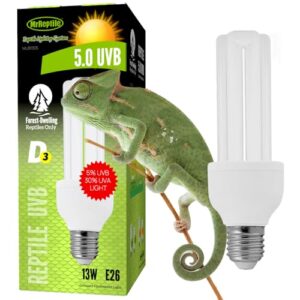
MRREPTILE 13W UVB Reptile Light is another compact fluorescent option worth considering for smaller corn snake setups.
It screws into a standard E26 or E27 socket and uses UV-transmitting glass to increase output.
Real-world measurements show around 2 UVI at 8 inches — right in the 2.0–3.0 sweet spot corn snakes need.
Keep it above mesh, not glass, or UVB won’t reach your snake.
Replace it every 6 to 12 months, and pair it with a separate heat source.
| Best For | Owners of smaller reptile setups — especially tropical species like chameleons, geckos, and turtles — who need a compact, affordable UVB supplement. |
|---|---|
| UVB Type | 5.0 UVB |
| UVA Output | Not specified |
| Power (Watts) | 13W |
| Material | Glass |
| Reptile Suitability | Tropical reptiles |
| Vitamin D3 Support | Yes |
| Additional Features |
|
- Screws into a standard E26/E27 socket, so no special fixture needed
- UV-transmitting glass helps push more UVB output than regular bulbs
- Flexible mounting — works vertically or horizontally depending on your setup
- Real-world UVB readings run lower than advertised, so it’s better as a supplement than a primary source
- Won’t work through glass tops — mesh only
- Some users report early burnout, so lifespan can be hit or miss
7. Hygger Zoo Adjustable UVB Reptile Light
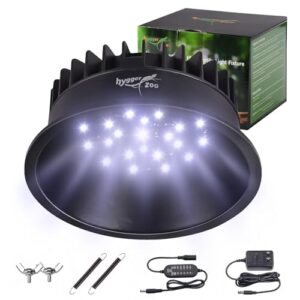
The Hygger Zoo Adjustable UVB Reptile Light stands out because it gives you real control. Five UVB modes — from 2.0 up to 12.0 — let you dial in exactly the gentle exposure corn snakes need, generally UVB 2.0 or 5.0 above a mesh lid.
The LED design runs cool, which matters for keeping temperatures stable. A built‑in timer manages your 12‑hour photoperiod automatically. Its slim bar also creates a UV gradient, so your snake can choose light or shade freely.
| Best For | Reptile owners who want precise UVB control for species like bearded dragons, geckos, and turtles — or corn snakes needing lower, adjustable exposure. |
|---|---|
| UVB Type | Adjustable UVB |
| UVA Output | Not specified |
| Power (Watts) | Not specified |
| Material | Aluminum |
| Reptile Suitability | Various species |
| Vitamin D3 Support | Yes |
| Additional Features |
|
- Multiple UVB modes let you fine-tune light intensity to match your reptile’s specific needs
- Cool-running LED design helps keep enclosure temps stable and predictable
- Built-in timer takes the guesswork out of maintaining a consistent day/night cycle
- The timer can be unreliable when used alongside the adjustable UVB feature
- Light may not restart automatically after a timer cycle — you might need to reset it manually
- Getting the best results takes some trial and error during initial setup
8. REPTI ZOO Tropical UVB Light 15W
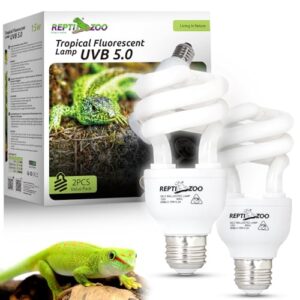
The REPTI ZOO Tropical UVB Light 15W is a compact CFL-style bulb that delivers 5% UVB output — right in the sweet spot for corn snakes. At just 15 watts, it won’t overheat your enclosure, and the E26 screw base fits most standard dome fixtures.
Mount it above a mesh lid, keeping the basking surface about 20–30 centimeters below the bulb.
UVB output fades before the bulb dims, so replace it every 6 months to keep your snake’s calcium metabolism on track.
| Best For | Reptile and amphibian owners keeping tropical or subtropical species who need reliable, affordable UVB coverage without overheating their enclosure. |
|---|---|
| UVB Type | 5.0 UVB |
| UVA Output | 30% UVA |
| Power (Watts) | 15W |
| Material | ABS |
| Reptile Suitability | Tropical & subtropical |
| Vitamin D3 Support | Yes |
| Additional Features |
|
- Comes as a dual-pack, so you’ve got a spare ready when it’s time to swap bulbs every 6 months
- 5% UVB hits the sweet spot for most tropical reptiles, supporting healthy calcium absorption and natural behavior
- Standard E26 base means it fits most dome fixtures you probably already own
- Not a great fit for desert species or anything that needs higher UVB intensity
- A few customers have reported bulbs dying well before the 10,000-hour mark
- UVB output fades silently before the bulb burns out, so you’ll need to stay on top of replacements even when it still looks bright
9. Hygger Zoo Dimmable UVB Reptile Light
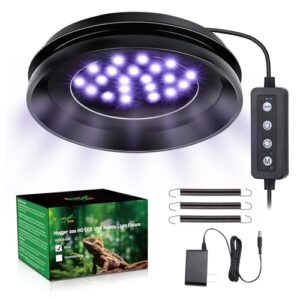
Five preset UVB levels make this light unusually adaptable. The Hygger Zoo Dimmable UVB Reptile Light cycles through 2.0, 5.0, 10.0, 12.0, and a near-dark night mode — and for corn snakes, the 2.0 or 5.0 setting hits the right range.
Mount it 8–15 inches above the basking surface, set the built-in timer to 12 hours, and you’re done. At 6W, it draws almost no power, and the LED design holds stable UVB output far longer than a standard CFL bulb.
| Best For | Reptile owners who want precise UVB control for species like bearded dragons, geckos, turtles, and corn snakes without running up their energy bill. |
|---|---|
| UVB Type | LED UVB |
| UVA Output | Not specified |
| Power (Watts) | 6W |
| Material | Semiconductor |
| Reptile Suitability | Various species |
| Vitamin D3 Support | Yes |
| Additional Features |
|
- Five UVB presets (including a night mode) give you real flexibility to match your reptile’s natural environment
- At 6W, it’s incredibly energy-efficient and the LED holds stable UVB output much longer than a CFL bulb
- Three installation options and a built-in timer make setup quick and hassle-free
- Doesn’t produce heat, so you’ll still need a separate basking lamp for species that need warmth
- Not a full-spectrum light, which means it won’t cover every lighting need on its own
- The hanging hooks feel a little flimsy and could be more secure
10. EnchOrch LED UVB UVB Reptile Light
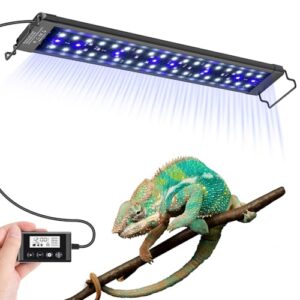
The EnchOrch LED UVB Reptile Light packs a lot into a slim 20.3‑inch bar. Its three dedicated UVB diodes, paired with UVA and visible light LEDs, deliver a broad wash of UV across your enclosure without the bulk of a T5 tube.
At 13–15 watts, it runs cool, so you’ll still need a separate heat source. Mount it 10–13 inches above the basking surface and verify UVI levels with a Solarmeter — the 10.0 rating needs real‑world confirmation for corn snakes.
| Best For | Reptile owners who want an all-in-one UVA/UVB LED light for tropical or desert species like bearded dragons, turtles, and snakes. |
|---|---|
| UVB Type | LED UVB |
| UVA Output | Not specified |
| Power (Watts) | Not specified |
| Material | Aluminum Alloy |
| Reptile Suitability | Tropical & desert |
| Vitamin D3 Support | Yes |
| Additional Features |
|
- Three preset lighting modes (Rainforest, Desert, Reproduction) plus manual control make it easy to match your reptile’s natural habitat
- Built-in 24-hour auto timer and 10 dimming levels mean you can set it and forget it
- Slim, lightweight aluminum bar fits most enclosures without taking up much space
- UVB output degrades over time and needs a Solarmeter to verify — you can’t just trust the bulb looks bright
- The timer and preset modes have given some users headaches, and custom scheduling isn’t really an option
- Still needs a separate heat source since it runs cool, so it’s not a complete setup on its own
Proper Setup and Maintenance of UVB Lighting
Getting UVB lighting right isn’t just about buying a good bulb — it’s also about where you put it, how close it sits to your snake, and how often you swap it out.
Each of those steps directly affects how much UV your corn snake actually receives. Here’s what you need to know to set everything up correctly and keep it working.
Ideal Fixture Positioning and Mounting
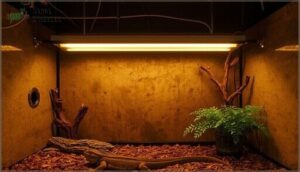
Where you mount your UVB lighting fixture changes everything about how well your corn snake actually uses it.
- Mount the fixture on the ceiling of the enclosure, never sideways on walls
- Use secure bracket security hardware — screws or clips, not adhesive hooks
- Cover two-thirds of the enclosure length for proper gradient placement
- Route cables outside for clean, safe cable routing
- Use reflector-equipped fixtures for best reflector alignment toward the basking spot
Safe Distance From Basking Surface
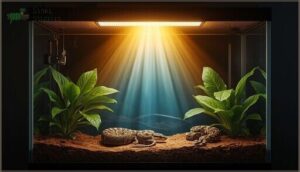
Getting fixture placement right sets the stage, but bulb distance calculations decide whether your corn snake actually benefits.
For T5 HO UVB lighting over mesh, position the basking spot 7 to 10 inches below the bulb — mesh attenuation cuts output by up to 50%.
Use UVI metering to confirm a 2.0 to 3.0 reading at the basking spot, then build a shade gradient with perch height variation throughout the enclosure.
Cleaning and Replacing UVB Bulbs
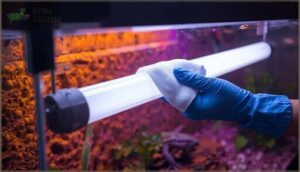
Once your distance is dialed in, keeping that output consistent comes down to regular cleaning and replacing UVB bulbs on schedule.
- Dust Removal: Wipe bulbs and reflectors every 2–4 weeks with a dry paper towel — dust silently cuts UV output.
- Safe Cleaning Products: Use alcohol-based sprays on cool fixtures only; avoid bleach or ammonia near your enclosure.
- Bulb Lifespan Tracking: Write the install date on each T5 tube and replace it every 10–12 months, regardless of visible brightness.
Monitoring Health and Adjusting UVB Exposure
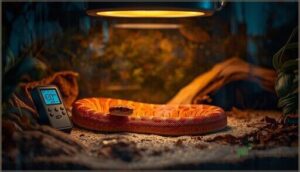
Getting the light set up is only half the job — the other half is watching how your snake actually reacts to it. Your corn snake’s behavior, appetite, and activity levels will tell you a lot about whether your UVB setup is working or needs a tweak.
Here’s what to what to look and how to adjust when something feels off.
Behavioral Signs of Proper Lighting
Your corn snake tells you everything through its behavior. When UVB lighting and lighting cycles align correctly, you’ll notice active basking sessions of 10–30 minutes, exploratory movement between warm and cool zones, and calm coils during rest.
| Healthy Sign | What It Means |
|---|---|
| Increased appetite | Proper snake health and wellness |
| Regular shedding cycles | Balanced UVB lighting absorption |
Confident visits to the basking spot confirm everything’s dialed in.
Recognizing Over- or Under-exposure
Good behavior is your baseline — but watch for when things shift.
Too little UVB exposure shows up as jaw softness, shedding issues like retained patches, and sluggish growth.
Too much brings skin irritation along the dorsal surface and eye cloudiness near the basking spot.
Use a UV meter: UVI thresholds below 0.5 or above 3.0 signal a snake health and wellness problem worth correcting immediately.
Adjusting Lighting Schedule and Intensity
Fine-tuning your lighting setup is where corn snake care and maintenance really clicks into place. Shift photoperiod gradually — one hour every few days — when making seasonal photoperiod shifts between summer (13 hours) and winter (10 hours).
Use timer synchronization to automate consistency. A UVB meter calibration check confirms your UVI stays in the 1.0–3.0 range, and dimming fixture use or gradual light change adjustments handle the rest.
Frequently Asked Questions (FAQs)
Which UVB light for corn snakes?
Imagine sunlight filtering through forest leaves—your corn snake needs that gentle UVB glow.
Choose a T5 HO 0 or 6% tube, considering budget, enclosure material, and seasonal photoperiod.
Always check UVI with a meter for species‑specific gradients.
Is 0 UVB good for corn snakes?
Yes, a 0 UVB light works well for corn snakes. It delivers a safe UVI of 0 to 0 at the basking spot, matching their naturally low-to-moderate lighting requirements perfectly.
Does my corn snake need an UV light?
Corn snakes don’t strictly need UVB lighting to survive, but low-level UVB genuinely helps them thrive — supporting vitamin D3 production, calcium absorption, and more natural behavior overall.
Is too much UVB bad for snakes?
Too much UVB exposure is genuinely harmful. Overexposure symptoms include squinting, cloudy eyes, and skin burns — especially in albino morphs with high morph sensitivity due to reduced melanin protection.
Can corn snakes share UVB lighting with other reptiles?
Technically, no.
Corn snakes occupy lower Species UVB Zones than most lizards, and Mixed‑Species Housing Risks — stress, disease, and mismatched Animal Lighting Requirements — make sharing a single reptile enclosure setup genuinely dangerous.
How does seasonal photoperiod affect corn snake behavior?
Nature keeps its own calendar — and your corn snake reads it closely.
Photoperiod shapes activity cycles, brumation triggers, feeding response, and reproductive cues by regulating its circadian rhythm through shifting day-night cycles.
Conclusion
Think of UVB lighting the way old-timers thought about feed quality—you can’t see the damage until it’s already done. The right reptile UVB light for corn snake setups isn’t optional equipment; it’s the foundation your snake’s entire biology depends on.
Calcium metabolism, bone density, long-term vitality—all of it traces back to this one decision. Choose a bulb that matches your enclosure, replace it on schedule, and your snake will reward that consistency for years.
- https://www.reptilecentre.com/blogs/reptile-blog/which-ferguson-zone-are-corn-snakes
- https://www.zenhabitats.com/blogs/reptile-care-sheets-resources/corn-snake-complete-lighting-and-heating-guide
- https://www.reptileknowledge.com/reptile-pedia/do-corn-snakes-need-uv
- https://talis-us.com/blogs/news/understanding-uvb-needs-for-corn-snakes
- https://www.knobcreeknaturalist.com/blog/lighting-and-uvb-for-corn-snake