
This site is supported by our readers. We may earn a commission, at no cost to you, if you purchase through links.

Young reptiles grow at staggering rates—bearded dragons can triple their size in eight weeks, and hatchling turtles develop their entire shell structure within their first year. This explosive development demands a precise balance of calcium, vitamin D3, and micronutrients that captive diets rarely provide on their own.
Without proper supplementation, you’ll see metabolic bone disease, stunted growth, and compromised immune function before your juvenile reaches adulthood.
Reptile vitamins for young reptiles bridge the nutritional gaps between what feeders offer and what rapidly developing skeletal and organ systems actually need. The right supplement protocol, matched to your species’ specific requirements and combined with UVB exposure, sets the foundation for a healthy adult reptile.
Table Of Contents
- Key Takeaways
- Essential Vitamins for Young Reptiles
- Nutritional Needs by Reptile Species
- Signs of Vitamin Deficiency in Juvenile Reptiles
- Administering Reptile Vitamins Safely
- Preventing Vitamin Overdose and Toxicity
- Top 9 Reptile Vitamin Supplements Reviewed
- 1. Zoo Med Reptile Vitamins Supplement
- 2. Herptivite Reptile Multivitamin Supplement
- 3. Zilla Reptile Vitamin Supplement Spray
- 4. Exo Terra Reptile Multivitamin Powder
- 5. Fluker’s Reptile Vitamin Supplement
- 6. Fluker’s Reptile Calcium Supplement
- 7. Exo Terra Reptile Vitamin Powder Supplement
- 8. Gargeer Reptile Probiotic Supplement
- 9. Exo Terra Calcium Powder Supplement
- Choosing The Right Supplement for Your Reptile
- Frequently Asked Questions (FAQs)
- What vitamins do reptiles need?
- What supplements does my beardie need?
- Is calcium without D3 better than D3 for reptiles?
- Is too much Vitamin D3 bad for bearded dragons?
- Can homemade diets replace commercial reptile supplements?
- How often should feeder insects be dusted?
- Do all young reptiles need vitamin supplementation?
- What role does humidity play in nutrient absorption?
- Should supplements change during breeding season preparations?
- Conclusion
Key Takeaways
- Young reptiles require precise calcium-to-phosphorus ratios (1.5:1 to 2:1) paired with vitamin D3 to prevent metabolic bone disease, which affects 70% of captive reptiles with poor nutrition.
- Supplementation needs vary dramatically by species—snakes consume whole prey with naturally balanced nutrients, while insect-eating lizards demand frequent calcium dusting and turtles need daily calcium carbonate during rapid growth phases.
- Vitamin A from beta carotene reduces toxicity risk compared to preformed vitamin A, while excess vitamin D3 can cause irreversible kidney damage and soft tissue calcification in juveniles.
- Effective supplementation combines species-specific powder dusting or gut-loading schedules with proper UVB lighting, adjusting vitamin D3 frequency based on natural UV exposure to avoid both deficiency and overdose.
Essential Vitamins for Young Reptiles
Young reptiles don’t just need food—they need the right nutritional building blocks to support rapid bone development, immune function, and long-term health. Calcium, vitamin D3, and a balanced suite of essential vitamins work together to prevent devastating conditions like metabolic bone disease, which affects 70% of captive reptiles with poor nutrition.
Recognizing early warning signs like lethargy, tremors, or loss of appetite can help you intervene before deficiencies escalate into serious reptile illnesses requiring intensive treatment.
Young reptiles need calcium, vitamin D3, and essential vitamins working together to prevent metabolic bone disease, which affects 70% of captive reptiles with poor nutrition
Understanding what each vitamin does, and how they interact, gives you the foundation to make informed choices for your growing reptile.
Importance of Calcium and Vitamin D3
Calcium balance and vitamin D3 role form the cornerstone of bone health in growing reptiles. You need both nutrients working together because D3 unlocks calcium absorption through the gut wall, while calcium builds the dense skeleton your juvenile requires.
Without this partnership, three critical failures emerge:
- Soft, rubbery limbs from demineralized bones
- Blocked nutrient absorption despite calcium-rich diets
- Irreversible skeletal deformities as growth accelerates
Insufficient calcium or improper UVB light exposure can cause serious bone disease risks in young reptiles.
Role of Vitamins A, E, and B-complex
Beyond bone density, your juvenile reptile needs vitamin A for clear vision and smooth skin, vitamin E to guard cells from metabolic stress, and B-complex vitamins to power energy use during rapid growth. These nutrient balance pillars work with vitamin D3 and calcium to fuel immune support and normal development—deficiencies show up as cloudy eyes, weak muscles, or poor wound healing, especially in fast-growing hatchlings.
Vitamin supplements bridge gaps when live prey or plant matter alone can’t deliver balanced vitamin interactions your reptile metabolism demands. Monitoring your pet’s health may include checking to better understand and manage their nutritional needs.
| Vitamin | Core Function in Young Reptiles |
|---|---|
| Vitamin A | Maintains vision, skin health, and respiratory lining integrity |
| Vitamin E | Protects cell membranes as antioxidant, aids muscle function |
| B-complex | Powers metabolism, nerve function, and energy from food |
| Combined Role | Strengthens immunity and coordinates growth factors with calcium |
Calcium-to-phosphorus Ratio Explained
Those micronutrients won’t deliver bone health without proper mineral absorption—your juvenile needs calcium-to-phosphorus ratios between 1.5:1 and 2:1 to support fast skeletal growth.
Most feeder insects carry far more phosphorus than calcium, so elevated phosphorus levels block calcium uptake even when vitamin D3 is present.
Correcting nutrient ratios through gut-loading and dusting keeps calcium balance strong and prevents the body from stealing minerals from developing bones.
Risks of Vitamin Deficiencies in Juveniles
When vitamin deficiency strikes your juvenile reptile, the health consequences appear fast—you’ll see soft jaws, curved spines, and muscle tremors within weeks as metabolic bone disease takes hold. Nutrient imbalance doesn’t wait; bone deformity becomes permanent if you don’t correct calcium and vitamin D3 shortages early, and vitamin A deficiency triggers swollen eyes that can lead to blindness.
Nutritional Needs by Reptile Species

Not all young reptiles eat the same way, and that means their vitamin needs vary dramatically depending on whether you’re raising a snake, lizard, or turtle.
Each group requires different ratios of calcium, protein, and micronutrients to support healthy bone development and growth.
Let’s break down what your specific species needs to thrive.
Differences Between Snakes, Lizards, and Turtles
Each juvenile reptile brings distinct dietary adaptations and feeding habits shaped by evolution. You’ll notice critical species variations in how snakes, lizards, and turtles process reptile nutrition and dietary supplements:
- Snakes consume whole prey that naturally balances calcium and vitamin D3, requiring minimal reptile vitamins compared to other species.
- Lizards depend heavily on insect-heavy diets, demanding frequent calcium dusting to prevent deficiencies.
- Turtles need balanced calcium needs across plant and protein sources with careful supplementation schedules.
Species-specific Vitamin Requirements
You’ll tailor reptile vitamins and calcium needs based on sharp species variations in dietary balance.
Young green iguanas require daily calcium dusting with alternating vitamin D3 formulas, while juvenile bearded dragons need calcium at almost every feeding to counter poor calcium-to-phosphorus ratios in insects.
Hatchling red-eared sliders demand daily calcium carbonate, whereas corn snakes benefit from occasional all-in-one supplementation on whole prey.
Protein and Mineral Considerations for Growth
Growing reptiles burn through protein to build muscle, skin, and organs—hatchling turtles may need around 40% dietary protein for peak growth and development.
You’ll pair that protein balance with calcium and phosphorus at a 2:1 mineral ratio to support bone mineralization, since insect diets skew high in phosphorus.
Proper nutrient absorption depends on vitamin D3, making reptile vitamins and dietary supplements critical for meeting developmental needs.
Signs of Vitamin Deficiency in Juvenile Reptiles
Spotting a vitamin deficiency early can mean the difference between a thriving juvenile and one headed for serious health problems. Your young reptile won’t tell you it’s sick, but its body will show you subtle warning signs that something’s off with its nutrition.
Here’s what you need to watch for as your reptile grows.
Early Symptoms of Metabolic Bone Disease
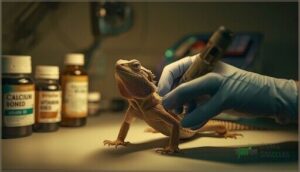
When calcium and vitamin D3 fall short of your juvenile reptile’s nutritional requirements, early metabolic bone disease arrives quietly. You’ll notice subtle signs first—decreased appetite, slight muscle twitching in the toes, or mild jaw swelling around the mouth edges.
As the condition progresses, limb weakness and neuromuscular signs emerge, followed by visible bone deformities, making early detection vital for preventing permanent skeletal damage.
Vitamin a Deficiency Indicators

Eye Problems signal the most visible early warning of vitamin A deficiency in your young reptile. Swollen eyelids that won’t open, excess mucus buildup, and squinting tell you hypovitaminosis A is taking hold.
You’ll also spot Skin Issues like rough, thickened patches and difficult shedding, while Feeding Difficulties from sore mouth corners slow weight gain.
Growth Abnormalities and lethargy follow when nutritional deficiencies persist untreated.
Impact on Immune Function and Development
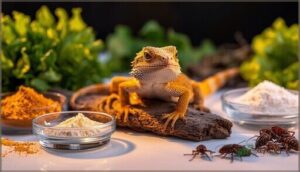
When vitamin shortfalls persist, your young reptile’s immune system loses its edge against infections. Reptile vitamin supplements bridge these gaps, supporting immune function and meeting nutritional requirements that captive diets often lack.
Poor Nutrient Absorption from calcium and vitamin D3 deficiency disrupts Cellular Defense and Growth Factors essential for Developmental Health. Proper reptile health and nutrition guarantee your juvenile builds resilience during critical growth windows.
Administering Reptile Vitamins Safely

Knowing how to properly administer reptile vitamins can make the difference between a thriving juvenile and one struggling with deficiencies. You’ll need to understand correct dosing, choose the right delivery method for your species, and coordinate supplements with your lighting setup to avoid both deficiencies and toxicity.
Here’s what you need to know to supplement safely and effectively.
Dosage Guidelines for Young Reptiles
Accurately tailoring dosage planning to your juvenile reptile’s age and species prevents both deficiency and vitamin toxicity while supporting healthy bone development. Feeding schedules that rotate dietary supplements help you maintain proper calcium balance without risking overdose, particularly when combining reptile vitamin products with UVB exposure.
- Hatchling insect-eaters usually receive calcium without D3 at five to seven feedings weekly, matching their rapid skeletal growth.
- Indoor young tortoises need lightly dusted salads with calcium at most meals plus multivitamins once weekly for even shell development.
- Keepers must reassess supplement rotation at weaning, first major shed, and sexual maturity as nutritional requirements shift with slowing growth.
Methods: Powder, Spray, and Gut Loading
Once you’ve settled on the right dosing schedule, you can choose from powder application, spray techniques, or gut loading to deliver those vitamins. Each feeding strategy offers unique advantages for young reptiles, so many keepers rotate supplement methods throughout the week to guarantee thorough digestive support and balanced nutrient intake.
| Method | Best For | Application Frequency |
|---|---|---|
| Powder Supplements | Insect-eaters | Every 5–7 feedings |
| Spray Versions | Herbivorous juveniles | 2–3 times weekly |
| Gut Loading | All feeder insects | Continuous diet |
| Powder on Greens | Tortoises, iguanas | Most salad servings |
| Combined Rotation | Omnivorous species | Alternating schedule |
Dusting live feeders in a cup coats crickets and roaches lightly, while spray techniques stick better to moist leafy greens. Gut health improves when you feed insects nutrient-dense vegetables for 24–48 hours before offering them, ensuring reptile vitamins reach your juvenile from the inside out.
Combining Supplements With UVB Lighting
When UVB lighting meets your supplement schedule, photoperiod management becomes your most powerful tool. You’ll maintain calcium balance by offering plain calcium on most feeding days while UVB exposure drives vitamin D3 synthesis naturally, then reserve calcium and vitamin supplementation with D3 for once or twice weekly use.
Strong UVB setups let you reduce reptile vitamins supplements markedly, preventing the soft tissue damage that excess D3 can trigger in fast-growing juveniles.
Preventing Vitamin Overdose and Toxicity
While supplements are essential for young reptiles, you can actually overdo it, and the consequences can be just as serious as deficiency. Too much vitamin D3, in particular, can damage your reptile’s kidneys and soft tissues, while excessive calcium disrupts other critical mineral balances.
Here’s what you need to watch for to keep supplementation safe and effective.
Dangers of Excess Vitamin D3
Too much of a good thing can turn deadly—excess vitamin D3 drives calcium levels so high that soft tissue calcification begins in blood vessels, kidneys, and even the heart.
Reptile kidney damage often appears first as increased thirst and dilute urine, then progresses to lethargy, poor appetite, and potentially fatal kidney failure as hypervitaminosis symptoms worsen in your young reptile.
Monitoring Calcium and Phosphorus Intake
You can track calcium balance and phosphorus levels by recording weekly feeder types and checking published dietary ratios. Growing reptiles need roughly 2 to 1 calcium-to-phosphorus ratios for proper mineral absorption.
Dust crickets and mealworms with high-calcium reptile vitamins before feeding, since these insects naturally run 1 to 9 phosphorus-heavy, which triggers metabolic bone disease without correction through careful nutrient monitoring.
Recognizing Symptoms of Vitamin Toxicity
Vitamin overload often announces itself through dry, flaky skin that won’t resolve after shedding—a hallmark of vitamin A toxicity. Watch for lethargy, appetite loss, and reluctance to move, since nutrient imbalance disrupts normal reptile behavior and energy.
Health monitoring becomes vital when you spot swollen eyelids, skin cracks, or wobbly coordination, because these toxicity signs point to dangerous vitamin supplement excess requiring immediate dietary correction.
Top 9 Reptile Vitamin Supplements Reviewed
You’ll find nine supplements below that cover everything from broad-spectrum multivitamins to targeted calcium powders and advanced probiotic formulations. Each one has been selected based on ingredient quality, species compatibility, and real-world effectiveness for supporting juvenile growth.
I’ve organized them so you can quickly compare options and match the right product to your young reptile’s developmental needs.
1. Zoo Med Reptile Vitamins Supplement
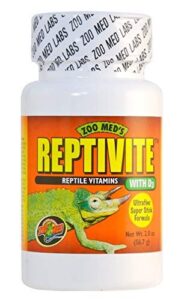
Zoo Med Reptivite with D3 delivers a complete multivitamin formula built around the 2:1 calcium-to-phosphorus ratio your growing reptile needs for strong bones.
This ultra-fine powder contains 220,264 IU of vitamin A per kilogram to support healthy skin and eyes, plus 22,907 IU of vitamin D3 for calcium absorption, alongside essential B vitamins and trace minerals including manganese and zinc.
You’ll also find a complete amino acid complex—one of the first supplements to include this profile—helping juvenile reptiles build muscle tissue efficiently.
| Best For | Reptile owners looking for a complete multivitamin that supports bone growth, immune health, and overall development in species like geckos, turtles, and frogs. |
|---|---|
| Form | Powder |
| Brand | Zoo Med |
| Weight | 1.6 ounces |
| Age Range | All Life Stages |
| Key Ingredient | Calcium & Vitamin D3 |
| Application Method | Dust on insects |
| Additional Features |
|
- Contains a full amino acid complex alongside the 2:1 calcium-to-phosphorus ratio that promotes strong bone development
- Includes high levels of vitamin A (220,264 IU/kg) and D3 (22,907 IU/kg) for healthy skin, eyes, and calcium absorption
- Works across all life stages and can be easily dusted on insects or mixed with water
- The powder texture isn’t always fine enough, so it may fall off food or insects before your pet eats it
- Bottles sometimes arrive less than full, which can feel like you’re getting shorted
- May not work for every reptile species, so check with your vet before switching supplements
2. Herptivite Reptile Multivitamin Supplement
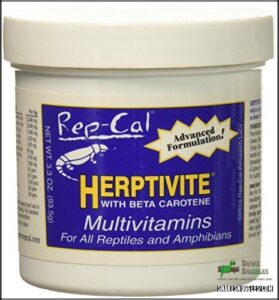
Herptivite stands apart by using beta carotene instead of preformed vitamin A, which lowers toxicity risk for your young reptile.
The formula delivers 5,500 IU of vitamin E per kilogram and 2,200 mg of vitamin C alongside a complete B-vitamin complex to fuel growth. You’ll find 4.4 percent calcium and a full amino acid profile—including glutamic acid and leucine—on a base of alfalfa and kelp.
Mix it 1:1 with calcium powder, dust your feeder insects, and you’re giving juveniles balanced nutrition without over-supplementation.
| Best For | Reptile owners who want a safer multivitamin for young or sensitive species, especially if they’re concerned about vitamin A toxicity. |
|---|---|
| Form | Powder |
| Brand | Rep-Cal |
| Weight | 3.3 ounces |
| Age Range | Not specified |
| Key Ingredient | Multivitamins & Minerals |
| Application Method | Dust on food |
| Additional Features |
|
- Uses beta carotene instead of preformed vitamin A, reducing the risk of over-supplementation and toxicity in juveniles
- Packed with high levels of vitamin E (5,500 IU/kg) and vitamin C (2,200 mg) plus a full B-vitamin complex for healthy growth
- Natural ingredient base of alfalfa and kelp with a complete amino acid profile including essential nutrients like glutamic acid and leucine
- Some reptiles may refuse food dusted with this supplement alone, requiring it to be mixed with calcium powder for better acceptance
- Pricier than several competing multivitamin products on the market
- No independent lab testing mentioned, which raises questions about consistency and quality control across batches
3. Zilla Reptile Vitamin Supplement Spray
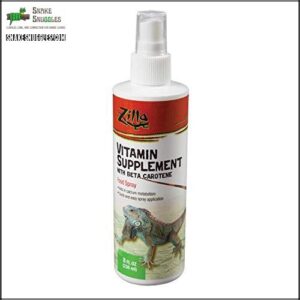
Spraying vitamins directly onto food gives you precision your juvenile reptile needs without the mess of dusting. Zilla’s liquid formula delivers vitamin D3 at 0.21 IU per kilogram alongside high-dose ascorbic acid—1037 mg per kilogram—and a complete B-complex to support energy metabolism and tissue repair.
Beta carotene provides vitamin A safely, reducing hypervitaminosis risk. Shake well, mist onto crickets or greens 15 seconds before feeding, and pair it with a dedicated calcium spray since this product contains only 0.0006 percent calcium.
| Best For | Reptile owners who want precise vitamin supplementation without the hassle of powder dusting, especially for juveniles or picky eaters that avoid coated food. |
|---|---|
| Form | Liquid |
| Brand | Zilla |
| Weight | 0.6 pounds |
| Age Range | Not specified |
| Key Ingredient | Vitamins C, B, D3 |
| Application Method | Spray on food |
| Additional Features |
|
- Spray-on application makes it easy to apply directly to insects or vegetables without mess or waste
- Contains a complete vitamin blend including D3, B-complex, and safe vitamin A from beta carotene
- Works well when paired with calcium spray for comprehensive nutritional coverage
- Sprayer mechanism often sticks or breaks according to user reports
- Contains minimal calcium (0.0006%), so you’ll need a separate calcium supplement
- Not suitable for all species without veterinary guidance
4. Exo Terra Reptile Multivitamin Powder
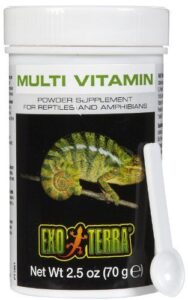
Balanced multivitamins give young reptiles the breadth of sustenance they can’t get from calcium alone, and Exo Terra’s powder formula delivers vitamin A as beta carotene—safer for growing animals—alongside 22,000 IU per kilogram of vitamin D3.
You’ll apply it by mixing one-to-one with calcium powder, then dusting crickets or coating vegetables.
Dried seaweed and yeast provide trace minerals and amino acids, while the 14-20 percent crude protein fosters muscle development.
Guaranteed potency until the printed date keeps your dosing accurate.
| Best For | Reptile owners looking for a well-rounded multivitamin that’s safe for young animals and easy to mix with calcium powder or dust onto feeder insects. |
|---|---|
| Form | Powder |
| Brand | Exo Terra |
| Weight | 0.1 kilograms |
| Age Range | Not specified |
| Key Ingredient | Vitamin A, Amino Acids |
| Application Method | Dust on food |
| Additional Features |
|
- Uses beta-carotene form of vitamin A, which is safer for growing reptiles than preformed vitamin A
- Contains 14-20% crude protein plus amino acids from dried seaweed and yeast to support muscle development
- Guaranteed potency until the expiration date ensures consistent, reliable dosing
- Some pets may refuse food dusted with the powder due to taste preferences
- The gritty texture can be noticeable, though the powder is generally fine
- Hard to measure whether it’s actually improving your pet’s health since effects aren’t immediately visible
5. Fluker’s Reptile Vitamin Supplement
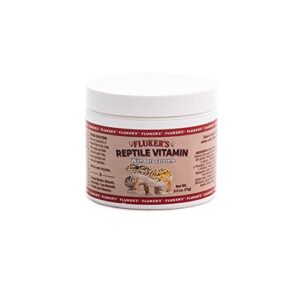
Fluker’s powdered multivitamin brings a different approach: roughly 19.8 percent calcium and 9.9 percent phosphorus by weight yield a 2:1 ratio, while beta carotene sidesteps vitamin A toxicity in juveniles.
You’ll find B-complex vitamins—thiamine through B12—supporting appetite and energy use during rapid growth. Shake feeder insects in a bag to coat them, or mix one tablespoon per pound of chopped vegetables.
Because phosphorus is present, pair this supplement with a phosphorus-free calcium on alternate days to prevent skewed mineral balance in your young gecko or turtle.
| Best For | Reptile owners who want a complete vitamin solution with color enhancers and are willing to rotate it with phosphorus-free calcium for balanced supplementation. |
|---|---|
| Form | Powder |
| Brand | Fluker’s |
| Weight | 3.84 ounces |
| Age Range | All Life Stages |
| Key Ingredient | Beta Carotene |
| Application Method | Dust on food |
| Additional Features |
|
- Contains beta carotene instead of preformed vitamin A, reducing toxicity risk in young reptiles
- Includes B-complex vitamins that support appetite and energy during growth phases
- Easy application by dusting insects or mixing into chopped vegetables
- Contains phosphorus, requiring you to alternate with phosphorus-free calcium to maintain proper mineral ratios
- Doesn’t include a measuring scoop, making dosing less convenient
- Lacks clear frequency guidelines on the label beyond general user reports
6. Fluker’s Reptile Calcium Supplement
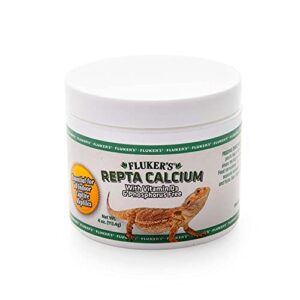
Turning to a phosphorus-free option, Fluker’s calcium with vitamin D3 delivers 38 percent minimum calcium alongside 100,000 IU of D3 per pound—a concentrated mineral boost for indoor juveniles that lack natural sunlight.
Shake crickets in a bag until they’re coated, or dip the hindquarters of pinkie mice before feeding.
If you keep your young bearded dragon outdoors under intense UVB, choose the D3-free formula instead; that prevents vitamin overdose while your animal synthesizes its own D3 naturally.
| Best For | Reptile owners who keep their bearded dragons indoors and need a convenient way to dust feeders with calcium plus D3. |
|---|---|
| Form | Liquid |
| Brand | Fluker’s |
| Weight | 4.48 ounces |
| Age Range | All Life Stages |
| Key Ingredient | Vitamins A, C, D, E |
| Application Method | Dropper dosing |
| Additional Features |
|
- High calcium concentration at 38% ensures strong bone development in growing dragons
- Easy dusting method—just shake crickets in a bag or dip pinkie mice before feeding
- D3-free version available for dragons getting natural UVB outdoors
- No clear dosage guidelines make it tricky to know how much or how often to use
- D3 formula can cause vitamin overdose if your dragon already gets plenty of natural sunlight
- Effectiveness depends on proper storage since powder supplements can degrade over time
7. Exo Terra Reptile Vitamin Powder Supplement
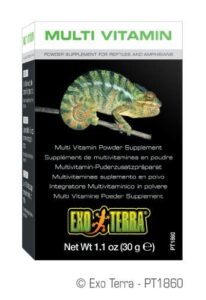
Exo Terra’s Multi Vitamin Powder switches your focus from pure calcium to a complete micronutrient package. You’ll find 90,000 micrograms of vitamin A per kilogram—delivered as beta carotene to sidestep toxicity—plus 22,000 IU of D3 and 100 mg of vitamin E.
Mix one half tablespoon with an equal measure of calcium powder, then shake your crickets or dust your salad greens; that one-to-one ratio covers every feeding without stacking supplements.
Store the container in a cool spot to preserve potency through the printed best-before date.
| Best For | Reptile and amphibian owners looking for a broad-spectrum vitamin supplement to pair with their calcium routine. |
|---|---|
| Form | Powder |
| Brand | Fluker’s |
| Weight | 4 ounces |
| Age Range | Not specified |
| Key Ingredient | Calcium & Vitamin D3 |
| Application Method | Dust on food |
| Additional Features |
|
- Delivers a full range of vitamins including safe beta-carotene vitamin A, D3, and E in one powder
- Simple one-to-one mixing ratio with calcium makes dosing straightforward at every feeding
- Works on both live feeders and fresh greens so you can dust whatever your pet eats
- Texture can be gritty or granular, which may put off picky eaters
- Some reptiles won’t touch it unless you hide it in other foods
- Hard to measure whether it’s actually working since results are subtle and take time
8. Gargeer Reptile Probiotic Supplement
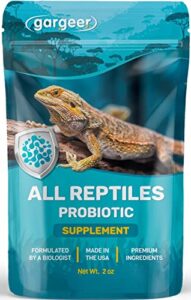
Gargeer’s probiotic powder shifts gears from vitamins to gut health, delivering 200 million colony-forming units of Lactobacillus acidophilus, L. casei, Enterococcus faecium, and Aspergillus oryzae per gram.
Mix one teaspoon per pound of food weekly—either shake it onto crickets in a bag or sprinkle it over salad greens—to stabilize digestion, boost appetite, and reduce harmful bacteria in bearded dragons, snakes, and other species.
A two-ounce bag supplements ten to twelve pounds of food, making it practical when you’re managing multiple enclosures.
| Best For | Reptile owners who want to improve their pet’s digestion, appetite, and immune function through regular probiotic supplementation across multiple enclosures. |
|---|---|
| Form | Powder |
| Brand | Exo Terra |
| Weight | 30 grams |
| Age Range | Not specified |
| Key Ingredient | Vitamins & Minerals |
| Application Method | Dust on food |
| Additional Features |
|
- Delivers 200 million CFUs of four beneficial bacterial strains per gram to support gut health and reduce harmful bacteria
- Easy to administer by mixing with food—just shake onto feeders or sprinkle over greens weekly
- One two-ounce bag supplements ten to twelve pounds of food, making it cost-effective for multi-reptile households
- Dosing instructions (one teaspoon per pound of food weekly) may be impractical for smaller reptiles
- Some customers report receiving broken or damaged products during shipping
- Limited information available on interactions with other supplements or compatibility with specific reptile diets
9. Exo Terra Calcium Powder Supplement
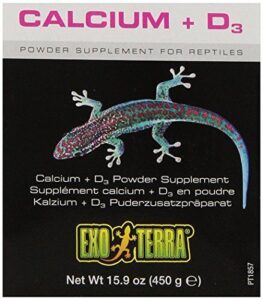
Phosphorus-free formulas matter when bone growth is on the line, and this ultra-fine powder delivers 35 to 37 percent calcium from carbonate and oyster shell flour alongside iron, zinc, manganese, and copper.
Blend one half tablespoon with multivitamin per 500 grams of vegetables for omnivores, or dust crickets lightly before feeding insect eaters.
Because it lacks vitamin D3, you can rotate it with D3-containing supplements to fine-tune intake and sidestep toxicity in sensitive juveniles building skeleton mass.
| Best For | Reptile owners who need a phosphorus-free calcium supplement to support bone health in geckos, bearded dragons, and similar pets without risking vitamin D3 overdose. |
|---|---|
| Form | Powder |
| Brand | Zoo Med |
| Weight | 2 ounces |
| Age Range | All Life Stages |
| Key Ingredient | Probiotics |
| Application Method | Mix with food |
| Additional Features |
|
- Ultra-fine powder sticks easily to insects and vegetables for better coverage and absorption
- Phosphorus-free formula prevents mineral imbalance that can harm bone development
- Can be safely rotated with D3 supplements to customize your pet’s calcium intake
- Doesn’t include vitamin D3, so you’ll need a separate supplement or UVB lighting for proper calcium absorption
- Requires careful measuring—one half tablespoon per 500 grams of food—to avoid under or over-supplementing
- Not suitable for all reptiles without veterinary guidance on proper dosing
Choosing The Right Supplement for Your Reptile
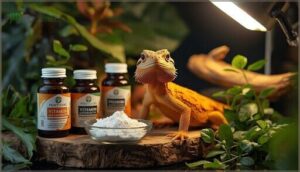
Selecting the right vitamin supplement for your young reptile isn’t just about grabbing the first bottle on the shelf, it requires matching the product’s formulation to your specific species’ nutritional needs and developmental stage.
You’ll need to evaluate ingredient quality, verify the manufacturer’s reputation, and understand how to incorporate the supplement into your daily feeding routine without creating nutritional imbalances.
The following considerations will guide you through making an informed choice that promotes ideal growth and prevents common deficiencies.
Evaluating Ingredients and Species Compatibility
Not all reptile vitamin supplements match every species’ dietary needs, so you must check ingredient lists against your juvenile’s natural diet and calcium-to-phosphorus ratios before purchasing. Nutrient balance and ingredient safety depend on evaluating:
- Vitamin D3 content relative to your UVB lighting setup
- Preformed vitamin A versus beta carotene for species-specific dosing
- Phosphorus-free calcium for insect-eating lizards
- Species matching labels confirming suitability for your reptile type
- Supplement efficacy data supporting healthy reptile nutrition and growth
Importance of Reputable Brands
Choosing a well-known brand ensures you get reptile vitamin supplements with verified quality control and regulatory compliance, protecting your juvenile from contaminated or mislabeled products. Brand transparency means you’ll see exact calcium and vitamin D3 levels on the label, plus customer support if you need dosing help. Product consistency across batches keeps reptile health and nutrition stable through critical growth phases.
| Brand Feature | Benefit for Juveniles |
|---|---|
| Batch Testing | Prevents underdosing or overdosing |
| Clear Labels | Matches calcium ratios to UVB setup |
| Stable Formulas | Avoids sudden nutrient shifts during growth |
Tips for Integrating Supplements Into Daily Care
Set a supplement schedule—calcium at most meals and multivitamins weekly—to prevent metabolic bone disease while maintaining proper calcium-to-phosphorus ratios. Track doses on a calendar near the enclosure to avoid gaps or accidental doubles, ensuring digestive health for your reptile.
Dust insects in a cup before daily feeding so reptile vitamin supplements coat evenly. Adjust vitamin D3 frequency to match your UVB setup for consistent nutrient balance and peak reptile health.
Frequently Asked Questions (FAQs)
What vitamins do reptiles need?
Young reptiles thrive when you provide calcium and vitamin D3 for bone strength, plus vitamins A, E, and B-complex for healthy eyes, skin, and metabolism—creating the balanced reptile nutrition every growing animal needs.
What supplements does my beardie need?
Some keepers treat bearded dragons like salad bars, forgetting that calcium powder on most feeding days, vitamin D3 two to three times weekly, and a multivitamin once or twice each week prevent metabolic bone disease.
Is calcium without D3 better than D3 for reptiles?
Neither calcium supplement is universally “better”—your reptile’s UVB exposure determines the right choice.
Strong UVB lighting pairs with calcium without D3, while weak or absent UVB demands calcium with D3 to prevent deficiency.
Is too much Vitamin D3 bad for bearded dragons?
Like pouring gas on a fire, excessive vitamin D3 drives a dangerous calcium imbalance in bearded dragons, causing kidney damage, soft tissue mineralization, tremors, and organ failure.
Vitamin D3 toxicity demands careful dosing paired with UVB lighting.
Can homemade diets replace commercial reptile supplements?
Homemade diets rarely provide complete nutritional balance for reptiles, especially juveniles. While fresh foods form a solid foundation, commercial reptile vitamins supplements remain essential for delivering precise calcium and vitamin D3 levels that prevent metabolic bone disease.
How often should feeder insects be dusted?
Dusting feeder insects with calcium at nearly every feeding—five to seven times weekly meets juvenile reptile calcium needs during rapid growth.
Vitamin and mineral supplements are usually added once or twice per week to maintain nutrient balance.
Do all young reptiles need vitamin supplementation?
Not all young reptiles need vitamin and mineral supplements. Whole-prey feeders often get balanced reptile nutrition naturally, while insect-eaters require calcium importance through regular dusting to maintain dietary balance and reptile health.
What role does humidity play in nutrient absorption?
Proper humidity control keeps young reptiles hydrated, which directly boosts nutrient uptake by supporting digestive health and calcium absorption.
Environmental factors like moisture levels help transport reptile vitamins through the bloodstream to growing tissues effectively.
Should supplements change during breeding season preparations?
Yes, breeding season demands higher calcium frequency and careful Vitamin D3 balance to support egg production and reproductive health.
While monitoring supplement timing prevents metabolic bone disease and ensures ideal calcium-to-phosphorus ratios throughout preparation.
Conclusion
Your juvenile reptile’s skeletal development happens once—there’s no rewind button on metabolic bone disease or vitamin deficiencies that compromise lifelong health.
Selecting appropriate reptile vitamins for young reptiles, administering them at species-specific intervals, and pairing supplementation with proper UVB exposure creates the physiological foundation your animal needs.
Match the product to your reptile’s biology, monitor for deficiency symptoms, and adjust protocols as growth rates shift. Their adult vitality depends entirely on the nutritional decisions you make now.